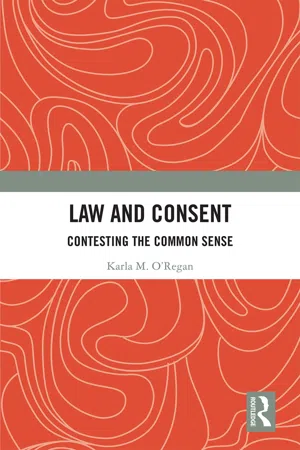
Law and Consent
eBook - ePub

Law and Consent

Contesting the Common Sense

  1. 224 pages
  2. English
  3. ePUB (mobile friendly)
  4. Available on iOS & Android
eBook - ePub

Law and Consent

Contesting the Common Sense

About this book

Consent is used in many different social and legal contexts with the pervasive

understanding that it is, and has always been, about autonomy – but has it?

Beginning with an overview of consent's role in law today, this book investigates

the doctrine's inseparable association with personal autonomy and its effect

in producing both idealised and demonised forms of personhood and agency.

This prompts a search for alternative understandings of consent. Through an

exploration of sexual offences in Antiquity, medical practice in the Middle Ages,

and the regulation of bodily harm on the present-day sports field, this book

demonstrates that, in contrast to its common sense story of autonomy, consent

more often operates as an act of submission than as a form of personal freedom

or agency. The book explores the implications of this counter-narrative for the

law's contemporary uses of consent, arguing that the kind of freedom consent is

meant to enact might be foreclosed by the very frame in which we think about

autonomy itself.

This book will be of interest to scholars of many aspects of law, history, and

feminism as well as students of criminal law, bioethics, and political theory.

Trusted byĀ 375,005 students

Access to over 1.5 million titles for a fair monthly price.

Study more efficiently using our study tools.

Information

Publisher
Routledge
Year
2019
Topic
History
eBook ISBN
9780429877353

1 The common sense of consent

The indivisible association of consent with autonomy is commonplace in legal and political scholarship. There, consent is understood as a core element of personhood. There are, however, preconditions to the freedom and subjectivity that consent signifies. One must first demonstrate a capacity to consent, and the acts to which one is consenting must not be irrational or unreasonable. Consent, to be valid, must be adequately informed and enacted voluntarily by clear-thinking (and recognisable) subjects, for socially valuable ends. Thus, despite its promise of universal self-rule and independence, consent is a rather selective and highly governed means of enacting freedom. Some subjects are excluded from its presumption of autonomy and marginalised from the scope of consent not simply because of non-conformity to hegemonic ideals of subjectivity and statehood, but by way of being unintelligible within them. There is, then, a paradox in the story of autonomy that is told about consent which forecloses certain forms of personhood or liberty in the name of others.
This chapter seeks to interrogate this paradox through a contextualisation of contemporary deployments of consent in each of the three legal areas examined in upcoming chapters, namely: consent to sex, informed consent to medical treatment, and the defence of consent in sport. This modern account of consent aims to reveal the pervasiveness with which consent is defined as a form of personal autonomy, even among the more critical approaches that recognise its internal contradictions and an inequity in its application. An examination of the law’s three most prevalent ā€˜preconditions’ of consent (ie knowledge, voluntariness, and rationality) and their roots in liberal concerns with legal paternalism forms part of this analysis.
Second, this chapter explores how this narrative of autonomy gains such widespread adoption through an invocation of a ā€˜common sense’ that not only serves to ā€˜naturalise’ the conditions needed for liberal accounts of autonomy but also establishes the frames of intelligibility that exclude all other notions of what consent might be or do. Ultimately, this chapter maintains that to suggest that autonomy is central to understandings of consent is to understate the matter. Autonomy is not simply the most popular or widely accepted understanding of consent; it is the only story there is. How this narrative is employed to limit the content and scope of consent on the basis of conformity to particular forms of (liberal) subjectivity is explored in the chapter’s conclusion, highlighting the need to uncover alternative understandings of consent – a task to which the book’s ensuing chapters take aim.

Mediated magic: paternalism and its paradox

The understanding of the human will as serving to eradicate wrongdoing is ascribed a long history, often sourced in the Roman maxim volenti non fit injuria (ā€˜to the willing no injury is done’)1 and used by the courts to cement the principle that one should be able to consent to anything, even the impossible.2 While seemingly a prima facie case for consent’s ancient origins in autonomy, there is evidence that twentieth-century understandings of ā€˜autonomy as independence’ have little in common with these early roots.3 Onora O’Neill, for instance, has noted that autonomy in the antiquity context was a reference to the self-governance of states rather than the actions of individuals.4 Instead, the association of consent with inviolable individualism owes more to the work of early theorists of liberalism than it does to ancient maxims.5 John Stuart Mill’s text, On Liberty, positioned consent as a tool for balancing the competing interests of the state and its individuals.6 O’Neill observes that contemporary understandings of autonomy stem from Mill’s work and amount to a kind of ā€˜self-legislation’ which is not more (nor less) than the establishment of a set of principles that all persons can employ to both govern their own behaviour and judge that of others. Instrumentalism lies at the heart of this conception of autonomy where ā€˜some ways of choosing are more likely than others to produce valuable choices’.7 Consent, in this frame, acts as a value exchange: unconstrained liberty is surrendered for some other (more valuable) aim (eg freedom in the universal).8
This has had implications for how the scope of consent operates in law, bringing to the fore one of liberalism’s underlying tensions between the sacred ideal of individual autonomy and the state’s forays into legal paternalism. Ostensibly, this discord is mediated through a narrowly interpreted harm principle, often attributed to Mill,9 where governments are permitted some coercive power over the citizenry so as to act in its ā€˜best interest’. This necessarily places limits on the ā€˜moral magic’ of consent when some actions are deemed to be too harmful to be permitted merely on the basis of individual will. As Ashworth notes:
[I]ndividual autonomy has both positive and negative aspects: on the one hand it argues for liberty from attack or interference, whereas on the other hand it argues for the liberty to do with one’s body as one wishes … If a person wishes to give up her or his physical integrity in certain circumstances or to risk it for the sake of sport or excitement, should the criminal law allow the consent to negative what would otherwise be a crime?10
Joel Feinberg has suggested that this conundrum results from a misreading of the volenti maxim so as to interpret it as saying something about ā€˜harm’ whereas it might be better understood to be directed towards ā€˜legal wrongs’.11 This re-reading results in a view of consent as vitiating a liability claim rather than a harm or injury, similar to a waiver of legal right(s). Based on this view, Feinberg argues a better reading of the volenti maxim might be: ā€˜To one who freely consents to a thing no wrong is done, no matter how harmful to [her/]him the consequences may be’.12 This suggests that the ā€˜magic’ of consent to transform wrong to right is constrained by the liberal understanding of autonomy as individualised agency, where legal paternalism is positioned as its greatest foe. Thus, any state intervention which impedes an individual’s exercise of free will (even if to prevent self-inflicted harm) amounts to a coercion which is itself too harmful to allow.13 This has the effect of exempting certain ā€˜problematic’ or even ā€˜unconscionable’ interactions from the label of ā€˜illegitimate’ (and thus criminal and civil liability) on the basis that the (self-inflicted) harm they occasion is less than the harm that would be incurred by state interventions to prevent it.14
There are, however, many circumstances in which interference with another’s liberty or autonomous action might be deemed necessary or advisable for a multitude of reasons ranging from a broad sense of social welfare or the ā€˜common good’ to an assessment of individual interests or self-protection.15 Indeed, the classic tenets of liberalism first penned by the political theorists of the seventeenth and eighteenth centuries were composed with these restraints on autonomy in mind.16 This represents what Kultgen has characterised as the dilemma created by absolutist positions on autonomy where ā€˜if one defines autonomy so that it always deserves respect, no one is autonomous; and if one defines it so that everyone is autonomous, it does not always deserve respect’.17 This has prompted many liberal theorists to propose varying degrees of justifiable (or ā€˜valuable’) paternalism. Feinberg distinguishes between cases of ā€˜hard’ and ā€˜soft’ paternalism as a way of rationalising the use of state intervention to prevent harm in some cases while opposing it in others.18 Hard paternalism is thus understood to be coercive state action (eg criminal legislation) which prohibits individuals (against their will) from engaging in conduct that is harmful to themselves and/or others. Soft paternalism, on the other hand, is a more qualified form of state coercion reserved for determinations of an individual’s will, exemplified by Mill’s now famous example of a man about to cross a damaged bridge.19 While the hard paternalist would prevent the man from crossing irrespective of his own wishes, the soft paternalist would detain the man only long enough to determine whether he was aware of the bridge’s state of disrepair and its dangers, leaving him to his own actions once the nature of his will had been settled.
The scope of, limits to, and justifications for the state’s acts of soft paternalism are the subject of much debate in legal and moral philosophy, political theory, bioethics, criminal, and contract law. It is within these deliberations that most of the contemporary discussions of consent take place (be that in the name of enhancing the informed choices of patients or contractors, the physical integrity of sexual actors or sport participants, or in debating the proper boundaries of free-acting citizens). This literature is largely concerned with the necessary conditions, capacities, circumstances, and evidences of consent. How much harm can a free citizen consent to? What steps or procedures must be taken to ensure a choice is made knowledgeably? What individual acts, if allowed, will garner more widespread harm than the harm of state-imposed infringements on personal freedom? And so on.
There is a paradox in this treatment of consent, however, given that the problem of paternalism and how (or if) it should be addressed stems from the liberal commitment to autonomy. Therefore, even attempts to offer solutions to or critiques of the problem must engage with this same narrative of autonomy. Consent discussions are also confined to this box.20 Take, for instance, Tom Beauchamp’s defence of soft paternalism in ...

Table of contents

  1. Cover
  2. Half Title
  3. Title Page
  4. Copyright Page
  5. Dedication Page
  6. Table of Contents
  7. Acknowledgements
  8. List of abbreviations
  9. Introduction
  10. 1 The common sense of consent
  11. 2 Ancient sex
  12. 3 Medieval medicine
  13. 4 Modern sport
  14. 5 The political economy of consent
  15. Conclusion
  16. Index

Frequently asked questions

Yes, you can cancel anytime from the Subscription tab in your account settings on the Perlego website. Your subscription will stay active until the end of your current billing period. Learn how to cancel your subscription
No, books cannot be downloaded as external files, such as PDFs, for use outside of Perlego. However, you can download books within the Perlego app for offline reading on mobile or tablet. Learn how to download books offline
Perlego offers two plans: Essential and Complete
  • Essential is ideal for learners and professionals who enjoy exploring a wide range of subjects. Access the Essential Library with 800,000+ trusted titles and best-sellers across business, personal growth, and the humanities. Includes unlimited reading time and Standard Read Aloud voice.
  • Complete: Perfect for advanced learners and researchers needing full, unrestricted access. Unlock 1.5M+ books across hundreds of subjects, including academic and specialized titles. The Complete Plan also includes advanced features like Premium Read Aloud and Research Assistant.
Both plans are available with monthly, semester, or annual billing cycles.
We are an online textbook subscription service, where you can get access to an entire online library for less than the price of a single book per month. With over 1.5 million books across 990+ topics, we’ve got you covered! Learn about our mission
Look out for the read-aloud symbol on your next book to see if you can listen to it. The read-aloud tool reads text aloud for you, highlighting the text as it is being read. You can pause it, speed it up and slow it down. Learn more about Read Aloud
Yes! You can use the Perlego app on both iOS and Android devices to read anytime, anywhere — even offline. Perfect for commutes or when you’re on the go.
Please note we cannot support devices running on iOS 13 and Android 7 or earlier. Learn more about using the app
Yes, you can access Law and Consent by Karla O'Regan in PDF and/or ePUB format, as well as other popular books in History & Jurisprudence. We have over 1.5 million books available in our catalogue for you to explore.