This essay collection examines one of the most fearsome, fascinating, and hotly-discussed topics of the long eighteenth century: masculinity compromised. During this timespan, there was hardly a literary or artistic genre that did not feature unmanning regularly and prominently: from harrowing tales of castrations in medical treatises, to emasculated husbands in stage comedies, to sympathetic and powerful eunuchs in prose fiction, to glorious operatic performances by castrati in Italy, to humorous depictions in caricature and satirical paintings, to fearsome descriptions of Eastern eunuchs in travel narratives, to foolish and impotent old men who became a mainstay in drama. Not only does this unprecedented study of unmanning (in all of its varied forms) illustrate the sheer prevalence of a trope that featured prominently across literary and artistic genres, but it also demonstrates the ways diminished masculinity reflected some of the most strongly-held anxieties, interests, and values of eighteenth-century Britons.
eBook - ePub
Castration, Impotence, and Emasculation in the Long Eighteenth Century
- 242 pages
- English
- ePUB (mobile friendly)
- Available on iOS & Android
eBook - ePub
Castration, Impotence, and Emasculation in the Long Eighteenth Century
About this book
Information
1
Unmanning
1. The Relationship Between Castration, Impotence, and Emasculation
One might expect the three pillars of this collection—castration, impotence, and emasculation—to have had a great deal in common during the long eighteenth century. On the surface, there is certainly a case to be made for the similarity of the three. After all, all three states of being are sexual in nature, and all tend to refer to male sexual maladies, accidents, operations, or sicknesses. What is more, they each posed threats to the patriarchy, and they differed from one another, above all, in the degree to which they threatened it. Indeed, whether castrated, impotent, or emasculated, such a man represented a deviation from ideal masculinity and, thus, from his proper place within the patriarchy. A look at Samuel Johnson’s definition of “masculine” helps underscore this deviation, as he defines “masculine” as that which is “resembling man; virile; not soft; not effeminate” (Dictionary). Certainly castrated and impotent males—given their association with nonstandard genitalia and/or genital function and with the inability to procreate—were not thought to “resemble[e] man” nor possess “viril[ity].” And one needn’t delve far into eighteenth-century descriptions of castrated and impotent men to see strong associations with Johnson’s last two criteria, softness and effeminacy.1 What is more, an emasculated man, although a much slipperier designation, was also understood as a deviation from ideal masculinity. Johnson even builds into his definition of “emasculate” an absence of the very qualities he used to describe masculinity. For Johnson, to “emasculate” is “to castrate; to deprive of virility” and “to effeminate; to weaken; to vitiate by unmanly softness” (Dictionary). Tellingly, for Johnson, “emasculate” and “castrate” could be synonyms. Thus, even though an “emasculated” man was not, by necessity, physically sterile or impotent, the public vitriol often aimed at him united him with castrated and impotent males, and the connection between the three underscores the perceived threat to society these men represented during the eighteenth century.
Indeed, in many contexts, disdain for castrated, impotent, and emasculated men abounded. Medical treatises tended to harbor particularly high levels of vitriol for such men. As Pierre Dionis writes, in his General Treatise of Midwifery (1719),
for Eunuchs are shunn’d and despis’d by all Mankind, not only as good for nothing, but of a disagreeable Aspect that bodes no good where ever they come: and even in a Hen-house, Capons and Pullets are chas’d up and down, and peck’d by all other Fowls, that have an Aversion to them, tho they know not what moves them to it. Thus, by the Appointment and Instinct of Nature, every Animal that cannot engender, or bring forth, is defective and contemptible.
Charles Ancillon, too, puts it bluntly in 1707: “and one may say of Eunuchs the same that is usually said of Bastards, that for the most part they are very bad, but that sometimes we may chance to find one that may prove good for something” (11). And this view, that these noni-deal males were regrettable and disagreeable, has been echoed even in modern-day scholarly accounts of them. Wendy Heller has described these recent reactions as “a combination of fear, distaste and sometimes prurient interest” (308), and it has taken subsequent work by scholars such as Alan Sikes (“Snip Snip Here, Snip Snip There, and a Couple of Tra La Las: the Castrato and the Nature of Sexual Difference”), Yvonne Noble (“Castrati, Balzac, and BartheS/Z”), and others to interpret these figures in light of their nuanced historical contexts rather than in light of a modern sense of revulsion.
As we shall see, however, a closer look into how these men were actually written about, responded to, and depicted during the long eighteenth century reveals not only a huge variety of sentiment (negative and positive) about them but also, at times, remarkable differences in how each was understood in relation to the other two. The truth is, the three pillars of this collection bore a highly complicated relationship to one another during this era. The complexities of this relationship are exhibited in the chapters that follow; however, it is worthwhile at the outset to illustrate and explain some of them.
What complicates this relationship between castrated, impotent, and emasculated men is that such figures were hardly judged, defined, and understood in light of the patriarchy alone (and the threats they posed to it). As historians now widely acknowledge, notions of masculinity and idealized male roles are complex, they tend to shift greatly over time, and they are shaped by, as R. W. Connell puts it, “institutional context,” including “the state, the workplace/labor market, and the family” (602).2
When one considers how these males could be perceived in light of other institutions, functions, and venues, that is, outside the lens of patriarchy alone, one finds a whole array of often wildly diverging attitudes, connotations, and assumptions associated with them. For instance, a castrato singer might be loathed and detested by the public when he attempts to marry a young woman (thereby threatening patriarchal social structures), but he might equally be adored and rewarded when he performs well in an opera (thereby excelling as an artist and enhancing the quality of the production). In fact, when considered outside of their relationships to the patriarchy, responses to castrated, impotent, and emasculated men could sometimes have very little in common with one another, and a man could sometimes be one of the three and yet neither of the others. The Venn diagram along with examples below, although not proportional to the size of these populations, represents an exhaustive range of possible overlap (see Figure 1.1). As one would expect, there are many areas of overlap between these three categories, and yet, more surprisingly, there are also many areas where these three types of males do not overlap according to popular perceptions at this time. And importantly, as we shall find, these unexpected cases of nonoverlap are often found as recurring trends, rather than mere solitary outliers.
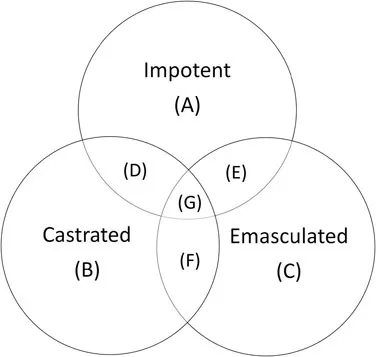
Figure 1.1 A Venn diagram illustrating the relationships between popular assumptions about castrated, impotent, and emasculated males (see corresponding examples in the text).
When one parses examples of castrated, impotent, and emasculated men within the diagram, schisms abound. Among the most obvious were impotent males who were uncastrated, as certainly most impotent males were (category A). And yet there were also occasionally males who found themselves in category B. These were castrated males (or rather, males who underwent castration surgeries) who were not impotent (category B), whether as a consequence of trickery on their part (think William Wycherley’s Horner) or botched surgery. An example of such a man in category B includes the nominal “eunuchs” in Antoine Galland’s 1704 translation of Les mille et une nuits [The Thousand and One Nights] who engage in illicit sex acts with the women of the seraglio. Another instance is found in an anecdote from Giacomo Casanova, who writes,
[T]he castrato Tenducci surprised me by introducing me to his wife, of whom he had two children. He laughed at people who said that a castrato could not procreate. Nature had made him a monster that he might remain a man; he was born triorchis, and as only two of the seminal glands had been destroyed the remaining one was sufficient to endow him with virility.
(407)
Admittedly, this report is of undetermined veracity, and we can’t know whether or not Tenducci was, in fact, the biological father of the two children. However, the perception that a eunuch or castrato could be in reality highly sexed and virile was common enough to become a trope in the discourse of the era. Particularly during the 1670s and 1680s, one finds a series of plays inspired by Terence’s Eunuchus (161 bce) that depicted men feigning sexual inability in order to gain access to women.3 And Quintilian even reportedly commented on this phenomenon, saying, “Libidinosior es quam ullus spado” [“You are more lustful than any eunuch”] (97). In other words, public perception allowed for the possibility that castrated males could retain sexual function and even virility. And yet, interestingly, the concern that castrated males were libidinous may equally have arisen from the link between them being “not quite fully masculine,” as Roger Freitas puts it, and being “especially susceptible to love” (247).4 Whatever the reasons for this association, it recurred in depictions and discussions of castrated males during the era, a reminder that castrated males were not simply and universally disliked for their sterility.
The question of emasculated males, and how they were perceived in relation to men who were castrated and impotent, is more difficult. It is indisputable that castrated and impotent men often were regarded as emasculated (categories E, F, and G). In fact, the term “emasculate” derives from the Latin “ēmasculāre,” meaning “to castrate” (Oxford English Dictionary), and one needn’t look far to find derisive descriptions of castrated men who are thought lacking in masculine qualities. For example, John Marten explains in 1709 in his Gonosologium Novum,
by the loss of [his testicles], Man is very much injur’d, not only as to the Strength, Activity, and Vigour of his Body, Acuteness of his Reason and Judgment, &c. but is the sole hindrance as to Procreation, which perfectly un-Mans him; for we see those that are Born without Stones, or are Castrated, are much more effeminate and Womanish, with squeaking Voices, little or no Beards, &c. and thereby despis’d, especially by the Women.
(4)
Likewise, impotent men found no shortage of contempt in eighteenth-century popular culture, a phenomenon documented thoroughly by Angus McLaren (see “Shameful to Wives,” Impotence, A Cultural History). And one need not look far to find an abundance of comments on the link between Italian effeminacy and castrati. For example, Steele published a poem trying to evict castrati from England, which says, “Begone, our national’s pleasure and reproach! / Britain no more with idle trills debauch, / Back to thy own unmanly Venice sail, / Where luxury and loose desires prevail; / There thy emasculating voice employ, / And raise the triumphs of the wanton boy” (qtd. in King 365). This disdain was a clear result of the well-documented, close association between masculinity and virility (Mueller 86). Ultimately, to be known to be castrated and/ or impotent in this age could easily mean facing emasculation as well.
However, as Thomas King warns, “The tendency of modern critics to hear an appropriated femininity within the male body of the castrati is a resistant reading—one based on our own assumptions about gender, privacy, and self-possession” (369), pointing out the “penetrating, ravishing power” of the castrati (369). As Schopenhauer put it, “His [Crescentini’s] supernaturally beautiful voice cannot be compared with that of any woman: there can be no fuller and more beautiful tone, and in its silver purity he achieves indescribable power” (qtd. in King 371). Equally, Charles De Brosses said,
Their timbre is as clear and piercing as that of choirboys and much more powerful; they appear to sing an octave above the natural voice of women. Their voices have always something dry and harsh, quite different from the youthful softness of women; but they are brilliant, light, full of sparkle, very loud, and with a very wide range.
(qtd. in King 371)5
We should not underestimate the power and force, and indeed masculinity, of castrati.
In fact, neither castrated nor impotent men were necessarily seen as emasculated at this time (category D). Take, for example, the numerous celebrated castrati who were admittedly unable to procreate and yet could attract willing sex partners effortlessly. As Katherine Arens puts it, “Outside the theater, they were favored companions to noble ladies (since they could, in many cases, even offer sex without procreation—or elegant companionship their husbands would not be jealous of” (266). And as Yvonne Noble says, “A castrato who was successful in becoming a singer, far from experiencing his body as a site of hideous absence, found it looked upon as something to be specially cherished as a container—and instrument—of precious sound” (31). In the case of famous castrati, the threat to patriarchy usually associated with castration and impotence was overshadowed by the positive connotations of the cult of celebrity and top notch, indeed “precious,” singing ability.6 And the so-called emasculation of castrati is further discredited when we look at the roles these singers were given. As Freitas reminds us, “heroes and lovers were regularly portrayed by castrated men” (197). It seems unlikely that powerful and sexually desirable men such as these would be thought to comport with Johnson’s sense of “emasculation,” that which is effeminate, weak, and soft.
A related example of castrated and impotent, but not emasculated, men (category D) may be found in English depictions of Eastern eunuchs (males castrated in order to serve a political function in a, usually Eastern, court). In Orientalist plays of the Restoration, for example, one finds examples of eunuchs who wield power that is surpassed by only the sultan himself, who bravely and capably lead entire armies to victory, and who provide wise advice to sultans.7 In these depictions, as in attitudes toward the castrati, the negative connotations usually paired with castration and impotence are sometimes replaced with positive associations that praise governmental power, military success, and political acumen. In these new contexts, that is, Orientalist settings and the operatic stage, castrati and eunuchs were often not understood in purely patriarchal terms solely based on their (in)ability to represent manly strength and virility. Rather, these men could be exalted and avoid emasculation because of their, as Connell might put it, “institutional” value (602) in other arenas—whether artistic, cultural, political, or military.
The perceived similarities between impotence and the taint of emasculation similarly break down in the case of impotent males who were elderly, so long as they didn’t dare take a young wife. Countless old, impotent men lived with dignity and free of emasculation in their old age (category A). By and large, it was only when such a man threatened to marry a virile woman, thus spoiling any chance for progeny in the marriage, that he found himself the emasculated butt of jokes. Similarly, prepubescent males, although technically impotent, certainly need not face emasculation, as th...
Table of contents
- Cover
- Half Title
- Series Page
- Title
- Copyright
- Contents
- List of Figures
- List of Contributors
- Editor’s Acknowledgements
- 1 Unmanning
- SECTION 1 Sexual Impotence
- SECTION 2 Eunuchs and Orientalism
- SECTION 3 Symbolic Unmanning
- SECTION 4 Italian Castrati
- Index
Trusted by 375,005 students
Access to over 1.5 million titles for a fair monthly price.
Study more efficiently using our study tools.
Frequently asked questions
Yes, you can cancel anytime from the Subscription tab in your account settings on the Perlego website. Your subscription will stay active until the end of your current billing period. Learn how to cancel your subscription
No, books cannot be downloaded as external files, such as PDFs, for use outside of Perlego. However, you can download books within the Perlego app for offline reading on mobile or tablet. Learn how to download books offline
Perlego offers two plans: Essential and Complete
- Essential is ideal for learners and professionals who enjoy exploring a wide range of subjects. Access the Essential Library with 800,000+ trusted titles and best-sellers across business, personal growth, and the humanities. Includes unlimited reading time and Standard Read Aloud voice.
- Complete: Perfect for advanced learners and researchers needing full, unrestricted access. Unlock 1.5M+ books across hundreds of subjects, including academic and specialized titles. The Complete Plan also includes advanced features like Premium Read Aloud and Research Assistant.
We are an online textbook subscription service, where you can get access to an entire online library for less than the price of a single book per month. With over 1.5 million books across 990+ topics, we’ve got you covered! Learn about our mission
Look out for the read-aloud symbol on your next book to see if you can listen to it. The read-aloud tool reads text aloud for you, highlighting the text as it is being read. You can pause it, speed it up and slow it down. Learn more about Read Aloud
Yes! You can use the Perlego app on both iOS and Android devices to read anytime, anywhere — even offline. Perfect for commutes or when you’re on the go.
Please note we cannot support devices running on iOS 13 and Android 7 or earlier. Learn more about using the app
Please note we cannot support devices running on iOS 13 and Android 7 or earlier. Learn more about using the app
Yes, you can access Castration, Impotence, and Emasculation in the Long Eighteenth Century by Anne Leah Greenfield in PDF and/or ePUB format, as well as other popular books in Literature & Literary Criticism. We have over 1.5 million books available in our catalogue for you to explore.