eBook - ePub
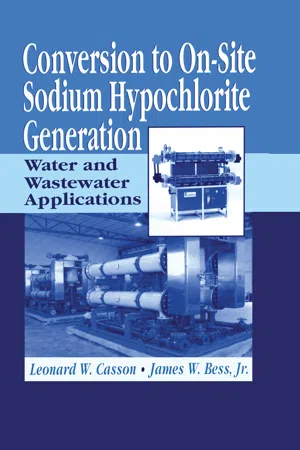
Conversion to On-Site Sodium Hypochlorite Generation
Water and Wastewater Applications
- 216 pages
- English
- ePUB (mobile friendly)
- Available on iOS & Android
eBook - ePub
Conversion to On-Site Sodium Hypochlorite Generation
Water and Wastewater Applications
About this book
Since the implementation of the USEPA Clean Air Act Risk Management Plan, many water treatment and wastewater treatment utilities have converted to on-site sodium hypochlorite generation. Conversion to On-Site Sodium Hypochlorite Generation: Water and Wastewater Applications is a comprehensive text and design manual for on-site sodium hypochlorite
Information
chapter 1
Introduction
1.1Origins of sodium hypochlorite generation
Chlorine gas was first prepared in 1774 by Karle Scheele of Sweden. It was not until 1810, however, that Humphry Davy declared it an element before the Royal Society of London (White, 1999). Davy proposed the name of chlorine based on the Greek word chloros translated to green, greenish yellow, or yellowish green. The gas was liquified by compression in 1805 by Thomas Northmore (White, 1999).
In 1883, Faraday postulated the laws governing the passing of electric current through an aqueous salt solution, coining the word electrolysis (White, 1999). These fundamental laws are:
•The weight of a given element liberated at an electrode is directly proportional to the quantity of electricity passed through the solution. The electrical unit quantity is the coulomb.
•The weights of different elements liberated by the same quantity of electricity are proportional to the equivalent weights of the elements.
The first commercial production of chlorine began in 1890 by the Elektron Company (now Fabwerke-Hoechst A.G.) of Griesheim, Germany (White, 1999). The first electrolytic plant in the United States was started at Rumford Falls, Maine in 1892. In 1894, the Mathieson Chemical Company acquired the rights for the Castner mercury cell for the manufacture of bleaching powder at a demonstration plant in Saltville, Virginia (White, 1999). This facility subsequently moved to Niagara Falls, New York in 1897 and operated successfully until 1960 (White, 1999).
At first, the original electrolytic process was used primarily for caustic production. In 1909, the first commercial manufacturing of liquid chlorine began. This liquid was stored in 100-pound cylinders supplied from Germany. Tank cars were manufactured in the United States in 1909, as well, with a capacity of 15 tons. It was not until 1917 that 1-ton containers came into use for the U. S. military (White, 1999).
1.2Bleach
Bleach was used as a bleaching agent starting in 1785 by mixing Scheele’s gas in water and adding caustic potash (White, 1999). In 1789, Berthollet Tennent produced another liquid bleaching agent termed chlorinated milk of lime. This original product was greatly improved when it was dried to form bleaching powder (White, 1999).
Commercial bleach manufacture for domestic use was begun by the Mathieson Chemical Company in 1897 as a by-product of caustic manufacture to utilize some of the excess chlorine from the process. Chlorine that was not used in the bleach process or to manufacture hydrochloric acid was dumped into the Niagara River as a waste material (White, 1999).
1.3On-site generation of sodium hypochlorite
While on-site generation was feasible at the tum of the 20th century, the limitation was the electrode materials, carbon or platinum, which would dissolve in service causing cell damage and poor product quality or were too expensive for practical use. No cell developed during this period provided reliable on-site sodium hypochlorite generation. Not until the development of the dimensionally stable anode for the chlorine industry in 1967 by an independent Belgian scientist, Henry Beer, was a reliable economic on-site generation cell practical (White, 1999). In 1971 J.E. Bennett, using the dimensionally stable anode, developed an unseparated electrolytic cell that was patented by Diamond Shamrock Corporation. Many variations in the electrodes and cell configurations have become available in the marketplace during the ensuing 25 years for electrolysis of both dissolved salt solution and seawater as the system feed stock.
1.4Dimensionally stable anodes
The primary difference in the production of chlorine gas and on-site generation of bleach is the separation of the two basic cell products. In the production of chlorine the gas is separated on the anode side of the cell from the caustic (sodium hydroxide) solution produced on the cathode side through the reaction of sodium with feed water releasing hydrogen as a by-product gas. Each product is packaged separately when removed from the generation cell for use in unrelated processes such as pulp and paper bleaching using chlorine and caustic, chlorinating hydrocarbons for products such as PVC, and caustic used for glass manufacture. On-site generating cells do not separate the chlorine and caustic; thus the two products react together to form weak bleach solution up to 1.2% strength, also releasing by-product hydrogen gas.
References
- White, G.C., (1999) Handbook of Chlorination and Alternative Disinfectants, Fourth Edition, Wiley Interscience, New York.
chapter 2
Federal regulations and pending regulations
The implementation of the Clean Air Act (CAA) risk management plan (RMP) for the storage of hazardous chemicals by the U.S. Environmental Protection Agency (USEPA) (June 1999) and the reregistration of chlorine gas by USEPA office of pesticide programs as a pesticide (Spring 2001) have accelerated the use of liquid sodium hypochlorite in the water and wastewater treatment industry. Below is a brief discussion of each of these regulations.
2.1USEPA clean air act risk management plan
Congress passed the Clean Air Act Amendments of 1990. One section of these regulations required the USEPA to publish regulations and guidance for chemical accident prevention at facilities using extremely hazardous substances. The risk management program rule (RMP rule) implemented Section 112(r) of the CAA amendments. The RMP rule was written based upon existing industry codes and standards. This rule requires companies of all sizes that use certain flammable and toxic substances to develop a risk management program, which includes all of the following:
•A hazard assessment that details the potential effects of an accidental release, an accident history of the last five years, and an evaluation of worst-case and alternative accidental releases.
•A prevention program that includes safety precautions and maintenance, monitoring, and employee training measures.
•An emergency response program that spells out emergency health care, employee training measures, and procedures for informing the public and response agencies (e.g., the fire department) should an accident occur.
•A summary of the facility’s risk management program must be submitted to the USEPA by June 21, 1999, which will make the information available to the public. The plans must be revised and resubmitted every five years.
The risk management program was created to reduce chemical risk at the local level. The information included in the plan was intended to help local fire, police, and emergency response personnel (who must prepare for and respond to chemical accidents), and be useful to citizens in understanding the chemical hazards in communities. The USEPA anticipates that making the RMPs available to the public will stimulate communication between industry and the public to improve accident prevention and emergency response practices at the local level. A complete description of the risk management plan can be found on the World Wide Web at http://www.epa.gov/swercepp/bi-rima.htm.
The RMP defines threshold quantities (in pounds) of chemicals stored at a site as shown in Table 2.1. Exceeding these quantities at a single location requires the development of a risk management plan. A complete listing of chemicals and threshold quantities can be found at http://www.epa.gov/ceppo/caalist.html.
Table 2.1Threshold Quantities for the Clean Air Act Risk Management Plan
| Chemical | ...
Table of contents
- Cover
- Title Page
- Copyright Page
- Dedication
- Preface
- Acknowledgments
- About the authors
- Table of Contents
- Chapter 1 Introduction
- Chapter 2 Federal regulations and pending regulations
- Chapter 3 Disinfection applications and alternatives
- Chapter 4 Disinfection chemistry
- Chapter 5 Electrolyzer systems
- Chapter 6 Electrolysis system design considerations
- Chapter 7 Economic evaluation principles for electrolysis systems
- Chapter 8 Electrolysis system installation, operation, and maintenance
- Chapter 9 System design and trouble analysis
- Chapter 10 System safety
- Technical Standard Documents
- Index
Trusted by 375,005 students
Access to over 1.5 million titles for a fair monthly price.
Study more efficiently using our study tools.
Frequently asked questions
Yes, you can cancel anytime from the Subscription tab in your account settings on the Perlego website. Your subscription will stay active until the end of your current billing period. Learn how to cancel your subscription
No, books cannot be downloaded as external files, such as PDFs, for use outside of Perlego. However, you can download books within the Perlego app for offline reading on mobile or tablet. Learn how to download books offline
Perlego offers two plans: Essential and Complete
- Essential is ideal for learners and professionals who enjoy exploring a wide range of subjects. Access the Essential Library with 800,000+ trusted titles and best-sellers across business, personal growth, and the humanities. Includes unlimited reading time and Standard Read Aloud voice.
- Complete: Perfect for advanced learners and researchers needing full, unrestricted access. Unlock 1.5M+ books across hundreds of subjects, including academic and specialized titles. The Complete Plan also includes advanced features like Premium Read Aloud and Research Assistant.
We are an online textbook subscription service, where you can get access to an entire online library for less than the price of a single book per month. With over 1.5 million books across 990+ topics, we’ve got you covered! Learn about our mission
Look out for the read-aloud symbol on your next book to see if you can listen to it. The read-aloud tool reads text aloud for you, highlighting the text as it is being read. You can pause it, speed it up and slow it down. Learn more about Read Aloud
Yes! You can use the Perlego app on both iOS and Android devices to read anytime, anywhere — even offline. Perfect for commutes or when you’re on the go.
Please note we cannot support devices running on iOS 13 and Android 7 or earlier. Learn more about using the app
Please note we cannot support devices running on iOS 13 and Android 7 or earlier. Learn more about using the app
Yes, you can access Conversion to On-Site Sodium Hypochlorite Generation by Leonard Casson,Jim Bess in PDF and/or ePUB format, as well as other popular books in Technology & Engineering & Environmental Management. We have over 1.5 million books available in our catalogue for you to explore.