This monograph makes a major new contribution to the historiography of criminal justice in England and Wales by focusing on the intersection of the history of law and crime with medical history. It does this through the lens provided by one group of historical actors, medical professionals who gave evidence in criminal proceedings. They are the means of illuminating the developing methods and personnel associated with investigating and prosecuting crime in the eighteenth and nineteenth centuries, when two linchpins of modern society, centralised policing and the adversarial criminal trial, emerged and matured. The book is devoted to two central questions: what did medical practitioners contribute to the investigation of serious violent crime in the period 1700 to 1914, and what impact did this have on the process of criminal justice? Drawing on the details of 2,600 cases of infanticide, murder and rape which occurred in central England, Wales and London, the book offers a comparative long-term perspective on medico-legal practice – that is, what doctors actually did when they were faced with a body that had become the object of a criminal investigation. It argues that medico-legal work developed in tandem with and was shaped by the needs of two evolving processes: pre-trial investigative procedures dominated successively by coroners, magistrates and the police; and criminal trials in which lawyers moved from the periphery to the centre of courtroom proceedings. In bringing together for the first time four groups of specialists – doctors, coroners, lawyers and police officers – this study offers a new interpretation of the processes that shaped the modern criminal justice system.
eBook - ePub
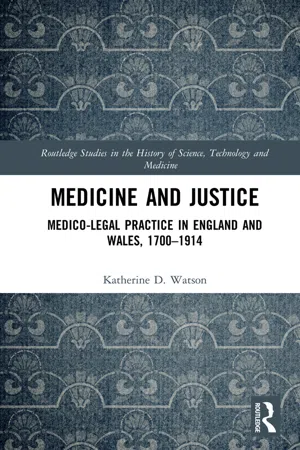
Medicine and Justice
Medico-Legal Practice in England and Wales, 1700–1914
- 312 pages
- English
- ePUB (mobile friendly)
- Available on iOS & Android
eBook - ePub
Medicine and Justice
Medico-Legal Practice in England and Wales, 1700–1914
1
Introduction
The medico-legal landscape
In delivering his opinion, or explaining the cause of death, the surgeon’s narrative should be simple and candid; let him use as few technical terms as possible, both for the better information of the jury, and to avoid giving a lawyer an opportunity of embarrassing him.
William Dease, Remarks on Medical Jurisprudence; Intended for the General Information of Juries and Young Surgeons (Dublin: James Reilly, 1793), p. 22
In a scenario replayed countless times in modern fiction, a hapless doctor sits transfixed in a courtroom witness box, pinned like a bug to a board by the questioning of a just-barely-civil defence barrister determined to undermine their credibility, weaken their evidence and ensure the client’s acquittal. This, it seems, was a state of affairs not unknown to the medical profession of the late eighteenth century, as the warning issued by the Irish surgeon William Dease (c.1752–1798) attests. Though he was speaking of the practices he had witnessed at first hand in Dublin, there was little difference to the English courts of the day, as noted by the Somerset-based physician Samuel Farr (1741–1795) in his earlier textbook: “it is to be hoped, that this little treatise will meet the attention of judges and lawyers… and that they will be enabled to correct the errors of coroners, or ignorant surgeons, who may have been misled in the depositions they give in.”1 But what do we really know about the encounters between medicine and law, doctors and lawyers, in the criminal courts of the past? How and why did medical professionals enter the courtroom; what did they do to get there and what reception did they receive? This book will situate doctors in their rightful place as contributors to the investigation of crime, as part of a criminal justice system that evolved over the course of the eighteenth and nineteenth centuries to create the regularised policing and legal structures so familiar today.
The book is conceived primarily as a contribution to the historiography of criminal justice in England and Wales. As such, it is broadly concerned with the history of the formal systems of practice directed at deterring, detecting and punishing crime.2 But it engages this far-reaching field of study by focusing on the intersection of the social history of law and crime with medical history. Legal historians examine the common law and legal process, in order to understand how and why these embodiments of the state-controlled administration of justice adapt and evolve in response to internal and external stimuli.3 Crime historians adopt a complementary perspective, taking as their main focus of study the individuals who engaged with the criminal justice system and the terms on which they did so to explain how people in the past understood crime and criminality and either engaged in criminal conduct or attempted to manage it.4 The present study examines the history of crime and legal process through the lens provided by one group of historical actors: medical professionals who gave evidence in criminal proceedings. They are the means of illuminating the developing methods and personnel associated with investigating and prosecuting crime in eighteenth- and nineteenth-century England and Wales, when two linchpins of modern society, centralised policing and the adversarial criminal trial, emerged and matured.5 It is devoted to two central questions: what did medical practitioners contribute to the investigation of serious violent crime in the period 1700 to 1914, and what impact did this have on the process of criminal justice?
Criminal justice historians – a term used here to include all scholars who study law and crime in historical context – are interested in specific groups of actors and particular practices. Thus, the scholarship of the past 30 years has shed considerable light on offenders and victims; juries; law officers such as police, magistrates, lawyers, judges and coroners; criminal trials and punishment, including execution, transportation and imprisonment. Key themes that serve to unite these broad areas of study have emerged, including the relationship between gender, law and crime, examined most often through women’s experience of the criminal justice system;6 and the changing attitudes to violence revealed through criminal justice proceedings. Probably no form of criminal behaviour has been subject to more scrutiny than homicide (a term used here to denote three species of fatal interpersonal violence: murder, manslaughter and infanticide), as historians have sought to identify the incidence and characteristics of violence in the past.7 Similarly, the history of rape is integral to understanding contemporary beliefs about sexual assault.8 The prosecution of homicide and rape, as crimes against the person, involved some estimation of physical harm done to a victim, yet medical professionals have for the most part been excluded from British criminal justice historiography. This represents a significant omission given the observation with which this chapter began. By the late eighteenth century, the medical contribution to the prosecution of serious crimes against the person had become so common as to merit both publications on the subject and Dease’s note of caution to young practitioners who might be called into court: they must be wary of lawyers but considerate of jurors.9
A great deal of scholarly attention has concentrated on England in the eighteenth and nineteenth centuries, when “legal, procedural and cultural changes crystallized modern attitudes” to violence and crime,10 stimulated the adoption of professionalised methods of policing and prosecution,11 encouraged more reliance on lawyers in criminal trials and inspired the development of evidentiary rules.12 Legal historian Lindsay Farmer has noted that as a result of these innovations, trials became longer and more contentious, began to rely more on expert evidence, and allowed more influence to accrue to “the personalities of the lawyers, detectives and scientific experts that came to dominate” legal proceedings.13 The same might be said of the coroner’s inquest, the other jurisdiction where the evidence of a medical practitioner was most likely to be required.
Historical interest in the inquest as a legal process began in the late 1950s,14 but doctors and the evidence they provided have escaped thorough scrutiny despite the fact that the inquest’s primary function was the investigation of sudden death – which by definition created a decision-making process to establish cause and manner of death: natural, accident, suicide or homicide.15 Detailed research on inquisitions, the formal records of inquest findings, led to the conclusion that medical determination of cause of death, as opposed to lay assessment, was relatively under-developed in relation to continental practices, though it was becoming more usual by the early nineteenth century.16 A later series of important books on medico-scientific expertise considered medical evidence in both inquests and the criminal courts, but focused on public accountability and scientific objectivity rather than matters of routine practice.17 Thus, despite the pioneering work of Catherine Crawford and Jennifer Ward on the institutional development of forensic medicine,18 few academic studies have examined medical practitioners as ordinary actors in the criminal justice system.19
The fact that forensic practices are embedded in socio-legal context was highlighted by an important collection of essays, Legal Medicine in History, which emphasised the “formative influence of legal systems on medico-legal knowledge and practice” through a series of case studies.20 Crawford’s seminal chapter presented a persuasive interpretation of the slow development of “medico-legal science” in early modern England as a product of the framework created by the common law tradition of jury trial and oral evidence. Unlike the procedures created by the Roman-canon legal system, there was no requirement for the testimony of experts, written or otherwise, and hence no ready-made point of entry for medical practitioners to the English courtroom. Crawford noted that medical testimony was often sought by “English coroners, magistrates and trial participants” before 1800, but dated the beginnings of legal acceptance of medical expertise to the nineteenth century, thereby explaining the late development of forensic medicine as a learned science.21 In Crawford’s interpretation, the law led and medico-legal practice followed. Although subsequent studies by Julia Rudolph and Carol Loar have dispelled the assumption that early modern death investigations placed little reliance on medical evidence,22 there has, to date, been no study of medico-legal practice across precisely the period that historians of crime have identified as crucial to the development of English criminal procedure, the eighteenth and nineteenth centuries.
Crawford’s research firmly linked legal history to the social history of medicine, a third area of study directly relevant to this book. Engaged in what is now a flourishing historical sub-discipline, social historians of medicine examine all aspects of health, illness and medical practice from a range of perspectives including the political, socio-economic and cultural; important areas of focus include health, disease, institutions, patients and the development of the various professions involved in medicine.23 The concept of the ‘medical marketplace’, used to describe the variety of medical provision available to sick people in the past, is particularly interesting, as historians have identified eighteenth-century changes brought about by a burgeoning consumer society as factors that expanded both the demand for and supply of medical services. The very diversity of the available provision suggests, however, that “historians should… think of the markets for medical goods and services rather than a generalized image of the medical market or marketplace.”24 While the medical market has been used by historians in relation to health care, the historiography of this important concept has largely overlooked a very different yet parallel market for medical services: the market created by the needs of the English legal system. The service offered was not health care but crime investigation; the consumers were not sick people but legal officials; there were no patients, only victims. This relationship evolved, like the traditional medical market, on the basis of supply and demand, but, in a departure from the customary model of medical care, the ‘commercialising’ marketplace in which medical practitioners were located was that defined by the requirements of criminal justice administration.
It is therefore important to recognise a distinction between academic scholarship and what the average practitioner actually did. The former is best described as the body of systematic knowledge known as forensic medicine: during the course of the nineteenth century an international group of university lecturers wrote textbooks that came to define and establish the intellectual standards for this emerging medical specialism.25 The terms ‘legal medicine’ and ‘medical jurisprudence’ were often used interchangeably to signify the same scholarly field: the application of medical science to legal problems. But the hands-on forensic activities that medical practitioners actually undertook are more accurately understood as ‘medico-legal work’, a term that embraces all possible applications of medical knowledge for legal purposes but which in criminal cases most often involved some form of body examination, of the living or the dead or, less frequently, an assessment of mental capacity. Both terms are informed by the presumption that forensic medicine and its practical mechanisms – that is, forensic practices – exemplify the use of medical evidence to establish facts in aid of legal decision-making processes.
Medico-legal work in England and Wales pre-dates the academic discipline of forensic medicine. Thus, one of the main tasks of this book will be to identify its form and scope and to show how embedded in and responsive to wider patterns in crime and criminal justice administration it was. Essentially, medico-legal work developed in tandem with and was shaped by the needs of two evolving processes: pre-trial investigative procedures dominated successively by coroners, magistrates and the police; and crimina...
Table of contents
- Cover
- Half Title
- Series Page
- Title
- Copyright
- Contents
- List of figures
- List of tables
- List of abbreviations
- Currency
- Dates
- Preface and acknowledgments
- 1 Introduction: the medico-legal landscape
- 2 Medical education and forensic medicine
- 3 Locating patterns of medico-legal provision
- 4 Infant murder in medico-legal practice
- 5 Crime (scene) investigation: expertise in action
- 6 Conclusion: medicine and justice
- Appendix 1: Chronology of events and statutes affecting medical and legal practice
- Appendix 2: Medical practitioners in Wales, 1783
- Appendix 3: Introduction of the new police into London, Wales and the counties of the Oxford Circuit
- Appendix 4: Coroners trained as surgeons or physicians
- Appendix 5: Glossary of medical and legal terms
- Bibliography
- Index
Trusted by 375,005 students
Access to over 1.5 million titles for a fair monthly price.
Study more efficiently using our study tools.
Frequently asked questions
Yes, you can cancel anytime from the Subscription tab in your account settings on the Perlego website. Your subscription will stay active until the end of your current billing period. Learn how to cancel your subscription
No, books cannot be downloaded as external files, such as PDFs, for use outside of Perlego. However, you can download books within the Perlego app for offline reading on mobile or tablet. Learn how to download books offline
Perlego offers two plans: Essential and Complete
- Essential is ideal for learners and professionals who enjoy exploring a wide range of subjects. Access the Essential Library with 800,000+ trusted titles and best-sellers across business, personal growth, and the humanities. Includes unlimited reading time and Standard Read Aloud voice.
- Complete: Perfect for advanced learners and researchers needing full, unrestricted access. Unlock 1.5M+ books across hundreds of subjects, including academic and specialized titles. The Complete Plan also includes advanced features like Premium Read Aloud and Research Assistant.
We are an online textbook subscription service, where you can get access to an entire online library for less than the price of a single book per month. With over 1.5 million books across 990+ topics, we’ve got you covered! Learn about our mission
Look out for the read-aloud symbol on your next book to see if you can listen to it. The read-aloud tool reads text aloud for you, highlighting the text as it is being read. You can pause it, speed it up and slow it down. Learn more about Read Aloud
Yes! You can use the Perlego app on both iOS and Android devices to read anytime, anywhere — even offline. Perfect for commutes or when you’re on the go.
Please note we cannot support devices running on iOS 13 and Android 7 or earlier. Learn more about using the app
Please note we cannot support devices running on iOS 13 and Android 7 or earlier. Learn more about using the app
Yes, you can access Medicine and Justice by Katherine D. Watson,Katherine Watson in PDF and/or ePUB format, as well as other popular books in History & British History. We have over 1.5 million books available in our catalogue for you to explore.