eBook - ePub
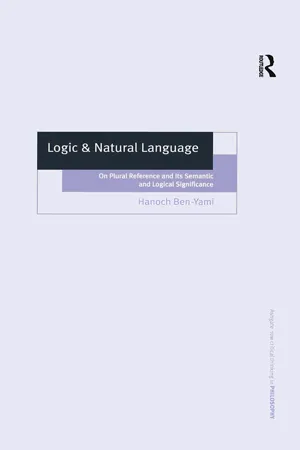
Logic & Natural Language
On Plural Reference and Its Semantic and Logical Significance
- 168 pages
- English
- ePUB (mobile friendly)
- Available on iOS & Android
eBook - ePub
Logic & Natural Language
On Plural Reference and Its Semantic and Logical Significance
About this book
Frege's invention of the predicate calculus has been the most influential event in the history of modern logic. The calculus' place in logic is so central that many philosophers think, in fact, of it when they think of logic. This book challenges the position in contemporary logic and philosophy of language of the predicate calculus claiming that it is based on mistaken assumptions. Ben-Yami shows that the predicate calculus is different from natural language in its fundamental semantic characteristics, primarily in its treatment of reference and quantification, and that as a result the calculus is inadequate for the analysis of the semantics and logic of natural language. Ben-Yami develops both an alternative analysis of the semantics of natural language and an alternative deductive system comparable in its deductive power to first order predicate calculus but more adequate than it for the representation of the logic of natural language. Ben-Yami's book is a revolutionary challenge to classical first order predicate calculus, casting doubt on many of the central claims of modern logic.
Information
Chapter 1
Introduction
Frege's invention of the predicate calculus, first published in his Begriffsschrift of 1879, has been the most influential event in the history of modern logic. The predicate calculus made formal logic an object of study for many logicians and mathematicians, and consequently fundamental logical concepts were clarified and some notable logical theorems were proved. Moreover, the calculus both constituted a language which many found of philosophical significance, and was used for the analysis of natural language. Partly as a result, the philosophy of language acquired an unprecedented eminent position in philosophy. For some time, many philosophers thought that it is, or should be, what philosophy consists in; and although this position is not prevalent any longer, the importance of logic and the philosophy of language both as domains of philosophical investigations and for other philosophical studies remains undisputed.
The predicate calculus' place in logic is so central that many philosophers, when they think of logic, think in fact of the calculus. Since Frege's time the calculus has undergone several modifications, but all versions studied and used today are very close descendants of his Begriffsschrift. Any introductory course on logic devotes much of its time, and frequently most of it, to the study of the calculus. For many, to speak about logic is to speak about the calculus.
Moreover, logicians, philosophers and linguists analyze natural language by means of the calculus. When one writes on the logical form of an ordinary sentence, one means by it the form of the sentence's translation into some version of the calculus. When one analyzes the semantics of natural language, one does it with the apparatus of sentential functions, quantifiers, variables, domain of discourse, scope, etc., all borrowed from the calculus and exemplified in its formulas.
It is, indeed, usually admitted that Frege's calculus is insufficient for the adequate analysis of the semantics of natural language; but, it is thought, the calculus needs only to be enriched in various respects in order to become adequate for that purpose. The following paragraph from Wiggins (1997, p. 5) is representative of the current attitude:
Given the universality and generality of the insights that originate with Frege, what we now have to envisage is the final extension of Begriffsschrift, namely the extension which, for purposes rather different from Frege's, will even furnish it with the counterpart of such ordinary sentences as "the sun is behind cloud" (say). In the long run, the extended Begriffsschrift might itself be modified further, to approximate more and more closely to the state of some natural language.
I think that the calculus' position in contemporary logic and philosophy of language is based on mistaken assumptions. In order for the calculus to be used as a tool for the study of natural language, its semantic categories should parallel those of the latter and be implemented in the same way. But I hope to show in this book that neither is the case. Most importantly, I shall argue that the way reference is incorporated in the calculus is fundamentally different from the way it is incorporated in natural language, and that as a result predication and quantification in the two systems are profoundly dissimilar. Consequently, reference, predication and quantification in natural language cannot be understood if one attempts to explain them by means of the calculus. Thus, the logic and semantics of sentences of natural language cannot be captured by the calculus. One distorts the semantics and logic of natural language when one studies them by means of the calculus.
By contrast, the calculus, as a language with a semantics and logic of its own, is a legitimate object of study for Logic. And I do not think that the calculus involves any incoherence. Of course, the question then arises: if the calculus cannot contribute to our understanding of natural language, why should its study be of interest? Shouldn't Logic investigate the languages actually used in the various fields of knowledge? We shall return to this question in the conclusion.
A main purpose of this book is, therefore, to demonstrate several significant semantic distinctions between the predicate calculus and natural language, distinctions that make the former inadequate for the study of the semantics and logic of the latter.
In order to accomplish that, I pursue various logical and semantic investigations of natural language. Some of these investigations may posses, however, independent interest as well. For instance, the system of natural deduction for natural language, developed in Part III, may be found interesting, independently of its contribution to the criticism of the value of the predicate calculus to the study of natural language. Accordingly, these investigations of semantic and logical properties of natural language can be considered independently of their contribution to the critical purpose of this work.
The book is divided as follows. In Part II discuss plural reference. I explain what plural reference is, and I show that natural language, in contrast to the predicate calculus, uses plural referring expressions. Most significantly, I argue that common nouns, in many of their uses, are such expressions. I consider Frege's and subsequent arguments to the contrary, and show them to be unsound; this leads to a discussion of the nature of reference.
In Part II I discuss the nature of quantification. I contrast quantification in the predicate calculus with quantification in natural language, and I show that the absence of plural referring expressions from his calculus made Frege introduce quantification into it in a way significantly dissimilar to the way quantification functions in natural language. I continue to show how my analysis applies to multiply quantified sentences and how it avoids difficulties that confront the predicate calculus, even in its versions that employ generalized quantifiers. I explain the logical necessity of devices like the passive, converse relations and the copula for natural language – all logically redundant from the predicate calculus' point of view. I also discuss anaphora, in order to show in what way bound anaphors are different from bound variables, and how bound anaphora functions across sentential connectives.
In Part III I develop, on the basis of the semantic foundations laid in the previous parts, a deductive system for natural language. I first introduce my derivation rules and prove the consistency of my system. I then prove the valid inferences of Aristotelian logic – the Square of Opposition, immediate inferences and syllogisms. I proceed to prove some logical relations between multiply quantified sentences and some properties of relations. I conclude this part by incorporating identity into my system.
A few preliminary remarks are necessary before we proceed. Firstly, although the semantics usually applied today to the predicate calculus is model-theoretic semantics, my discussion in this work is not committed to this interpretation of the calculus. This is for several related reasons. Firstly, Frege, as well as Russell and other developers of the calculus, did their work before model-theoretic semantics was invented by Tarski. It might therefore be unwarranted to commit their work to a semantics with which they were not familiar. Moreover, their conception of meaning, in so far as they had any general theory of meaning, does not always agree with model-theoretic semantics. For instance, Frege's distinction between Sinn and Bedeutung is not incorporated into that extensional semantics. So a criticism of the predicate calculus as interpreted by that semantics might be based on features to which the calculus is not necessarily committed.
In fact, if we consider how sentences of natural language are translated into the calculus, we see that the calculus is committed by that translation to something quite minimal. Its predicate letters should be interpreted as predicates (hence their name), its singular constants as singular referring expressions, its sentence connectives as sentence connectives, and its quantified constructions as parallel to those of natural language. We can accordingly regard predication in the calculus, for instance, as the same as that in natural language, without committing ourselves to any theory of predication. Any further theory of predication should be equally applicable to both languages. Model-theoretic semantics is just one such theoiy, problematic in several respects (e.g., in being extensional). We should not limit the calculus to the way this theory construes meaning.
Furthermore, the way meaning is sometimes interpreted by means of model theory in contemporary linguistics is definitely unacceptable. For instance, a proper name – say 'John' – is claimed to denote the set of all subsets of the domain of discourse that contain John as a member. Assuming that we have any understanding of what we mean when we say, e.g., that John is asleep, this claim is surely mistaken.
I shall not, therefore, rely on model-theoretic semantics in this work. In particular, my discussion in Part II of the achievements of modern formal linguistics will ignore what I take to be the inessential contribution of this semantics. I shall discuss model-theoretic semantics only once (note 2, page 31), where it might seem to offer a reply to one of my criticisms.
My second preliminary remark concerns my use of technical terms. Although I occasionally use terms which are found in the literature, I do not always observe their accepted meaning. This is for two reasons. Firstly, some are used in different ways by different authors – in such cases, an accepted meaning does not actually exist. Secondly, their explanations or use often presuppose semantic theories to which I wish not to be committed. I therefore explain most of the technical terms I introduce, even when my use of such a term agrees with some use found in the literature. My claims should always be judged on the basis of these explanations.
A related point is that I attempted to make this work accessible to students whose relevant background consists of standard introductory courses in philosophical logic and philosophy of language. I therefore introduce, although concisely, some material with which many readers will be familiar.
My third and last preliminary remark concerns my attempt to contrast the semantics of the predicate calculus with that of natural language. There are many natural languages, some quite different from each other in many respects. It therefore seems that one should discuss the semantics of this or that natural language, not the semantics of natural language in general. And this may cast doubt on the coherence of my project.
However, the semantic properties I am about to ascribe to naturai language are such that should be expected if language is to be an efficient tool for describing things and events of importance for us – and all natural languages are very efficient at that. To give an example, unrelated to my discussion below, of such a semantic property: although the grammar of tenses differs widely between some languages (as it does between English and Hebrew, say), we should expect all natural languages to have the means to distinguish between an event being past, present or future. The semantic properties I discuss in this paper are true of all languages I have checked, which include such quite dissimilar languages as Indo-European languages, Semitic languages and Chinese. For this reason I believe I am justified in contrasting the predicate calculus with natural language generally, without maintaining that all natural languages are semantically equivalent in each and every detail.
All the same, it is still possible that some of the semantic observations I make below do not apply to some natural languages. This should be empirically determined, and I have checked but a negligible number of the world's thousands of languages (although I have sampled a non-negligible number of language families). As I said, constraints that have to do with the descriptive power of language make me inclined to reject this possibility. But even if I am mistaken, the fact that my claims are true of a wide variety of natural languages is sufficient for a criticism of the value of the predicate calculus to the study of the semantics and logic of natural language.
Part I
Plural Referring Expressions
Chapter 2
Plural Referring Expressions in Natural Language
2.1 The Common View on Reference
The predicate calculus distinguishes between singular terms, which are said to denote, designate, "stand for" or refer to particulars; and predicates, which can be said to attribute properties and relations to particulars denoted by singular terms. The form of the basic sentence of the calculus is 'P(a1, ... an)', where each of 'a1' to 'an' designates a particular, and 'P' is used to say that an n-place relation holds between these particulars, or, in case n=1, that the single particular referred to has a certain property.
Philosophers and logicians who study the semantics of natural language apply this distinction to natural language as well. Firstly, the referring expressions of natural language are taken to be singular terms. This almost universal position is usually presupposed without being made explicit in logical discussions, but some philosophers do state it. Quine, for instance, writes that '[o]ne thinks of reference, first and foremost, as relating names and other singular terms to their objects.'1 Gareth Evans writes about 'singular terms or referring expressions' and notes that 'these two phrases will be used interchangeably throughout' (1982, p. 1). He then elaborates (ibid, p. 2):
1 At some stage in the process of revising this work I mistakenly deleted and consequently lost the reference of this quotation. I nevertheless use it here, since it succinctly expresses the position I am criticizing, and since it is supported, as representative of Quine's view, by the additional quotations from him below.
In coupling a referring expression with a predicate, say 'smokes', a speaker intends to be taken to be making a remark about just one particular thing – a remark that is to be determined as true or false according to whether some one indicated individual smokes. So it is said that the role of a referring expression is that of indicating to the audience which object it is which is thus relevant to the truth-value of the remark.
And similarly, Stephen Neale writes (1990, p. 15; cf. his 1995, p. 765):
With respect to natural language, I shall use 'genuine referring expression' (or 'genuine singular term') to cover ordinary proper names, demonstratives, and (some occurrences) of pronouns.
In consequence, philosophers maintain that predication,...
Table of contents
- Cover
- Half Title
- Title
- Copyright
- Contents
- Preface
- 1. Introduction
- PART I: PLURAL REFERRING EXPRESSIONS
- Bibliography
- Index
Trusted by 375,005 students
Access to over 1.5 million titles for a fair monthly price.
Study more efficiently using our study tools.
Frequently asked questions
Yes, you can cancel anytime from the Subscription tab in your account settings on the Perlego website. Your subscription will stay active until the end of your current billing period. Learn how to cancel your subscription
No, books cannot be downloaded as external files, such as PDFs, for use outside of Perlego. However, you can download books within the Perlego app for offline reading on mobile or tablet. Learn how to download books offline
Perlego offers two plans: Essential and Complete
- Essential is ideal for learners and professionals who enjoy exploring a wide range of subjects. Access the Essential Library with 800,000+ trusted titles and best-sellers across business, personal growth, and the humanities. Includes unlimited reading time and Standard Read Aloud voice.
- Complete: Perfect for advanced learners and researchers needing full, unrestricted access. Unlock 1.5M+ books across hundreds of subjects, including academic and specialized titles. The Complete Plan also includes advanced features like Premium Read Aloud and Research Assistant.
We are an online textbook subscription service, where you can get access to an entire online library for less than the price of a single book per month. With over 1.5 million books across 990+ topics, we’ve got you covered! Learn about our mission
Look out for the read-aloud symbol on your next book to see if you can listen to it. The read-aloud tool reads text aloud for you, highlighting the text as it is being read. You can pause it, speed it up and slow it down. Learn more about Read Aloud
Yes! You can use the Perlego app on both iOS and Android devices to read anytime, anywhere — even offline. Perfect for commutes or when you’re on the go.
Please note we cannot support devices running on iOS 13 and Android 7 or earlier. Learn more about using the app
Please note we cannot support devices running on iOS 13 and Android 7 or earlier. Learn more about using the app
Yes, you can access Logic & Natural Language by Hanoch Ben-Yami in PDF and/or ePUB format, as well as other popular books in Filosofia & Storia e teoria della filosofia. We have over 1.5 million books available in our catalogue for you to explore.