- 290 pages
- English
- ePUB (mobile friendly)
- Available on iOS & Android
eBook - ePub
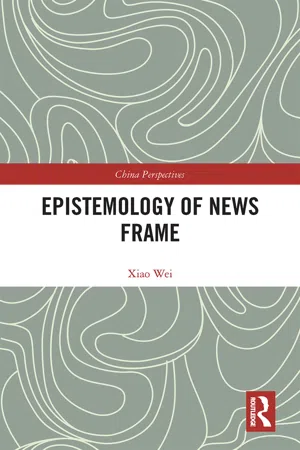
Epistemology of News Frame
About this book
"Frame analysis" has long been an active field in journalism and communication, but there are many chaotic, ambiguous definitions and duplicated studies.
This book combines subjective philosophy with empirical research to fully explore what news framing is and how a media organization's news frame is constructed. Topics discussed include connotation and composition, facts and sources, functions and effects, construction and updates, competition and negotiation, presenting as a whole a clear and systematic epistemological framework and providing inspiration for news frame researchers, media practitioners and the public to understand the role of the news media.
In addition, the book also examines and analyses empirical cases from different countries and regions, including particular emphasis on frame analysis in China, which can help foreign readers better understand Chinese media reports.
Information
1 Introduction
News frame, communication subject and reality construction
In countless ways and ceaselessly, social life takes up and freezes into itself the understandings we have of it.
From news ontology to news phenomena, it is a process of the subject reflecting the factual world, a process of the subject reporting on the factual world, as well as a process of the subject constructing scenes of the factual world. In a certain sense, this process can be said to be as a process of the subject creating news.
Generally speaking, “news frame” has two related meanings: (1) the cognitive model of news workers on news facts and (2) the specific subjective thoughts and discourse features that the model exhibits in the news text. This book is written mainly under the second meaning, but it inevitably takes the first meaning as its base. On the one hand, a news frame is the product of the integration of social existence into the subjective conception, which is inevitably constrained by social structure. On the other hand, it plays a dominant and leading role in journalism practice, and there is no doubt that it impacts social life. The cross interaction between these two perspectives makes the news frame as a news concept at a particular level play a complex and important role in news production and social life. How people form news discourse through cognition and “how to communicate in constructing social reality” (Z. Pan, 2006a) are inseparable from the news frame.
What this book sets out to explore is how the news frame of the communication subject (professional media organization) is formed between structuring and “being structured,” that is, under the joint action of the internal subjective initiative and the external social structure constraints. Structuring and “being structured” can be seen as the root of various contradictions and tensions in the process of news representation1 and discourse construction. The author’s ultimate concern is the question of value: what kind of news frame can be used by a subject having the dual personalities of both the structuring person and the structured person to truthfully reproduce and rationally construct the real world? However, both the theoretical logic and the status quo of Chinese and Western research require this booking to adopt use “structuring” and “being structured” as the entry point to focus on answering the factual questions: what is the news frame of the communication subject? How is it constructed?
Section 1: The origin and significance of news frame research
In essence, news activities are activities by which humans understand the real world (B. Yang, 2010a, p. 20). As for the influence and role of the subjective conception in such cognitive activities, different answers have been given by different schools of journalism communication at different time. Among them, the category of research on “news frame” featuring subject cognition, “meta-communication” and symbolic interaction occupies a unique position. What kind of news frame should communicators use to understand, represent and construct the world of news symbols is a fundamental issue facing journalism practice and research. Compared with Western countries, the specific context of China’s social modernization and transformation requires scholars to give specific answers to these questions in light of the Chinese reality.
Specific category of news conception
For news reports, people often say: “If not at the spot, you would think that…” The symbolic world presented by news reports is often different from the real world. The same fact will appear differently in different news reports, sometimes even completely the opposite. For this reason, some have called the news media as “unreliable narrators.” The above phenomenon is by no means an obliteration of the “authenticity” of news. However, it does reflect an important fact: there is an inherent difference between news facts (ontology) and news presentation (expression). It is precisely because of such differences that news is the product of inter-mediation and it is because of such inevitable inter-mediation that the presentation of the ontology by news is not only a representation, but also an unavoidable construction. News presents the factual reality in both representation and construction (B. Yang, 2008a, Preface, p. VIII). The dual characteristics of representation and construction suggest that subjective conception plays a vital role in news cognition activities.
Then, how do communication subjects form their conceptions? How does such conception work? Western news theory based on journalism professionalism once held an independent and self-contained concept of media organization, contending that media is a natural tool without any bias and can be used by people for various purposes. This also means that news workers have absolute professional autonomy. However, from White’s “gatekeeper” research (1950), the inseparable relationship between the concept of the transmitter and politics, economy, society and culture has gradually been displayed in many aspects. On the one hand, the communication subject is limited by social structure. On the other hand, it is the subject which undertakes information communication. “Structure and Agency” are always the core contradiction in the process of reproducing subjective conception and constructing social reality. Especially since the 1970s, sociological research on news production has combined journalistic individuals with organizations and institutions for observation, the complex and entangled relationship between the control and under control of social factors has attracted great attention from scholars (Gans, 1979/2004; Gitlin, 1980; Tuchman, 1978). Different scholars have given their answers to this question, which adopt different and even opposite stances.
In 1974, the Canadian-American sociologist Goffman published Frame Analysis: An Essay on the Organization of Experience. With it, the concept of “frame” was officially defined and quickly applied in journalism studies. In just 40 years, “news frame” has become an extremely important research field. One of the most fertile areas of current research in journalism and mass communication involves the concept of “framing” (Riffe, 2004, p. 2). When the history of academic research on journalism is examined from a historical perspective, one can find that the origin of news framing theory—the theory of construction, has long been established. Lippmann (1922) distinguished between “the world outside” and “the pictures in our heads” and believed that our understanding of facts depends on our position and observation habits. He said
For the most part we do not first see, and then define, we define first and then see. In the bustling external world, we pick out what our culture has already defined for us, and we tend to perceive what we have picked out in a form stereotyped for us by our culture.
Similar construction views are essentially reflections and expressions of the notion “theory preceding observation” from the epistemology of philosophy of science in news cognition activities. It seeks to correct the intuitiveness and mechanics of news representation and depiction theory (B. Yang, 2008a, p. 289). However, compared with other construction theories, there are multiple specific reasons for extensive news frame research in Western countries.
First of all, it is directly related to the fact that as a concept, “news frame” has extremely rich connotations: (1) it focuses on ideas and cognition, and provides a methodology for specific news compilation practices. As Z. Pan (2006b) says, “the so-called news frame emphasizes different basic values. This is the essence of the news frame” (p. 174); (2) it involves the “meta-communication” level and is the rule provided by the communicator to the audience about how to interpret symbols; (3) it adopts the perspective of “relationship” and places and examines media production in a complex relationship structure of multiple links; and (4) it integrates various academic paths such as sociology, psychology, journalism and communication.
Second, it is related to the “bridge” feature of the frame perspective. News production is a kind of social production. The mass media “name different parts of society by taking advantages of its pervasive, universal nature and symbol highlighting capabilities” (D. Huang, 2005, p. 239). The “frame” provides a new perspective for studying this critical social system. As argued by Reese (2001), since it focuses on the interaction between media practices, culture, audiences and producers, the frame perspective can prevent the over-segmentation of various parts of the communication process, thereby potentially establishing a bridge between them to facilitate the communication of studies that have been long isolated from each other (pp. 8–10).
Third, frame is considered suitable for discussing the “generation of meaning.” With the continuous integration of thoughts and theories from sociology, semiotics, phenomenology and human methodology, many scholars have begun to view journalism as a social reality arising from the dialectical relationship between subjectivity and objectivity (G. Zang, 1999, pp. 93–106). Based on such understandings, news media texts are not fixed entities; rather, framing involves interactions among texts, text producers and audience members operating in the context of various social influences (Woo, 1996). A similar but more sociological approach has been more typically applied to questions of framing in media and communication research and opened an important field of analysis: precisely how are issues constructed, discourse structured and meanings developed? (Reese, 2001, p. 7). In the topic of media discourse competition, the frame concept boasts special explanatory and perspective powers.
Therefore, we have every reason to regard “news frame” as an important and specific research area in the study of news ideas. Due to the existence of news frames, media organizations always pick news facts within certain boundaries, structuring, interpreting and constructing the news in particular ways. From a more expanded point of view, the subjects of news activities composed of the whole society are all involved in the cognition-selection-construction process. But this does not mean denying the representation feature of news; otherwise the journalism industry will lose its foundation for survival. Recognizing the constructive feature of news and acknowledging the existence of the news frame must be based on the representation of ontology. However, there is an obvious contradiction between construction and representation: if there is subjective cognition, there will be objective thinking; if there is frame selection, there will be omissions; if there is construction, there will be competition for interpretations and discourses. Coupled with the operation of history, changes in the social context and interaction among multiple activity subjects, the news frame has particularly complex formative and function mechanisms. The thorough exploration of relevant issues should be an important part of news idea research.
Practical significance in the Chinese context
On the whole, the news frame research in mainland China is still in its infancy. The 1990s saw a small number of papers on the theme of news frames and non-pure-academic works, such as Behind the Demonized China by Xiguang Li and K. Liu (1996). Since 2000, researches on this topic have been growing year by year. If one enters the search words “Article title = frame and theme = news” into CNKI (for the period from January 1, 2000 to July 1, 2017), a total of 1,101 relevant documents, including journal papers, master theses, doctoral theses and other literatures can be found. Just as some researchers have said, “Frame analysis is increasingly becoming an academic discourse in China’s journalism and communication circles” (L. Wang, 2009, p. 253).
Practically speaking, news frame is still a new research field in need of active exploration. Its development in China is related to growing efforts by the Chinese journalism and communication circles to learn from their foreign peers and broaden their theoretical horizons. But such rapid development also reminds us of the real-world context behind it. “Scholarship is a product of its particular time; to understand why something was written we have to look at its historical context” (Nerone, 1995, p. 7). The frame issue was raised on the premises that the different interpretations of news facts by the subjects of news activities, that news media organizations can make relatively independent news reporting, and that different subsystems of the social system and different social members can be involved in social construction independently. When only one voice is allowed to exist in the society, the “frame” and “frame competition” consciousness can hardly be accepted by social members (including researchers). From this perspective, frame research is gradually developing with the changing context of China’s modernization drive. It is a product of social change. News frame research, especially the news frame of communication subjects in in the Chinese context, has great practical significance.
At the journalistic level, the news frame plays a dominant role in specific news reports. News presentations will be significantly different under different frames. The media should provide real, objective, fair and comprehensive information to the audience in a timely manner and protect the public’s right to know, provided that it has a reasonable cognitive frame and constructs a reasonable textual frame. The news frame is also a bridge that links macro-news concepts with micro-news practices. At the core of China’s news reform is the reform of news ideas. “Deepening China’s news reform with constantly updating news ideas has been a clear development trajectory of the news reform in the country in the past 30 years, which is a distinctive feature different from the reforms in other fields” (B. Tong, 2008, p. 7). This is closely related to the fact that news belongs to the ideological field and that the news system is closely related to the political system. As for the subjects of news communication at all levels, especially at the level of media organization and individual reporters which do specific reporting, news ideas play an important role in news practice through the intermediary of the frame. In turn, news practice also promotes the transformation and renewal of news ideas through the intermediary of the frame. News frame research can not only provide scientific guidance for news practice, but also promote the renovation of news ideas.
In the current social context of diversified Chinese values, it is not easy to answer the question of what is a “reasonable” news idea, but this is the primary question to be answered. B. Yang (2014) proposed that the more reasonable leading news idea that can be constructed should be the idea of “developing journalistic professionalism,” that is, the journalism and news ideas that can achieve the sound development of journalism through journalistic professionalism and promote the overall development of society as well as the positive interaction between journalism and other social fields (pp. 378–395). How can the media apply this dominant idea into daily news production through practice and present it in a reasonable news report is a question in urgent need of study at the frame level.
At the social level, the news frame is closely related to public participation. The subjects of various news activities, starting from their ideas, interests and needs, will form different frames for the same fact and engage in frame competition in the public domain to jointly construct news discourses. Ensuring that citizens can participate in competition through their own frames and speak in the news discourse constructed by the media are important connotations for safeguarding the “four rights.”2 In particular, the development of new network media technologies is making the public increasingly an important communication subject who is actively participating in the activities of news communication. However, some blind and irrational factors also show up along with the cognitive frame of the public. How social members can compete in the frame of rationality and public interest is of great significance to social functioning. In the historical stage, professional media organizations are the direct constructors of the news frame, but to a considerable extent this construction can also be regarded as a concentrated projection of the cognition of members of society. The frame presents a constant mode generally hidden in the psychology of members of society. In order to promote the development of news through the improvement of public news activities, how to optimize the cognitive frame of social groups and individuals through the news frame is also an important proposition.
At the international level, the news frame is closely related to the dissemination of democracy. The democratization of Chinese and international communications is one of the goals of China’s media reform (Yuezhi Zhao, 2008). To achieve this goal, it is necessary to face up to the existing differences in ideas between countries and nations with different historical and cultural backgrounds and social systems. The news frames of media organizations in different countries often have distinct ideological characteristics. In addition, differences in national psychologies, cultural concepts and interests cause divided news reporting, which will mislead the audience and impede information exchanges. A reasonable news frame is a bridge to enhance international understanding, communication and cooperation.
The analysis at the above three levels shows that in the realistic context of Chinese society, news frame research has an important practical significance.
Subjectivity of media organizations
The mass media is not the only subject in...
Table of contents
- Cover
- Half Title
- Series Page
- Title Page
- Copyright Page
- Table of Contents
- List of figures
- List of tables
- Foreword
- Acknowledgments
- 1 Introduction: news frame, communication subject and reality construction
- 2 Literature review and research approach
- 3 Connotation and composition of news frame
- 4 Source of news frame
- 5 Function and effect of news frame
- 6 Construction and update of news frames
- 7 News frames interaction: competition and negotiation between subjects
- 8 Discussion on the news framework from different perspectives
- 9 Conclusion
- Postscript to the Chinese edition
- References
- Index
Trusted by 375,005 students
Access to over 1.5 million titles for a fair monthly price.
Study more efficiently using our study tools.
Frequently asked questions
Yes, you can cancel anytime from the Subscription tab in your account settings on the Perlego website. Your subscription will stay active until the end of your current billing period. Learn how to cancel your subscription
No, books cannot be downloaded as external files, such as PDFs, for use outside of Perlego. However, you can download books within the Perlego app for offline reading on mobile or tablet. Learn how to download books offline
Perlego offers two plans: Essential and Complete
- Essential is ideal for learners and professionals who enjoy exploring a wide range of subjects. Access the Essential Library with 800,000+ trusted titles and best-sellers across business, personal growth, and the humanities. Includes unlimited reading time and Standard Read Aloud voice.
- Complete: Perfect for advanced learners and researchers needing full, unrestricted access. Unlock 1.5M+ books across hundreds of subjects, including academic and specialized titles. The Complete Plan also includes advanced features like Premium Read Aloud and Research Assistant.
We are an online textbook subscription service, where you can get access to an entire online library for less than the price of a single book per month. With over 1.5 million books across 990+ topics, we’ve got you covered! Learn about our mission
Look out for the read-aloud symbol on your next book to see if you can listen to it. The read-aloud tool reads text aloud for you, highlighting the text as it is being read. You can pause it, speed it up and slow it down. Learn more about Read Aloud
Yes! You can use the Perlego app on both iOS and Android devices to read anytime, anywhere — even offline. Perfect for commutes or when you’re on the go.
Please note we cannot support devices running on iOS 13 and Android 7 or earlier. Learn more about using the app
Please note we cannot support devices running on iOS 13 and Android 7 or earlier. Learn more about using the app
Yes, you can access Epistemology of News Frame by Xiao Wei in PDF and/or ePUB format, as well as other popular books in Social Sciences & Media Studies. We have over 1.5 million books available in our catalogue for you to explore.