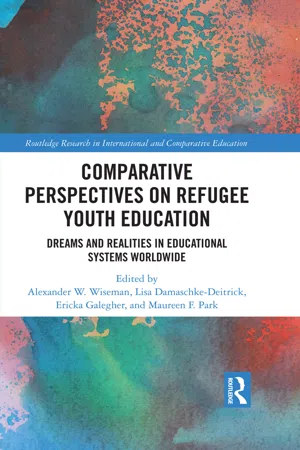
This volume explores the shared expectations that education is a panacea for the difficulties that refugees and their receiving countries face. This book investigates the ways in which education is both a dream solution as well as a contested landscape for refugee families and students. Using comparative, cross-national perspectives across five continents, the editors and contributors critically analyze the educational structures, policies, and practices intended to support refugee youth transition from conflict and post-conflict zones to mainstream classrooms and schools in their new communities.
eBook - ePub
Comparative Perspectives on Refugee Youth Education
Dreams and Realities in Educational Systems Worldwide
- 302 pages
- English
- ePUB (mobile friendly)
- Available on iOS & Android
eBook - ePub
Comparative Perspectives on Refugee Youth Education
Dreams and Realities in Educational Systems Worldwide
About this book
Information
Part 1
Global Policy Expectations for Refugees’ Educational Transitions
1
Education as a Panacea for Refugee Integration? Evidence From Germany and the United States
Introduction
As a result of war in Syria as well as conflict and unstable circumstances elsewhere, including Afghanistan, Kosovo, the Democratic Republic of Congo, and Eritrea, Europe and North America have experienced a higher influx of refugees in recent years (Organisation for Economic Co-operation and Development [OECD], 2015; United Nations High Commissioner for Refugees [UNHCR], 2017). Looking across data from 2006 to 2017, asylum applications peaked in 2015 with a slight decrease in 2016 before decreasing by almost half in 2017 across European Union member states (Eurostat, 2018). In Germany, the Bundesamt für Migration und Flüchtlinge (BAMF; Federal Office for Migration and Refugees) registered about 477,000 refugees in 2015, even though arrivals actually numbered approximately 890,000 (Beauftragte der Bundesregierung für Migration, Flüchtlinge und Integration [BBMFI], 2016). Despite recent declines, the United States has historically been the leading country for resettlement worldwide (Mossaad & Baugh, 2018). Notably, large numbers of those received overall have been children and adolescents, both unaccompanied and separated, alongside individuals with special needs stemming from violence and maltreatment (UNHCR, 2016).
This influx of refugees poses challenges to the economic, social, political, and cultural contexts of the receiving countries, particularly regarding the integration of newcomers. Different challenges also arise as arrivals to Europe come from more varied countries than in the past and have more diverse reasons for leaving their homes (OECD, 2015). To aid in coping, international organizations, and the United Nations High Commissioner for Refugees (UNHCR) in particular, advocate using education as a panacea or solution to integrate newcomers when they arrive. Education is expected to provide the necessary skills and knowledge to participate in society. It has been argued that the idea of education as a solution or panacea for integration has become ubiquitous, accepted as a shared idea, and promoted on the international level (Wiseman, Damaschke-Deitrick, Bruce, Davidson, & Taylor, 2016). This belief in education’s role is exemplified in the following quote from the UNHCR Division of International Protections:
Education provides knowledge and skill development that strengthens the capacity of refugees to be agents of social transformation, and is essential to understanding and promoting gender equality and sustainable peaceful coexistence. The future security of individuals and societies is inextricably connected to the transferrable skills, knowledge, and capacities that are developed through education.
(2012, p. 3)
Though aligning with international expectations of integrating newcomers with the help of education, countries have pursued education policies and practices for refugees differently, just as they have pursued varying goals for integration overall. For example, some Western countries mainly focus on social and cultural integration regarding language proficiency, residential inclusion, and even religious and ethnic inclusion, while others focus primarily on achieving economic integration through the employment and eventual self-sufficiency of newcomers (Portes & Rumbaut, 1996, 2001; Van Tubergen, 2006). Differences in the main objectives for integration appear related to the history and development of integration in a particular country and on that country’s current economic, social, political, and cultural contexts. The influence of national integration objectives on education policies and practices to place refugees on a path to achieve these objectives has not been researched. This study addresses this gap.
The focus of this study is on the integration of refugee children and adolescents through education in Germany and the United States. The reason these particular countries were chosen is threefold. First, the countries are similar in that they have federal systems of education. However, variations in their handling of integration over time are evident. Finally, objectives of what integration is meant to achieve economically, socially, politically, and/or culturally in each context differ as well. Thus, it is possible to compare how different integration objectives become evident in education policies and practices in the two countries.
This study contends that German education policies and practices have been established to prepare refugees for social integration, and particularly for German language acquisition. German language knowledge is often considered key to education and labor market access and to integration overall. A report published by the German government highlights: “Anyone learning our language today, starting an apprenticeship, or undertaking training will be more likely able to find their place in our society tomorrow”1 (BBMFI, 2016). For the United States, this chapter maintains that education policies and practices have been primarily focused on preparing refugee students to enter the labor market and achieve economic integration. Exemplifying this, the OECD (2015) describes the US resettlement approach as “front-loaded with the expectation that refugees will, where possible, rapidly enter the labour market” (p. 13).
With these contentions in mind, this research addresses the following question:
How do differences in integration objectives become evident in education policies and practices for refugees in Germany and the United States?
Influenced by international organizations and scripts framing education as a solution to achieve integration, the two cases of Germany and the United States are studied qualitatively through detailed content analysis examining national policy documents and representative evidence of practices. The investigation allows for a critical comparison of these two cases to identify where differences in refugee education for integration occur.
We begin by giving an overview of integration and operationalizing the term. Then we present the conceptual framework guiding this chapter: sociological neo-institutionalism leading to the widely held belief in education as the solution for integration. A description of the methodology follows before demonstrating how integration is understood in the two countries. Policies and practices for refugee education in Germany and the United States are then presented according to whether they address economic, social, political, or cultural aspects. In particular, we analyze the ways in which Germany and the United States apply education as a key solution for refugee integration within their borders.
Conceptualizing Integration
In the literature, integration has different meanings and is often subject to debate. In the US context, integration is often used as an “antonym of segregation” (Alba, Sloan, & Sperling, 2011, p. 397; Anderson, 2001), while in many countries in Europe, integration is seen as a substitute for assimilation. Alba and Nee (2003) discuss how assimilation relates to integration, presenting assimilation trends in the United States since the mid-1960s and arguing that these continue to shape immigrant experiences today.2 This article follows the broader definition of integration offered by Alba et al. (2011) who define it as preparation of “newcomers for a robust membership in the host country, corresponding with the ability to participate in various institutional sectors as fully entitled members” (p. 397). This chapter argues that education is deemed the solution to enabling “the ability to participate” through integration.
The research on integration is delineated further with work on “socio-cultural integration” (Alba & Nee, 2003; Van Tubergen, 2006, p. 7) and economic integration (Van Tubergen, 2006). Socio-cultural integration research can be further broken down into its individual components, social integration and cultural integration. Social integration references “the extent to which immigrants interact socially with natives” and cultural integration concerns “the degree to which cultural values and patterns are shared among immigrants and natives” (Van Tubergen, 2006, p. 7). According to Van Tubergen (2006), “economic integration indicates the degree of economic equality between immigrants and natives” connecting its strength to lower unemployment, better jobs, and increased income (p. 7).
Research on integration, or rather assimilation at that time, started with the first great US immigration wave in the late 19th and early 20th centuries. The assumption was that over time, immigrants would assimilate into the new host society. However, as Van Tubergen (2006) highlights, these researchers underestimated the impact of macro-level factors on newcomers’ abilities to achieve assimilation, including “the role of the immigrant group and the influence of the receiving context” (p. 8). Immigrant groups show, for example, variation regarding their language proficiency. In addition, regional differences also exist: depending on their destination, newcomers have different chances to integrate. These “contexts of reception” can be differentiated by government policies, status of the labor market conditions, and community characteristics (Portes & Rumbaut, 1996, 2001; Van Tubergen, 2006, p. 13). For example, Alba (2005) investigated the assimilation of second-generation immigrants in France, Germany, and the United States, identifying citizenship, religion, language, and race as key factors for assimilation.
Existing research has mainly focused on either economic and political integration or on socio-cultural integration (Van Tubergen, 2006). In this chapter, our approach is to look across economic, social, political, and cultural factors relevant for the integration of refugees.
Conceptual Framework: Education as a Panacea for Refugee Integration
The conceptual framework employed is based on sociological neoinstitutionalism as an overarching theory. Sociological neo-institutionalism provides explanations for ways education systems in different countries enact universally taken-for-granted scripts with institutional actors engaging in legitimacy seeking (Jepperson, 2001; Meyer, Boli, Thomas, & Ramirez, 1997). Uniform approaches to enactment are neither expected nor guaranteed by sociological neo-institutionalists, and decoupling between global norms and local enactment is often evident (Jepperson, 2001; Meyer et al., 1997).
Education has become a solutionist tool employed worldwide not only for society as a whole but also for distinct issues and specific populations or groups (Wiseman et al., 2016). This study investigates the way in which the global script of education is used as a key solution or panacea for the integration of refugees. International organizations like the UNHCR promote the global understanding of the central role of education as a solution to integrate newcomers into a country (see UNHCR Division of International Protection, 2012). The belief in education as a panacea to transition refugees to a new host country is understood to occur through improving language aptitude, enhancing social inclusion, and learning key skills necessary for the labor market, among others (see Koehler, 2017; OECD, 2015).
This study builds on work offering evidence of an inclusion approach to refugee education, which has begun to replace the parallel education for refugees that was previously widespread (Dryden-Peterson, 2015, 2016; Dryden-Peterson et al., 2018; Dryden-Peterson, Adelman, Bellino, & Chopra, Under review). Dryden-Peterson et al. (2018) define inclusion as “the process of coming together through refugee learners’ access to government schools and/or the curriculum followed by the governments of the host countries” (p. 7). The evidence presented here gives insights into what constitutes this access and curriculum for refugee students in the educational systems of Germany and the United States.
Allemann-Ghionda (2009) noted how comparative analysis of individual European countries’ educational policies demonstrates differences of interpretation as a result of different situations and politics in these countries at a certain point in time. Countries, including Germany and the United States, considered here, exhibit a spectrum of differences in enactment despite sharing similar global views regarding norms and beliefs about education (Wiseman et al., 2016). The differences arise as each country makes choices based on its own society, culture, and history (Fernanda Astiz, 2006). Education policymakers and educators filter scripts through their own frameworks, including their understanding of integration and the education system’s institutional structure. Using the lens of sociological neo-institutionalism, this study examines how the sc...
Table of contents
- Cover
- Half Title
- Series Page
- Title
- Copyright
- Contents
- Acknowledgments
- Introduction: The Contested Expectations of Education as a Panacea for Refugee Transitions
- PART 1 Global Policy Expectations for Refugees’ Educational Transitions
- PART 2 Local Adaptations for Refugees’ Educational Transitions
- List of Contributors
- Index
Trusted by 375,005 students
Access to over 1.5 million titles for a fair monthly price.
Study more efficiently using our study tools.
Frequently asked questions
Yes, you can cancel anytime from the Subscription tab in your account settings on the Perlego website. Your subscription will stay active until the end of your current billing period. Learn how to cancel your subscription
No, books cannot be downloaded as external files, such as PDFs, for use outside of Perlego. However, you can download books within the Perlego app for offline reading on mobile or tablet. Learn how to download books offline
Perlego offers two plans: Essential and Complete
- Essential is ideal for learners and professionals who enjoy exploring a wide range of subjects. Access the Essential Library with 800,000+ trusted titles and best-sellers across business, personal growth, and the humanities. Includes unlimited reading time and Standard Read Aloud voice.
- Complete: Perfect for advanced learners and researchers needing full, unrestricted access. Unlock 1.5M+ books across hundreds of subjects, including academic and specialized titles. The Complete Plan also includes advanced features like Premium Read Aloud and Research Assistant.
We are an online textbook subscription service, where you can get access to an entire online library for less than the price of a single book per month. With over 1.5 million books across 990+ topics, we’ve got you covered! Learn about our mission
Look out for the read-aloud symbol on your next book to see if you can listen to it. The read-aloud tool reads text aloud for you, highlighting the text as it is being read. You can pause it, speed it up and slow it down. Learn more about Read Aloud
Yes! You can use the Perlego app on both iOS and Android devices to read anytime, anywhere — even offline. Perfect for commutes or when you’re on the go.
Please note we cannot support devices running on iOS 13 and Android 7 or earlier. Learn more about using the app
Please note we cannot support devices running on iOS 13 and Android 7 or earlier. Learn more about using the app
Yes, you can access Comparative Perspectives on Refugee Youth Education by Alexander W. Wiseman, Lisa Damaschke-Deitrick, Ericka L. Galegher, Maureen F. Park, Alexander W. Wiseman,Lisa Damaschke-Deitrick,Ericka L. Galegher,Maureen F. Park in PDF and/or ePUB format, as well as other popular books in Education & Comparative Education. We have over 1.5 million books available in our catalogue for you to explore.