- 426 pages
- English
- ePUB (mobile friendly)
- Available on iOS & Android
eBook - ePub
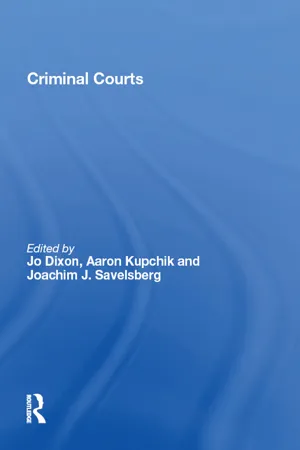
Criminal Courts
About this book
The social organization of criminal courts is the theme of this collection of articles. The volume provides contributions to three levels of social organization in criminal courts: (1) the macro-level involving external economic, political and social forces (Joachim J. Savelsberg; Raymond Michalowski; Mary E. Vogel; John Hagan and Ron Levi); (2) the meso-level consisting of formal structures, informal cultural norms and supporting agencies in an interlocking organizational network (Malcolm M. Feeley; Lawrence Mohr; Jo Dixon; Jeffrey T. Ulmer and John H. Kramer), and (3) the micro-level consisting of interactional orders that emerge from the social discourses and categorizations in multiple layers of bargaining and negotiation processes (Lisa Frohmann; Aaron Kupchik; Michael McConville and Chester Mirsky; Bankole A. Cole). An editorial introduction ties these levels together, relating them to a Weberian sociology of law.
Part I
Macro-Level Organization
[1]
Law That Does Not Fit Society: Sentencing Guidelines as a Neoclassical Reaction to the Dilemmas of Substantivized Law1
University of Minnesota
Chances of realizing a legal rationality that does not fit society are limited. Referring to Weber’s “Sociology of Law,” to related themes in the sociology of polity, organizations, and occupations, and to recent debates on technocratization, juridification, delegalization, and responsive law, this article presents a theoretical discussion of this thesis. An empirical case, using the neoclassical concept of sentencing guidelines, exemplified by the federal and Minnesota cases, supports the argument. The neoclassical movement, aiming to reverse the substantivation of law and to correct lack of due process, functional failures, disparities, and discrimination, faces considerable impediments and may result in counterproductive effects. The article demonstrates that (1) societal conditions that caused substantivation hamper reformalization in the political process; organizational and occupational consequences of substantivation also impede (2) political and (3) implementation chances of neoclassical instruments; and (4) impediments to reformalization derive from the method of central guidance used to reestablish sociologically formal rationality.
I. INTRODUCTION: SOCIETY AND RATIONALITIES OF CRIMINAL LAW
Weber’s writings on substantive rationalization deal with a sociolegal process characteristic of advanced stages of the modernization process. Substantive rationalization means the intrusion of economic, sociological, and ethical criteria upon formal-rational reasoning and decision making (Weber 1978, esp. pp. 657 and 880–95). The term is closely related to contemporary debates on “juridification” (Teubner 1987, pp. 10–13), “technocratization” (Stryker 1989, 1990a, 1990b), “delegalization” (Abel 1982), and “responsive law” (Nonet and Selznick 1978).2 Applying the term is both difficult and potentially fruitful in trying to understand (a) the development of law throughout the emergence and transformations of the interventionist welfare state and (b) the nature and consequences of current neoclassical countermovements.
Sentencing guidelines are a strategy of these countermovements in criminal law. They attempt to cure several dilemmas of substantivation that critics in sociolegal scholarship, the legal profession, the political sector, and the public have increasingly stressed: lack of due process, sentencing disparities, favoring the powerful. I argue and exemplify for the cases of the federal and Minnesota guidelines, for the policy-making and implementation processes, that neoclassical strategies meet serious structural and cultural impediments in modern society, conditions that caused substantive rationalization in the first place.3
Substantive rationalization is the most recent step in the historical process of legal rationalization and state development. The changing rationality of law is based on the process of societal differentiation discussed in classical sociology (e.g., Durkheim, Parsons, Simmel, Weber) and, particularly in the late 19th and early 20th centuries, on changes in class relations and class conflicts (Therborn 1978; Turkel 1980). Positive and public bureaucratic law emerged with the differentiation of a specialized and centralized political sector. With the later separation of powers the law of the (now) republican state also became general and autonomous (Unger 1976, pp. 47–86). The result was described by Weber (1978) as formal-rational law (autonomous law in Nonet and Selznick [1978]). Because it created legal security and a stable foundation for economic exchange without intervening in societal structures, such law was basic to the bourgeois state and the capitalist economy. While it treated all persons as formally equal, it disregarded substantive social inequalities (e.g., Hurst 1956, p. 820). Under this law, to paraphrase Anatole France, it was forbidden to rich and poor alike to sleep under bridges and steal bread. In criminal law, the idea, prominently proposed by philosophers like Hegel and Kant (1965, pp. 99–106), was simply to be just, retributive, and to punish equal and free individuals equally for equal offenses.
It was recognized early that such formal-rational law contributes to social inequality (Marx and Engels 1938; Weber 1978, pp. 812–13). The resulting social, especially class, conflict was one of the strongest motors toward the interventionist welfare state and substantive-rational law (Alber 1982, pp. 200 ff.). Labor movements and political parties with labor constituencies demanded that those who create and apply the law ought to moderate the fiction of formal equality and liberty and acknowledge the substantively differentiated access to these desired goods (Ginsburgh 1979). In criminal law and related policy debates, concepts like intervention, therapy, rehabilitation, and social reform gained prominence. Other concerns also contributed to the eclipse of formal rationality. Weber (1978, p. 882) diagnosed “the desire to eliminate the formalities of normal legal procedure for the sake of a settlement that would be both expeditious and better adapted to the concrete case.” He associates this “weakening of legal formalism” with a desire for “substantive expediency,” a concern with impact, effect, and ends served by legal action, and adaptation “to the concrete case.” This substantive rationalization of law results on the one hand in an intrusion of the state into society and, on the other hand, in an opening of state decision making to social (“extralegal”) criteria (Teubner 1987, pp. 10–12).
Critics stressed follow-up problems of substantivation. Already Weber (1978, pp. 886–87 and 892–93) was concerned about an eventual loss of rationality and new problems to social justice. Particularly in most recent decades, and especially in the United States, substantivation was claimed to be the source of counterproductive effects.4 First, in the late 1960s and early 1970s, community and treatment programs began to evoke frustrations (these are most effectively expressed in Martinson’s [1974] well-known “nothing works” resignation). In addition, a loss of due process was claimed to result from probation, indeterminate sentencing, parole, and preventive programs. Resignation and due process concerns were coupled with doubts concerning the justice of substantivized law. For example, the difficulties of clearly distinguishing between legal and extralegal determinants of sentencing (Nagel 1983) were related to the dilemma of high disparities in sentencing along the traditional set of legal criteria. In addition, substantive rationalization and related deformalization admitted both extralegal criteria and patterns of social inequality to legislative processes (Savelsberg and Brühl 1988; Savelsberg 1987, 1988) and legal decision making (Abel 1982). Numerous studies demonstrated that disparities in prosecution and sentencing tend to favor upper-class and powerful offenders (Benson and Walker 1988; Hagan and Parker 1885; Wheeler, Weisburd, and Bode 1982).
In the United States, frustration with substantivized criminal law legitimized a series of steps attempting to reverse the trend from formal to substantive rationality. The first step was a retreat to a general deterrence perspective (e.g., Wilson 1975), including a return to imprisonment and determinate sentences, that was expressed in many legislative efforts on the state level. As a result, prisons became overcrowded and many states could no longer meet costs. A decade of enforced imprisonment proved this strategy could not solve the crime problem (Pontell 1984). Rates of crime and recidivism remained high and continued to increase, resulting in further frustration and ironically in the incarceration of some who had caused jail overcrowding (Pontell et al. 1988). The response among some criminal lawyers was further withdrawal from general deterrence to a retributive, neoclassical just-desert principle (e.g., Von Hirsch 1987a, p. 85), combined with an attempt to control the prison population and to equalize sentencing practices through guidelines.
It is fascinating to observe how two decades of criminal justice policy have tried to reverse a long historical process leading from retribution to the substantivation of criminal law. The neoclassical movement does not seek ways to diminish the risks of substantive law while accepting its existence. It aims to redesign law, to clearly redraw the borders that had separated state and society and return to formal-rational law. Since the movement does not automatically get translated into legal practice, its members attempt to institutionalize reformalization through programs of central state guidance.
These neoclassical attempts offer an ideal case to confront the discussion on the autonomy or congruency of different subsystems or sectors in society, for example, the legal, political, social, and economic systems, with empirical reality. I hypothesize that the chances to return to a past type of legal rationality are very limited. More specifically, I argue that the sociostructural conditions that caused legal substantivation continue to be effective and that these conditions hinder the reconstruction of formal rationality. I argue further that substantivation itself has induced organizational and occupational changes that reinforce substantivation and now work as an additional force against reformalization in legislation and implementation. The interrelation between law, state formation, and forms of organization and occupation hypothesized here is not surprising if we understand law as that part of society’s normative order backed by specialized agents of social control (Weber 1978, pp. 34–35), that is, in modern societies, formally organized state agencies that are staffed with specialized and professionalized personnel. In the theory discussion I further clarify Weber’s concept of substantive rationalization, apply it to criminal law, and discuss its structural causes. A differentiated set of hypotheses is then followed by an empirical illustration for the case of sentencing guidelines.
II. SUBSTANTIVE RATIONALIZATION, ITS STRUCTURAL ROOTS AND CONSEQUENCES
One important clarification of Weber’s “formal rationality” is warranted at the outset. Ewing (1987) demonstrates that Weber’s theory distinguishes between (a) logically formal rationality in legal thought and (b) sociologically formal rationality of formal justice. Whereas the former refers to the generalization and systematization of legal subject matter so that it constitutes a deductive, logical, and gapless system of rules (see Schluchter 1981), the latter signals the rational-legal state emphasizing calculable enforcement of guaranteed rights. Sociologically formal rationality of formal justice “is abstract and bound by strict procedure, and guarantees the legal certainty essential for calculability in economic transactions, all of which applies to both civil [logically formal] and common [not logically formal] law systems” (Ewing 1987, p. 489). Weber also includes the idea of noninterventionism when he points to the advantages of formal-rational law, as the basis for free societal and economic exchange, for the dominant classes (Weber 1978, pp. 812–13). Applying this conceptual clarification to our case, neoclassicism aims at the reestablishment of sociologically formal rationality. The method used for this end is central guidance, a logical and gapless system of rules, which provides for the establishment of logically formal rationality.
A. Substantive Rationalization of Criminal Law
Criminal law, in its quantity and quality (Black 1976) and in its relation to the political sector, varies with the societal context. Its long-term development, prominently discussed in sociological theory (Durkheim 1893; 1899/1900; Foucault 1975), contributes to criminal law’s present dilemmas, which can best be understood as a result of the changing rationality of law. The process of substantive rationalization occurred in several ideal-typical stages, each of which represents a higher degree of substantive rationality (see table 1). First, le...
Table of contents
- Cover
- Half Title
- Title Page
- Copyright Page
- Table of Contents
- Acknowledgements
- Series Preface
- Introduction
- PART I MACRO-LEVEL ORGANIZATION
- PART II MESO-LEVEL ORGANIZATION
- PART III MICRO-LEVEL ORGANIZATION
- Name Lndex
Trusted by 375,005 students
Access to over 1.5 million titles for a fair monthly price.
Study more efficiently using our study tools.
Frequently asked questions
Yes, you can cancel anytime from the Subscription tab in your account settings on the Perlego website. Your subscription will stay active until the end of your current billing period. Learn how to cancel your subscription
No, books cannot be downloaded as external files, such as PDFs, for use outside of Perlego. However, you can download books within the Perlego app for offline reading on mobile or tablet. Learn how to download books offline
Perlego offers two plans: Essential and Complete
- Essential is ideal for learners and professionals who enjoy exploring a wide range of subjects. Access the Essential Library with 800,000+ trusted titles and best-sellers across business, personal growth, and the humanities. Includes unlimited reading time and Standard Read Aloud voice.
- Complete: Perfect for advanced learners and researchers needing full, unrestricted access. Unlock 1.5M+ books across hundreds of subjects, including academic and specialized titles. The Complete Plan also includes advanced features like Premium Read Aloud and Research Assistant.
We are an online textbook subscription service, where you can get access to an entire online library for less than the price of a single book per month. With over 1.5 million books across 990+ topics, we’ve got you covered! Learn about our mission
Look out for the read-aloud symbol on your next book to see if you can listen to it. The read-aloud tool reads text aloud for you, highlighting the text as it is being read. You can pause it, speed it up and slow it down. Learn more about Read Aloud
Yes! You can use the Perlego app on both iOS and Android devices to read anytime, anywhere — even offline. Perfect for commutes or when you’re on the go.
Please note we cannot support devices running on iOS 13 and Android 7 or earlier. Learn more about using the app
Please note we cannot support devices running on iOS 13 and Android 7 or earlier. Learn more about using the app
Yes, you can access Criminal Courts by Aaron Kupchik in PDF and/or ePUB format, as well as other popular books in Law & Criminal Procedure. We have over 1.5 million books available in our catalogue for you to explore.