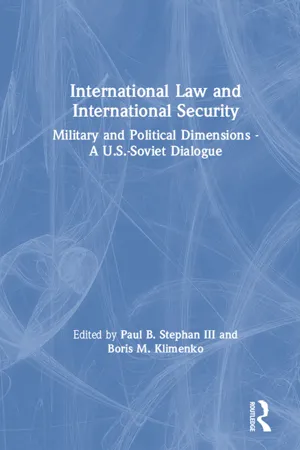
eBook - ePub
International Law and International Security
Military and Political Dimensions - A U.S.-Soviet Dialogue
- 384 pages
- English
- ePUB (mobile friendly)
- Available on iOS & Android
eBook - ePub
International Law and International Security
Military and Political Dimensions - A U.S.-Soviet Dialogue
About this book
This volume brings together experts and political actors from the United States and the USSR to assess the status of international law in the post-Cold War era with the intention of contributing ideas, judgements, and proposals tempered by experience. The topics covered range from terrorism to peaceful conflict resolution; from the renunciation of aggression to the right of self-defence; from chemical, biological, and nuclear weapons limitations to problems of verification; and from the military use of space to the right of political self-determination. Each chapter features contributions by both US and Soviet experts who have themselves participated in high-level policy making and international negotiations in the area (including, for example, the ABM, SALTI, SALTII, CFE, and START talks).
Information
PART I. INTERNATIONAL LEGAL PRINCIPLES AND RULES IN THE MILITARY SPHERE
1. RENUNCIATION OF MILITARY AGGRESSION AND THE THREAT THEREOF AS AN INSTRUMENT OF NATIONAL POLICY
THE UN CHARTER AND THE PROHIBITION OF AGGRESSION IN THE POST-COLD WAR ERA
Professor of Political Science, Miami University
With the adoption of a series of UN Security Council resolutions in response to the Iraqi invasion of Kuwait in August 1990, an important new precedent has appeared in the history of the effort to prohibit military aggression through the strengthening of international law. The Security Council’s decisions represent a significant revivification of the mandate conferred on the Security Council by Article 39 of the Charter to “determine the existence of any threat to the peace, breach of the peace, or act of aggression” and “to decide what measures shall be taken in accordance with Articles 41 and 42 to maintain or restore international peace and security.” In promptly condemning the Iraqi invasion of Kuwait (Resolution S.660), and in deciding, first, to impose sweeping economic sanctions against Iraq (Resolution S.661), and, subsequently, to authorize Members to use necessary means to end the Iraqi occupation of Kuwait (Resolution S.678), the UN Security Council assumed a role which its founding members had originally intended it to play in enforcing international legal prohibitions against the aggressive use of military force. With the single exception of its decision, under unusual circumstances, in the case of the Korean War, the Security Council had been unable to play its intended role throughout the Cold War. By its actions in the case of the Iraqi attack on Kuwait, which were possible only as a result of the cooperation of all the Permanent Members, the Security Council has demonstrated its potential to act effectively in the interpretation and enforcement of the provisions of the Charter regarding the use of force in the emerging “post-Cold War” world.
The purpose of the following essay is to suggest that the international law regarding the use of force that has come into existence since 1945 is clear and consistent in terms of the prohibition of military aggression. Notwithstanding some disputes concerning the interpretation of aspects of the law regarding the use of force, consensus on its basic principles has been in fact very substantial. The full potential of contemporary international law regarding the prohibition of the aggressive use of force has been unrealized not as a consequence of defects in the law itself, but as a result of unfavorable political circumstances of the Cold War that frequently rendered the application of the law to factual situations controversial. These circumstances are now rapidly disappearing. Far from needing major reform, or significant amendment or elaboration, this law requires for its enhanced effectiveness a prudential application based upon new efforts to coordinate the security policies and perspectives on the law regarding force of the Permanent Members of the Security Council, including especially the policies of the United States and the Soviet Union.
A. THE PROHIBITION OF MILITARY AGGRESSION
A central tendency in the development of international law in the twentieth century has been the growth of an international consensus in support of an increasingly restrictive set of international legal norms regarding the use of force in international relations. The Covenant of the League of Nations, the 1928 Treaty Providing for the Renunciation of War as an Instrument of National Policy, the Charter of the International Military Tribunal affirmed in the London Agreement, and the Charter of the United Nations represent steps in the development of an international legal regime regarding the use of force that represents an achievement of profound importance. The essence of the international legal regime regarding the use of force in the post-World War II world is contained in Article 2(4) of the UN Charter which provides:
All Members shall refrain in their international relations from the threat or use of force against the territorial integrity and political independence of any state, or in any other manner inconsistent with the Purposes of the United Nations.
As a corollary to this broad prohibition on the threat or use of force, the Charter in Article 2(3) imposes on all members of the United Nations an obligation to settle international disputes “by peaceful means in such a manner that international peace and security, and justice, are not endangered.” That these provisions of the Charter represented both a profound change in international law and possessed a character of overriding importance has been widely acknowledged by jurists and governments alike. Far from being an expression of unrealistic aspirations to transform international relations, the law concerning the use of force contained in Article 2 of the Charter reflected a profound and realistic appreciation of the destruction of modern war and the greatly increased interest governments had in preventing such war.
Though the Charter affirmed in Article 51 that members continued to have “the inherent right of individual or collective self-defense if an armed attack occurs,” and “until the Security Council has taken measures to maintain international peace and security,” nothing in the language of Article 51 was intended to diminish the comprehensive restriction of Article 2 of the Charter. Rather, the intention of the drafters of the Article, as reflected in Secretary of State Stettinius’s report to the President on the work of the San Francisco Conference, was to affirm that as sweeping as the restraints on the use of force were under the Charter, they did not deny members the right to use force defensively if an armed attack occurred and until, as Stettinius stressed, the Security Council acted. The qualifying language of Article 51 itself reflected a view on the part of the government assembled at San Francisco that the nature of modern war required the establishment of restraints on the right to use force of a new and highly restrictive character.
Notwithstanding a subsequent degree of dissensus surrounding the interpretation of certain ambiguities in the Charter regime, e.g., the meaning of “armed attack,” the nature of the inherent right of self defense under the Charter, and the more general ambiguities of Article 2, which some have sought to argue implicitly legitimizes uses of force which are neither against the territorial integrity or political independence of states nor inconsistent with the purpose of the Charter, the legal norms contained in the Charter regarding the use of force were certainly, when compared to earlier international law, relatively unambiguous in their basic formulation. Members were obligated to refrain from the use of military force against the territorial integrity or political independence of states. Only armed attack could justify the use of force in self defense.
The same determination to condemn the aggressive use of military force in the Charter was reflected in the Charter of the International Military Tribunal, which declared the planning or participating in wars of aggression a crime under international law. Like the Charter’s radical prohibition of military aggression, the Nuremburg Principles, it is well to recall, reflected a close identity of views between the Soviet and American governments. Together Washington and Moscow played a leading role at the close of World War II—at conferences in Washington, San Francisco, and London—in framing a set of international legal principles designed to both prohibit and deter the aggressive use of military force. Notwithstanding deep differences over many aspects of international law, both the U.S. and Soviet governments shared a common determination to establish international legal controls which would deter the types of military aggression that had provoked the devastating world war from which they had just emerged. The efficacy of this new regime to control the use of force would depend greatly, however, on the self-restraint of the Permanent Members of the Security Council, including of course the United States and the Soviet Union, who were protected from the threat of Security Council sanctions by the veto, and the willingness of the Permanent Members to cooperate in using the power granted to the Security Council to maintain international peace in general.
Though at the close of World War II the Superpowers had cooperated closely in framing a far-reaching set of legal prohibitions on the aggressive use of military force, the development of the Cold War led both to frequently conflicting claims of the “lawful” use of force and to a general ineffectiveness of the Security Council as a mechanism for maintaining peace.
The Superpowers themselves on numerous occasions sought to justify their own use of military force with claims to be acting within the framework of Article 51. Significantly, these claims were generally rejected by large majorities in the General Assembly. Such was the case, for example, with respect to Soviet claims regarding the introduction of Soviet forces into Hungary in 1956, Czechoslovakia in 1968 and Afghanistan in 1979. Similarly, it was the case with respect to U.S. claims regarding the introduction of U.S. troops into Cambodia in 1970, Grenada and Lebanon in 1983, and Panama in 1989, and the bombing of Libya in 1986. In the Case Concerning Military and Paramilitary Activities In and Against Nicaragua (Nicaragua v. United States), the International Court of Justice refused to sustain the U.S. claim that U.S. support for the Contras was a justifiable exercise of the right of collective self-defense on the grounds, inter alia, that evidence was lacking that the Nicaraguan government was engaged in activities that constituted an armed attack against its neighbors. Notwithstanding the general lack of endorsement that Superpower claims received in the international community, there can be little doubt that the Cold War contributed negatively to the development of the law regarding force, by nurturing dissensus between the Superpowers, and more generally East and West, on the meaning and application of the provisions of the Charter regulating the use of force.
A second principal respect in which the Cold War negatively affected the development and application of the restrictive regime regarding the use of force is to be found in the effect that Superpower conflict had on the operation of the Security Council. That the Security Council would be unlikely to play the role in the maintenance of peace assigned to it in the Charter was clear to the more perspicacious observer of international politics as early as 1946, and widely acknowledged by the mid-1950’s. The prospect of effective collective sanctions organized by the Security Council under Chapter VII in response to a threat to the peace, breach of the peace, or act of aggression could not serve as a meaningful deterrent, as was intended under the Charter design, to states who might contemplate uses of military force unlikely to be viewed generally as consistent with Article 2 or 51 of the Charter. Nor, given its divisions, could the Security Council exert leadership in the application and interpretation of the Law of the Charter by acting and responding with a voice grounded in a consensus of view. By design, the Permanent Members of the Security Council had protection, in their right of veto, against collective sanctions of Chapter VII. It was hoped in 1945, however, that the Permanent Members would provide leadership through the Security Council in enforcing the norms that they had taken the lead in framing. The onset of the Cold War rapidly eliminated these expectations of cooperation among the Permanent Members.
Though the Cold War had a generally negative impact on the constructive application of the regime regarding the use of force grounded in the Charter, it is significant that nearly half a century after the adoption of the Charter, and notwithstanding a multiplicity of Cold War related conflicts, the centrality of the Charter norms prohibiting the aggressive use of military force as governing international law remains virtually universally acknowledged by governments as well as legal scholars. The International Court of Justice in its 1986 decision in Nicaragua v. United States affirmed and endorsed the view expressed by the UN International Law Commission that “the law of the Charter concerning the prohibition of the use of force in itself constitutes a conspicuous example of a rule in international law having the character of jus cogens.” (Paragraph 190). Significantly, in almost all cases in which governments have resorted to the use of force since 1945, they have sought legally to justify their actions by referring to the right of self-defense in response to an alleged previous armed attack. Such a pattern further testifies to the widespread acceptance that, in principle at least, the use of force in international relations is generally deemed illegitimate except defensively in response to an armed attack.
The basic principles of the Charter regarding the use of force have been affirmed and elucidated, moreover, in a long series of resolutions by the General Assembly which have been adopted either unanimously or by consensus. Among these documents not least in importance have been the 1970 Declaration on the Principles of International Law Concerning Friendly Relations and Co-operation Among States in Accordance with the Charter of the United Nations and the 1974 Resolution on the Definition of Aggression. The former document is remarkably clear in its formulation regarding a state’s obligation to refrain from the use of force. It affirms inter alia, “Every state has the duty to refrain from the threat or use of force to violate the existing international boundaries of another State or as a means of solving international disputes.” The 1974 Resolution on the Definition of Aggression, the product of long and arduous discussions, though not itself wholly devoid of ambiguity, expresses a consensus on the nature of aggression which is of considerably political as well as legal significance. Of special importance in this respect is Article 2 of the Definition, which affirms that “[t]he first use of armed force by a State in contravention of the Charter shall constitute prima facie evidence of an act of aggression” unless the Security Council concludes that such a determination is not justified.
That a substantial general consensus on the general norms embodied in the Charter endured despite the Cold War is testimony to an overarching recognition that the unprecedented destructiveness of modern war gives all states an interest in supporting far-reaching international legal restraints on the aggressive use of military force. Even during the period of the Cold War, when the Superpowers disagreed over the application of the Charter’s restraints regarding the use of force, they cooperated both tacitly and explicitly in the affirmation of its basic principles. It was a consensus that transcended the Cold War and included both Superpowers that produced the 1970 UN Declaration on Friendly Relations and the 1974 Resolution Defining Aggression. Outside the context of the United Nations, as Superpower relations improved beginning in the 1970’s, both in bilateral negotiations and in the context of the multilateral Conference on European Security, the Superpowers did affirm and develop the commitment to refrain from the use of force in international relations. Of significance in this regard are the 1972 Agreement on Basic Principles of Relations and the 1975 Helsinki Final Act in which the Superpowers reaffirmed in a general and unqualified manner their commitment to refrain from the use of force commensurate with their obligations under the Charter.
The International Court of Justice in its decision in the Nicaragua Case attributed considerable significance to the elaboration and development of legal prohibitions on the use of force that occurred in the context of the East-West agreements of the 1970’s. In particular, the Court referred to the Second Principle of the 1975 Final Act of the Helsinki Conference in which the participating states undertake to “refrain in their mutual relations as well as in their international relations in general from the threat or use of force.” (Emphasis added by the Court). The Court concluded that “acceptance of a text in these terms confirms the existence of an opinio juris of the participating States prohibiting the use of force in international relations.” (Paragraph 189).
In “the long view” of the development of international law regarding the use of force over the last half century, it is evident that the restrictive regime which the Superpowers themselves had cooperated to frame at the end of World War II not only survived the Cold War, but continued to be developed and elaborated during the period of the Cold War itself. In this regard perhaps, the law has expressed an underlying rationality in the assessment of states’ interests in the nuclear age.
B. LEGAL RESTRAINTS ON AGGRESSION IN THE POST-COLD WAR ERA
If the Charter regime has survived the Cold War intact, the present decade offers new opportunities for its development. The emergence of a new and increasingly cooperative relationship between the United States and the Soviet Union on a growing range of international security issues in recent years provides a promising basis for enhancing the role of the United Nations in the maintenance of international peace and security, and more generally, for enhancing the effectiveness of international law in the regulation of the use of force. In pursuit of these ends, closer Superpower cooperation in several realms of policy is desirable.
First, in order to further the effectiveness of legal controls on the use of force in international relations, the United States and the Soviet Union should seek to develop a cooperative and coordinated approach to interpreting and applying the provisions of the Charter regarding the use of force. Often during the period of the Cold War the “discussion” of differing interpretations of Articles 2(4) and 51 took place around real conflicts, e.g. Czechoslovakia or Vietnam, Afghanistan or Grenada, in which the two governments sought to condemn each other’s policies. Given the general climate of mistrust and the broad and deep-seated conflicts in the security policies and objectives of the two sides during the period of the Cold War, as well as the impact that ideological differences exerted on approaches to many questions of international law, a reasoned discussion of legal policy differences was not possible. In recent years this situation has changed significantly. The emergence of a new and cooperative relationship between the two governments, and the development of “new thinking” with respect to the use of the United Nations in the management of regional conflicts can be conducive to a less conflict-ridden approach to interpreting and applying the principles of the Charter. The close identity of the views of the two governments with respect to the interpretation and application of the relevant international law following the introduction of Iraqi troops into Kuwait in August 1990 itself suggests that the new political relationship h...
Table of contents
- Cover
- Half Title
- Title Page
- Copyright Page
- Dedication
- Table of Contents
- Authors
- Acknowledgments
- Introduction
- I. INTERNATIONAL LEGAL PRINCIPLES AND RULES IN THE MILITARY SPHERE
- II. INTERNATIONAL LEGAL PRINCIPLES AND RULES IN THE POLITICAL SPHERE
- Index
Trusted by 375,005 students
Access to over 1.5 million titles for a fair monthly price.
Study more efficiently using our study tools.
Frequently asked questions
Yes, you can cancel anytime from the Subscription tab in your account settings on the Perlego website. Your subscription will stay active until the end of your current billing period. Learn how to cancel your subscription
No, books cannot be downloaded as external files, such as PDFs, for use outside of Perlego. However, you can download books within the Perlego app for offline reading on mobile or tablet. Learn how to download books offline
Perlego offers two plans: Essential and Complete
- Essential is ideal for learners and professionals who enjoy exploring a wide range of subjects. Access the Essential Library with 800,000+ trusted titles and best-sellers across business, personal growth, and the humanities. Includes unlimited reading time and Standard Read Aloud voice.
- Complete: Perfect for advanced learners and researchers needing full, unrestricted access. Unlock 1.5M+ books across hundreds of subjects, including academic and specialized titles. The Complete Plan also includes advanced features like Premium Read Aloud and Research Assistant.
We are an online textbook subscription service, where you can get access to an entire online library for less than the price of a single book per month. With over 1.5 million books across 990+ topics, we’ve got you covered! Learn about our mission
Look out for the read-aloud symbol on your next book to see if you can listen to it. The read-aloud tool reads text aloud for you, highlighting the text as it is being read. You can pause it, speed it up and slow it down. Learn more about Read Aloud
Yes! You can use the Perlego app on both iOS and Android devices to read anytime, anywhere — even offline. Perfect for commutes or when you’re on the go.
Please note we cannot support devices running on iOS 13 and Android 7 or earlier. Learn more about using the app
Please note we cannot support devices running on iOS 13 and Android 7 or earlier. Learn more about using the app
Yes, you can access International Law and International Security by Paul B. Stephan, III,Boris M. Klimenko in PDF and/or ePUB format, as well as other popular books in Media & Performing Arts & Film & Video. We have over 1.5 million books available in our catalogue for you to explore.