- 372 pages
- English
- ePUB (mobile friendly)
- Available on iOS & Android
eBook - ePub
About this book
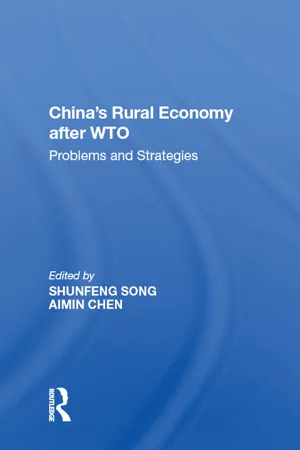
China's Rural Economy after WTO discusses and analyses China's rural sector problems in detail, including the areas of poverty, income inequality, the gender gap, barriers of rural-urban migration, discrimination against rural workers, poor rural governance and the impact of WTO membership. It also tackles the important subjects of inadequate infrastructure and discriminatory credit services. Strategies to modernize China's rural economy are proposed and the relevant experiences and lessons of other countries are analyzed.
Part 1
Gender Inequality in Rural Areas
Chapter 2
Gender Inequalities and Rural Development: Some Neglected and Hidden Dimensions*
1 Introduction
Mainstream economics has paid rather inadequate attention to gender inequality, but even within gender economics, some issues are especially neglected or hidden, such as women’s rights in land and property and social norms and perceptions. This essay focuses on these dimensions. The examples are drawn mostly from South Asia, but many of the issues raised here would also have relevance for China. On occasion, the Chinese context has also been explicitly discussed.
2 Gender Inequality
Rural women in northwest India, married to strangers miles away from their birth villages, use folk songs to decry their estrangement from the green pastures of their childhood homes—homes to which their brothers, who inherit the ancestral land, have automatic access. I quote excerpts from two folk songs:
To my brother belong your green fields,
O father, while I am banished afar.
Always you said
your brother and you are the same.
O Father. But today you betray me…
My doli leaves your house, O father
My doli leaves your house.
These dowry jewels are not jewels
but wounds around my neck, O father,
my doli leaves…1
Women in Sri Lanka, by contrast, traditionally inherited immovable property and sometimes their husbands moved in with them. But according to folklore, such a husband was advised to always keep a walking stick, an umbrella, and an oil lamp handy. Why? In case his wife evicted him when he was ill, and in the rain, in the middle of the night! And some wives indeed did so.
Both examples depict gender inequality. In the first, the woman has no property, and social norms require her to join her husband—a dislocation she sees as banishment. In the second, the man has no property, and social norms allow him to join his wife, but in a home from which he can easily be evicted. In the first example, the woman is the less equal, in the second the man.
These examples illustrate several things. They highlight that gender inequality and indeed gender in general, is a relational category, and even though most times we are grappling with women’s disadvantaged position, in rare cases men too might occupy that position. In particular, these examples highlight the importance of women’s property status and enabling social norms in determining gender relations.
Compared with other inequalities, such as those of class or race, gender inequality also has some distinct features. For one, it dwells not only outside the home but within it as well. Mainstream economic theory has long treated the household as a unitary entity in relation to both consumption and production. The unitary household model assumes that all household resources and incomes are pooled, and family members either share common interests and preferences, or an altruistic household head (who represents the household’s tastes and preferences and seeks to maximize household utility) ensures equitable allocations of goods and tasks (Agarwal, 1997).
Most people know from personal experience that this is not how real families behave, but in recent years within academia, virtually every assumption of the unitary household model has been challenged effectively through empirical evidence, including assumptions of shared preferences and interests, pooled incomes, and altruism as the guiding principle of intra-household allocations. Gender, in particular, is noted to be an important signifier of differences in interests, preferences, endowments, and allocations. In addition, the alternative of “bargaining models” of the household—bargaining power rather than altruism is seen as guiding intra-household allocations—developed.
Secondly, gender inequalities stem not only from differences in economic endowments between women and men but also from social norms and perceptions, meaning that the inequalities are also ideologically embedded. While norms and perceptions also impinge on other social inequalities like race and caste, gendered norms and perceptions cut across these categories and exist additionally.
Thirdly, gender inequalities not only pre-exist, new ones can arise from the foundations of the old ones, and people with prior advantage can set in place rules that perpetuate that advantage, such as rules governing new institutions now being promoted to manage common pool resources. Although based on principles of cooperation, such institutions can effectively exclude women from decision-making and any benefits. In other words, gender inequality can be in the process of constant recreation in new forms.
Gender inequality is thus a vast subject with a vast amount of literature on it, but some aspects are more neglected and hidden than others. It is on these aspects that I will now focus, namely:
1. Inequality in command over property – a notably neglected dimension;
2. Inequalities in social perceptions and social norms, the workings of which are often hidden but which have visible economic outcomes;
(the former is a significant material form of inequality, the latter a significant ideological form); and
(the former is a significant material form of inequality, the latter a significant ideological form); and
3. How both of these dimensions can interactively create new inequalities. This will also throw light on the process of inequality creation.
In addition, I will illustrate how gender inequalities are simultaneously constituted in several arenas: the family, the community, the market, and the state. The bargaining approach provides a promising analytical framework for understanding how both the material and the ideological aspects of gender inequality can be challenged.
3 Gender Gap in Command Over Property
3.1 The Nature of the Gap
Consider first the issue of property. Economists have long emphasized the importance of property rights for incentives and efficiency, but relatively few have looked at the gender gap in command over property. Economic analysis and policies concerning women continue to be preoccupied with employment and education. In the process, inequality in command over property has largely been neglected, yet it is this aspect that remains one of the most important forms of persisting economic inequality between women and men—one which has a critical bearing not only on women’s economic well-being but also on their social and political status.
The idea of “command” over property is more complex than it appears on the surface (for a detailed discussion, see Agarwal, 1994). First of all, it takes us away from the narrow legalistic way in which many think of property rights. Command over property implies not merely rights in law, but effective rights in practice. Equality in legal rights to own property need not guarantee equality in actual ownership. This is especially true of inheritance where the gap between law and practice can be vast.
In India, for example, women enjoy significant—and legal—inheritance rights, even if they are unequal to those of men (Agarwal, 1994). In practice, only a small percentage of women inherit. A sample survey of rural widows in 1991 by development sociologist Martha Chen found that only 13 percent of the surveyed women with landowning fathers inherited any land as daughters. And only 51 percent of widows whose deceased husbands owned land inherited any. Thus 87 percent of daughters and 49 percent of widows with legal claims did not inherit (cited in Agarwal, 1998).
Secondly, property advantage stems not only from ownership but also from effective control over it. Ownership alone does not always guarantee control. In many countries, even when women inherit something, they do not fully control what they receive. Some obstacles are social. For example, some cultures restrict women’s public interactions in the public sphere and hence their ability to manage their property effectively. Other barriers can be legal. For instance, in Sri Lanka’s Jaffna Province, a married Tamil woman, under local law, needs her husband’s permission to lease out or sell her own property. Similar laws prevailed earlier in parts of Europe. The distinctions between law and practice—as well as between ownership and control—are thus especially critical for women.
Thirdly, property advantage can arise not only from private property but also from public property. For instance, in most societies today, control over wealth-generating public property is largely in male hands, be they managers in large corporations, or heads of government bureaucracies. Even in the former socialist USSR, although private property ownership was abolished, decision-making over public property remained mostly with men.
Fourly, men (as a gender, even if not all men as individuals) also largely control the instruments through which existing property advantages get perpetuated, such as institutions that enact and implement property laws (such as Parliament and the law courts) and the mechanisms of recruitment into bodies which control property.
Lastly, command over property can also significantly influence the institutions that shape ideas about gender, such as the media and educational as well as religious bodies. Predominantly male control over these institutions can thus affect the persistence of certain ideological assumptions about women’s needs, work roles, capabilities, and so on.
Seen in this broad way, gender inequality in regard to command over property is thus important in both developing and developed countries. However, which form of property is important can differ by context, and...
Table of contents
- Cover
- Half Title
- Title Page
- Copyright Page
- Table of Contents
- List of Figures
- List of Tables
- List of Contributors
- Introduction
- Part 1 Gender Inequality in Rural Areas
- Part 2 Poverty and Income Inequalities
- Part 3 Rural-Urban Migration
- Part 4 The Role of Government in Rural Development
Trusted by 375,005 students
Access to over 1.5 million titles for a fair monthly price.
Study more efficiently using our study tools.
Frequently asked questions
Yes, you can cancel anytime from the Subscription tab in your account settings on the Perlego website. Your subscription will stay active until the end of your current billing period. Learn how to cancel your subscription
No, books cannot be downloaded as external files, such as PDFs, for use outside of Perlego. However, you can download books within the Perlego app for offline reading on mobile or tablet. Learn how to download books offline
Perlego offers two plans: Essential and Complete
- Essential is ideal for learners and professionals who enjoy exploring a wide range of subjects. Access the Essential Library with 800,000+ trusted titles and best-sellers across business, personal growth, and the humanities. Includes unlimited reading time and Standard Read Aloud voice.
- Complete: Perfect for advanced learners and researchers needing full, unrestricted access. Unlock 1.5M+ books across hundreds of subjects, including academic and specialized titles. The Complete Plan also includes advanced features like Premium Read Aloud and Research Assistant.
We are an online textbook subscription service, where you can get access to an entire online library for less than the price of a single book per month. With over 1.5 million books across 990+ topics, we’ve got you covered! Learn about our mission
Look out for the read-aloud symbol on your next book to see if you can listen to it. The read-aloud tool reads text aloud for you, highlighting the text as it is being read. You can pause it, speed it up and slow it down. Learn more about Read Aloud
Yes! You can use the Perlego app on both iOS and Android devices to read anytime, anywhere — even offline. Perfect for commutes or when you’re on the go.
Please note we cannot support devices running on iOS 13 and Android 7 or earlier. Learn more about using the app
Please note we cannot support devices running on iOS 13 and Android 7 or earlier. Learn more about using the app
Yes, you can access China's Rural Economy after WTO by Aimin Chen in PDF and/or ePUB format, as well as other popular books in Business & Business General. We have over 1.5 million books available in our catalogue for you to explore.