- 250 pages
- English
- ePUB (mobile friendly)
- Available on iOS & Android
eBook - ePub
About this book
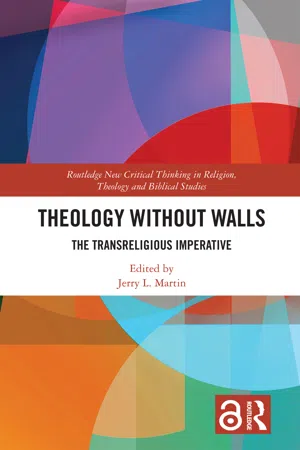
Thinking about ultimate reality is becoming increasingly transreligious. This transreligious turn follows inevitably from the discovery of divine truths in multiple traditions. Global communications bring the full range of religious ideas and practices to anyone with access to the internet. Moreover, the growth of the nones and those who describe themselves as spiritual but not religious creates a pressing need for theological thinking not bound by prescribed doctrines and fixed rituals. This book responds to this vital need. The chapters in this volume each examine the claim that if the aim of theology is to know and articulate all we can about the divine reality, and if revelations, enlightenments, and insights into that reality are not limited to a single tradition, then what is called for is a theology without confessional restrictions. In other words, a Theology Without Walls. To ground the project in examples, the volume provides emerging models of transreligious inquiry. It also includes sympathetic critics who raise valid concerns that such a theology must face. This is a book that will be of urgent interest to theologians, religious studies scholars, and philosophers of religion. It will be especially suitable for those interested in comparative theology, inter-religious and interfaith understanding, new trends in constructive theology, normative religious studies, and global philosophy of religion.
Information
Part I
Why Theology Without Walls?
Introduction
DOI: 10.4324/9780429000973-2
The most comprehensive systematic transreligious theology is presented in Robert Cummings Neville’s three-volume Philosophical Theology. The first volume is called Ultimates and contains a précis of the whole. Neville establishes a metaphysical structure within which the various “ultimates” represented by or symbolized through various traditions find their place. His accomplishment, requiring a philosophical sophistication and cross-cultural erudition few possess, can be daunting, rather than empowering, for emerging theologians. For that reason, he was asked to reflect on “how to become the next Robert Neville.” He does that by telling his own story, which goes back to the age of four and is still ongoing.
Why Theology Without Walls (TWW)? Because, says Neville, there are inescapable questions about “what is ultimate and how it is ultimate” with respect to the “problematic” aspects of life and the universe. “No one really trusts walled-in answers to them.” In fact, “theologies with walls reduce to sociological claims” – this is what my tradition “believes.” In spite of his own metaphysical grounding and comprehensive interreligious scope, Neville reminds us that “theologians need to make their own decisions.” He recognizes that, in spite of powerful arguments on its behalf, his way is not the only way to engage in Theology Without Walls. Other ways, some quite different, are also represented in this volume.
For theologians to make thoughtful choices based on years of study is one thing; for everyone to shop casually among religious and nonreligious offerings is quite another. Scholars from Robert Bellah to Christopher Smith have lamented the rise of the loosely affiliated “Sheila” as a cultural type. For Christopher Denny, teaching Catholic theology in a Catholic university, it came as a shock to realize to what extent we live in an age of casual shoppers in the spiritual supermarket. But the shock prompted an insight that, contrary to the concerns of Bellah and Smith, in religious as well as secular life, “there is a human agent making the choice.” The great religions themselves resulted from human choices and, in our more democratic and egalitarian times, these choices are open to a larger population. He concludes that “the recognition of preferences provides theology with a new starting point from which to engage the bewildering array of religious options.” The phenomenon of choice does not imply relativism. He quotes Kurt Richardson: “The self as the locus of truth does not mean the self as the source of truth.” Not every choice, Denny says, will be “intellectually coherent, morally defensible, or spiritually attractive to others.” This is true whether we choose a traditional path or a personal one. “Whatever mistakes we make, they will be our own,” he concludes. “In that sense, we are all Sheilas.”
As radical as Denny’s argument may seem, Richard Oxenberg argues that a transreligious thrust is implied by the theological project itself and, surprisingly, “forecast by Jesus himself.” He begins by exploring the reasons for theology within walls. He answers that “faith requires understanding in order simply to fulfill itself as faith.” He quotes Jesus’s warning about hearing the message but failing to understand it. Oxenberg argues that TWW “also has its basis in revelatory experience; a revelatory experience more and more of us are having in the context of the global encounter of the world religions with one another.” We are seeing “divine truth” outside our home traditions. Dogmatic faith gives way to “Socratic faith,” which requires humility rather than claims of infallibility. It involves the dialectical examination of the revelations themselves. He goes further: TWW “itself betokens a new revelation of the divine,” one that has its own soteriological power, namely, to overcome tribalistic rivalries and “thereby bring us closer to a recognition of the divine as One.”
In place of a world of fixed religions, maintaining their own stable doctrines and devotions, we face a world of contending, unpredictable individual choices. In such a world, Kurt Anders Richardson argues, TWW creates a hermeneutical space for “open-field” theology, a meta-discourse about theological practices and their contexts in relation. It seeks to “coordinate discursive spaces with no theological limitations” while respecting “the inviolate mind, conscience and body of every human being.” Thus “any discursive handling of divine or ultimate topics … qualify as kinds of theology.” TWW as a hermeneutic open-field theology creates a “community field of discourse where multiple rationalities and theological priorities can find concourse” without having to agree to “common ground” or “common problems.” Put simply, it provides the “working space” for theology suitable to our times.
1 Paideias and programs for Theology Without Walls
DOI: 10.4324/9780429000973-3
Editor Jerry L. Martin asked me to explain how I became the kind of theologian without walls that I am. The first thing to say about that is that there are many kinds of theologians without walls, not just mine. Many different starting points exist, and there are many different kinds of theological problems in which to be interested. I myself am a systematic philosophical theologian, and I take myself to be accountable to any thinker in any tradition, religious or secular, who has an interest in the outcome of my inquiry. My inquiry has a number of parts, and at the beginning of my career I could not develop any of them very well. But I kept working on them all together and gradually became more sophisticated. It would be great to be deeply and evenly sophisticated, although I do not expect that! Here are some of the parts of my systematic philosophical inquiry. Note that this is the first time I have been asked to write in an avuncular voice: if I wobble between braggadocio and patronizing, remember it is a first attempt.
Knowledge of religion
I was born in 1939 in St. Louis, Missouri, and raised there through public schools until I left for college in 1956.1 My family was active in a rather liberal Methodist church. Most of our neighbors and my classmates were Roman Catholic; the more established German and Irish Catholics were resentful of the newly arrived Italians. When I was about 14, I edited our congregation’s weekly newsletter and decided to write a series of 500-word columns about world religions. Based on encyclopedia articles, my columns dealt sequentially with Buddhism, Confucianism, Christianity, Daoism, Judaism, Hinduism, and Islam (in alphabetical order). This was not high scholarship and certainly had no peer review. Notice that Christianity was presented as one religion among many. No one gave me any grief for that. I’m proud that my first “publications” were about world religions.
In college I roomed with a Greek Orthodox and a Jew, never having met representatives of those religions before (my St. Louis neighborhood was rather homogeneous). I majored in philosophy, but we studied only Western philosophy, no Indian, Chinese, or Islamic. Not until I was teaching at Fordham University did I begin to study non-Western philosophies and religions, under the prodding of Thomas Berry. He taught me Sanskrit and arranged for me to learn a little Chinese; moreover he arranged for me to teach both Indian and Chinese philosophy, which I have done ever since until I retired in the spring of 2018. Although I cannot keep up with a well-trained historian of any religion, I am literate in frontline research in those fields and can talk with scholars from most religious traditions. I’m recognized as a contemporary progressive Confucian philosopher (Neville 2000). I think it is possible for a theologian without walls to grow slowly from a position of naiveté and bias about religions to enough erudition to be conversant with thinkers from most traditions and to be relatively expert in those of personal interest.
Systematic thinking
In college I was taught that system in philosophy means the development of a group of connected categories in terms of which everything can be represented as a specification. Hegel, Peirce, and Whitehead were the model systematic thinkers, and I thought a lot about Whitehead’s criteria for a philosophical system: consistency, coherence, adequacy, and applicability (Whitehead 1978). At my college, Yale, systematic thinking was encouraged, not discouraged, as would have happened at nearly any other college in those days. My senior thesis on interpretation and nature was my first attempt at a system.
Nevertheless, systems are based on core ideas, and my first core philosophical-theological idea came when I was in kindergarten. One of my classmates told me that God is a person. I checked with my father who said that, although Jesus was a person, God is more like light or electricity. I understood that idea at a five-year-old level and began working on it. My current theological naturalism is a more sophisticated version of my father’s hypothesis. I never had a serious commitment to a personal God that I would have to get over in order to deal with Brahman or the Dao. About the time I was editing the church newsletter, one of my high school teachers said to me, “You know, Bob, that God is not in space or time.” I understood immediately what he meant and agreed with it. I also immediately knew that understanding that idea was an unusual kind of thinking, to which I decided to dedicate my life. So my systematic theology of creation ex nihilo began in high school and became the topic of my PhD dissertation (1963), which was revised and published in 1968 as God the Creator (Neville 1968, 1992). That is a real systematic book, although not half as sophisticated as my recent systematic statement, Ultimates: Philosophical Theology Volume One (Neville 2013).2
The moral I draw about this part of my inquiry is that it is important to begin as soon as possible with systematic thinking and grow from naïve and brash to more sophisticated and intelligent. Do not wait until you have mastered everything that systems need and then try to put them together. People I’ve known who waited until old age to put things together in a systematic way simply did not develop the tastes and skill of system making. Good systems have multiple layers, and really good ones allow you to see through many layers and interconnections at once. So I think you have to start young, duck your head when critics cry “juvenile,” and just make your system more complex and transparently simple.
Comparative theology
It is one thing to learn a lot about many religions and another to be able to compare them. Comparison usually begins by noting some at least surface similarities between the religious positions and then inquiring into just how similar and different they are. Progress in comparison, however, requires hard work identifying exactly the respects in which the comparison is being made. Comparison is always “with respect to something.” The respects in which things can be compared are comparative categories, and they are astonishingly hard to develop. Often what looks like a similarity between two positions turns out to be thinking at cross purposes. Some years ago, for instance, some comparativists got excited about the similarities between sunyata in Buddhism and kenosis in Christianity. But upon examination, the similarities boiled down to the fact that both translate as “emptiness” in English: Buddhist sunyata is a metaphysical characteristic of things as experienced by enlightened people, and Christian kenosis is Christ’s or a person’s taking on a humble station. There was no respect in which they can be compared except the accident of translation into English. The question of gods is an interesting comparative one. But in what respects is it important to compare them? Whether religions believe in one, several, or thousands? How many are male, female, both, ungendered? Do the gods squabble in ways that affect humans? Are there divine hierarchies? What is at stake in these comparisons, all of which can be made? I suspect that continued reflection on gods gives rise to the comparative category of what is ultimate and how is it ultimate. Monotheisms identify the ultimate with one God, however differently that God might be understood among and within monotheisms. Polytheisms, even those with a top God in a hierarchy, do not consider the ultimate to be a god with intentional agency, but some deeper principle. Some religions like Buddhism, many forms of Hinduism, Confucianism, and Daoism in their early forms believed that the world is populated with many kinds of supernatural beings but that they were not ultimate at all. Confucianism and Daoism do not use many personalistic metaphors for ultimacy, but rather look to metaphors of spontaneous emergence. The important categories for comparing theological positions emerge only slowly with the process of learning and systematizing.
In my own experience, the categories that emerge as important for theological comparison, the respects in which it is important to compare religious positions, turn out to be the categories that are important for the system in philosophical theology. I think that there are five problematics that any seriously developed theological tradition must address: why there is something rather than nothing; how human choice determines not only what happens sometimes but also the character of the chooser; how to have a good self; how to relate to other people, institutions, and nature on their own terms; and what the meaning of life and existence is. These are extremely complicated problematics, and religions say many different things about them. But the problematics can be sorted through to develop important categories for comparative theology. Of course, the religious positions are often in wild disagreement.3 Theologians without walls need to make their own decisions about how to evaluate the positions compared.
The moral here is that the development of important comparative categories for theology is a long, evolving, and critical process. It is not that the theologian can first get categories for comparison and then work for years filling in how the theological positions compare. Rather, every comparative category is itself an hypothesis about the important respects in which to compare theological positions and should be kept vulnerable to correction throughout a comparative theologian’s continuing inquiry. Start young and correct yourself.
Programs of teaching
I assume that most theologians without walls are teachers at the high school, undergraduate, or perhaps graduate levels. Some of us are retired from all that, and it is possible to be a serious theologian without walls without an academic career at all. Nevertheless, teaching helps one become a better theologian without walls. We all know that trying to explain something to students who do not know it makes you figure out just what you understand and what you do not.
I recommend that, to as great an extent as circumstances allow, we should teach courses about the three topics I have already mentioned, namely courses on different religions, courses on systematic theology aiming to say what you think is true, and courses in comparison where you lead students to understand both the nature of religion and what should be said about the most important theological topics. I have been fortunate that in my 57 years of teaching I have taught all three kinds of courses. Some people, of course,...
Table of contents
- Cover
- Half Title
- Series
- Title
- Copyright
- Dedication
- Contents
- List of figures
- List of tables
- Acknowledgements
- List of contributors
- Introduction
- Part I Why Theology Without Walls?
- Part II Experience and transformation
- Part III Challenges and possibilities
- Part IV Theologizing in a multireligious world
- Part V Expanded confessional theologies
- Index
Trusted by 375,005 students
Access to over 1.5 million titles for a fair monthly price.
Study more efficiently using our study tools.
Frequently asked questions
Yes, you can cancel anytime from the Subscription tab in your account settings on the Perlego website. Your subscription will stay active until the end of your current billing period. Learn how to cancel your subscription
No, books cannot be downloaded as external files, such as PDFs, for use outside of Perlego. However, you can download books within the Perlego app for offline reading on mobile or tablet. Learn how to download books offline
Perlego offers two plans: Essential and Complete
- Essential is ideal for learners and professionals who enjoy exploring a wide range of subjects. Access the Essential Library with 800,000+ trusted titles and best-sellers across business, personal growth, and the humanities. Includes unlimited reading time and Standard Read Aloud voice.
- Complete: Perfect for advanced learners and researchers needing full, unrestricted access. Unlock 1.5M+ books across hundreds of subjects, including academic and specialized titles. The Complete Plan also includes advanced features like Premium Read Aloud and Research Assistant.
We are an online textbook subscription service, where you can get access to an entire online library for less than the price of a single book per month. With over 1.5 million books across 990+ topics, we’ve got you covered! Learn about our mission
Look out for the read-aloud symbol on your next book to see if you can listen to it. The read-aloud tool reads text aloud for you, highlighting the text as it is being read. You can pause it, speed it up and slow it down. Learn more about Read Aloud
Yes! You can use the Perlego app on both iOS and Android devices to read anytime, anywhere — even offline. Perfect for commutes or when you’re on the go.
Please note we cannot support devices running on iOS 13 and Android 7 or earlier. Learn more about using the app
Please note we cannot support devices running on iOS 13 and Android 7 or earlier. Learn more about using the app
Yes, you can access Theology Without Walls by Jerry L. Martin in PDF and/or ePUB format, as well as other popular books in Theology & Religion & Christian Theology. We have over 1.5 million books available in our catalogue for you to explore.