- 516 pages
- English
- ePUB (mobile friendly)
- Available on iOS & Android
eBook - ePub
About this book
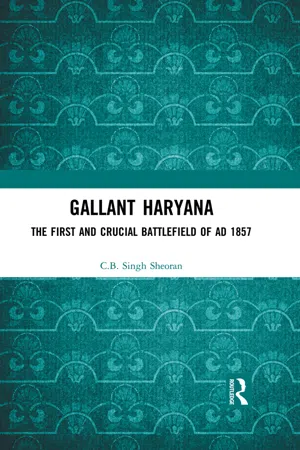
The book contains a narrative of the events of the first Indian war of Independence (1857-60) in modern Haryana and surrounding areas in a chronological order derived from hitherto untouched sources such as original and first-hand reports of the British commanding officers and accompanying magistrates, available in the contemporary newspapers archival files and government publications.
Please note: Taylor & Francis does not sell or distribute the Hardback in India, Pakistan, Nepal, Bhutan, Bangladesh and Sri Lanka
Chapter 1
The Army in 1857
Historiography
It is necessary to understand the structure of the army, its organization and the prevalent terminology in the year 1857, before starting the narrative. We start by asking how the history of the ‘First War of Independence’ came to be written, who the historians were, why they were writing, and about the ideological and intellectual influences that shaped their writings. A cautious and consciously analytical approach needs to be adopted.
The available histories of the 1857 war have been written mostly by non-professional historians; some being even padres of churches who accompanied various regiments for rendering funeral services, while the majority of writers came from the military. Only a few historians were able to write history for lay readers or students of history, and since it was a full-fledged war, they too perceived it a war history. So, technical terms and terminology used were purely militaristic. The words light infantry, light cavalry, division, brigade, battalion, regiment, troop, detachment, squadron, march, forced march, intelligence, round shot, grape, battery, 6-pounder, 24-pounder, subaltern, field officers, siege-train, irregulars, etc., find frequent mention in the narratives, but are not understood by everyone.
The history of the 1857 war has been mainly based on the reports of commanding officers for whom the use of military jargon was natural and essential. Second, in most of the cases they wanted to conceal from the general public the numbers of British involved and killed whereas at the same time they would give large figures of their Indian adversaries. For example, a European officer would say, we had 3 regiments of infantry, 3 squadrons of cavalry and a light field battery, whereas the enemy had at least 1,000 infantry and 300 cavalry with 3 guns. A lay reader would think that 1,300 men with 3 guns was a comparatively large force. In reality, however, the European force was at least 3,300 men with 4 guns. Another officer reported that the 10th Irregular Cavalry had 4 squadrons, 3 at Naushehra and one at Peshawar.1 How can a layman know their actual strength? One squadron of the 6th Carabineers plus one squadron of HM’s 9th Lancers made 170 sabres2 while 3 squadrons of HM’s 9th Lancers plus 50 Jind Horse made 350 sabres.3 We see that the strength of a squadron varies from 85 to 100; however, the sanctioned strength was above 160 soldiers.
In 1857 the army in India had a very complex structure and consisted of five different employers: the British government in the name of Queen, the Honorable British East India Company (BEIC) or John Company, the British Indian states as the Punjab, Indian Native states like the Patiala and Jhajjar, and also private warlords like the Tiwanas of Shahpur whose Tiwana Horse was very famous. The army of the Indian Native states was generally trained by the European officers and commanded by them. The armies of the private warlords were either available on hire or their services were obtained by agreements in lieu of certain concessions by the authorities. The infantry, cavalry, and artillery had different organization, for their units according to the five different employers. Some of the employers had two types of regiments, regular and irregular. Let us take first of all the British government’s or Her Majesty’s (HM’s or simply HM) units, which were purely European.
1. The British Army
INFANTRY
There were no irregulars and the infantry consisted of battalions and regiments. Except in few cases battalions and regiments were synonymous, but there were some heavy regiments which consisted of two battalions. For example, Her Majesty’s 60th (The King’s Royal) Rifle Corps (Regiment) consisted of 2 battalions divided into 8 or 10 companies. The 1st Battalion of the 60th Rifles consisted of 10 companies, with about 40 officers including surgeons, 52 sergeants, 45 corporals, 19 drummers and 787 privates (soldiers). That meant about 95 persons per company. The officers above the rank of captain were called field officers, whereas those below that rank were called subalterns and included ensigns and lieutenants. Similarly, the 2nd Battalion of the 60th Rifles consisted of 8 companies with about 40 officers, 39 sergeants, 31 corporals, 19 drummers and 593 privates. That meant about 90 men per company. Such regiments were very few in number, most of the regiments were small: HM’s 75th Regiment of Foot consisted of 10 companies with about 44 officers, 57 sergeants, 50 corporals, 21 drummers and 681 privates; that meant about 85 men per company.
CAVALRY
The cavalry regiments were divided in squadrons and troops. Normally a cavalry regiment had 4 squadrons and 9 troops. For example, the 6th Regiment of Dragoon Guards (Carabineers) consisted of 9 troops with about 40 officers including surgeons and veterinary surgeons, 50 sergeants, 32 corporals, 10 trumpeters and 616 privates. That meant normally 80 to 85 men per troop and generally one squadron contained about 150 to 165 men. HM’s 9th Lancers had 100 men per squadron while marching to Delhi in May 1857.4 The numerical strength was sometimes expressed in sabres as well, meaning thereby soldiers with sabres or swords. The lowest rank in the officers’ cadre was ‘cornet’ equivalent to the ‘ensign’ in the infantry.
ARTILLERY
It had two branches namely the Royal Horse Artillery (RHA) and the Royal Foot Artillery (RFA).
The Royal Horse Artillery (RHA)
In 1857, a Royal Horse Artillery troop was composed of 2 captains, 3 subalterns, 3 staff sergeants, 3 sergeants, 3 corporals, 6 bombardiers, 80 gunners, 1 trumpeter and 1 farrier; 102 Europeans.5 In addition to these 102 fighting men, the RHA troop was supplemented by 1 carriage smith, 3 shoeing smiths, 2 collar makers, 1 wheeler, 1 driver sergeant, 1 driver corporal and 69 privates; totaling to 86 men.6 Thus full strength of one troop was 188 men.
In 1859, however, each troop consisted of 6 officers including 1 surgeon and 1 veterinary surgeon, 2 staff sergeants, 9 sergeants, 6 corporals, 9 bombardiers, 90 gunners, 70 drivers, 1 trumpeter, 1 farrier, 6 shoeing smiths, 30 collar makers and 3 wheelers, a total of 200 men and 200 horses, each troop managed a battery of 4 to 6 guns.
The Royal Foot Artillery (RFA)
The foot artillery of the British force had its own nomenclature. Each battery consisted of 6 officers, 2 staff sergeants, 8 sergeants, 6 corporals, 9 bombardiers, 100 gunners, 70 drivers, 2 trumpeters, 1 farrier, 6 shoeing smiths, 3 collar makers and 2 wheelers: total 209 men and 142 horses. The organization of artillery was a little bit more complicated.
2. The British East India Company Army
The army of East India Company had units such as the Bengal Army, the Madras Army and the Bombay Army. Let us keep to the Bengal Army only.
THE BENGAL INFANTRY
The infantry consisted of two types of regiments namely the European Regiments (EnRs) and the Bengal Native Infantry (BNI or simply NI) Regiments. There was no irregular EnR but the native regiments were both regular and irregular.
The European Regiments
There were 6 infantry regiments containing persons of European origin, with no Indians, except for private servants, who outnumbered the Europeans. Out of these six, two regiments were named the 1st European Bengal Fusiliers (1st EnBF) and the 2nd European Bengal Fusiliers (2nd EnBF) or simply Fusiliers probably because of their weapons which were fusils (light muskets), or European Regiments (EnRs), the other four were all European Regiments (EnRs). The organization of these infantry regiments was similar to that of the Royal Infantry, with a total of about 1,020 men, thus approximately 100 in a company. In the 1st EnBF and 2nd EnBF there were 2nd lieutenant and 1st lieutenant ranks, whereas in other four EnRs these were called ‘ensigns’ and ‘lieutenants’ respectively. The EnRs No. 4 to 6 had left and right wings.7
The Bengal Native Infantry Regiments (BNIs or NIs)
In 1857, there were 74 NIs, and the majority had mutinied. The strength and structure of these regiments were similar to that of the 1st EnBF or 2nd EnBF but the difference was that while officers from ensign to colonel were European, subahdar major was the highest rank an Indian could achieve. Then there were jemadars, non-commissioned officers (NCO) and sepoys. The average strength of each native infantry regiment was 1,090 men.8
The native infantry was further classified as regular and irregular. The difference was basically in training. Those regiments which were regularly paraded and had a standard uniform were called regular regiments. The aforementioned 74 NIs were all regular regiments; and in 1857, there were 31 such regular regiments which were deployed in Meerut, Delhi, Roorkee and in the Punjab; whereas there were 15 regiments of the irregular infantry including 6 companies ...
Table of contents
- Cover
- Half Title
- Title
- Copyright
- Dedication
- Contents
- List of Illustrations
- Abbreviations
- Acknowledgements
- Introduction
- 1. The Army in 1857
- 2. Haryana before 10 May 1857
- 3. Haryana in May 1857: Districtwise Sequence of Events
- 4. June 1857: The Return of the British Forces
- 5. July 1857: Struggle and Merciless Vengeance
- 6. August 1857: Balance Tilting towards the British
- 7. September 1857: Recapture of Delhi – Fall Out
- 8. The Shahibbas
- 9. Towards the Final Struggle: The Nasibpur Battle
- 10. Mewat: May to December 1857
- 11. Indian Saviours of the British
- 12. The Perpetrators of Barbarities in Haryana
- 13. Retribution: Martyrs of Haryana in 1857
- 14. Freedom Fighters of Haryana in 1857: Lest we Forget
- 15. 1857–1860: The Scenario
- Glossary
- Bibliography
- Index
Trusted by 375,005 students
Access to over 1.5 million titles for a fair monthly price.
Study more efficiently using our study tools.
Frequently asked questions
Yes, you can cancel anytime from the Subscription tab in your account settings on the Perlego website. Your subscription will stay active until the end of your current billing period. Learn how to cancel your subscription
No, books cannot be downloaded as external files, such as PDFs, for use outside of Perlego. However, you can download books within the Perlego app for offline reading on mobile or tablet. Learn how to download books offline
Perlego offers two plans: Essential and Complete
- Essential is ideal for learners and professionals who enjoy exploring a wide range of subjects. Access the Essential Library with 800,000+ trusted titles and best-sellers across business, personal growth, and the humanities. Includes unlimited reading time and Standard Read Aloud voice.
- Complete: Perfect for advanced learners and researchers needing full, unrestricted access. Unlock 1.5M+ books across hundreds of subjects, including academic and specialized titles. The Complete Plan also includes advanced features like Premium Read Aloud and Research Assistant.
We are an online textbook subscription service, where you can get access to an entire online library for less than the price of a single book per month. With over 1.5 million books across 990+ topics, we’ve got you covered! Learn about our mission
Look out for the read-aloud symbol on your next book to see if you can listen to it. The read-aloud tool reads text aloud for you, highlighting the text as it is being read. You can pause it, speed it up and slow it down. Learn more about Read Aloud
Yes! You can use the Perlego app on both iOS and Android devices to read anytime, anywhere — even offline. Perfect for commutes or when you’re on the go.
Please note we cannot support devices running on iOS 13 and Android 7 or earlier. Learn more about using the app
Please note we cannot support devices running on iOS 13 and Android 7 or earlier. Learn more about using the app
Yes, you can access Gallant Haryana by C.B. Singh Sheoran in PDF and/or ePUB format, as well as other popular books in History & World History. We have over 1.5 million books available in our catalogue for you to explore.