By exploring how the religious beliefs, scientific knowledge, and social surroundings of African-American sufferers of type 2 diabetes mellitus (T2DM) impacts their understanding of the condition, this book develops a new model of effective adult learning.
Presenting the findings of rigorous qualitative research undertaken with five individuals with T2DM, this volume considers how individuals' educational background, their personal experiences, and their relationship with African-American theism have impacted on their efforts to understand and manage the disease. Identification of the social and spiritual dynamics which govern adults' acceptance of a chronic condition such as diabetes, and their ability to manage the illness according to modern medical principles, informs the development of a new theory of adult learning known as permeated learning. This model, which extends beyond transformative learning to recognize the influence of social constructs specific to African-American communities, will have broad application to adult education and the management of chronic diseases.
This scholarly text will be of great interest to graduate and postgraduate students, researchers, academics, and policymakers in the field of adult education, African-American education, transformative learning, lifelong learning, and multicultural education.
Part 1 lays the groundwork to develop a theory to help African-Americans with type 2 diabetes mellitus (T2DM) manage and prevent the disease. It serves three purposes: (i) to reveal the chronic problems of diabetes in the African-American community, (ii) to establish the influences of subcultural religious segregation, and (iii) set the background for understanding how one subculture constructs knowledge about diabetes in light of their practices of faith. Initially, the overview demonstrated the devastating effects of African-Americans attempting independent management of this insidious disease. Part 1 extracts principles of adult education relevant to the development that necessarily includes their strategies of survival through faith, knowledge, and social constructs; corroborated with Dewey (1982), in knowing how they learn; and then applied to diabetes education.
So, Chapter 1 begins with a reflective look at the effects of T2DM and adult learning. The chapter continues by giving reasons for selecting one group of African-Americans for the study. Chapter 2 continues with an introduction of the participants, and the importance of establishing rapport with them in their environment. It also introduces the choice of using the grounded theory methodology for African-Americans suffering from diabetes with a focus on faith, knowledge, and social constructs. The assessment includes a look at the adult learning theories of self-directed learning and their importance in the African-American subcultures. Chapter 3 examines the concept of Afro-Theism and subcultures. Chapter 4 concludes Part 1 with an expansion on previously discussed self-directed learning into self-efficacy, and upon reasons for selecting a social group of one church denomination, the Church of God in Christ (COGIC).
1 Mothers, the Martyr’s Response, and Afro-Theism
The term Afro-Theism is developed later contextually as Black descendants of African slaves who necessarily developed a social construct around their religious belief for survival. The researcher’s Afro-Theistic background serves as an example of the desperate need to understand the silent suffering of African-Americans with diabetes. Therefore, the theory developed will give the reader, educators, and qualitative researchers a new approach to understanding how chronic sufferers learn ad hoc and systematically about their affliction. In other words, the theory meets the sufferer in their daily struggles with diabetes that have invaded an already difficult life. Although the theory emerged from efforts to incorporate both the character and learning processes of one marginalized community, the findings resonate with the masses.
The research conducted in producing the permeated learning theory originated in the African-American culture, which in many ways continues to suffer from the diaspora. For these, there are daily reminders of otherness, mainly in the perceptions of non-African-Americans, some subtle and rapidly dismissed, while others are blatantly obvious and impossible to ignore. The inability to escape the color of one’s skin has caused the African-American culture to become a unique and diverse ethnic group in the American society. Thanks to the civil rights movement, for some African-Americans, they are so diverse in education, jobs, positions, and all vestige of the American pursuit of happiness that the only commonality is the color of their skin. Regardless, the greater majority are those who descended from slaves, which has produced some unique influences on how these individuals in the culture learn and process the information they are privy to receiving. Historically, learning self-restraint at an early age in a hostile society was a matter of survival. Having to learn how to survive at an early age in a prejudice society was the researcher’s childhood experiences in the 1960s and as a teenager in the 1970s in the South. As the emic or insider who identifies with the participants, the theory emerged from those of his and the surrounding generations who are suffering from type 2 diabetes mellitus (T2DM).
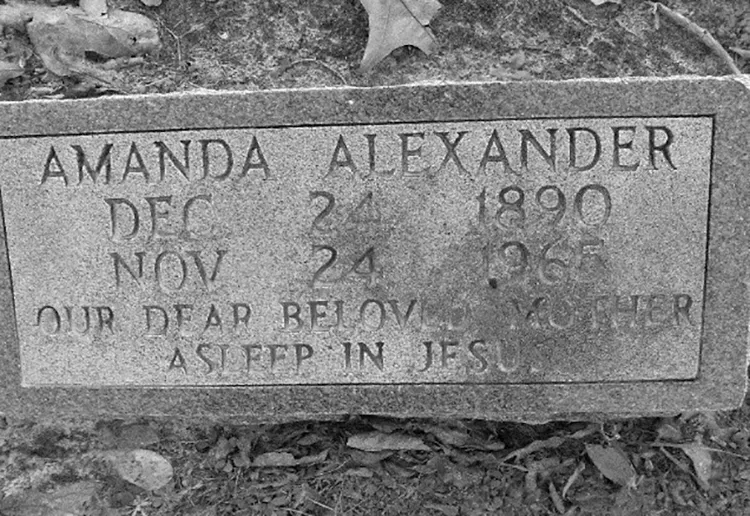
Typical of these African-Americans, education extends from the home and church and includes practical and philosophical wisdom. For example, imported to this study is the researcher’s first philosophical discussion that came at the age of seven and still has an impact on his ontology. In 1965, at the age of seven years, Sister Amanda Alexander, his first teacher (Sunday school) outside of the home, died (see Figure 1.1). A few days before the funeral, a philosophical joust ensued because of a new word that resonated, and that word was “death.” The researcher’s mother had said, Sister Alexander would no longer teach the Sunday school class because she had died, and they were going to attend her funeral. The thought evoked a question,
Figure 1.1 Sunday school teacher: Amanda Alexander 1890–1965.
“What is death?” His mother’s response was, “When people go to sleep and don’t wake up.” Why he asked. They go home to be with the Lord, she replied. After several bouts, she saw that the researcher did not understand death. She then gave him some shocking news to make her point. She said, “One day I am going to die and no longer be with you.” With this revelation came the immediate understanding of death and the wailing began. In fact, he cried bitterly from that morning until two or three in the afternoon. Early on, she sent his brother to console him whom he shook off his shoulders and refused his condolence. Many years later, while serving in the Air Force, she visited him, and he asked her if she remembered the episode, to which she responded, “Yes.” He said, “if you die before me know that I’ve already done my crying.” She smiled as though she knew he would still cry, but when he did weep, it was not due to shock. He was aware that it was coming one day.
In 1991, while serving overseas, the American Red Cross informed the researcher that his mother had passed away. She was only 64 years old and had died from complications of T2DM. When the researcher received the news, he thought, “Lord it is not fair that a woman who devoted her life to answering you, her church and the community as a missionary, would die without receiving some benefit.” In the 33 years of observing her, he never heard her complain or reveal personal information before, during, or after she assisted families, friends, neighbors, and church members with personal issues. In fact, she never let others know when she gave assistance or complained that those needing help were a burden. She faithfully served at her church and loved her husband, his dad, 40 years her elder, until his death at the age of 97. All family members called him Papa, whether his children, grandchildren, or in-laws, the name “Papa” was the same.
Following Papa’s death, his mother went 100 percent blind within one month due to the stress surrounding the death of her husband. T2DM caused her to have periodical lapses into comas for the next six years. Despite those obstacles, she continued to serve at the country church, until living alone, blind, and complaints from family members forced her to leave what had been her home for nearly 30 years. The researcher thought he could take care of her until he realized the unreasonable expectation of his wife. He had married her when she was 18 years old, and six years later, they had four children. She had already sacrificed a career to rear their children, all under the age of eight, and adding her blind mother-in-law made that unreasonable. Due to his military obligations limiting the researcher’s ability to assist his wife, and with scarce resources, with utter consternation, he sent his mother to her sister. Seeing her tears and hearing her plead to say, she would not be a burden, ripped his heart apart, but he made the best decision under the circumstances. With remorse, he thought it was so unfair that the timing was such that he could not take care of his mother, who had served everyone so well. She certainly was not deserving of continuous moves from one house to another, but diabetes was the source of this problem.
Consequently, in February 1991, while stationed at Bitburg Air Base Germany, the researcher received the dreaded call that made it impossible to make restitution to someone he owed so much. His baby brother said that one month earlier their mother surreptitiously and slowly examined his firstborn’s body, and extremities, as though she was making sure her baby was a man who no longer needed her. Apparently seeing that her son had a healthy child and a wife to take care of her baby triggered a martyr’s response (D. Wood, Pilisuk, & Uren, 1973), with diabetes being the executioner, since, within a month she slipped into her final coma and died. Her response seems equivalent to Watson’s (2002) statement that, “The martyr is not a victim of circumstances. The martyr chooses” (p. 15). Unlike Watson’s (2002) belief that “…the martyr must capture the imagination of those hearing his or her story” (p. 15), his mother would never bring attention to herself in that manner. As she would put it, “that was between her and God.” Ironically, about ten years after the researcher’s mother died, he also developed diabetes. After reflecting upon the circumstances of his mother’s death, he panicked. He thought, “I cannot allow diabetes to kill me at an early age like it did his mother.” For the next two months, he lived on soup and water and lost 40 pounds. Subsequently, doctors discontinued his prescription of Glucophage, faster than they prescribed it. With determination, he managed to keep the weight off for five years. However, over the next three years, he regained about 15 pounds, and the insidious diabetes’s elevated glucose reemerged.
Furthermore, in 2011 while feverishly perplexed over the focus of his research on diabetes for a dissertation, the researcher’s wife received a call stating that the ambulance had rushed her mother to a local hospital over 300 miles away. Doctors immediately started life support, all because of diabetes complications. Once the family members arrived; on the Thanksgiving Day, they decided to end life support. Consequently, the researcher, along with family members, including children, were grief-stricken as they watched her mother, affectionately known as “Grannie Reen,” gasp for her last breaths of life; again diabetes. Ironically, Gran’s death occurred only months after the researcher lamented to his cohorts in a History of Adult Education class that his mother-in-law’s children could not see what was happening. They had taken away her privileges of independence by insisting that she eat properly, be submissive to the nurse’s aide provided for her, and most of all, stop supporting a son that should be supporting her. Like with the researcher’s mother, the effects of diabetes seemed to trigger a martyr’s response, since, within a month, she went into a fatal coma.
In addition to the previous diabetes-related deaths, about a year before his mother-in-law’s death, a first cousin in her forties died from gas gangrene. Her death was sudden and unexpected from neuropathy that caused her to be unaware of an infected toe. The emergency staff admitted her into the hospital, and the intravenous medication seemed to arrest the infection. She was conscious, in good spirits and talking one day, but the next day, she died. Also, about a year before his first cousin’s death, an older brother had a kidney donated by his wife. The transplant was necessary because diabetes had destroyed his kidneys. Lastly, in 2011, doctors admitted the researcher into a local hospital while experiencing severe abdominal pain, without him realizing the cause was uncontrolled diabetes, which overwrote his belief that by faith that he was healthy.
Each of these cases of diabetes had the Church of God in Christ (COGIC) in common. The commonality of historical background, membership in, or attendance primary in a local COGIC assembly makes this an Afro-Theistic study of a subculture. From these cases and considering the prevalence of T2DM in African-Americans (CDC, 2012b) and the potential number having an association with the COGIC faith, a need was seen to focus this research on understanding this group of African-American with diabetes. Specifically, this qualitative research sought for an Afro-Theistic theory grounded in the data of participants that explains how faith joins with diabetes education (Glesne, 2011). This discourse revealed stressors that complicates a typical African-American home, most with similarly limited resources that complicates learning and changes with chronic diseases like T2DM. The method of inquiring in developing a theory came through the interviews of the COGIC adults with diabetes. Again, the theory developed is for the benefit of those suffering from chronic diseases, especially diabetes, by providing a theory of learning for researchers and healthcare providers who work with these individuals.
2 The Participants and the Church of God in Christ (COGIC) Subculture
The selection of participants came with certain expectations based upon literature concerning commonalities of adult learners in various diseases states, primarily patients with prediabetes and type 2 diabetes mellitus (T2DM), to understand how their faith, knowledge, and social constructs worked together in managing T2DM. Identifying these diabetic patients as adult learners also classified them as self-directed learners, according to Knowles (1970). By self-directed learning, Knowles meant that these adults become lifelong learners through an inquiry about a subject, especially relevant to T2DM. Others predicted that these adult learners would typically be middle-aged self-directed learners out of necessity since managing diabetes depended upon them understanding the disease and taking necessary actions after gaining that knowledge (Kiawi et al., 2006).
The participants in this study elected to participate after an introduction to the study following a diabetes workshop sponsored by Jane (pseudonym). The five Church of God in Christ (COGIC) members with T2DM, briefly introduced below, accepted the invitation presented by Jane to the participants after a diabetes workshop. Jane was sent enough flyers for multiple participants in hopes of getting five to ten qualified. Other acquaintances were contacted to provide the additional names of potentially qualified candidates if needed for the study. Jane gave the participants instructions and the researcher’s contact information to anonymously let him know that they wanted to participate. After the phone call, they received a consent form to examine, by post.
Data collection is the most crucial aspect of this study because the COGIC members with and without T2DM are private individuals who do not openly discuss private matters with strangers. Therefore, getting to know the participants is the only way to gain their trust in discussing their deepest feelings and thoughts. Since COGIC members are highly social, spending considerable time in multiple church settings, it served as an introduction to establish rapport with members of their social group, the church, as part of the interview strategy.
Interview Preparation
This study used interviews as the means of collecting data for purposive sampling of T2DM COGIC members. Conducting the interviews of COGIC members required forethought in approaching a people skeptical of outsiders. The following sections describe this process in choosing the setting and establishing rapport with the community and the participants. A digital recorder captured each interview and was downloaded directly into a password-protected computer following each session. To maintain confidentiality, each participant received a pseudonym. All data collected, including the recording, refer to the participants by their pseudonym. Most of the data consisted of an in-depth interview of the participants with semistructured open questions, but also field notes with observations.
A second factor, based on experience from the mentioned courses and with the literature review, comes in the method of data collection. The participants chose, within reason, the place of the interview as a means of ameliorating the interview interactions (Glesne, 2011). The fifth and final factor for this study is the interview guide. The experience gained in coursework, the literature review, and the theoretical framework resulted in carefully constructed interview questions that were an adaptation, by permission, from two sources. The open-ended questions only guided the conversation and used to stimulate dialog over an area the participants may have missed. However, as a guide, they proved invaluable in obtaining information on the participants’ processes of combining their Afro-Theistic faith and the knowledge of T2DM through their social construct.
Weiler’s (2007) interview questions for the study of the socio-culture of Latino migrant workers with T2DM served as a source for developing questions concerning diabetes knowledge and social constructs. Cordova’s (2011) interview questions for the study of spirituality among T2DM patients served as a source for developing questions concerning diabetes knowledge and faith. The semistructured questions provided data from purposive sampling (Birks & Mills, 2011) of five participants. To answer the research questions in developing a theory grounded in data of how African-American COGIC diabetic adults construct meaning to reconcile their faith with the knowledge of diabetes (Glesne, 2011). These semistructured questions were flexible and allowed for the probing of other details in understanding the diabetic member’s faith, knowledge of diab...
Table of contents
Cover
Half Title
Series Page
Title Page
Copyright Page
Dedication Page
Table of Contents
List of Figures
List of Tables
Acknowledgments
Introduction
PART 1 Laying the Foundation
PART 2 Research Approach
PART 3 Background and Methodology
PART 4 Data Collection and Analysis
PART 5 Emerging Theory
PART 6 The Theory: Permeated Learning Emergence
References
Index
Trusted by 375,005 students
Access to over 1.5 million titles for a fair monthly price.
Study more efficiently using our study tools.
Frequently asked questions
Yes, you can cancel anytime from the Subscription tab in your account settings on the Perlego website. Your subscription will stay active until the end of your current billing period. Learn how to cancel your subscription
No, books cannot be downloaded as external files, such as PDFs, for use outside of Perlego. However, you can download books within the Perlego app for offline reading on mobile or tablet. Learn how to download books offline
Perlego offers two plans: Essential and Complete
Essential is ideal for learners and professionals who enjoy exploring a wide range of subjects. Access the Essential Library with 800,000+ trusted titles and best-sellers across business, personal growth, and the humanities. Includes unlimited reading time and Standard Read Aloud voice.
Complete: Perfect for advanced learners and researchers needing full, unrestricted access. Unlock 1.5M+ books across hundreds of subjects, including academic and specialized titles. The Complete Plan also includes advanced features like Premium Read Aloud and Research Assistant.
Both plans are available with monthly, semester, or annual billing cycles.
We are an online textbook subscription service, where you can get access to an entire online library for less than the price of a single book per month. With over 1.5 million books across 990+ topics, we’ve got you covered! Learn about our mission
Look out for the read-aloud symbol on your next book to see if you can listen to it. The read-aloud tool reads text aloud for you, highlighting the text as it is being read. You can pause it, speed it up and slow it down. Learn more about Read Aloud
Yes! You can use the Perlego app on both iOS and Android devices to read anytime, anywhere — even offline. Perfect for commutes or when you’re on the go. Please note we cannot support devices running on iOS 13 and Android 7 or earlier. Learn more about using the app
Yes, you can access Beyond Transformative Learning in African-American Adult Education by Gerald D. Redwine in PDF and/or ePUB format, as well as other popular books in Education & Adult Education. We have over 1.5 million books available in our catalogue for you to explore.