The Second Ku Klux Klan's success in the 1920s remains one of the order's most enduring mysteries. Emerging first as a brotherhood dedicated to paying tribute to the original Southern organization of the Reconstruction period, the Second Invisible Empire developed into a mass movement with millions of members that influenced politics and culture throughout the early 1920s. This study explores the nature of fraternities, especially the overlap between the Klan and Freemasonry. Drawing on many previously untouched archival resources, it presents a detailed and nuanced analysis of the development and later decline of the Klan and the complex nature of its relationship with the traditions of American fraternalism.
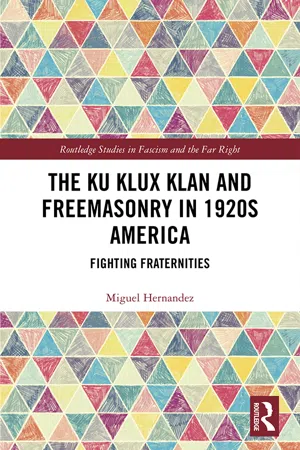
- 212 pages
- English
- ePUB (mobile friendly)
- Available on iOS & Android
eBook - ePub
1 Klanishness
Brotherhood in the Invisible Empire
Throughout the 1920s, millions of Americans from across the country would have shared in the bizarre experience that was the Ku Klux Klan’s initiation ceremony. The ritual took place within a klavern, which much like other fraternal lodges resembled an ornate boardroom. The room was dutifully arranged according to the ritual, and was decorated with symbols such as a Bible, a sword, and an American flag. Upon entering the klavern, the new inductees of the fraternity were greeted by a dark room filled with Klansmen standing in a square around a central altar. The candidates would then perform as part of a sombre ceremony, with various Klan officers reciting lofty catechisms on brotherhood and warning them of the dangers of revealing the secrets of the order. Half-way through their rites, one of the klavern’s officers would stop the new applicants and proclaim:
God give us men! The Invisible Empire demands strong minds, great hearts, true faith and ready hands. Men whom the lust of office does not kill; Men whom the spoils of office cannot buy; Men who possess opinions and a will. Men who have honor; men who will not lie.…
Throughout this “naturalization ceremony” these recruits would be repeatedly questioned and tested as to their character, manliness and intentions. The Klan’s “Exalted Cyclops” would threaten them with retribution for revealing the fraternity’s secrets as they completed the ceremony. After swearing their oath, the “aliens” from the outside world were consecrated as Klansmen, faithful citizens of this Second Invisible Empire, and were awarded the klavern’s secrets and passwords.1
The Ku Klux Klan’s prayers, ceremonies and fraternal admonitions were a vital part of daily life in the Invisible Empire. These recruits vowed to uphold the laws of the fraternity and the duties of a Klansman, and to remain loyal to the organization and their brothers until death. The fraternity’s practices were designed create a strong sense of camaraderie and devotion among Klansmen, helping to bond a klavern together and provide a sense of familial union. The order’s traditions were an intrinsic part of the fraternity’s appeal, and they continue to be practised by present-day successors of the 1920s Klan. The Invisible Empire’s iconic ceremonies and fraternal traditions are also its most recognizable features, setting them apart from other similar organizations with comparable beliefs.
Many of those undertaking the Klan’s initiation degree during the 1920s would have experienced practically identical forms of public participatory theatre if they belonged to any of the other popular fraternities of the day. From the Knights of Pythias to the Knights of Columbus, dozens of different brotherhoods met in lodges throughout the nation, reproducing similar initiation degrees and performing them weekly. Membership in a fraternity during the 1920s was not only common, but even expected among certain sectors of the American population as a marker of respectability.
Klansmen spent a considerable amount of their time in the klavern acting out these degrees and practising the “benevolence” and “brotherly love” they had sworn to uphold. Critics and supporters of the order often remarked on the centrality of the Invisible Empire’s fraternalism and ritual. Despite this, the role of fraternalism within the Second Klan has received relatively little attention from scholars. In order to address this dearth, this chapter will begin by analysing the rise of fraternalism in post-Civil War America. This will allow us to understand the burgeoning craze for ritualism and brotherhood that influenced the Klan’s founder, William Joseph Simmons, and the development of the organization itself. This will be followed by an assessment of the Klan’s role as a fraternity, where we will discuss what sort of brotherhood the Invisible Empire was. We will then evaluate why this organization managed to become so successful in an age when fraternalism was starting to show signs of decline. Ultimately, this chapter will help us understand two overarching questions: Was the Ku Klux Klan a fraternity? And how important was this status to its success?
The golden age of fraternity and the Roaring Twenties
Although Americans had been fascinated with fraternities and their mysteries since the Colonial Era, it was only really after the Civil War that they became a phenomenon that concerned all classes. The emergence of this craze requires careful analysis, since the 1920s Ku Klux Klan and its popularity might appear as a natural result of the nation’s continued interest in fraternities. Writing in 1896 in the prestigious North American Review, W.S. Harwood estimated that at the time, the membership in secret fraternal orders was roughly around 5,400,000. Because some people held multiple memberships in various fraternities, he estimated that, broadly speaking, every fifth or eighth man in America was a fraternalist. Harwood even declared that “so numerous, so powerful, have these orders become, that these closing years of the century might well be called the Golden Age of fraternity”. A more thorough assessment of the phenomenon was completed a few years later by Albert Stevens, but he arrived at a very similar conclusion. “Notwithstanding the century’s extraordinary developments in agriculture, commerce, manufactures, in the arts, in the dissemination of intelligence, in the machinery of finance and good government,” wrote Stevens in his introduction, “interest in the older and better types of secret societies has grown with even greater rapidity.”2 This widespread interest made itself apparent in all aspects of late nineteenth century American life. Lodges became a common feature of even the smallest towns in the country, and fraternal dues and regalia became a regular expense for many American families.
Harwood’s label, the Golden Age of Fraternity, is now used by historians not only to describe the state of fraternalism at the turn of the century, but during the whole period of expansion of these orders, roughly from the end of the Civil War and into the post-World War I era. This period saw the appearance, growth and decline of a countless number of fraternities, from well-known brotherhoods like the Freemasons or the Odd Fellows, to the once popular but now almost forgotten Knights of the Maccabees. As sociologist Jason Kaufman explains, this intensely competitive fraternal market means the era was not one of peaceful or “golden” stability or growth, but one where the remarkable public interest in fraternities caused chaotic and often aggressive competition between different brotherhoods.3 The true extent of this Golden Age of Fraternity remains somewhat of a mystery for historians. This is due to the fact that an untold number of fraternities cropped up without lasting long enough to make an enduring impact on the historical record.
Historians and sociologists are still at odds about what caused so many Americans to spend their evenings in their local lodge during this Golden Age, and there are several views on the matter. Mary Ann Clawson argues that fraternities united men of different social classes and inducted them into the doctrines of equality and social mobility, which helped to efface notions of class and class consciousness at the turn of the century by emphasizing race, ethnicity, and masculinity as the primary markers of identity in a progressively diverse American society. Mark C. Carnes, through his analysis of the rituals of various orders, has proposed that the substantial time and money devoted to acting out complex initiations and ceremonies within the lodges suggests that ritualism was the key factor in the success of these orders. Carnes identified several recurring themes in these symbolic rituals and has argued that fraternities attracted members because the ceremonies fulfilled a psychosocial male need, by which men came to understand their masculinity in an increasingly feminized Victorian American culture. David T. Beito however, dismisses these ideas and emphasizes the functional role that fraternities played in American communities as a form of social security. Having emerged in a time when the government did not offer health insurance and where other security nets were unavailable, Beito believes that the mutual benefits insurance and welfare provided by most fraternities was the primary appeal of these brotherhoods.4
Though identity, ritualism and insurance were undeniably decisive components of the fraternal boom, it could be argued that the essential feature of this phenomenon was the sheer number and variety of fraternities. If Americans primarily joined fraternities to enjoy the insurance benefits or to partake in the spectacle of ritualism, why did they feel the need to form such a colourful array of brotherhoods? Why did they all not join a smaller number of orders that fulfilled these roles?
The fact is that Americans formed a countless number of fraternities that suited every single class at the time. The daughters of Freemasons could join the Order of Rainbow for Girls, whereas Irish Catholic men could become members of the Ancient Order of Hibernians; the Prince Hall Shriners was reserved for wealthier African-American men, while their wives joined the Daughters of Isis. Fraternalism concerned all classes, as fraternal enthusiast and former Klansman Henry P. Fry explained to his readers in 1922:
If the psychologist, looking over the diversified and conflicting interests and classes of American people, attempted to find a common state of mind, he would probably discover one thing that applies to all American men, without regard to ‘race, color, or previous condition of servitude.’ He would learn that there is a common American trait possessed by the white man and the negro, the Jew and the Gentile, the Catholic and the Protestant, the native and the foreign-born – in fact by every conceivable group of the males of the United States.
They are all ‘joiners’!
One has to search far and wide for an American who does not ‘belong’ to some sort of an organization, and who would not, under proper circumstances, join another.5
Although this obsession with fraternalism transcended class, race and gender, the parameters of most organizations were intrinsically defined by these classifications.
Contrary to their message of universal brotherhood, most fraternities of the “Golden Age” had a strict code of requirements that ensured the homogeneity of their membership. In the case of the Ku Klux Klan these membership requirements were unequivocal, but other organizations like Freemasonry had an unofficial list of criteria that excluded African-Americans, Catholics, and others from applying for membership. This exclusivity within the Freemasons and other organizations derived not from any explicitly exclusionary policy, but from the selection process at the local lodge level. Applicants who did not meet the approval of the members could be blackballed, ensuring the general homogeneity of the brotherhood. These policies resulted in a highly stratified fraternal ecosystem, where in practice each citizen could only belong to a particular niche of brotherhoods. Building on Clawson’s work, Kaufman argues that it is this self-segregation between different races and social classes, as well as the two sexes, which is the true motive for the rise of fraternalism in nineteenth-century American society.6 The lodge was meant to be a place of camaraderie and harmony, and many members simply preferred to avoid political issues of racial, religious and class conflict by excluding people who belonged to radically different worlds. Homogeneity within the fraternal lodge helped guarantee the stability of the organization and to develop friendship among like-minded members from broadly similar backgrounds.
Ultimately, the esoteric ritualism, the mutual benefits insurance, and particularly the ethnic and class camaraderie that was provided by various fraternities, all contributed to the immense popularity and power gained by these brotherhoods in the period 1865–1917. The Golden Age established the local lodge as an essential feature of most American communities and membership in such brotherhoods, especially the most exclusive ones, became a valuable commodity and a marker of social stature.
America’s passion for fraternalism did not culminate with the First World War, and the lodge continued to hold its noteworthy place in society. Statistics from a number of different fraternities suggest that these organizations remained popular with American men and women after 1918. Estimates from the Masonic Grand Lodges of Texas and New York seem to indicate a relatively stable and healthy growth for Freemasonry throughout the period, with a sharp surge during the first half of the 1920s (see Figure 1.1). Data also shows that among some of the other major fraternities – the Odd Fellows, Elks, and the Knights of Columbus – all experienced growth throughout the 1920s, with only the Knights of Pythias and the Loyal Order of Moose showing signs of slight decline.8 The estimates made by one dictionary of fraternal organizations from 1924 gives us a snapshot of the relative strength of the nation’s orders (see Figure 1.2). The Order of Owls had only been founded in 1904 and already had over 600,000 initiates just two decades later. Similarly, the Fraternal Order of Orioles was created in 1910 and by 1923 had 143,000 enlisted members.
Many of these organizations seemed to have realized there was significant revival in interest in fraternalism since the end of the war and welcomed the initiation of new candidates. Grand Master John W. Birney, head of the Odd Fellows in Illinois, encouraged his brethren to ...
Table of contents
- Cover Page
- Half Title Page
- Series Page
- Title Page
- Copyright Page
- Dedication
- Table of Contents
- Figures
- Acknowledgements
- Abbreviations
- Introduction
- 1 Klanishness: brotherhood in the Invisible Empire
- 2 Freemasonry’s fighting brother: militancy, fraternalism and the Ku Klux Klan
- 3 Kluxing America: the use and abuse of the Masonic reputation
- 4 Hate at $10 a package: selling the Invisible Empire
- 5 Hooded Freemasons: dual membership and conflict in local lodges
- 6 Dallas Klan No. 66 and Anaheim Lodge No. 207: a case study of two communities
- 7 Friend or foe? Grand Masters’ responses to the Ku Klux Klan
- 8 The collapse of the Second Ku Klux Klan
- Conclusion – an “Invisible” Empire?
- Glossary
- Index
Trusted by 375,005 students
Access to over 1.5 million titles for a fair monthly price.
Study more efficiently using our study tools.
Frequently asked questions
Yes, you can cancel anytime from the Subscription tab in your account settings on the Perlego website. Your subscription will stay active until the end of your current billing period. Learn how to cancel your subscription
No, books cannot be downloaded as external files, such as PDFs, for use outside of Perlego. However, you can download books within the Perlego app for offline reading on mobile or tablet. Learn how to download books offline
Perlego offers two plans: Essential and Complete
- Essential is ideal for learners and professionals who enjoy exploring a wide range of subjects. Access the Essential Library with 800,000+ trusted titles and best-sellers across business, personal growth, and the humanities. Includes unlimited reading time and Standard Read Aloud voice.
- Complete: Perfect for advanced learners and researchers needing full, unrestricted access. Unlock 1.5M+ books across hundreds of subjects, including academic and specialized titles. The Complete Plan also includes advanced features like Premium Read Aloud and Research Assistant.
We are an online textbook subscription service, where you can get access to an entire online library for less than the price of a single book per month. With over 1.5 million books across 990+ topics, we’ve got you covered! Learn about our mission
Look out for the read-aloud symbol on your next book to see if you can listen to it. The read-aloud tool reads text aloud for you, highlighting the text as it is being read. You can pause it, speed it up and slow it down. Learn more about Read Aloud
Yes! You can use the Perlego app on both iOS and Android devices to read anytime, anywhere — even offline. Perfect for commutes or when you’re on the go.
Please note we cannot support devices running on iOS 13 and Android 7 or earlier. Learn more about using the app
Please note we cannot support devices running on iOS 13 and Android 7 or earlier. Learn more about using the app
Yes, you can access The Ku Klux Klan and Freemasonry in 1920s America by Miguel Hernandez in PDF and/or ePUB format, as well as other popular books in History & Military & Maritime History. We have over 1.5 million books available in our catalogue for you to explore.