- 294 pages
- English
- ePUB (mobile friendly)
- Available on iOS & Android
eBook - ePub
About this book
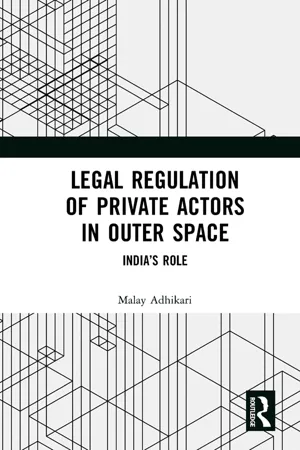
The book addresses legal issues and challenges in using Space Technology. Especially covered are the provisions of International Space Law and few national space legislations to regulate private actors in outer space.
The key chapters covered are history of space regulations, private actors in space, legal issues for such actors, regulating these issues outside India, and the same in India. In concluding chapter, the author has worked out some recommendations.
The book would be of immense use to people especially startups in private space industry; students, faculties and scholars of Space Law and Policy, Space Security, Defence and Security Studies.
Please note: Taylor & Francis does not sell or distribute the Hardback in India, Pakistan, Nepal, Bhutan, Bangladesh and Sri Lanka
V. Space Regulations in India
Introduction
Since this research study is titled as ‘Regulation of Private Actors in Outer Space — India’s Role’, it would require some broader analysis for India unlikely not so much required in the case of countries outside India. The structure of this chapter follows the basic three pillars of regulation — policies, legislations and institutions. The sequence of this chapter begins with policies to regulate private actors. But it was observed in the previous chapter that there were no private actors at first instance in any country. It is also true for India. So the policies were made to make some basic foundation to build national space infrastructure and then subsequently moved forward to regulate the state and private actors. The second sequence connects with almost all existing legislations of India to regulate the space activities of private actors though there is no direct or dedicated space legislation till date. The legislations are informally classified for analysis to be more meaningful. The last sequence relates with regulation for private actors on making institutions.
Policies
Table 27 Policies for Regulations1
| Departments | Ministries | Policies |
| Department of S & T (DST) | Ministry of S & T | 1. Scientific Policy Resolution, 1958. 2. Technology Policy Statement, 1983. 3. Science & Technology Policy, 2003. 4. Science, Technology & Innovation Policy, 2013. 5. Draft of National Geospatial Information Policy, 2012. |
| Department of Space (DoS) | Prime Minister’s Portfolio | 1. Satellite Telecommunication Policy (SATCOM), 2000. 2. Remote Sensing Data Policy, 2011. 3. Industry Participation Policy. 4. Commercialisation Policy. 5. International Co-operation Policy. 6. Human Resource Development Policy. 7. Technology Transfer Policy of ISRO. 8. Intellectual Property Policy of ISRO. |
| Department of Telecommunications (DoT) | Ministry of Communication & Information Technology | 1. National Telecom Policy, 1994. 2. New Telecom Policy, 1999. 3. National Telecom Policy, 2012 (NPT 2012). |
| Department of Land Resources | Ministry of Rural Development | 1. National Rehabilitation and Resettlement Policy, 2007. 2. Draft National Land Reforms Policy, 2013. |
| Planning Commission | Nil | 1. Report of Working Group on DoS in 11th FYP 2007-2012. 2. Report of Working Group on DoS in 12th FYP 2012-2017. |
These are categorised above into general science and technology (S &T) policy, reports of Working group on Department of Space (DoS) in 11th and 12th FYP, policies under DoS, polices under Department of Telecommunications (DoT) and Department of Land Resources. These may not be all inclusive. Moreover, these policies are not always directly connected with the regulation of private actors. It may be the case that future of private space activities would be planned according to some of the policies.
The regulation through policy in Table 27 starts with S&T policy in general. In this category, the Scientific Policy Resolution (SPR), 1958, was the backbone of development of science and technology in India after independence.2 It is prime mover of any S&T policies framed subsequently in different disciplines including space. Homi J. Bhabha was the person patronised by Jawaharlal Nehru, the then Prime Minister of India, to draft this resolution. The development of S&T would be based solely on nationalistic approach.3
The review of SPR expressed that one of its aims was industrialisation which would invite private sectors by default. So, the SPR could be extended to develop the domestic legal regulation for any industrialisation of S&T programme.4 This extension may find a place for private actors in outer space. In this regard the sovereignty issue from chapter III is more correlated here because the country legitimised its sovereignty in science and technology for the first time on framing this policy resolution in 1958.
Though there were changes in this policy subsequently for different reasons but SPR was the first step to build a science and technological base in India. It happened when the country’s S&T base was almost nil just after independence. However, the very characteristic of science policy is a dynamic concept. It is continuously evolved as well as modified. No country has yet succeeded in introducing a comprehensive science policy although many are striving in that direction. The case of India is not an exception.5
The subsequent policy was Technology Policy Statement, 1983. This Policy Statement was made in a scenario that was totally different from the SPR. India has achieved industrial base through science and technology development. The key points were technological self-reliance, initiatives for technological co-operations amongst developing countries and legislative framework to protect national technological know-how as industrial property right.6
This Policy Statement is very supporting to develop private actors in outer space because it not only stresses on self-reliance but also it states about export of technologies on internationally competitive basis. There may be import of technologies in some sectors but it will be restricted within a certain period. The overall impact is that there is competition amongst the industrial players in India. It is assumed to be very vital for any technology based industry including private space industry. It refers the technological cooperation amongst similar developing countries like India. So it may be an extended base for interacting the domestic and foreign private actors as mentioned in chapter II and IV. Moreover, it was for the first time to think about development of legislative framework for safeguarding national technological achievements. Therefore this policy statement acknowledges the significance of IPR that is one of the issues for private actors in outer space.
The Science and Technology Policy, 2003, follows the next sequence in Table 27. The Indian capabilities in different disciplines of S&T were mentioned for the first time within the policy where there was a place of space technology and applications with astronomy and astrophysics. This policy implied and invoked international law. It noticed the ongoing globalisation and the intensely competitive environment. Some of the policy objectives were: (i) implementation of speedy and effective domestic commercialisation related with S&T inventions, and (ii) promoting the international S&T cooperation as key element of international relations of India. It reminds that export of techn...
Table of contents
- Cover
- Half Title
- Title Page
- Copyright Page
- Dedication
- Table of Contents
- Acknowledgements
- Introduction
- Abbreviations
- I. History of Space Regulations
- II. Private Actors in Outer Space
- III. Legal Issues
- IV. Space Regulations Outside India
- V. Space Regulations in India
- VI. Conclusion
- Bibliography
Trusted by 375,005 students
Access to over 1.5 million titles for a fair monthly price.
Study more efficiently using our study tools.
Frequently asked questions
Yes, you can cancel anytime from the Subscription tab in your account settings on the Perlego website. Your subscription will stay active until the end of your current billing period. Learn how to cancel your subscription
No, books cannot be downloaded as external files, such as PDFs, for use outside of Perlego. However, you can download books within the Perlego app for offline reading on mobile or tablet. Learn how to download books offline
Perlego offers two plans: Essential and Complete
- Essential is ideal for learners and professionals who enjoy exploring a wide range of subjects. Access the Essential Library with 800,000+ trusted titles and best-sellers across business, personal growth, and the humanities. Includes unlimited reading time and Standard Read Aloud voice.
- Complete: Perfect for advanced learners and researchers needing full, unrestricted access. Unlock 1.5M+ books across hundreds of subjects, including academic and specialized titles. The Complete Plan also includes advanced features like Premium Read Aloud and Research Assistant.
We are an online textbook subscription service, where you can get access to an entire online library for less than the price of a single book per month. With over 1.5 million books across 990+ topics, we’ve got you covered! Learn about our mission
Look out for the read-aloud symbol on your next book to see if you can listen to it. The read-aloud tool reads text aloud for you, highlighting the text as it is being read. You can pause it, speed it up and slow it down. Learn more about Read Aloud
Yes! You can use the Perlego app on both iOS and Android devices to read anytime, anywhere — even offline. Perfect for commutes or when you’re on the go.
Please note we cannot support devices running on iOS 13 and Android 7 or earlier. Learn more about using the app
Please note we cannot support devices running on iOS 13 and Android 7 or earlier. Learn more about using the app
Yes, you can access Legal Regulation of Private Actors in Outer Space by Malay Adhikari in PDF and/or ePUB format, as well as other popular books in Law & Administrative Law. We have over 1.5 million books available in our catalogue for you to explore.