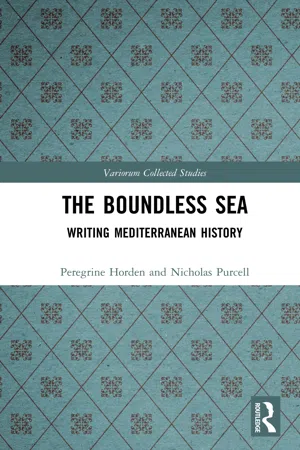
This volume brings together for the first time a collection of twelve articles written both jointly and individually by Peregrine Horden and Nicholas Purcell as they have participated in the debates generated by their major work, The Corrupting Sea: A Study of Mediterranean History (2000). One theme in those debates has been how a comprehensive Mediterranean history can be written: how an approach to Mediterranean history by way of its ecologies and the communications between them can be joined up with more mainstream forms of enquiry – cultural, social, economic, and political, with their specific chronologies and turning points. The second theme raises the question of how Mediterranean history can be fitted into a larger, indeed global history. It concerns the definition of the Mediterranean in space, the way to characterise its frontiers, and the relations between the region so defined and the other large spaces, many of them oceans, to which historians have increasingly turned for novel disciplinary-cum-geographical units of study. A volume collecting the two authors' studies on both these themes, as well as their reply to critics of The Corrupting Sea, should prove invaluable to students and scholars from a number of disciplines: ancient, medieval and early modern history, archaeology, and social anthropology. (CS1083).
- 228 pages
- English
- ePUB (mobile friendly)
- Available on iOS & Android
eBook - ePub
1
The Mediterranean and ‘The New Thalassology’
I
Sea and ocean history is more novel than it sounds. It admirably exemplifies a new historiography of large areas. In one sense, the enquiry revisits a traditional historical geography. At the same time, both its scope and its methods are so distinctive as to make it an exciting – and quite unpredictable – area of reflection and research.
A decade or so ago, such histories were hardly encouraged. In postmodern historiography, subjects of every kind, but especially identities and power relationships, became inflections of discourse. And because it made its own world, discourse could not be anchored to a particular place, even if, for practical reasons, its historians had to use texts from a particular region and period. Preset frontiers were taboo.1 The context, whether for an exercise in microhistory, in new historicism, or in post-colonialism, was, ideally, global.
Area studies, in many ways the creation of cultural anthropology and long suspect in that discipline, now flourish again.2 But they are invigorated by what has been learned from the linguistic turn: there is no turning back. Even area studies, in their revived form, are therefore in some sense global, too. They may, for instance, be directly or indirectly influenced by debates on the nature and impact of economic and cultural globalisation. The new interest in regional history derives, fundamentally, from the task of finding a different approach to world history – not through formulating generalisations about everything, but through the analysis of the whole by way of its components, and, consequently, of how those components fit together.3 The regions of the new regional history tend to have one obvious characteristic: they are big – inevitably, since they are implicitly or explicitly elements in a larger and potentially all-embracing historical project. For the same reason, their historians share a sophisticated consciousness of the problems of delimitation.4
The new regional history also (hardly surprisingly) retains the taste of late-twentieth century scholarship for the erasure of established disciplinary and historical frontiers. Some existing categories seem reinvigorated; others are new. But a further common feature is that they cut across the political divisions that have shaped traditional history: the study of the lakes of the East African Rift Valley, for example, or the Silk Road.
History of seas appeals to this project because the layout of sea and land makes the oceans and their embayments a way of approaching most parts of the world. By a simple metaphorical extension, ‘virtual seas’ can be included, too, spaces of danger and variable communications – mountain ranges, forests, or arid wildernesses such as the Sahara. Some of these will resemble oceanic expanses; others, in being more densely surrounded by populated zones and dotted with island oases, will be inland ‘seas’ like the Mediterranean. The systematic comparison of real and metaphorical seas can suggest a new configuration of history, and one that might attain a global scale.5 So promising, indeed, does the notion of a sea or an ocean appear for this task that the term ‘the new thalassology’ has seemed an appropriate coinage to denote it.6
The choice of sea sometimes follows traditional geographical classifications, as with the Atlantic, Pacific, and Indian Oceans; but it is more enticing in many ways to propose less familiar, and sometimes smaller, maritime spaces, such as the Philippine island world.7 Novel species of juxtaposition and comparison become possible. They reveal unexpected coherences, such as the recurrent features of the northeast shores of the Atlantic in the pre-modern archaeological record.8 Peripheries become cores, and it is arguably one of the main attractions of the newly created or identified areas that they tend to be politically neutral. Apart from ignoring national boundaries, they subvert imperial hierarchies that privilege some powers’ involvement in the areas in question. Thus, for instance, in the ‘new’ Atlantic historiography, a ‘white’, a ‘black’, a ‘green’ (Irish), and even a ‘red’ (Marxist) Atlantic may coexist in equilibrium.9 Sea history also helps expose the ‘myth of continents’ – their coherence and primacy – that is, the precedence that historians have given to land over water as the support of social life.10 ‘East Asia’ may be preferable to ‘the Far East’, but the investigation of the continuum of the China Sea is more liberating still. Last, and not least, we might guess from our own experience, sea history allows sedentary landlubber historians to indulge a taste for the romance or the frisson of seafaring.11
The Mediterranean has some claim to be the great original of seas as the subject of history. Sea-based political hegemony was identified as an object of historiographical enquiry in the fifth century BC by the first historians in the Western tradition, Herodotus and Thucydides, who invented for it the label ‘thalassocracy’ (sea rule). From still earlier, in the Odyssey, seafaring occupied a central place in the first Greek literary imagination.12 Even more influential in the twentieth century has naturally been the prototype sea history, Fernand Braudel’s The Mediterranean and the Mediterranean World in the Age of Philip II.13 Braudel elaborated a unitary theory of time and causation, and applied it, on the grandest scale, in that characteristic product of the Annales school, the regional monograph in which all the social sciences are synthesised into ‘total history’. ‘When I think of the individual’, he wrote in the concluding paragraph of the second edition of The Mediterranean,
I am always inclined to see him imprisoned within a destiny in which he himself has little hand, fixed in a landscape in which the infinite perspectives of the long term stretch into the distance both behind him and before. In historical analysis as I see it, rightly or wrongly, the long run always wins in the end … I am by temperament a ‘structuralist’, little tempted by the event, or even by the short-term conjuncture which is after all merely a grouping of events in the same area.14
Yet, in that ‘long run’ that always wins, Braudel’s legacy has lain less in philosophy than in geography, through which the Mediterranean is upheld as a distinctive unity:
None of my critics has reproached me for including in this historical work the very extended geographical section which opens it, my homage to those timeless realities whose images recur throughout the whole book … The Mediterranean as a unit, with its creative space, the amazing freedom of its sea-routes … with its many regions, so different yet so alike, its cities born of movement, its complementary populations, its congenital enmities, is the unceasing work of human hands; but those hands have had to build with unpromising material, a natural environment far from fertile and often cruel, one that has imposed its own long lasting limitations and obstacles. All civilization can be defined as a struggle, a creative battle against the odds; the civilizations of the Mediterranean basin have wrestled with many often visible obstacles, using sometimes inadequate human resources, they have fought endlessly and blindly against the continental masses which hold the inland sea in its grip … I have therefore sought out, within the framework of a geographical study, those local, permanent, unchanging and much repeated features which are the ‘constants’ of Mediterranean history.15
For all its emphasis on the constraining force of a ‘timeless’ landscape, Braudel’s vividly peopled geography is maritime as well as terrestrial. It allows as much conceptual space to freedom of movement and communication across and around the sea as to the local hold of the environment. Above all, it places the Mediterranean region within a larger frame, a ‘greater Mediterranean’ that can include Antwerp and places still more remote.16
This distinguished genealogy has helped make the Mediterranean a standard point de repère for maritime historians. The Baltic/North Sea region is ‘the Mediterranean of the North’. The world created by later medieval Iberian navigators around the islands of the eastern Atlantic, in the period preceding that for which a ‘full’ Atlantic history is conceivable, is the ‘Atlantic Mediterranean’ or ‘Mediterranean Atlantic’.17 David Abulafia has even generalised the concept of the Mediterranean, in its strict meaning of ‘inland sea’, to a range of areas over which trade and communication have been comparatively intense. He applies the term not only to the ‘sub-Mediterraneans’ of the Adriatic,18 Aegean, and Black Seas,19 and the quasi-Mediterranean of the Caribbean, but also to the ‘Japanese Mediterranean’.20 The Mediterranean proper appears to have an unassailable position in the mainstream of historiography, and to lend itself to the comparativism of modern regional study. So it is reasonable to expect that the Mediterranean will also have much to offer the new thalassology.
But does it? In what follows, we address that question in four parts: first, by reviewing the serious criticisms that have been levelled at ‘Mediterranean’ as a category; second, by looking at how other Mediterranean historians have responded to the challenge; third, by outlining our own suggestions for doing Mediterranean history; and finally, by debating the place of the Mediterranean thus configured in a wider scholarly world of comparative sea history and global history.
II
The ‘original’ Mediterranean is in fact more problematic as a component in the new regional history than its illustrious forebears might suggest. First, when historians elsewhere are robustly constructing regions out of unexpected seaboards, so as to ponder recherché networks of communication and patterns of cultural resemblance, those studying the Mediterranean find that their subject is frequently dismissed precisely on the grounds that it is no more than a construction. Second, when the new regional vision helps to emancipate scholars from insidious political focalisation, the Mediterranean stands accused of being an essentially oppressive concept, born of imperialism and deployed in the service of politically undesirable master narratives. Third, even apart from the specific ideological undesirability of links with European imperialism, the Mediterranean carries so much baggage of a more general kind that its usefulness in comparative history can seem very limited. Its problems as a historiographical subject are those of success.
Such problems tend to accentuate its uniqueness. No other sea has been the focus of a cultural history in which a unified stretch of water gives its name to a supposedly distinctive surrounding landscape and culture, and even to presumed personality traits.21 The relative seniority and sophistication of Mediterranean studies as a discipline are also significant, even if we date it back no further than the 1930s, when Braudel conceived his major work.22 A greater challenge for the historian is that the Mediterranean is culturally freighted in so many ways. This freighting is of course a far larger phenomenon than could be conjured up from the history of geography.23 It hardly needs stating that the Mediterranean, as an area seldom clearly defined but often subconsciously reduced to Italy and Greece, has been the perceived centre of European civilisation since the Renaissance, and in many respects since classical Antiquity. ‘The Baltic of the South’: the absurdity of the inversion makes the point.
The cultural stature so often ascribed to the...
Table of contents
- Cover
- Half-Title
- Series
- Title
- Copyright
- Contents
- Preface
- Abbreviations
- Acknowledgements
- 1 The Mediterranean and ‘The New Thalassology’ American Historical Review, special issue, Forum, ‘Oceans of History’, 111.3 (2006), pp. 722–40
- 2 Years of Corruption: Some Responses to Critics [of The Corrupting Sea] Rethinking the Mediterranean, ed. W. V. Harris (Oxford: Oxford University Press, 2005), pp. 348–75
- 3 The Boundless Sea of Unlikeness?: On Defining the MediterraneanMediterranean Historical Review, 18.2 (2003), pp. 9–29
- 4 FixityMobility and Travel from Antiquity to the Middle Ages, ed. R. Schlesier and U. Zellmann (Berlin: Lit, 2004), pp. 74–83
- 5 Meshwork: Towards a Historical Ecology of Mediterranean Cities The Mediterranean Cities between Myth and Reality, ed. F. Frediani (Lugano: Nerbini, 2014), pp. 37–51
- 6 The Ancient Mediterranean: The View from the Customs House Rethinking the Mediterranean, ed. W. V. Harris (Oxford: Oxford University Press, 2005), pp. 200–32
- 7 Colonisation and Mediterranean HistoryAncient Colonizations: Analogy, Similarity and Difference, ed. H. Hurst and S. Owen (London: Bristol Classical Press, 2005), pp. 115–39
- 8 The Mediterranean and the European Economy in the Early Middle AgesNot previously published
- 9 Water in Mediterranean HistoryManaging Water Resources Past and Present: The Linacre Lectures 2002, ed. J. Trottier and P. Slack (Oxford: Oxford University Press, 2004), pp. 35–49
- 10 Tide, Beach, and Backwash: The Place of Maritime HistoriesThe Sea: Thalassography and Historiography, ed. P. N. Miller (Ann Arbor: University of Michigan Press, 2013), pp. 84–108
- 11 Situations Both Alike?: Connectivity, the Mediterranean, the SaharaSaharan Frontiers: Space and Mobility in Northwest Africa, ed. J. McDougall and J. Scheele (Bloomington: Indiana University Press, 2012), pp. 25–38
- 12 Mediterranean Connectivity: A Comparative ApproachNew Horizons: Mediterranean Research in the 21st Century, ed. M. Dabag, D. Haller, N. Jaspert, and A. Lichtenberger (Paderborn: Wilhelm Fink/Ferdinand Schöningh, 2016), pp. 211–24
- Index
Trusted by 375,005 students
Access to over 1.5 million titles for a fair monthly price.
Study more efficiently using our study tools.
Frequently asked questions
Yes, you can cancel anytime from the Subscription tab in your account settings on the Perlego website. Your subscription will stay active until the end of your current billing period. Learn how to cancel your subscription
No, books cannot be downloaded as external files, such as PDFs, for use outside of Perlego. However, you can download books within the Perlego app for offline reading on mobile or tablet. Learn how to download books offline
Perlego offers two plans: Essential and Complete
- Essential is ideal for learners and professionals who enjoy exploring a wide range of subjects. Access the Essential Library with 800,000+ trusted titles and best-sellers across business, personal growth, and the humanities. Includes unlimited reading time and Standard Read Aloud voice.
- Complete: Perfect for advanced learners and researchers needing full, unrestricted access. Unlock 1.5M+ books across hundreds of subjects, including academic and specialized titles. The Complete Plan also includes advanced features like Premium Read Aloud and Research Assistant.
We are an online textbook subscription service, where you can get access to an entire online library for less than the price of a single book per month. With over 1.5 million books across 990+ topics, we’ve got you covered! Learn about our mission
Look out for the read-aloud symbol on your next book to see if you can listen to it. The read-aloud tool reads text aloud for you, highlighting the text as it is being read. You can pause it, speed it up and slow it down. Learn more about Read Aloud
Yes! You can use the Perlego app on both iOS and Android devices to read anytime, anywhere — even offline. Perfect for commutes or when you’re on the go.
Please note we cannot support devices running on iOS 13 and Android 7 or earlier. Learn more about using the app
Please note we cannot support devices running on iOS 13 and Android 7 or earlier. Learn more about using the app
Yes, you can access The Boundless Sea by Peregrine Horden,Nicholas Purcell in PDF and/or ePUB format, as well as other popular books in History & World History. We have over 1.5 million books available in our catalogue for you to explore.