- 200 pages
- English
- ePUB (mobile friendly)
- Available on iOS & Android
eBook - ePub
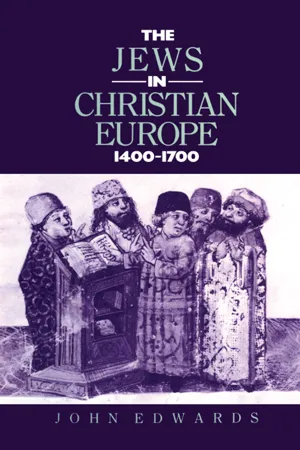
The Jews in Christian Europe 1400-1700
About this book
This social and religious history of European Jews in the early modern period is unique in placing Jewish experience in the context of Christian society. Beginning with late medieval Jewry and the expulsion from Spain in 1492 of Jews who refused to convert to Christianity, John Edwards goes on to analyse the role of Jews during the Renaissance, the Reformation and the Counter-Reformation, and ends with the early development of religious toleration and the Enlightenment. He examines the complexity of personal and communal belief and practice, and also describes the social, political and economic experience of Jews and Christians, bringing together Christian and Jewish historiography in order to enrich our understanding of the social relations between the two.
1
Jewish expulsion and dispersion from Spain
Although the greatest historical attention has, with good reason, been focused on the expulsion of unbaptized Jews from Spain in 1492 and from Portugal in 1497, these acts were only the most prominent among many which had the effect of almost removing a Jewish presence from western Europe. The Jewish experience of the sixteenth and seventeenth centuries is incomprehensible without an awareness of the events of the later Middle Ages and of the theoretical and practical attitudes towards Jews which had been evolved before 1500 by Christians of all social levels. The concept of expelling whole Jewish communities from kingdoms or other states itself evolved from a long period of co-existence between adherents of the two religions on the European continent. Once the first such decision had been taken, by Edward I of England, in 1290, there followed a gradual extension of the principle to other areas, the initiative finally coming from rulers themselves. The Capetian Philip IV attempted to expel Jews from the French territories under his control in 1306, and a further effort was made by his Valois successors in 1394. The social, economic, and political upheavals of the fourteenth century, including warfare and the natural catastrophe of the Black Death, led to pressure and restriction on the remaining Jewish communities in France, Germany, and Spain because of the widespread accusation that Jews were responsible for the spread of the plague. But ‘definitive’ expulsions only became widespread in the first half of the fifteenth century, beginning in Vienna in 1421 and continuing with Linz in the same year, Cologne in 1424, Augsburg in 1439, Bavaria in 1442, with a second attempt in 1450, and the royal cities of Moravia in 1454. The piecemeal implementation of the expulsion policy in the Holy Roman Empire reflects the fragmented nature of that political entity in the period. Between 1490 and 1510, Jews were expelled from Geneva, Mecklenburg, Pomerania, Halle, Magdeburg, Lower Austria, Styria, Carinthia, Württemberg, the archdiocese of Salzburg, Nuremberg, Ulm, and the electorate of Brandenburg. Local expulsions also occurred in Italy, at Perugia in 1485, Vicenza in i486, Parma in 1488, Milan and Lucca in 1489, and Florence and its subject towns in 1494. The Spanish expulsion also spilled over into Spanish-ruled territories in Italy, including Sardinia and Sicily in the same year, 1492, and, once Ferdinand had regained Naples from the French in 1510, most of the Jews on the mainland south of Rome were expelled too. In 1498, the French Crown finally achieved a long-term aim by removing Jews from its lands in Provence.1 The shift of the centre of gravity of Jewish life in Europe from the west of the continent to the centre and east will be one of the major themes of what follows. It is necessary first, though, to examine the process which led to such remarkable unanimity among the rulers of Europe, apart from the Popes, who allowed Jews to remain in their Italian and French territories, and those who controlled comparatively few other lesser political units.
The medieval Church and the Jews
Religious tension between the Jews and Christians is of the essence of the origins of Christianity itself. A conflict seems to have arisen inevitably from the historical priority of Judaism and the fact that Christianity first broke away from it and then achieved vastly greater power and influence. These two phenomena created a fundamental imbalance in the relationship between the two religions and their adherents in later centuries. In the first place, Jews needed much less from religious dialogue, for its own sake, than did Christians. In theological terms, it was the Christians who needed to justify, to themselves as much as to anyone else, their rebellion against Judaism and their subsequent independence. They needed Jews to admit that this rebellion had in fact been justified, and to end the schism by accepting the Christian revelation. Jews, on the other hand, had no special need for religious dialogue as such. As has already been stated in the earlier discussion of historical perceptions, medieval Jews believed that they already had the truth and a divinely ordained role in the world’s history. In religious terms, they had nothing to learn from Christians. In political, social, and economic terms, on the other hand, the situation was very different. Quite early in the independent history of Christianity, and certainly by the fourth century, when the Emperor Constantine converted to that religion and officially adopted it throughout his empire, the Christian theological attitude to Judaism had begun to interrelate with social policy towards Jews. Theory was beginning to influence practice. Although the authorship and redaction of the texts which came eventually to be regarded as the canonical New Testament is a subject of deep doubt and controversy, it is undeniable that the versions which were handed down as the revealed word of God to medieval Christians, in the Latin Vulgate translation, already contained words which theologically condemned and downgraded Judaism and which could, if turned into practical policy, have had a similar effect on the persons of Jews themselves. Thus the apostle Paul, in the midst of his pastoral controversies with non-Christian and Christian Jews, often resorted to strong language in his letters. Writing to the Corinthians, for example, he said: ‘Their minds were hardened; for to this day, when they read the old covenant, the same veil remains unlifted, because only through Christ is it taken away. Yet to this day whenever Moses is read a veil lies over their minds’ (2 Cor. 3: 14–16). This passage includes the motifs of blindness and hardness of heart which were to become stock attributes of Jews in the minds of medieval Christians and which were to be faithfully repeated in the Good Friday collect in Cranmer’s Anglican prayer book, still ‘legal tender’ today, in its 1662 version. Some Gospel passages, probably written later in the first century, although this is very much a matter of dispute, go even further in providing ideas and vocabulary for Christian hostility to Jews. This is particularly true of John’s gospel, through its varied and undiscriminating use of the phrase ‘the Jews’ to mean, at different times, the Jewish political leadership, religious parties or sects, such as the Pharisees and Sadducees, or even the people as a whole.2 When Jesus said to the Pharisees, according to John’s account, ‘You are of your father the devil; and your will is to do your father’s desires. He was a murderer from the beginning, and has nothing to do with the truth’ (John 8:44), it seems hardly surprising that the ignorant, or the malicious, should have assumed these words to apply to all Jews, both past and contemporary.
Although good recent scholarship suggests, contrary to what some Christian theologians have thought in the guilt-laden period since the Holocaust, that it would be quite wrong to assume that anti-Jewish feeling did not exist in the Ancient World before the rise of Christianity,3 it cannot be denied that, in the medieval period, scriptural teaching, as interpreted by the Church, came to have a considerable influence on secular policy towards the Jews. In the seventh century, the apparent power vacuum in Visigothic Spain allowed Church councils, meeting in Toledo, to attempt to put into practice the anti-Jewish sentiments which had previously remained in the minds and written work of the Fathers. The success of these measures was very probably slight, even before they were overtaken and obliterated by the Muslim invasion and conquest, but they at least threatened economic and social persecution, as well as heavy pressure to convert to Christianity.4 However, it was in the eleventh century that European Jews under Christian rule once again found themselves subject to large-scale persecution.
He Who spoke causing the world to come into being – He shall avenge the spilt blood of His servants. The enemy said: ‘Let us take to ourselves possession of the habitations of God,’ and ‘Let us cut them off from being a nation; that the name of Israel may be no more in remembrance.’5
The late medieval history of the Jews in western Europe may be held to begin with the attacks on Jewish communities in the Rhineland mounted by forces taking part in the First Crusade. In the spring and summer of 1096, large but unknown numbers of Jews were murdered by the followers of Emicho of Leiningen, and probably in some cases by local inhabitants in Mainz, Cologne, Speyer, Worms, and many other places. A group of chronicles, or martyrologies as Kochan has described them in the case of an account of the similar massacres which took place in the Second Crusade, has survived.6 Although the literary relation between the three main sources, the chronicles of Bar Simson and of Rabbi Eliezer bar Nathan, together with the Narrative of the Old Persecutions, or Mainz Anonymous, is not entirely clear, they all appear to be twelfth-century compositions, intended not to give a historical account as such, but rather to provide a liturgical and religious commentary and commemoration to indicate to later Jewish communities the persecutions which might await them and the patterns of behaviour which would be expected of them in such circumstances. As such, they are characteristic of Jewish self-perception throughout the late medieval period, but they are also interesting because of the motives which they ascribe to their Christian opponents. As in the above quotation from Bar Simson, these are held by the Jewish writers to be both economic and religious. Jews were robbed of their wealth, but they were also faced, on numerous occasions, with the choice between baptism and death, and the authors of the chronicles of the First and Second Crusades held up the example of the Rhineland communities to their successors because so many, in 1096, chose to die, often by their own hands, rather than convert.7 This example was, however, to be rarely followed in later centuries. It is interesting also to note the contemporary Christian reaction to the massacres and mass suicides of the Jews. Christian chronicles of the Crusades generally have little or no space for these events, though Albert of Aix gives a brief account, critical of Christian conduct, of the deaths in Cologne and Mainz.8 It seems fairly clear, though, that whatever the motives of these attacks, they received no kind of official approval, ecclesiastical or secular.
This situation appears to change in the thirteenth century, thus forming the religious, political and social context in which most of western Europe’s Jews were to find themselves up to the sixteenth century. It is best to set out the general policies which were proposed, before attempting to understand the rationale and motives behind them. The most important single influence on secular policy towards Jews in the later Middle Ages, other than more immediate and local factors, was the Fourth Lateran Council of the Roman Church, which, in 1215, produced guidelines on Christian conduct towards Jews intended to be mandatory for all the faithful, including the rulers of states, who were to embody them in their own legislation and enforce them as soon and as effectively as possible. One purpose of this legislation was to reduce social contact between Jews and Christians. Ideally, the only dealings allowed would be economic transactions between specialized merchants and traders of the two communities. There should be no sexual relations between partners of differing religions. Jews were not to employ Christians or to hold any kind of public office which would give them authority over Christians. In addition, Jewish worship was to be restricted. Maintenance of existing synagogues was to be permitted, but new ones were not normally to be built, and, if they were, they should certainly not be elaborate or ornate in design. There is no specific demand for ghettos in Lateran IV, but the Church’s laws clearly supposed a large effective measure of segregation.9 The enthusiasm and effectiveness with which rulers attempted to enforce these laws in their own countries varied considerably, as will become clear, but at this stage it is important to consider why a religious body such as the Roman Church should have legislated in this way on matters of social policy.
The first point to notice is that the Lateran IV canons were not original in their content. The seventh-century Visigothic councils of Toledo, already mentioned, had gone considerably further. The difference was that, in taking up the old question of the proper relationship between Christians and the Jewish communities in their midst, the fathers of Lateran IV were legislating for the whole of the western Church. If their plans were implemented by secular rulers, they would therefore have considerable influence on the life of the continent. The question of what they were hoping to achieve by these measures is not, however, altogether simple to answer. In an important recent book, Jeremy Cohen has argued that the thirteenth century saw a significant change in the Church’s policy towards the Jews, one which is reflected not only in the 1215 legislation but also in the work of the orders of mendicant friars, which began and rapidly developed in the rest of the thirteenth century and beyond. Neither of these points can be accepted without careful consideration, which should begin with Christian theology concerning relations between Christians and Jews. For reasons which have already been suggested, much medieval Christian concern with Judaism, certainly in the period between the seventh and thirteenth centuries, was rooted in the pages of the Bible, rather than social relations with contemporary Jews. There were, however, two traditional views of the theological role of Jews, if this were to correspond to God’s plan. The assumption of all thoughtful Christians, and of many others more given to riot than to theological argument, was that eventually all Jews would have to become Christian. Their religion had become obsolete as soon as Jesus began his earthly ministry, so that later Jews were no more than stubborn adherents of a ‘fossilized’ religion. It will become clear, in due course, that such a view would by no means disappear at the end of the Middle Ages, but, for the moment, it is necessary to consider the problem with which medieval Christians believed themselves to be faced. What, if anything, was to be ‘done’ with the Jews? Opinions were divided, mainly on the question of time-scale. Although the long-term aim of including all Jews within the Church was shared almost universally by clerical and lay Christians, it was not clear how or when this should be done. It was generally agreed that the mass conversion of the Jews would be, as stated in the last book of the New Testament, the Revelation of St John the Divine (or the Apocalypse as most medieval Christians knew it), one of the events which heralded the end of the world and the Last Judgement, so vividly portrayed on the walls of many churches. It will be clear from this that the treatment of the Jews was very likely to become entangled with thinking about eschatology, or the study of the ‘last days’. In fact, in the later Middle Ages and on into the sixteenth and seventeenth centuries, policies and attitudes towards the Jews depended to a considerable extent on when particular rulers and churchmen believed the apocalypse was likely to take place. One school of thought, which Cohen links with the name of Augustine of Hippo, made little effort to predict the date when the last days would begin, taking into account Jesus’s request, as recorded in Mark, Matthew, and Luke’s gospels, not to attempt to ‘know the times or the seasons’.10 An historical scheme which envisaged an indefinite wait for the conversion of the Jews did not encourage active missionary work. Thus the Augustinian view assumed that, for the foreseeable future, Jews would remain, unconverted, among the Christian majority in Europe. Their right to do so could not be questioned, but, in order to ensure that they did not attract Christians away from the true faith, whether by means of religious proselytism or by economic pressures or personal ties, they were to be restricted to a subordinate and economically less successful social role. Thus, while the consummation of all things was awaited, Jewish communities would remain as a visible warning of what happened to those who deviated from Christian orthodoxy. It was neither necessary nor desirable, however, to convert them immediately, and it was certainly wrong to expel them. It must be clear that the provisions of the Fourth Lateran Council stand fairly and squarely within this tradition, which therefore became the ideal model for all provinces of the Church and all secular authorities in their policies towards Jews in the late Middle Ages, and, in the case of the Papacy, in the succeeding centuries.
There was, however, another interpretation of eschatology which led to a much more active Christian policy towards the Jews. The fundamental difference between this and the Augustinian view is that the former assumed the last days to be calculable and likely to occur before long. Such a view made the whole question of preparing for the second coming of Christ much more urgent, and the conversion of the Jews a high priority. If put into practice, it would lead to large-scale missionary work among the Jews, and even efforts to force them to be baptized. Strong feelings arose at different times throughout the Middle Ages, and among all social classes, that the end of the world was near. Commonly, such phenomena were connecte...
Table of contents
- Cover
- Half Title
- Title Page
- Copyright Page
- Dedication
- Table of Contents
- Preface
- Introduction: From medieval to modern times?
- 1 Jewish expulsion and dispersion from Spain
- 2 Renaissance, Reformation, and the Jews
- 3 Jews in Italy and the Counter-Reformation
- 4 Jews under Catholicism and Protestantism: the Netherlands, the Empire, and Poland
- 5 A ‘modern’ Jewish life?
- 6 Spiritual crisis and toleration
- 7 Jews and Christians on the eve of the Enlightenment
- Select bibliography
- Index
Trusted by 375,005 students
Access to over 1.5 million titles for a fair monthly price.
Study more efficiently using our study tools.
Frequently asked questions
Yes, you can cancel anytime from the Subscription tab in your account settings on the Perlego website. Your subscription will stay active until the end of your current billing period. Learn how to cancel your subscription
No, books cannot be downloaded as external files, such as PDFs, for use outside of Perlego. However, you can download books within the Perlego app for offline reading on mobile or tablet. Learn how to download books offline
Perlego offers two plans: Essential and Complete
- Essential is ideal for learners and professionals who enjoy exploring a wide range of subjects. Access the Essential Library with 800,000+ trusted titles and best-sellers across business, personal growth, and the humanities. Includes unlimited reading time and Standard Read Aloud voice.
- Complete: Perfect for advanced learners and researchers needing full, unrestricted access. Unlock 1.5M+ books across hundreds of subjects, including academic and specialized titles. The Complete Plan also includes advanced features like Premium Read Aloud and Research Assistant.
We are an online textbook subscription service, where you can get access to an entire online library for less than the price of a single book per month. With over 1.5 million books across 990+ topics, we’ve got you covered! Learn about our mission
Look out for the read-aloud symbol on your next book to see if you can listen to it. The read-aloud tool reads text aloud for you, highlighting the text as it is being read. You can pause it, speed it up and slow it down. Learn more about Read Aloud
Yes! You can use the Perlego app on both iOS and Android devices to read anytime, anywhere — even offline. Perfect for commutes or when you’re on the go.
Please note we cannot support devices running on iOS 13 and Android 7 or earlier. Learn more about using the app
Please note we cannot support devices running on iOS 13 and Android 7 or earlier. Learn more about using the app
Yes, you can access The Jews in Christian Europe 1400-1700 by Dr John Edwards,J. Edwards in PDF and/or ePUB format, as well as other popular books in History & World History. We have over 1.5 million books available in our catalogue for you to explore.