eBook - ePub
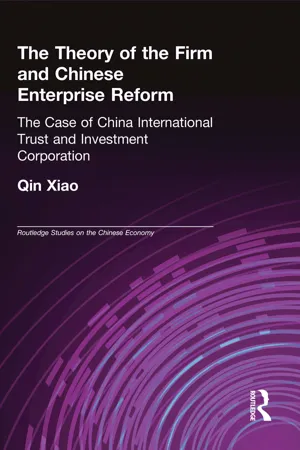
The Theory of the Firm and Chinese Enterprise Reform
The Case of China International Trust and Investment Corporation
- 224 pages
- English
- ePUB (mobile friendly)
- Available on iOS & Android
eBook - ePub
The Theory of the Firm and Chinese Enterprise Reform
The Case of China International Trust and Investment Corporation
About this book
Changes to corporate structure, including the role of the corporate headquarters, have been key factors in bringing about economic reform in China. In this penetrating and insightful book, Xiao questions the conventional theory of the firm, arguing that the ultimate goal of the headquarters of modern large corporations is to function as a substitute for the market, and introducing a new explanation for the nature of the firm - the 'substitution function model'. He provides an insider's account of the reforms in CITIC, a rare narrative that should be essential reading for scholars and practitioners who care about the theory and practice of the firm, in particular in the context of Chinese enterprise reform.
1 Introduction
Background
Development of enterprise and its management system
This book examines the function of the headquarters of modern large corporations (enterprise, company or firm hereinafter). The emergence of modern large corporations can be traced back to the United States in the early twentieth century. According to the investigations conducted by A.D. Chandler Jr (1977), new technology (for instance, the railway and freezing technology in meat processing) and market expansion created the environment for the emergence of large enterprises. The rise of large enterprises led to major changes in the enterprise system and organizational structure. This was mainly reflected in the replacement of the proprietors by professionally trained and salaried managers, thereby creating the separation of ownership from management and the establishment of the modern enterprise system in corporations. Professional managers set up a hierarchical system and used administrative means instead of the market mechanism to allocate resources and coordinate transactions, creating a “visible hand” in response to the “invisible hand” of the market.
Almost a hundred years have passed since the emergence of large corporations and the modern enterprise system. Modern large corporations have become a prominent phenomenon in global economic activities.
First of all, their sheer size is beyond one’s imagination. Based on the data from the World Bank and Fortune magazine for the year 2001, when we rank the largest economies according to sales revenue and gross domestic product (GDP) under the assumption that each corporation or country is in itself an economy, we find that there are 48 countries and 52 large corporations among the top 100 economies of the world. The combined sales revenue of the top 500 large companies in the world stands at US$14 trillion, accounting for 45 percent of the global GDP (World Bank 2001; Fortune 2001). Although sales figures and GDP figures are not strictly comparable, these statistics give us some idea of the scale of today’s giant corporations.
Second, from the perspective of industry concentration, large corporations have a very high market share, particularly in major modern industries such as automobiles, petrochemicals, financial services, public utilities, aviation, national defense, telecommunications, electronics and electrical appliances, as well as computer software. Though small in number, large corporations are the backbone of the national economy.
Third, apart from their size and their control over the major industries of the national economy, large corporations have created a network with the surrounding social economy, especially with small and medium-sized enterprises (SMEs). Large corporations operate in an open system as some of their business activities are outsourced or sub-contracted; for example, procurement of raw materials and components, the sale of products, franchises and specialized professional services (including financial services).1 Through contracts, large corporations establish broad relationships with a large number of SMEs as well as intermediary service providers, thereby creating a huge network, within which they function to coordinate and integrate the markets, leading to the improvement of efficiency of market economic activities as well as the enhancement of market order and stability.
Fourth, since the large corporations we are talking about here are transnational corporations, their roles and influences in the world economy are becoming increasingly important during the process of economic globalization. According to statistics published by the UN Committee on Trade and Development (UNCTAD) on September 18, 2001, the world’s 63,000 transnational corporations with their 800,000 foreign affiliates, drive foreign direct investment and account for about two-thirds of the total amount of world trade and increasingly shape trade-patterns (UNCTAD 2001).
In the past hundred years or so, major changes have taken place in the internal organizational structure and management systems of large corporations. The changes have raised a number of questions with respect to the motivating forces that lie behind this evolution and principles that should be applied in selecting and designing the model for the internal organizational structure: how to define the position and function of the headquarters within their gigantic organizational system; how to distribute the power between the headquarters and the subordinate units; and what the procedures are for making strategic and operational decisions. These issues are significant for theoretical study and have a vital importance for the decision-makers of large corporations as well, since the answers to these questions will have a decisive impact on the growth, performance and competitiveness of large corporations.
Since the early 1990s, five major changes have taken place in respect to global economic activities. First, the pace of economic globalization and economic regionalization has accelerated. The process has increased the flow of goods, capital and services, providing transnational corporations with more room for mobilizing and allocating resources. In this new market environment, improvement of efficiency in the allocation of internal resources has become an essential issue for large corporations. Second, the new round of corporate mergers, reorganizations and alliances rapidly gained momentum and with a greater number of industries involved. As a result, “super-large corporations” with multi-functions have emerged. What is the economic rationality of these mergers and acquisitions (M&A)? And while obtaining economies of scale and scope, increasing market share and reducing market transaction costs, how does one realize the synergies to achieve 1+1 >2 and solve the problem of increased internal coordination costs and “organizational failure?” Third, the development and application of high-tech, represented in particular by information technology, indicates the arrival of the knowledge-based economy and the information era. Information technology has had a huge impact on the production and management of corporations. Typical examples are flat hierarchies and the emergence of various types of “de-hierarchy models.” This has led to a new trend different from that of super-large multi-functional corporations. In future markets, how much room will there be for the development of the “de-hierarchy corporation?” Will it replace the traditional hierarchical organizational structure? These are the new topics attracting people’s attention. Fourth, the financial service industry occupies a prominent position at the heart of global economic activities. However, at the same time, the financial system is fragile, riddled with frequent financial turbulences and crises, which have caused severe economic damages and are increasing the uncertainties and risks for large corporations. Finally, human resources have become the key factor for corporations in improving their competitiveness. Those who possess knowledge and can contribute to management constitute companies’ most important resource. The transformation from personnel management to human resource management marks the new management concept of modern enterprises.
The developments in the external environment discussed above are influencing the business activities of large corporations. In addition, they are leading to changes in their internal organizational structure and management systems.
The development of firm theories
The emergence and development of large corporations have attracted the attention and interest of economists. They pose a challenge to the neoclassical theory of the firm and traditional management theory. Neoclassical economists start from a hypothesis of rationality, viewing a firm as a “production function” or just a “black box.” They believe that the basic production factors such as capital, land and labor determine the performance of a firm in a competitive market, and the responses of the firm to price signals in the market will ultimately lead to the rational allocation of scarce resources. However, the issue which has not been properly addressed is how to allocate these production factors within the enterprise as well as what elements will influence the cost and efficiency in the allocation process.
Chandler’s research on the history of modern American industrial enterprises shows the existence of a “visible hand” therein. Why did this “visible hand” come into being? How does it work? The new institutional school led by R.H. Coase and O.E. Williamson has answered the first question and conducted some research on the second. Based on transaction cost theory, Coase argues that the nature of the firm is to substitute for the market, namely, using organizational means through internalizing transactions to replace the market pricing mechanism in the allocation of resources, thus reducing transaction costs. This theory explains the reason behind the “visible hand” (Coase 1937). Williamson further develops Coase’s research by looking into the conditions and factors related to the substitution process. He also introduces the analytical method of transaction costs into the internal management of enterprises, focusing on the study of internal organizational structure (Williamson 1975).
Information economics and agency theory have also significantly contributed to the formation and development of the modern theory of the firm. They have examined the information mechanism and incentive mechanism under the hierarchical structure within the enterprise.
The emergence of the modern theory of the firm signifies a breakthrough of economics in examining modern enterprises. However, economics has its own limits with respect to the scope of coverage and depth of penetration in analyzing practical issues of the organizational structure and management systems within enterprises, especially in relation to the function of corporate headquarters. As a discipline focusing mainly on enterprise management, management theory or managerial theory of the firm should be more responsive in explaining and analyzing the management systems within enterprises.
Management theory was born in the late nineteenth century and early twentieth century, and has made profound progress in its history of approximately 100 years. It has established itself as an independent discipline with remarkable results and extensive applications. From classical management theory led by F.W. Taylor, H. Fayol and M. Weber to the behavioral school, and from Simon’s theory of decision-making, the systems approach and the management science school to the contingency approach, management thought has established its main principles beyond “economic man,” by viewing human behavior, demand and human resource as important elements of enterprise management. The introduction of systems theory, information economics, operational research and mathematical statistics has enriched management research and stimulated its development. Nevertheless, the important economic phenomenon of modern large corporations in real life seems to have escaped the attention of management scientists. The modern theory of the firm and its methods, such as transaction costs, principal and agent, have not been systematically integrated into management research. The basic framework of mainstream management study is still based on the traditional neoclassical theory of the firm, which views the enterprise as a “production function.” Its primary research focus is on the management of the operation and production of a factory as opposed to the function of the headquarters of modern large corporations. In modern large corporations, headquarters and their subordinate business units have become two relatively independent tiers within a system. Traditional management theory has not been able to provide a comprehensive explanation of the organizational structure and the management system, particularly in relation to the function of corporate headquarters.
In Chapter 2, “Overview of the Literature,” we shall have more extensive and in-depth discussions on the theoretical aspects of the issue.
The reform and development of Chinese enterprises in the transitional process
Studies on the function of headquarters of modern large corporations have special significance for China in terms of both theory and practice, as China is experiencing the transformation from a planned economy toward a market economy. Reform and development in its micro system do not occur as a result of a natural process of evolution. Instead, they are a process of mutation with a strong element of artificial design. Trends, progress and problems appearing in the process have special value for research.
Under the current Chinese economic structure, large and medium-sized State-owned enterprises (hereinafter referred to as SOEs) occupy a dominant position. This is reflected in their contributions to the national GDP and their market shares in important industries.2
China’s economic reforms beginning in the late 1970s have by now moved to a historical stage of micro-economic restructuring. Governments at various levels have gradually withdrawn from the direct operational activities of SOEs, while the market mechanism is becoming the predominant force in resource allocation. The SOEs established under the traditional planned economy are currently undergoing a corporatization process in order to establish a modern enterprise system. The open door policy has attracted capital and technology and at the same time introduced advanced management concepts and systems to China. Under the impact of market forces, the survival of the fittest and the trend toward economies of scale, as well as the division of labor, are feeding the wave of M&A, resulting in the emergence of an increasing number of large corporations. In the late 1990s, along with the acceleration of economic globalization and China’s imminent accession to the World Trade Organization (WTO), enterprises in China were facing more direct and all-around international competition. To cope with the changes, the government and business circles began to pay attention to the development and reform of large Chinese enterprises. For this purpose, the government started to formulate the strategy of developing large enterprises. Starting in 1998, the government began to restructure a dozen industries, including oil, petrochemicals, iron and steel, aerospace and aviation, shipbuilding, heavy machinery, military industry, nonferrous metals, telecommunications, railways and civil aviation, which has led to the reorganization of 30 large companies. The restructuring program was based on the principles of specialization, breaking up monopolies and the separation of government functions from corporate functions. At the same time, the government started to actively implement the reforms of SOEs with the objective to establish a modern enterprise system and obtain access to domestic and overseas stock markets.
The SOE reforms currently under way in China mainly try to achieve the following three objectives:
- 1 to transform the property rights structure of SOEs and to establish a modern enterprise system and corporate governance structure through joint-stock restructuring, privatization and listing on the stock market;
- 2 to improve the unsatisfactory situation of SOEs, such as the lack of vitality and protracted losses through reforms in incentive mechanisms and strengthening management;
- 3 to increase scale and improve the degree of specialization of SOEs to meet the competition in domestic and international markets through mergers and reorganizations.
Of course, reforms at the micro level also require corresponding reforms at the macro level. These mainly include readjustment of government functions, establishing social security systems, rectification of market order and strengthening the development of legislation and law enforcement.
Thanks to nearly three years of hard efforts since 1997, most SOEs have extricated themselves from the plight of prolonged losses. Quite a number of them have increased their scale and improved their degree of specialization. With the growth of domestic capital market, SOEs have made progress in corporatization, establishing a joint-stock structure and being listed on the stock exchange.3 Generally speaking, SOEs lag far behind large international companies in terms of scale, profitability and technology, as well as management. Therefore, reforms of SOEs in China have just achieved initial results while the implementation of the reforms will require a fairly long process.
Among the reforms mentioned above, this book focuses mainly on organizational structure and management systems, as well as the function of the headquarters of large SOEs in the transitional period. Based on this author’s observation and research, during the reform process of the past 20 years, China’s SOEs have made a detour from the proper path in terms of establishing an internal organizational structure and management system. They have paid...
Table of contents
- Cover
- Title
- Copyright
- Dedication
- Contents
- List of figures
- List of tables
- Endorsements
- Foreword
- Preface
- Preface
- Author's preface
- 1 Introduction
- 2 Overview of the literature
- 3 The establishment of the "substitution function model" and the study of the relevant variables
- 4 The CITIC story: a case study
- 5 Conclusion
- Appendix I: on the reform of CITIC's internal management system
- Appendix II: CITIC Internal Documents (CID)
- Notes
- Bibliography
- Index
Trusted by 375,005 students
Access to over 1.5 million titles for a fair monthly price.
Study more efficiently using our study tools.
Frequently asked questions
Yes, you can cancel anytime from the Subscription tab in your account settings on the Perlego website. Your subscription will stay active until the end of your current billing period. Learn how to cancel your subscription
No, books cannot be downloaded as external files, such as PDFs, for use outside of Perlego. However, you can download books within the Perlego app for offline reading on mobile or tablet. Learn how to download books offline
Perlego offers two plans: Essential and Complete
- Essential is ideal for learners and professionals who enjoy exploring a wide range of subjects. Access the Essential Library with 800,000+ trusted titles and best-sellers across business, personal growth, and the humanities. Includes unlimited reading time and Standard Read Aloud voice.
- Complete: Perfect for advanced learners and researchers needing full, unrestricted access. Unlock 1.5M+ books across hundreds of subjects, including academic and specialized titles. The Complete Plan also includes advanced features like Premium Read Aloud and Research Assistant.
We are an online textbook subscription service, where you can get access to an entire online library for less than the price of a single book per month. With over 1.5 million books across 990+ topics, we’ve got you covered! Learn about our mission
Look out for the read-aloud symbol on your next book to see if you can listen to it. The read-aloud tool reads text aloud for you, highlighting the text as it is being read. You can pause it, speed it up and slow it down. Learn more about Read Aloud
Yes! You can use the Perlego app on both iOS and Android devices to read anytime, anywhere — even offline. Perfect for commutes or when you’re on the go.
Please note we cannot support devices running on iOS 13 and Android 7 or earlier. Learn more about using the app
Please note we cannot support devices running on iOS 13 and Android 7 or earlier. Learn more about using the app
Yes, you can access The Theory of the Firm and Chinese Enterprise Reform by Xiao Qin in PDF and/or ePUB format, as well as other popular books in Business & Business General. We have over 1.5 million books available in our catalogue for you to explore.