This book is the first systematic scholarly study on the business history of Turkey from the nineteenth century until the present. It aims to place the distinctive characteristics of capitalism in Turkey within a global and comparative perspective, dealing with three related issues. First, it examines the institutional context that shaped the capitalist development in Turkey. Second, it focuses on the corporate actors, entrepreneurs and business enterprises that have led the national economic growth. Third, it explores the ethical foundations and social responsibility of business enterprises in the country. The comparative and historical approach sets the volume apart from previous books on the subject.
Business, Ethics and Institutions aims to strengthen scholarly and policy understanding of Turkish capitalism and the diversified business groups which dominate the economy by providing a deep analysis of the evolution of political and social institutions which shaped corporate activity. It demonstrates the key role played by large family-owned business groups in Turkey's development. It also seeks to identify both the similarities and the differences in the Turkish pattern of economic development, making comparisons with Japan, an early example of catch-up, and a more successful model than Turkey. The comparative perspective makes the book highly relevant to a wide range of scholars interested in the institutional foundations of modern capitalism and will be of value to researchers, academics, and students in the fields of business and economic history, ethics, organizational studies, and entrepreneurship.
The Evolution of Turkish Capitalism in a Comparative Perspective1
Asli M. Colpan and Geoffrey Jones
This book seeks to provide a broad overview of the business history of Turkey and its predecessor, the Ottoman Empire. There are major scholarly studies on the economic history and political economy of Turkey, some written by authors in this volume.2 The distinctive contribution of this book is the greater focus on business enterprises, and the attempt to explore the coevolution of business enterprises with the institutional, economic and social context in shaping Turkey’s politics and institutions. The authors address the role of political and social institutions in corporate development, how business formation and change contributed to economic growth, and how ethics and corruption shaped both political and business developments. The book seeks to place the Turkish experience in a comparative context, and so show how the Turkish example can shed light on broader issues of economic development, corporate strategy, and organizational change.
At the broadest level, the Turkish experience forms an important case study in the debate that has raged among economic historians for a decade about the “Great Divergence.” At some stage, which is still debated, incomes in Western Europe rose above those in Asia and elsewhere in the world. The Ottoman Empire appears to have broadly similar incomes to Western Europe around the sixteenth century, but then a gap opened. When modern economic growth started with the Industrial Revolution in eighteenth-century Britain, the gap in incomes between the developed West and the Rest grew wider still. A number of non-Western countries, beginning with Japan, caught up, but it was not the norm. The telling of this story has involved lengthy research in developing historical statistics, especially developing indices of GDP per capita and real wage levels.3 Yet despite considerable scholarly work, a dearth of historical data remains, along with many continuing uncertainties.
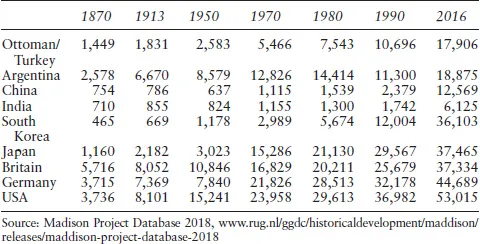
The available data certainly confirms that the Ottoman Empire and Turkey were on the “wrong” side of the Great Divergence. Table 1.1 compares per capita GDP growth in the Ottoman Empire/Turkey with that of other nations.
Table 1.1Real GDP Per Capita 1870–2016 in the Ottoman Empire/Turkey and Other Countries (in 2011 US$)
According to this data, the Ottoman Empire was well behind the per capita GDP levels of developed Western countries such as Germany and the United States in 1870. It was also behind Argentina, which was beginning to grow rich through commodity exports. However, the Ottoman Empire was far more affluent than China, India, Japan and Korea. By 1913, Japan, which was undergoing modern economic growth following the opening of the country in the Meiji Restoration in 1868, had surpassed the Ottoman Empire, but Japan’s per capita income levels were otherwise still far higher than those of the other Asian economies. This remained true in 1950: Indian real income levels had fallen during the last decades of British colonial rule, while China had been devastated by two decades of Japanese invasion and civil war. Turkey had not, however, caught up at all with the developed West. The gaps between Turkey and both the West and Japan grew much larger during the decades before 1980. By 1990, South Korea, which had been much poorer than Turkey before 1950, had surpassed Turkey in per capita income, and by 2016 the gap had become huge as South Korea grew wealthy rapidly. By 2016 Turkey’s per capita income was still higher than China and India’s, but both Asian countries began experiencing extremely rapid growth in 1990 and very sharply narrowed the gap between them and Turkey. Turkey never “caught up” with the West, and never achieved the growth spurts of China, Japan and South Korea.
Most of the research on why modern economic growth began in the West, and why countries in the Rest, such as the Ottoman Empire/Turkey, failed to catch up, has focused on macro-level explanations, of which three stand out. The earliest is the role of culture. Crudely put, the West had the “right” culture, and the Rest had “wrong” cultures for capitalist enterprise. Weber, Landes and Mokyr have made this argument in one form or another, as has Ferguson more recently when he identified the Protestant work ethic as one of the West’s “killer apps.”4 As Chapter 2, by Ağır, argues, Muslims’ attitudes on business were seen as a problem by late Ottoman intellectuals themselves. “Lack of striving for profit through trade, asceticism, and laziness” are cited as the cultural attributes of the “Ottoman man” that caused Muslims to fail in business activities. Thus, according to some authors, governmental attempts to fill the institutional void in order to develop the economy were doomed because of such cultural factors.5
The second proposed explanation is that, following the work of Douglass North, the West had the “right” institutions to promote capitalist economic growth, and the Rest did not.6 This has led to debates about whether the long-term impact of particular colonial regimes, such as the British colonies in North America, had the “right” sort of colonialism, while the Rest did not, and whether countries with a common law system had the “right” legal regime for encouraging capitalist development, and the Rest not. A serious flaw in this theory is its use of property rights laws as a proxy for institutions.7 It is not evident that the West’s property rights regimes were superior to those of parts of the Rest. British India, for example, operated under the common law system. The widespread existence of market activities and the importance of private property in nineteenth-century (and earlier) China would not suggest an overwhelmingly poor property rights regime.8 While the lack of company law in that country might have made capital raising difficult, when China finally introduced a Company Law Act enabling limited liability in 1904, few Chinese companies registered under the act.9
Whatever the weakness of some institutional theories, this line of thought has been influential in explaining Turkey and the Middle East’s developmental challenges. In a study published in 2011, Kuran described Islamic law as a major developmental obstacle. He argued that the inheritance system fragmented the estates and property of successful business, the practice of polygamy dispersed wealth, and the ban on usury made it difficult for merchants to obtain credit. The bar on interest also meant that banks could not fully develop.10 The Ottoman Empire did import French commercial law in 1850. This provided an organizational form that could be used to raise capital, but, as Ağır notes in Chapter 2, take-up was very low.
Finally, education (or lack of it) has been used to account for global wealth and poverty.11 While plausible, the link with the development of modern business has never been clearly established. Eighteenth- and nineteenth-century China had widespread literacy, for example, which did not translate into the creation of modern firms.12 Probably the greatest negative consequence of low education levels was raising the cost of skilled labor. In the case of colonial India, the high cost of skilled labor has been identified as one possible explanation for why the country remained inclined to small-scale traditional manufacture.13 Whatever the exact consequences, and accepting that there are acute difficulties with the methodology of measuring and comparing education levels between countries, we may safely conclude that literacy levels were low in the Ottoman Empire and the Republic of Turkey. Using an adult literacy metric, we observe that Turkey had 8.2 percent literacy in 1925 and 30 percent in 1950. In comparison Argentina, which had the best education system in Latin America, had adult literacy rates of 60 and 87 percent in those years. In 1950 China had 47 percent adult literacy and Thailand 52 percent, although India had only 19 percent.14
This book does not seek to engage directly with these macro explanations of the Great Divergence, although it contains particularly rich insights on the development of institutions. It does seek to develop a more firm-specific lens through which to view the issues, something that has been notably absent from most of the Great Divergence literature.15
1.1 Is Turkish Business History Distinctive?
A recent survey of the business history of emerging markets observed considerable commonalities across Africa, Asia and Latin America arising from the fact that businesses based in these regions faced five common challenges.16 Because Turkey encountered the same obstacles, its development experience was quite typical of many countries beyond Western Europe and North America. First, and most obviously, these countries had to catch up with the developed West. This left them with multiple impediments to building successful businesses, from finding skilled labor forces to breaking into markets already dominated by powerful Western incumbents. Naturally, in the broad picture there was much variation within individual countries. India may have been poor and rural before World War I, but the port cities of Bombay and Calcutta were important hubs of modern business enterprise.17 In the Ottoman Empire, Istanbul was a large commercial and cultural center, quite different from the rural areas where most people lived.18
A second challenge faced by these countries was Western imperialism. In nineteenth- and early twentieth-century Africa and South Asia, and earlier in Latin America, the social, institutional and cultural impact of colonization was huge, enduring and more often negative than positive. The Ottoman Empire was one of the countries that escaped formal colonialization, but experienced long periods of constrained autonomy.
In the case of the Ottoman Empire, the West’s political power was evident. The so-called “capitulation” treaties, especially those from the early nineteenth century, gave special privileges to Europeans and the non-Muslim minorities who lived in the Empire, primarily Greeks, Armenians and Jews. These communities were free to choose European legal jurisdictions besides the Ottoman Islamic judicial system in disputes involving non-Muslims, such as in contracting and dispute resolution. They were also exempted from several taxes and paid lower customs duties.19 As the Ottoman Empire aimed to modernize itself during the Tanzimat (Reform) period (1839–1876), Muslim Turks could obtain jobs in the bureaucracy and viewed business as an inferior occupation. The overall result was that the Turkish Muslim majority was relatively absent from private business.20
The financial collapse and default of the Ottoman government in 1875 was a pivotal event in Ottoman history that rendered the government subject to restrictive Western controls. The Empire basically lost financial autonomy after the formation of the Public Debt Administration, dominated by European bondholder organizations, in 1881. The consequences, however, are debatable. Although this crisis is classically seen as an example of malign Western imperialism, Burdal paints a more nuanced picture, arguing that it enabled the Ottoman government to borrow at lower rates because of reduced risk, and especially resulted in a surge of foreign direct investment, which among other things facilitated the development of railroads.21
Third, almost all these countries went through long periods of state intervention. As noted by Fridenson in Chapter 6, government ...
Table of contents
Cover
Half Title
Series
Title
Copyright
Contents
List of Figures
List of Tables
List of Abbreviations
Foreword
Part I Institutions and Capitalist Development
Part II Corporate Actors and Public Interest
Contributor Biographies
Index
Trusted by 375,005 students
Access to over 1.5 million titles for a fair monthly price.
Study more efficiently using our study tools.
Frequently asked questions
Yes, you can cancel anytime from the Subscription tab in your account settings on the Perlego website. Your subscription will stay active until the end of your current billing period. Learn how to cancel your subscription
No, books cannot be downloaded as external files, such as PDFs, for use outside of Perlego. However, you can download books within the Perlego app for offline reading on mobile or tablet. Learn how to download books offline
Perlego offers two plans: Essential and Complete
Essential is ideal for learners and professionals who enjoy exploring a wide range of subjects. Access the Essential Library with 800,000+ trusted titles and best-sellers across business, personal growth, and the humanities. Includes unlimited reading time and Standard Read Aloud voice.
Complete: Perfect for advanced learners and researchers needing full, unrestricted access. Unlock 1.5M+ books across hundreds of subjects, including academic and specialized titles. The Complete Plan also includes advanced features like Premium Read Aloud and Research Assistant.
Both plans are available with monthly, semester, or annual billing cycles.
We are an online textbook subscription service, where you can get access to an entire online library for less than the price of a single book per month. With over 1.5 million books across 990+ topics, we’ve got you covered! Learn about our mission
Look out for the read-aloud symbol on your next book to see if you can listen to it. The read-aloud tool reads text aloud for you, highlighting the text as it is being read. You can pause it, speed it up and slow it down. Learn more about Read Aloud
Yes! You can use the Perlego app on both iOS and Android devices to read anytime, anywhere — even offline. Perfect for commutes or when you’re on the go. Please note we cannot support devices running on iOS 13 and Android 7 or earlier. Learn more about using the app
Yes, you can access Business, Ethics and Institutions by Asli M. Colpan,Geoffrey Jones in PDF and/or ePUB format, as well as other popular books in Business & Business General. We have over 1.5 million books available in our catalogue for you to explore.