Although the Nordic countries have a reputation for tolerance and social democracy, they were not immune to fascism which spread across Europe in the 1920s and 1930s. This book offers the first comprehensive history of anti-fascism in the Nordic Countries. Through a number of case studies on anti-fascism in Sweden, Finland, Norway, Denmark and Iceland, the book makes a significant contribution to the history of contentious politics in the Nordic Countries and to our broader knowledge of European fascism and anti-fascism. The case studies concentrate on the different manifestations of resistance to fascism and Nazism in the interwar era as well as some of the postwar variants. The book will be of considerable interest to scholars of anti-fascism as well as researchers of Nordic and Scandinavian history and politics.
eBook - ePub
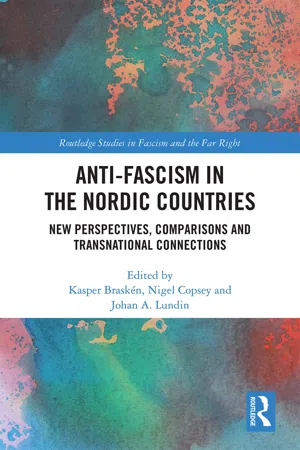
Anti-fascism in the Nordic Countries
New Perspectives, Comparisons and Transnational Connections
- 290 pages
- English
- ePUB (mobile friendly)
- Available on iOS & Android
eBook - ePub
Anti-fascism in the Nordic Countries
New Perspectives, Comparisons and Transnational Connections
Part I
Anti-fascism beyond the far left
1 Anti-fascist discourses, practices and confrontations in 1930s Iceland
Ragnheiður Kristjánsdóttir and Pontus Järvstad
Introduction
The history of fascist organisations in interwar Iceland is short. The first Nazi party, Þjóðernishreyfing Íslendinga (The Nationalist Movement of the Icelanders, NMI), which had close relations with the conservative Sjálfstæðisflokkur (Independence Party, IP), was established in 1933. The following year, the NMI formed an electoral alliance with the IP, but later that year, due to infighting between conservative and radical factions, it was dissolved and replaced by Flokkur þjóðernissinna (The Nationalist Party, NP). However, by 1938 the NP had withered away (Guðmundsson, 1976).
Historian Robert Paxton (2004) has explored the successes and failures of different European fascist movements. While Italian and German fascism succeeded by building a mass movement from all classes of society, Paxton shows that their rise to power was dependent on alliances with traditional elites, which involved sacrificing the more ‘radical’ sections within their movements. In Iceland, its indigenous Nazism failed to reconcile its extremist elements with its conservative ones; it never managed to appeal to traditional elites; and therefore, it was unable to grow beyond being a relatively small group of young men. It also had to face opposition from anti-fascists, as we shall see.
Yet even though there was no mass movement and no members elected as representatives to parliament or municipal governments, fascism and Nazism – as transnational and national phenomena – did exert some significant impact on Iceland’s political landscape. Publishing journals, periodicals and pamphlets, involving themselves in student politics, marching and fighting in the streets, the Nazi movement was still a force to be reckoned with. So too, was their already-mentioned connection with the conservative IP. The anti-fascist struggle thus went well beyond taking on the relatively weak and eventually abortive Nazi movement.
As was the case with most of the neighbouring countries, communists were the most outspoken and active opponents of fascism. Founded in 1930, the Communist Party of Iceland (CPI) evolved into a relatively strong and influential – by Northern European standards – political force. As a result, the CPI has received considerable attention in the historiography of 20th-century Iceland. Much of this has been penned from an anti-communist perspective, which means that the theory of totalitarianism has shaped the historical understanding of the communist struggle against fascism. Communists have either been put on equal footing with the Nazis, or have been represented as the greater threat to Icelandic society. This understanding has coincided with confusion or unwillingness to label right-wing radical nationalist parties as Nazis. Due to their initial close relations with the IP, they have been presented as ‘idealistic anti-communists’ – a bulwark against the Soviet and Communist threat.
Ultimately, this logic leads to a view of militant anti-fascism as part of the Communists’ support for the Soviet Union, and anti-fascist actions as attempts to destabilise the Icelandic state. Not only does this limit the historical and contemporary understanding of fascism as an ideology fundamentally different from communism – with nationalist, racialist and anti-emancipation politics at its core – it also limits our understanding of anti-fascism. Scholars of fascism have convincingly shown that totalitarian theory obscures more than it can explain. By equating communism with fascism, it ignores key differences such as the social composition of the movements, their system of rule, and ideology (Paxton, 2004). Furthermore, they have called into question the equation between anti-fascism and communism (Garcia et al., 2016: 4). And when it comes to fascism’s relation to traditional elites, Martin Blinkhorn (1990) has pointed out that all over Europe, fascism would coalesce with conservative parties on issues such as anti-communism and scepticism towards democracy. Fascism can thus be seen to have occupied a common political space with conservatives. It is worthwhile keeping this in mind when looking at fascism and anti-fascism in Iceland.
The history of anti-fascism in Iceland as a broadly based phenomenon reaching beyond the Communist movement has yet to be written. This is also true of the other Nordic countries where research on anti-fascism during the interwar period has until recently concentrated on the labour movement. This can be contrasted with the rich German historiography of anti-fascism, where the role of specific groups within the church, youth movements, the old elites, conservatives and the military has also been widely explored. Because of its diversity of expression and origins, anti-fascism should not be considered a singular ideology, but rather an oppositional force dependent on its foe for its political expression. Nevertheless, Nigel Copsey (2010) has proposed a definition of anti-fascism not only as an oppositional force, but also as a defence of enlightenment values of humanism, rationalism, modernism and universalism. This anti-fascist minimum is conceptualised from the historical context of interwar Britain, and Copsey has called for further comparative studies.
In a recent article on anti-fascism in the Nordic countries, Kasper Braskén, Matias Kaihovirta and Mats Wickström (2017) have taken steps in this direction. They discuss the unique position of the Nordic countries as stable democracies with strong nationally based Social Democratic movements. Consequently, communism and fascism could be contested with a nationalistic narrative labelling both ideologies as ‘foreign’. This was not as straightforward in Iceland where the Communists stood on firmer ground, seeking legitimacy through a radical nationalist discourse as well as active participation in the labour conflicts of the 1920s and 1930s (Kristjánsdóttir, 2017). Even so, a wider view of anti-fascism in Iceland is long overdue.
By exploring anti-fascist discourses, practices and confrontations in 1930s Iceland, the aim of this chapter is to consider the ways in which fascism found resistance. Even though the pro-Soviet Communist movement was the main agent of anti-fascism and the main player in fascist/anti-fascist confrontations, Icelandic Nazis also met opposition from conservatives, liberals and, in particular, Social Democrats.
Communist politics during the early 1930s in Iceland entailed an emphasis on direct action against the employers and the bourgeois state apparatus. Unions led by Communists were most active in labour conflicts. Following the example from Scandinavia, the leaders of the Social Democratic Party (Alþýðuflokkur, SDP) had taken a clear anti-communist stance in the late 1920s. When the Nazi movement arrived on the political scene, they accordingly defined it as an offspring of Communist militancy. Yet the Social Democrats were both targets of the ‘anti-Marxist’ campaigns of the Nazis as well as active participants in the anti-fascist struggle. So even though the SDP advocated working-class politics being fought by peaceful means and through parliamentary democracy, it took an active stance against state measures that could threaten the negotiating position of the workers. This applies to the youth movement of the party, the rank-and-file in addition to – even though to a lesser extent – the party leadership.
Iceland during the interwar years
When considering interwar Icelandic anti-fascism, it is important to bear in mind that the Icelandic Social Democratic and labour movement was younger, weaker and far less centralised than its sister parties in the Scandinavian countries. The most influential political parties were on the centre and right. First, and largest, was the aforementioned IP, established in 1929. It was a broadly based organisation drawing support from the far right, the moderate right, and even the centre. Second was the Progressive Farmers’ Party (Framsóknarflokkur, PP), a farmers’ party representing rural interests, and as such, both conservative and nationalistic in outlook.
Although the Scandinavian labour parties were founded in the late 19th century, it was as late as 1916 before the Social Democratic Party (Alþýðuflokkur, SDP) and the Icelandic Confederation of Labour (Alþýðusamband Íslands, ICL) were established. Consequently, the Social Democrats were faced with a Communist challenge from an early stage. Organised communism first took form as a small but influential group within the SDP. The CPI (Kommúnistaflokkur Íslands) was founded in November 1930, and it quickly managed to build a relatively strong base, receiving as much as 8.5 per cent of the votes in the parliamentary elections of 1937. In 1938, unity talks between the CPI and the SDP ended with a left faction breaking away from the SDP and joining the CPI in forming the People’s Unity Party – Socialist Party (Sameiningarflokkur alþýðu – Sósíalistaflokkur, SP). As we shall see, this merger can be traced back to the Communist and Social Democratic cooperation in strikes and anti-fascist action during the mid-1930s. Thus, the SDP never secured itself a position comparable to that of its sister parties in Scandinavia. By 1942, the newly founded SP had outgrown – measured in electoral strength – the SDP, leaving the SDP as the smallest of the four political parties in Iceland (Kristjánsdóttir, 2012).
ICL was formed by autonomous trade unions, which each had full freedom to act independently. During the 1930s, many unions remained unaffiliated to the ICL, union membership was relatively low, and the unions led a hard struggle for recognition from the employers. While in Scandinavia, important steps towards institutionalising relations between employers and unions had been taken before the First World War, it was the late 1920s before corresponding steps were first taken in Iceland (Ísleifsson, 2013; Jónsson, 2014). Consequently, labour actions and street-level confrontations were a significant part of the political practice of Icelandic labour – i.e. unions, workers and left-wing political organisations – during the 1930s. The Communists and unions led by Communists were prominent in these conflicts (Ísleifsson, 2013: 232–3).
One major street-level confrontation was the so-called Gúttóslagur of 9 November 1932 (hereafter the ‘Gúttó-incident’). It was a demonstration at a City Council meeting which turned into street fighting between workers and police, and significant for its unprecedented violence, as well as the fact that the workers got the upper hand, forcing the police to flee the scene. Tensions had been building for some time leading up to the event because of the conservative City Council’s intentions of ditching a badly needed job creation programme. It is important to mention that these pushes for a job creation programme only targeted working-class men in work with the direct exclusion of women from such work by the union. Women were not viewed as breadwinners by the labour movement and society, even though it was estimated that 300–400 women in Reykjavik in 1932 were just that (Ísleifsson, 2013: 138–9, 152–3). Although the dire circumstances of Reykjavík’s poor and unemployed were the immediate cause of events, afterwards they were subsequently framed as Communist revolutionaries and therefore a threat to the fledgling Icelandic nation state. As such the Gútto-incident fuelled a great deal of anti-communism. The Icelandic Nazis referred to it as the ‘notorious day of terror’ when the police had suffered battery and mutilation (‘Landráð’, 1933). They warned of a coming civil war (Sturlungaöld) if the Communists were not dealt with properly – i.e. put behind bars – and blamed the incumbent government of the Progressives for treating the Communists with leniency. Thus, anti-communism was one of the foundational ideological tenets of Icelandic Nazism (‘Ávarp’, 1933; ‘Heldur’, 1933).
Ambiguities
The emergence of organised fascism in Iceland in 1933 marked the beginning of a long and ambiguous relationship with the IP. The early Nazi movement had been formed partly in response to the leniency of the IP’s handling of what it saw as the Communist threat, exemplified through the Gúttó-incident. Furthermore, many of the founders were shopkeepers dissatisfied with the economic programme of the IP, which they saw as detrimental to small business owners. But while the Progressives, Social Democrats and Communists immediately renounced the young Nazi movement in their papers, classifying them as a foreign entity, with a foreign symbol, a foreign agenda and being intrinsically violent, the IP was the only party that responded positively, although cautiously (Guðmundsson, 1976: 14–20). In June 1933, the party newspaper, Morgunblaðið, had this to say:
No matter how the Icelandic Nationalists choose to practice their politics in the future, whether their party will use the swastika as an advertisement for Eimskip [A shipping company which used the swastika as its logo], or whether it will symbolize their loyalty to a foreign political party, one thing is sure: The Icelandic Nationalist Movement is a movement that aims to fight the Communist disease and its foreign decay. This movement is sprung from Icelandic soil, from a native necessity.
(‘Þjóðernishreyfingin’, 1933)
The paper’s ambiguity is clear; it makes fun of the use of the swastika while seeing the movement as a justifiable national response to communism.
Some historians have argued that the initial ‘flirt’ between the IP and the Nazis ended when the NP started expressing contempt for the IP and competing with it in elections (Whitehead, 2010: 218–9). It is true that outright positive commentary about the Icelandic Nazis subsided in 1934. But the relations between the two had not been cut short. From his interviews with the Nazi leader Jón Þ. Árnason, historian Ásgeir Guðmundsson concludes that although there were no formal ties between the parties, members of the IP saw the NP as a youth faction of their own party. Many young Nazis would later become prominent members of the IP. Individual IP politicians supported the party financially, giving monthly donations, which proved valuable due to the Nazis constant problems financing their newspaper (Guðmundsson, 1976: 53–4), and during its lifespan, the NP was allowed to advertise in Morgunblaðið. Moreover, when the IP formed a society for conservative workers in 1938, one of its leaders came from the Nazi movement, and some of its ideology was clearly inspired by Nazism, for instance, the motto ‘class with class’ (stétt með stétt), the slogan of the Nazi’s May Day marches (Guðmundsson, 1976: 48; Frostason, 2014: 8–9). As late as 1938, the Social Democrats criticised the IP for having invited the Nazi author Knútur Arngrímsson to speak at their meetings (Arngrímsson, 1937; ‘Sjálfstæðisflokkurinn’, 1938). And even though the conservative press criticised the Icelandic Nazi movement, it was considerably more cautious in criticising the Nazi regime in Germany before the war, writing puff pieces about the regime in its early days (1933–1934). Conservative journalists asked whether the Jews might deserve the persecution they suffered, as well as expressing concern that criticism against the regime could threaten important financial ties between the two countries (‘Gyðingar í Þýskalandi’, 1933; ‘Íslensku Gyðingarnir’, 1934; ‘Þýskalandsviðskiptin’, 1936; Heimisson, 1992: 168–70). Such expressions of sympathy with, or caution towards, the Nazi regime stopped with the outbreak of war and the British occupation of Iceland.
In instances after 1934, where Icelandic Nazis started or ended up in fights with Social Democrats and Communists, Morgunblaðið had condemned the Nazi violence as extremist, while, simultaneously, insisting that the Communists were worse (‘Samfylking’, 1935; ‘Reykjavíkurbrjef’, 1936; ‘Reykjavíkurbrjef’, 1937). And when the Nazi movement died out, the paper was quick to give the IP credit for it, arguing that it had managed the extreme right more skilfully than the left had managed the extreme left (‘Öfgarnar’, 1938). At the same time, it denied accusations that there was a Nazi faction within the party: ‘The Independence party has … shown that it is the only party that believes in democracy. The party refuses all association with the extremist Nazi party. Therefore, the Nazis have been fully removed from Iceland’s political landscape’ (‘Reykvíkingar’, 1938).
As mentioned in this chapter’s introduction, that the Communists and Nazis posed the same kind of threat has been part of anti-communist historiography to this day. The Nazi movement and its fighting group, Fánalið Þjóðernissinna, have been viewed as essentially a reaction to Communist activity and social unrest such as the Gúttó-incident. One extremist group is given the blame for the rise of other; ‘extremism’, it has been claimed, ‘begets extremism’ (Whitehead, 2010: 218). The Nazis have even been depicted as a lesser evil due to their willingness to assist the police in fighting the Communists; the fighting group portrayed as containing idealised anti-communists rather than ‘pure Nazis’. It is worth mentioning that the Nazi fighting group was not only larger than the communist fighting group, ...
Table of contents
- Cover
- Half Title
- Series Page
- Title Page
- Copyright Page
- Table of Contents
- Acknowledgements
- List of contributors
- Introduction
- Part I: Anti-fascism beyond the far left
- Part II: Anti-fascist youth activism and militant resistance
- Part III: Cultural fronts and anti-fascist intellectuals
- Part IV: Post-war anti-fascisms
- Afterword
- Index
Trusted by 375,005 students
Access to over 1.5 million titles for a fair monthly price.
Study more efficiently using our study tools.
Frequently asked questions
Yes, you can cancel anytime from the Subscription tab in your account settings on the Perlego website. Your subscription will stay active until the end of your current billing period. Learn how to cancel your subscription
No, books cannot be downloaded as external files, such as PDFs, for use outside of Perlego. However, you can download books within the Perlego app for offline reading on mobile or tablet. Learn how to download books offline
Perlego offers two plans: Essential and Complete
- Essential is ideal for learners and professionals who enjoy exploring a wide range of subjects. Access the Essential Library with 800,000+ trusted titles and best-sellers across business, personal growth, and the humanities. Includes unlimited reading time and Standard Read Aloud voice.
- Complete: Perfect for advanced learners and researchers needing full, unrestricted access. Unlock 1.5M+ books across hundreds of subjects, including academic and specialized titles. The Complete Plan also includes advanced features like Premium Read Aloud and Research Assistant.
We are an online textbook subscription service, where you can get access to an entire online library for less than the price of a single book per month. With over 1.5 million books across 990+ topics, we’ve got you covered! Learn about our mission
Look out for the read-aloud symbol on your next book to see if you can listen to it. The read-aloud tool reads text aloud for you, highlighting the text as it is being read. You can pause it, speed it up and slow it down. Learn more about Read Aloud
Yes! You can use the Perlego app on both iOS and Android devices to read anytime, anywhere — even offline. Perfect for commutes or when you’re on the go.
Please note we cannot support devices running on iOS 13 and Android 7 or earlier. Learn more about using the app
Please note we cannot support devices running on iOS 13 and Android 7 or earlier. Learn more about using the app
Yes, you can access Anti-fascism in the Nordic Countries by Kasper Braskén, Nigel Copsey, Johan A. Lundin, Kasper Braskén,Nigel Copsey,Johan A. Lundin in PDF and/or ePUB format, as well as other popular books in History & European History. We have over 1.5 million books available in our catalogue for you to explore.