Caught between two worlds of social transition and modern progression, young women in the Middle East have for some time been forging means to balance conventional gender roles and marriage expectations, while also advancing their position in society through improved legal status, health and educational attainment. Yet, with half of Egypt's university-educated women out of the labour market and not seeking work, this study reveals why middle-class women continue to pursue a degree that they fail to use. This book sheds light onto the lives of highly educated middle-class Egyptian women, where they share their stories of spouse selection and marriage, and how education, wealth and unyielding gender roles influence their employment status. Through qualitative ethnography, Negotiating Marriage, Family and Work gives voice to young Egyptian women, both married and single, presenting their self-perceptions, their roles as mothers and wives, and their agency. Carried out from the time of the Arab Spring, this research uncovers the key strategies that middle-class women employ to secure their economic well-being in their marital and domestic contexts, as well as the barriers that married women face in combining paid work and family care.
eBook - ePub
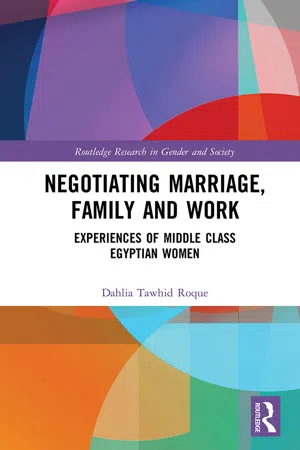
Negotiating Marriage, Family and Work
Experiences of Middle Class Egyptian Women
- 190 pages
- English
- ePUB (mobile friendly)
- Available on iOS & Android
eBook - ePub
Negotiating Marriage, Family and Work
Experiences of Middle Class Egyptian Women
About this book
Information
1 A situation analysis of Egyptian women
The MENA region has experienced the fastest gains in human development worldwide (OECD, 2014a), with women’s socio-economic prospects on the rise. The past three decades have witnessed immense social advancements made for females across the region. Most particularly, the gap between boys and girls has significantly decreased, life expectancy has risen, and access to health and education have greatly increased, so much that more girls are now enrolled in university than boys across the region. In addition, Egypt has made progress in gradually reducing its number of maternal deaths from 106 deaths per 100,000 live births in 1990 to 33 deaths per 100,000 live births in 2015 (WHO, 2016).
Despite these improvements, Egypt continues to lag on a worldwide scale, ranking 115 out of 189 in the UNDP’s human development rank (2018). Moreover, Egypt has continually been ranked as one of the worst countries for women in terms of the gender gap, and despite its impressive improvements in recent decades, it is ranked at 101 out of 160 countries on the gender inequality index (HDR, 2017). This poor ranking is primarily due to Egyptian women’s underrepresentation in politics and in the workforce. Despite the fact that political representation is a global challenge for women worldwide, where on average women only make up 25 per cent of parliamentary seats, the MENA region as a whole continues to have the lowest female parliamentary representation in the world at 18 per cent while for Egypt just 14.9 per cent of women hold parliamentary seats (Khodair and Farrag, 2016). In addition, the MENA region continues to have the lowest female labour force participation rates in the world at just 21 per cent (World Bank, 2017), and 22.8 per cent for Egyptian women (CAPMAS, 2018a).
This chapter presents a background for analysis on Egyptian women’s lives in relation to their approaches to labour market engagement by examining the existing data and literature that address marriage, class, education and the labour market in Egypt and the MENA region. The chapter aims to provide an understanding of the social context in which my participants live, which is discussed in subsequent chapters. The chapter examines the significance of the institution of family and the importance of marriage in Egypt and the wider MENA societies, including key demographic statistics about marriage, divorce and fertility in Egypt compared to other countries in the region. The second section analyses Egypt’s complex class structure, and links this to the current economic situation and the labour market. The chapter ends with an analysis of women’s position in the labour market following the 2011 uprisings.
The family and marriage
[The] family is the centre of all social organisations and constitutes the dominant social institution through which persons and groups inherit their religious, class, and cultural affiliations. It also provides security and support in times of individual and societal stress … [and is] the basic unit of production and economic activity.
(Barakat, 1993, p.98)
In all analyses of families in the MENA region, researchers describe the family as the absolute centre of life (Hoodfar, 1997; Moghadam, 2003; Roudi-Fahimi and Kent, 2007; Rugh, 1984; Shafey, 1998; Sherif, 1999; Sherif-Trask, 2006). The importance of the family is reflected in the World Values Survey (2015), whereby the MENA countries placed the highest level of importance on family in comparison to any other world region. Between 93 per cent and 99 per cent of respondents from the region stated that family in life is “very important”, with 97.4 per cent of respondents in Egypt confirming this. Sherif-Trask (2006) emphasises that despite regional and class differences, in contemporary Egypt the family remains the central institution. This precept is strongly and constantly reinforced both legally and socially. The Egyptian Constitution (1971), for example, identifies the family as the basic unit of society, stating that:
The family forms the basis of society, founded on religion, morality and patriotism. The State strives to preserve the authentic character of the Egyptian family and the values and traditions it embodies, while affirming and developing this character in relations within Egyptian society.
(Article 9)
Successive constitutions drafted since the 2011 revolution in 2012 and 2013 have also kept similar clauses. The core of the Egyptian family is based on marriage. As is in the entire MENA region, marriage in Egypt is considered to be at the centre of both social and religious life (Sherif-Trask, 2003). Moghadam (2004) asserts that in the region, the family is considered as the only institution in society that is both natural and essential (p.137). Marriage is also identified as the single most important event in an individual’s life (Hoodfar, 1997). Cultural norms across the region reject the possibility of living alone (Sherif, 1999; Sherif-Trask, 2003), and Hoodfar (1997) argues that the concept of living alone is almost unthinkable. As a result, individuals will move from their parental household directly into their new household formed through marriage. Marriage is regarded as a “social pinnacle and major turning point in the lives of both men and women” (Shafey, 1998, p.39). Marriage is also seen as a way of validating and strengthening one’s social status in society (Singerman and Ibrahim, 2001) by symbolising the transition to adulthood.
Because marriage is the only culturally and religiously approved form of sexual interaction between males and females (Salem, 2016, 2015; Singerman, 2007; Singerman and Ibrahim, 2001), an extremely strict moral code is enforced by parents for their children prior to marriage, particularly for females (Sherif, 1999). Despite the fact that Egyptian women now have greater opportunities to interact with males in university and the workplace (Moghadam, 2003; Sherif, 1999), women still observe behavioural restrictions so as not to ruin their prospects for marriage (see Chapter 2 for a more detailed discussion). Sherif highlights that from a young age, girls are made aware of their honourable obligations towards their families, and their duty to enter into a “good marriage” (1999, p.619).
According to Hoodfar (1997), marriage in Egypt is “regulated by custom, religion and the legal system, which dictate different roles and responsibilities for men and women” (p.52). Egypt follows the Hanafi school of Shari’a law which specifically outlines the functions of husband and wife in marriage. This law is fundamentally based on the ideology that men and women have complementary, yet unequal roles (Cowan et al., 2001; Rugh, 1984). Both Islam and social traditions specify that it is the man’s duty to provide for his wife and children. Islamic law states that Muslim men have the right to divorce without their wives’ consent, marry up to four wives and exercise the principle of ta’a. Ta’a literally means obedience and can refer to a man’s right to restrict his wife’s physical mobility. This right is based on Islamic interpretations and is incorporated into Shari’a law differently across Muslim countries. The principle of ta’a has generally been acknowledged in Egypt as encompassing the right of husbands to restrict their wives’ employment (Hoodfar, 1997), which has increasingly become a major issue in negotiations prior to marriage. In the case of divorce, a mother is first granted custody if her children are young; ultimately however, it is the father who gains formal custody of the children, usually at the age of nine for girls and seven for boys (Moghadam, 2013, p.118).
Women, on the other hand, are required to care for their husbands and children (Botman, 1999, p.48). According to most interpretations of Shari’a, women are not obligated to make any household contributions. Any property or income earned by a woman is solely hers and she has the right to do with it what she sees fit. In the case of divorce, a woman is only entitled to her mahr (mu’akhar1 payment), and to any possessions she may have owned prior to the marriage or acquired with her own income during the marriage (Hoodfar, 1997). She is then expected to return to her father’s home and is once again his financial responsibility. Men are obliged to financially care for all single women; this includes divorcees and widows. Such women would be heavily stigmatised if they chose to live alone following a divorce (especially if a woman has no children) or the death of a husband (Sherif-Trask, 2006). In all cases, the woman is expected to return to her parents’ home, if they are still alive, or alternatively live with a sibling or a son (Sherif-Trask, 2006). Sherif-Trask asserts that this type of “communal responsibility” allows women to feel that their kinship ties and strongest source of economic support derive from their relationships with the men in their lives – if not a husband, then the father, brother or son (2006, p.57).
Marriage is regarded as the institution through which gender ideologies are strengthened, enforced and perpetuated. Marriages in the MENA region are defined by pervasive gender roles and ideologies. Traditionally, the gendered division of labour is recognised as both natural and harmonising, enforcing the modern capitalist ideology of man as the breadwinner. Women control the household domain. According to Early (1993), the Egyptian household is considered as a “woman’s castle” and that “rules for gender interaction establish women’s priority over domestic space, but female society flourishes there and beyond” (Early, 1993, p.7). A woman’s control and management of the household is of great importance, and is the source of her reputation and respect within the community (Kamphoefner, 1996). As I found through my interviews, a woman is judged on her ability to skilfully keep her household in order and raise her children well. In contrast, men are not expected to, and rarely do, partake in household duties or childrearing. In fact, it is often frowned upon, and even ridiculed, if a man undertakes household tasks. In essence, this creates a strong co-dependence in marriages, with husbands providing financial support and wives providing meals and an orderly household (Hoodfar, 1997; Rugh, 1984).
The notion of tasks and roles being assigned according to gender continues to be perpetuated, regardless of social class and across generations. Qualitative data from the SYPE (2014) strongly suggests that Egyptian adolescents of both genders accept and support highly gendered household roles, which reinforces the male breadwinner – female homemaker model (Sieverding and Hassan, 2016). A wife’s duties typically include buying provisions, washing clothing, cooking and feeding, bathing, playing with and supervising children (Mensch et al., 2003). Married women do in fact devote several hours each day to cooking, cleaning and childcare. Hendy (2010) finds that on average married Egyptian women with children spend 51.7 hours a week on domestic chores. Despite this, the role of a housewife has always carried prestige, as it is women with better-educated husbands and good standards of living that do not need to work (Donahoe, 1999; Rugh, 1984). Hence, the use of the term sitt al-bayt – literally meaning “lady of the home” – to describe a woman carries significant weight, particularly in Egyptian society, and implies that a woman belongs to a household which can afford to keep her out of the labour market. Ultimately, a husband’s socio-economic status plays an integral role in a woman’s decision to engage in cash-generating activities. A husband with a good wage is not expected to subject his wife to labour market engagement, whereas a woman whose husband earns a small income is more likely to work for cash (Donahoe, 1999). As will be examined later, in more recent years the value of women’s paid work in Egypt has considerably deteriorated, with fewer job opportunities meeting the reservation wages2 of educated women in terms of conditions and benefits. Hence, the luxury of being sitt al-bayt is once again associated with those of more affluent classes, where husbands can afford to have their wives not engage in work.
Marriage, divorce and fertility indicators
Trends throughout the world indicate that increases in female education and a coincident rise in labour force participation have in turn corresponded to a delay in marriage, decreases in fertility and overall change to the traditional structure of marriage (World Bank, 2012). Whilst the MENA region has followed some of these trends in terms of increases in education, delayed age of first marriage and a decline in fertility rates, surprisingly these changes have not corresponded to an increase in female employment rates. Women across the region, Egypt included, do appear to be in...
Table of contents
- Cover
- Half Title
- Series Page
- Title Page
- Copyright Page
- Dedication
- Table of Contents
- Figures and tables
- Acknowledgements
- Transliteration and glossary
- Introduction
- 1. A situation analysis of Egyptian women
- 2. Marriage and spouse selection
- 3. The significance of being a university graduate
- 4. Daily practices of domestic labour
- 5. The barriers to women’s paid work
- Conclusion
- Index
Trusted by 375,005 students
Access to over 1.5 million titles for a fair monthly price.
Study more efficiently using our study tools.
Frequently asked questions
Yes, you can cancel anytime from the Subscription tab in your account settings on the Perlego website. Your subscription will stay active until the end of your current billing period. Learn how to cancel your subscription
No, books cannot be downloaded as external files, such as PDFs, for use outside of Perlego. However, you can download books within the Perlego app for offline reading on mobile or tablet. Learn how to download books offline
Perlego offers two plans: Essential and Complete
- Essential is ideal for learners and professionals who enjoy exploring a wide range of subjects. Access the Essential Library with 800,000+ trusted titles and best-sellers across business, personal growth, and the humanities. Includes unlimited reading time and Standard Read Aloud voice.
- Complete: Perfect for advanced learners and researchers needing full, unrestricted access. Unlock 1.5M+ books across hundreds of subjects, including academic and specialized titles. The Complete Plan also includes advanced features like Premium Read Aloud and Research Assistant.
We are an online textbook subscription service, where you can get access to an entire online library for less than the price of a single book per month. With over 1.5 million books across 990+ topics, we’ve got you covered! Learn about our mission
Look out for the read-aloud symbol on your next book to see if you can listen to it. The read-aloud tool reads text aloud for you, highlighting the text as it is being read. You can pause it, speed it up and slow it down. Learn more about Read Aloud
Yes! You can use the Perlego app on both iOS and Android devices to read anytime, anywhere — even offline. Perfect for commutes or when you’re on the go.
Please note we cannot support devices running on iOS 13 and Android 7 or earlier. Learn more about using the app
Please note we cannot support devices running on iOS 13 and Android 7 or earlier. Learn more about using the app
Yes, you can access Negotiating Marriage, Family and Work by Dahlia Roque,Dahlia Tawhid Roque in PDF and/or ePUB format, as well as other popular books in Social Sciences & Sociology. We have over 1.5 million books available in our catalogue for you to explore.