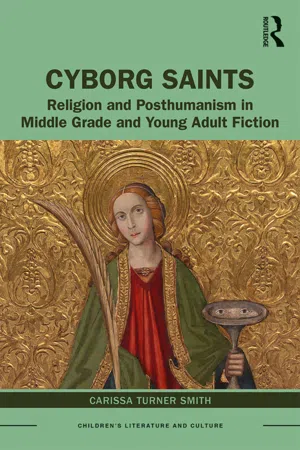
Saints are currently undergoing a resurrection in middle grade and young adult fiction, as recent prominent novels by Socorro Acioli, Julie Berry, Adam Gidwitz, Rachel Hartman, Merrie Haskell, Gene Luen Yang, and others demonstrate. Cyborg Saints: Religion and Posthumanism in Middle Grade and Young Adult Fiction makes the radical claim that these holy medieval figures are actually the new cyborgs in that they dethrone the autonomous subject of humanist modernity. While young people navigate political and personal forces, as well as technologies, that threaten to fragment and thingify them, saints show that agency is still possible outside of the humanist construct of subjectivity. The saints of these neomedievalist novels, through living a life vulnerable to the other, attain a distributed agency that accomplishes miracles through bodies and places and things (relics, icons, pilgrimage sites, and ultimately the hagiographic text and its reader) spread across time. Cyborg Saints analyzes MG and YA fiction through the triple lens of posthumanism, neomedievalism, and postsecularism. Cyborg Saints charts new ground in joining religion and posthumanism to represent the creativity and diversity of young people's fiction.
eBook - ePub
Cyborg Saints
Religion and Posthumanism in Middle Grade and Young Adult Fiction
- 252 pages
- English
- ePUB (mobile friendly)
- Available on iOS & Android
eBook - ePub
Cyborg Saints
Religion and Posthumanism in Middle Grade and Young Adult Fiction
About this book
Information
1 Neomedievalist Saints and the Embodiment of Hagiographic History
This chapter focuses on the figure of the saint as a litmus test for revealing a text’s approach to the medieval past—an approach often connected to its stance toward humanism. As explained in the Introduction, many works of MG and YA fiction promote what Kim Wilson calls the “humanistic metanarrative of positive progression” (5), which views history as moving linearly toward greater tolerance, rationality, and individualism. Saints particularly have the potential to challenge this narrative because of the ways, both within hagiographic texts and in the ways that those texts are read, that saints unsettle linear time. For example, according to Robert Bartlett, it is futile and misleading to index saints chronologically by birth and death years because, he points out, “The real life of saints, as saints, is when their cult is active, not when they themselves trod the earth” (141). Saints’ cults were spread in part through hagiographies, which encouraged alinear modes of narrating and reading; in hagiographic temporality, the “sacred becomes less of a historical event and more of a repeated fact” (Brown, Jennifer 48). Hagiographic narration depends upon layered repetition; the saint’s life events repeat those of Christ, and in turn the reader conforms his or her life to the pattern of both. Time, therefore, is collapsed. Hagiographic temporality, through its generic conventions of repetition, opposes humanist subjectivity. Even autobiographical hagiography is “not a personal expression of an autonomous, individual spirit, which viewed the self as a congeries of intellectual and ethical impulses separable from all others” (Heffernan 201), but rather the saintly individual’s behavior demonstrates the ways that multiple lives are intertwined in a collective biography.
Rather than seeking fidelity to these medieval views of temporality and subjectivity, contemporary humanist neomedievalist MG and YA novels often reject them, while promoting a façade of authenticity to the Middle Ages through realistic genre signals. Tison Pugh and Angela Jane Weisl argue that
authors of “medieval” children’s literature often portray two distinct views of the Middle Ages, in line with the overarching distinction between realist and fantasy fictions: the realist texts are often ripe with strong smells, dung, disease, and rot, whereas in the fantastic Middle Ages, the smells and dung are tempered with mystical beings and holy grails, while Ladies of the Lake turn into mists and use authentically medieval blacksmithing techniques to forge Excalibur.
(Pugh and Weisl 56)
Similarly, humanist MG and YA fiction that depicts saints tends to either vilify or glorify them; in either case, the emphasis on the past’s otherness from the present—an attitude that might be called temporal exceptionalism—underscores humanist views of time and subjectivity.
The texts examined in this chapter include some pre-twentieth-century texts in order to show a trajectory of the ways that the texts have used saints to reinforce humanist metanarratives. Late Victorian children’s texts view medieval saints with longing admiration, but they imply that the secular present is irrevocably cut off from this past; as a result, medieval saints are surrounded by generic conventions common to the fairy tale. This more conservative neomedievalism tends to emphasize the Middle Ages as a lost era of faith, an “innocent and magical time” that disappeared with the arrival of modernity (Pugh and Weisl 47). This reactionary narrative, which might be called the humanistic metanarrative of lamentable regression, may often come from a more religious worldview, but it is still humanist in that it accepts the secularization thesis and the modern view of temporality.
A century later, MG and YA fiction still highlights the divide between past and present, but these texts more commonly depict the medieval saints of the past as a childhood fantasy to be left behind (and potentially a harmful delusion if reproduced in the present) or as part of a threat to modern autonomy, especially sexual autonomy. These more recent novels are almost all realist in their genre; whether their setting is contemporary or medieval, the protagonist’s distance from the medieval is what sets him or her apart as an individual subject. The view of temporality and the view of subjectivity are linked in MG and YA fiction depicting saints; the need to portray an adolescent protagonist as an individual often involves othering the medieval past and medieval concepts of temporality. Novels participating in the “humanistic metanarrative of positive progression,” even those set in the medieval past, often construct the young adult protagonist’s individual subjectivity by showing how modern sensibilities set him or her apart from the medieval: “they imply that the main character is like us, but the general medieval population is unlike us: dirty, ignorant, and mired in superstition” (Barnhouse 23). In either case, whether through “positive progression” or nostalgic regression, children’s and YA fiction constructs the past as “other,” which closes the past off from readers and “keeps it contained within its ‘pastness’ ” (Wilson 22).
However, neomedievalist fiction for young people can seek authenticity through other means, gesturing toward a medieval view of the saintly life’s power to speak across time, as does Julie Berry’s The Passion of Dolssa (2016)—a text that is representative of the posthumanist MG and YA fiction discussed in the rest of Cyborg Saints. Berry’s novel, while less “realistic” in its genre, more nearly approximates medieval views of temporality and subjectivity in the way that readers of another time are confronted and remade by encounter with the saint’s life. Like The Passion of Dolssa, contemporary medievalist MG and YA texts, in the mode that Pugh and Weisl refer to as “liminal” fantasy, “do not provide readers with an authentic view into an historical past, unmediated by contemporary sensibilities, but a medievalized mode of reading, in which the space between past and present collapses and the two are bound together” (61). Liminal fantasy allows the medieval past, without regard to its supposed authenticity, to confront the reader—not unlike the way premodern hagiography confronted its readers.
Nostalgic Neomedievalism of the Late Nineteenth Century
In the 1896 novel Personal Recollections of Joan of Arc, an early episode occurs in which the child Joan makes her first legal argument. The novel’s narrator, a playmate of Joan’s from the village of Domremy, recounts the uneasy tension between the clergy of the village and the fairies who cluster around the aptly named Fairy Tree:
The fairies were still there when we were children but we never saw them; because, a hundred years before that, the priest of Domremy had held a religious function under the tree and denounced them as being blood kin of the Fiend and barred out from redemption; and then he warned them never to show themselves again … on pain of perpetual banishment from that parish.
(Twain 13)
The children of the village continue to hang wreaths on the tree “as a perpetual sign to the fairies that they were still loved and remembered” (14), and so the children are utterly dismayed when an adult woman accidentally stumbles upon the fairies’ secret revels and thus brings the threatened banishment upon them. Joan of Arc is, unfortunately, sick with a fever at the time, and so she learns of the fairies’ fate belatedly, at which point she upbraids the priest responsible. The young saint-to-be flies into a passion, telling him that the fairies “committed no sin, for there was no intent to commit one” (16) and, moreover, that the children who loved them had rights—rights that should have been respected. Though the priest, chagrined by Joan’s tirade, acknowledges his error, it is too late; the Fairy Tree “was not quite the same afterwards” (15), in spite of the fact that it remains “dear” to the children even in the fairies’ absence.
Perhaps the oddest thing about this fictional incident is that Mark Twain wrote it. Twain, who scoffed at saints and their relics in The Innocents Abroad, here, with a completely straight face, makes a saint his heroine and declares her “the most noble life that was ever born into this world save only One [presumably Jesus—also an oddly sincere note for Twain]” (Twain 2). Twain not only wrote Personal Recollections of Joan of Arc but also declared it the “best of all [my] books” (quoted in Warfield 262).1 Aside from its subject matter, the novel strikes many as stylistically uncharacteristic for Twain: it mostly lacks humor, and it rehashes nineteenth-century sentimental tropes regarding pious female children. Joan is “the most innocent, the most lovely, the most adorable” child “the ages have produced” (Twain ix). Perhaps even more strangely, the novel introduces fairies as a significant plot element in Joan of Arc’s story. Yet it is the fairies that make sense of the saint: for Twain, “a ‘vivid picture’ of Joan’s life can only be believable if it is ‘fabulous,’ a fairy tale” (Fulton 138). As Albert E. Stone has previously argued, the Fairy Tree in Joan’s village of Domremy—about which the children play, and which appears to them as a vision before their deaths later in life—is “the central symbolic vehicle for Mark Twain’s pastorale” (15). The episode in which the young child Joan upbraids the village priest for unjustly banishing the fairies from Domremy functions both as foreshadowing of Joan’s own treatment at the hands of the Church and as Twain’s own lament for the disenchantment of the world.2 Similarly, after Joan’s death, the “rich world” is “made empty and poor” (Twain 457), as the narrator reflects toward the novel’s end. For Twain, then, the saint is essentially a fairy, and Joan is a martyr for childhood wonder more than for devotion to Christ.
The narrator’s lament regarding the world “made empty and poor” bears considerable resemblance to philosopher Charles Taylor’s distinction between the premodern “porous” world and the modern “buffered” world (a variation on the secularization thesis that postsecularism challenges). According to Taylor, for the “porous self” of the past, the world is saturated with the divine, and it is impossible to maintain any distinct boundary between the self and the spiritual forces present in the world. In addition, for the porous self, meaning is not created by the human mind alone. For the porous self, the distinction between natural and supernatural would be unthinkable. We modern, buffered selves, by contrast, can view ourselves as separate from the world and from the spiritual realm. The buffered self is, as Taylor phrases it, the “master of the meanings of things” (38)—but with this mastery comes a sense of diminishment. This sense of diminishment is one of the reasons for attempts to re-enchant the world in the nineteenth century—first in Romanticism and later in the Victorian obsession with fairies.
The genres used at a particular time for writing about saints matter: fairies, in the late nineteenth century, are nice to have around to make the world more magical, but they are unlikely to challenge anything other than adult credulity. Sieur Louis de Conte, Twain’s narrator and alter ego (note that the initials are the same as Samuel Langhorne Clemens’s), knew Joan in childhood but narrates from the perspective of a jaded, embittered old man resigned to living the buffered world, a world emptied of spiritual forces. Sieur le Comte, while technically still living in the medieval era, is nostalgic for the premodern “porous” world but only for its safe, decorative elements. While Joan’s inquisitors accuse her of consorting with demons, no one in the novel seems to view such beings as real; the Christian saints who appear and speak to Joan are portrayed only hazily. Fairies are somehow more believable than either demons or saints. As Stone writes of the Fairy Tree, it is
a pagan sign, not specifically Christian, being associated with children, fairies, open fields, and animals of the forest rather than with Saint Catherine and Saint Margaret. Furthermore, it signifies a Paradise existing eternally in the past, not a future Christian heaven.
(17)3
Twain’s depiction of the saint reflects the late nineteenth century’s nostalgia for porosity, and the fairy story is the perfect genre to represent that nostalgia. Genre is closely tied to the text’s attitude toward the past. As Joe B. Fulton argues, Twain “employs the elements of fairy tale to create a believable fiction—as fiction” (121). Fairies are more “believable” than saints who battle literal demons, and thus “the fairy tale elements serve to blunt the ‘official’ hagiographic elements” (114). In Personal Recollections of Joan of Arc, fantasy becomes a way of picking and choosing the elements of medieval sainthood that are desirable—albeit inaccessible.
A similar alignment of saints with fairies, this time not by an agnostic American Protestant, but by a devout British Catholic, occurs in William Canton’s 1898 A Child’s Book of Saints. Canton, however, uses the device of fairies not to imply some enchanted past where saints and fairies were equally believable, but to transition from a child’s “natural” love of imaginary fairies to the love of real saints. The author-narrator begins the book by describing a walk with his 8-year-old daughter W.V., during which the two imagine that the trees are church attended by “Oak-girls and Oak-boys” (Canton 3). In their fancy, the mundane signs warning forest visitors, “Caution. Persons breaking, climbing upon, or otherwise damaging …” should instead say, “This way to the North Star Church” or “The public are requested not to disturb the Elves, Birch-ladies, and Oak-men” (Canton 4). Even better than admonitory signs, the narrator says, would be “to have a different fairy-tale written up in clear letters on each of the boards, and a seat close by where one could rest and read comfortably” (4–5). This is when the narrator makes his move to the enchanted reality of the saints:
I told her there were several forests I had explored, in which something like that was really done; only the stories were not fairy-tales, but legends of holy men and women; and among the branches of the trees were fixed most beautifully coloured glass pictures of those holy people, who had all lived and died, and some of whom had been buried, in those forests, hundreds of years go.
(5)
Here the forest and its fairies are but a type that find their fulfillment in the church and its saints.
Canton’s narrator’s nostalgia, however, is similar to that of Sieur Louis de Conte. At the close of the book, he takes a walk with W.V. at sunset and sees, amid the pleasant farms and fields, a “half-finished road” on which stands a “steam-roller” (250). “I think even W.V. felt it strange to see this new road so brusquely invading the ancient fields” (250), he reflects, and then once more makes plain his allegory:
Thinking of the [saints’] stories in my book, it seemed to me that the scene before me was a figure of the change that took place when the life we know invaded and absorbed the strange mediaeval life which we know no longer, and which it is now so difficult to realise.
(250–1)
Technology and “progress” cut us off from the past of both saints and fairies, for Canton. Personal Recollections of Joan of Arc and A Child’s Book of Saints may be written by authors whose religious affiliations could not be more different, but they both partake of the nostalgia for an enchanted world of the medieval past, a nostalgia communicated through the vehicle of the fairy story. Together, they show that texts’ construction of the saint-infused past reveals more about the time of the texts’ writing than about the medieval era depicted.
Outgrowing the Saints
Twain and Canton represent the trend described by Pugh and Weisl: “The medievalisms of children’s literature frequently construct the Middle Ages as a lost time of innocence, which corresponds with a widespread [Romantic] cultural desire to view children themselves as avatars of innocence” (7). Both “of these desires for innocence are cultural fantasies” (7), of course. In response, more recent works of MG and YA literature often repeat the Middle-Ages-as-childhood-innocence trope but imply the necessity of leaving it behind, “making one’s own way in the world and constructing one’s own family” (Pugh and Weisl 8). This view of the Middle Ages as a childhood that, for good or ill, has been left behind corresponds with a neomedievalist construction going back to the early modern period. As Seth Lerer explains,
The educators of the sixteenth and seventeenth centuries perceived such genres as romance and saint’s life as childish. So, too, the elaborate rituals of the pre-Reformation church were viewed as somehow childish. Victorian historiography only confirmed this attitude, as medieval culture came to be represented in the popular imagination as a world of fools and boy kings.
(13)
Even in contemporary neomedievalist children’s fantasy like the Chronicles of Narnia and the Harry Potter series, the “transition [from the real present] to the medieval is invariably constructed so that it becomes synonymous with (and representative of) the trauma of the protagonists as they struggle to make the transition from adolescence to adulthoo...
Table of contents
- Cover
- Half Title
- Series
- Title
- Copyright
- Dedication
- Contents
- Acknowledgments
- Introduction
- 1 Neomedievalist Saints and the Embodiment of Hagiographic History
- 2 Cyborg Saints, Born and Made
- 3 “Are We Not All Things?”: Relics, Posthumanist Agency, and Intersubjectivity
- 4 The Virgin Martyr of Comics: Distributed Agency and Saintly Iconography
- 5 Posthumanist Pilgrimage: Trans-corporeal Journeys
- 6 “Holy Dog!”: Animal Studies, Tolerance Discourse, and Posthumanist Ethics
- Conclusion
- References
- Index
Trusted by 375,005 students
Access to over 1.5 million titles for a fair monthly price.
Study more efficiently using our study tools.
Frequently asked questions
Yes, you can cancel anytime from the Subscription tab in your account settings on the Perlego website. Your subscription will stay active until the end of your current billing period. Learn how to cancel your subscription
No, books cannot be downloaded as external files, such as PDFs, for use outside of Perlego. However, you can download books within the Perlego app for offline reading on mobile or tablet. Learn how to download books offline
Perlego offers two plans: Essential and Complete
- Essential is ideal for learners and professionals who enjoy exploring a wide range of subjects. Access the Essential Library with 800,000+ trusted titles and best-sellers across business, personal growth, and the humanities. Includes unlimited reading time and Standard Read Aloud voice.
- Complete: Perfect for advanced learners and researchers needing full, unrestricted access. Unlock 1.5M+ books across hundreds of subjects, including academic and specialized titles. The Complete Plan also includes advanced features like Premium Read Aloud and Research Assistant.
We are an online textbook subscription service, where you can get access to an entire online library for less than the price of a single book per month. With over 1.5 million books across 990+ topics, we’ve got you covered! Learn about our mission
Look out for the read-aloud symbol on your next book to see if you can listen to it. The read-aloud tool reads text aloud for you, highlighting the text as it is being read. You can pause it, speed it up and slow it down. Learn more about Read Aloud
Yes! You can use the Perlego app on both iOS and Android devices to read anytime, anywhere — even offline. Perfect for commutes or when you’re on the go.
Please note we cannot support devices running on iOS 13 and Android 7 or earlier. Learn more about using the app
Please note we cannot support devices running on iOS 13 and Android 7 or earlier. Learn more about using the app
Yes, you can access Cyborg Saints by Carissa Turner Smith,Carissa Smith in PDF and/or ePUB format, as well as other popular books in Literature & Literary Criticism. We have over 1.5 million books available in our catalogue for you to explore.