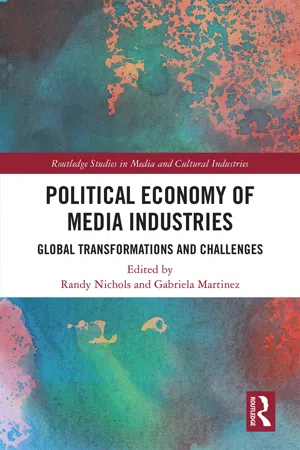
This book provides a critical political economic examination of the impact of increasingly concentrated global media industries. It addresses different media and communication industries from around the globe, including film, television, music, journalism, telecommunication, and information industries. The authors use case studies to examine how changing methods of production and distribution are impacting a variety of issues including globalization, environmental devastation, and the shifting role of the State. This collection finds communication at a historical moment in which capitalist control of media and communication is the default status and, so, because of the increasing levels of concentration globally allows those in control to define the default ideological status. In turn, these concentrated media forces are deployed under the guise of entertainment but with a mind towards further concentration and control of the media apparatuses many times in convergence with others
eBook - ePub
Political Economy of Media Industries
Global Transformations and Challenges
- 290 pages
- English
- ePUB (mobile friendly)
- Available on iOS & Android
eBook - ePub
Political Economy of Media Industries
Global Transformations and Challenges
About this book
Information
1 Introduction
As is the case with many projects, this book began as something very different from the end result. When it was started, this book was born from a desire to acknowledge Dr. Janet Wasko and her contributions to our understanding of media and communication, particularly the critical political economy of communication. Wasko has, after all, been a major figure in the political economy of media in a variety of ways, both through her scholarship and through her important work with organizations like the International Association for Media and Communication Research and the Union for Democratic Communications. However, we realized that the best way to honor her and her work was not just to say thanks or to offer call-outs to her contributions, but rather to join her in the continued critical examination of media and communication. This is particularly true because over the course of the project, we have seen the rise and retrenchment of authoritarian regimes around the world, which have relied in no small part upon the media to fuel their rise. Mass media have also been front and center in escalating battles in the culture wars, playing a role both in combatting but also supporting virulent ethnocentrism and white supremacy as well as a deteriorating public trust in a range of social institutions. Perhaps the prime example of this (though certainly not the only one) is the role the media have played in the presidency of Donald Trump in the United States. At the same time, the surveillance state has extended itself via algorithms and capitalist enterprise. Finally, the mass media have been central to both the gradual awakening to the dire environmental consequences that come with overconsumption, even as it is part of the problem. Those are just a few of the threads the chapters of this book address. Ultimately, this book offers, through its collection of chapters by well-established and emerging scholars, a look at the broad landscape covered by the political economy of communication. In its three main sections – The Film Industry, Other Media Industries, and New and Enduring Challenges – it details a range of challenges and concerns posed by our modern communication landscape.
Such concerns are ideal for analysis through the critical political economic approach, which seeks to understand not just the nature of the various industries involved but also insists on seeing them in their relevant historical and social contexts. As such, political economy begins with the recognition that there are not merely economic concerns but political and moral concerns as well. This means that, in turn, political economy is inherently concerned with the ideological. Rather than focusing just on “wealth and the allocation of resources,” as described by Smith (1993), critical political economy is more broadly concerned with, as Mosco (1996) describes it, “the study of power relations in society.” This means that political economy seeks to understand and effect change in the struggle between capitalism and the social good (Golding & Murdock, 1991). As Wasko (2004) notes, these struggles may occur at a variety of levels, including the commodification and commercialization of media, the ways in which media have diversified, the ways media have integrated and synergized, how concentration has impacted communication, and the changing relationship between media and the State.
This means that the political economy of communication, unlike some other schools of thought that emphasize understanding media as a business such as media economics or the creative industries approach, is not only interested in understanding the production and distribution of media content, but also how we might resist the problems presented by the capitalist control of media and communication (Gandy, 1992; Garnham, 1990; Meehan, Mosco, & Wasko, 1994). That understanding, in turn, leads to praxis, by which we mean taking action based in the knowledge gained in order to advance the social good. Further, the political economy of communication gives itself a broader purview than, particularly, the creative industries approach and studies that emphasize digital and information technologies. Both of those examples emphasize particular areas while obscuring others, whether it is labor seen as “uncreative” within media production or the long history of non-digital technologies and media production (Wasko & Meehan, 2013). Rather, the political economy of communication sees these as part of a broader range of cultural industries that extend even beyond the media to all the avenues that are involved in the production, structuring, and dissemination of culture. These cultural industries are often interlocking and integrated even as they compete for our time, our dollars, and our understanding. Wasko offers us a fairly succinct articulation of these concerns, suggesting that concentrated media industries can be understood in terms of three key impacts: power, profit, and paucity (Wasko, 2003). Each of these impacts has become a crucial focus of examination for critical political economists because they represent key power relationships, both within particular industries, between industries, and between those industries and institutions and the broader public.
We would add that there are two other important features that are part and parcel of political economy of communication, though they are not always foregrounded. First, the political economy of communication grounds itself in empirical evidence. Often this evidence is drawn from the particular instances and institutions being studied, though it is used to demonstrate the many dangers posed. That means political economy uses the same evidence as other approaches, such as the creative industries approach; the difference is not in the evidence but is rather how that evidence is used. Political economic research on media should lead not just to an understanding of particular power relations but to a suggestion of how things might be improved for everyone impacted by what is being studied. Second, while there is often an emphasis on the importance of the political economy of information media (for example, journalism or search engines), understanding media focused on entertainment and leisure are also of vital importance. That emphasis on information media holds particularly true in the North American strand of political economy, which, as Mosco (1996) noted, can be traced back to the work of Herbert Schiller and Dallas Smythe and which often emphasizes their same concerns, particularly the continued consequences of the New World Information and Communication Order and the importance of the audience commodity. Consider for a moment the role entertainment media played not just in the election and presidency of Donald Trump to President of the United States but also of the range of hard-right conservative movements around the world. Entertainment media were not only instrumental in helping Trump rise to prominence in the public imagination, but the norms of entertainment media have also increasingly been deployed against those of informational media, particularly journalists, and have been seen to increasingly infiltrate the norms of informational media production, as well.
In this regard, Wasko’s work serves as something of a bridge between the North American approach to critical political economy and the European articulation which, in addition to considering matters of the control of information, has maintained a focus on understanding the broader range of cultural life and practices (Mosco, 1996). Her work with H. Leslie Steeves (2002), for example, attempts to bridge the uneasy relationship North American political economy has sometimes had with feminist studies, while her work with the Global Disney Project not only drew attention to the impact of global media giant Disney but also bridged the work of political economy with that of audience studies (Wasko, Phillips, & Meehan, 2001). This global concern has long punctuated her approach, both through her years of work and leadership with the International Association for Media and Communication Research and in her own research as exemplified by Global Media Giants, a book that opens the space for discussion about media companies shaping the lives of people around the world through their global dominance (Birkinbine, Gómez, & Wasko, 2016).
This collection picks up many of those threads and attempts to extend them. We find ourselves at a historical moment in which capitalist control of media and communication is the default status, and so because increasing levels of concentration globally allow those in control to define the default ideological status. In turn, these concentrated media forces are deployed under the guise of entertainment but with a mind toward further concentration and control. In some cases, such concentrated media serves as an extension of the State, while in others it functions almost as an entirely separate entity, governed solely by the rules of the market or – more accurately since they are typically the most powerful entities in their markets – setting the rules that govern the transactions, the commodifications, and the very nature of how and whom that market serves. New methods of production and distribution are fundamentally altering the relationships between a variety of social institutions while building on long-term trends – globalization, environmental devastation, and a shifting role of the State among them.
Organization of the Book
With those concerns in mind, we have structured the book in a way that mirrors much of the trajectory of both Wasko’s work and of the critical political economy of communication itself.
Part I examines the medium Wasko has focused on most explicitly: film. It begins by assessing her impact on the study of film and media and continues by examining key developments in labor, technology, and global impacts of the film industry.
Chapter 2: “The Hollywood Trilogy, The Disney Duo” by Eileen Mehan offers a succinct overview of Wasko’s contributions to the study of media and the major implications her work suggests for other political economists.
Chapter 3: In “Movie Theaters and Money: Integration and Consolidation in Film Exhibition,” Ben Birkinbine examines the changing status of film exhibition in the United States in light of major technological changes.
Chapter 4: In “How Hollywood Workers Unite: Labor Convergence and the Creation of SAG-AFTRA,” Catherine McKercher and Vincent Mosco examine the 2012 merger of the Screen Actors Guild (SAG) and the American Federation of Television and Radio Artists (AFTRA), seeking to understand how advocates turned a defeated 2003 merger attempt into victory nine years later.
Chapter 5: “The Mexican Film Industry, 2000–2018: Resurgence or Assimilation?” by Rodrigo Gómez offers a probe at global impacts, providing a history of the role of the Mexican State and of Hollywood on the Mexican Film Industry.
Part II expands beyond film to consider a range of other industries, their impacts, and changing natures, providing key touchstones both for our understanding of new forms of production and distribution via digital technologies and changing State practices.
Chapter 6: “The New Holy Grail: Scripted Television Production and State, Provincial & National Incentives” by William Kunz offers a detailed examination on the impact of State production incentives as an extension of runaway television production, using examples drawn from television, cable, and internet services.
Chapter 7: “Old Strategies in the New Paradigm: Web Series and Corporate Control” by Mary Erickson details the impacts of serialized dramas produced for the web have both as a mechanism for competition with and control by television producers.
Chapter 8: “State Monopoly of Telecommunications in Ethiopia: Revisiting Natural Monopoly in the Era of Deregulation” by Tewodros Workneh and H. Leslie Steeves provide an in-depth history of Ethiopian telecommunication regulations while analyzing its changes and impact on a range of markets.
Chapter 9: “Through Being Cool: The Critical Political Economy of iTunes” by David Gracon uses the example of Apple’s music products, particularly iTunes, to demonstrate the impact of market concentration, corporate power, and monopolistic policies’ impact on the music industry.
Chapter 10: “In Practice and Theory? Scholarship on Wikipedia’s Political Economy” by Randall Livingstone concludes the section providing an overview of how political economy has addressed one of the key developments of Web 2.0 and audience production, Wikipedia.
Part III closes the volume by providing longer histories for some of the most consequential challenges political economy must consider as well as offering some provocations both in their approach and conceptualization to the field at large.
Chapter 11: “Bribe and Journalism” by Jörg Becker begins the section by bringing together history, literary analysis, and political economy of modern journalism in Germany to detail the long history of distrust about the impact of capitalist ownership of journalism, as seen in the work of Gustav Freytag, Emile Zola, and Mario Vargas Llosa.
Chapter 12: “Labor in the Age of Digital (Re)Production” by Gerald Sussman revisits the history and implications of digital technologies and production on labor, examining the relationship between ideology and propaganda in the modern information-rich workplace.
Chapter 13: “Power Under Pressure: Digital Capitalism in Crisis” by Dan Schiller expands on the concerns about digital technologies to critique how the ideology and practices of digital capitalism poses significant problems for the economy.
Chapter 14: “Minutes to Midnight: Capitalist Communication and Climate Catastrophe” by Graham Murdock details the role that communication continues to play in the worsening environmental crisis in the West, but also across the world.
Chapter 15: “Time, Globality, and Commodity Fetishism” by Wayne Hope closes the book, tying many of these threads together with the political economy of memory and the question of consumption to offer a provocation to political economic researchers.
References
- Birkinbine, B., Gómez, R., & Wasko, J. (Eds.). (2016). Global Media Giants. New York: Routledge.
- Gandy Jr., O. H. (1992). The Political Economy Approach: A Critical Challenge. Journal of Media Economics, 5(Summer), 23–42.
- Garnham, N. (1990). Contribution to a Political Economy of Mass Communication. In F. Inglis (Ed.), Capitalism and Communication: Global Culture and the Economics of Information (pp. 20–55). London: Sage.
- Golding, P., & Murdock, G. (1991). Culture, Communication, and Political Economy. In J. Curran & M. Gurevitch (Eds.), Mass Media and Society (pp. 15–32). London: Edward Arnold.
- Meehan, E. R., Mosco, V., & Wasko, J. (1994). Rethinking Political Economy: Change and Continuity. In M. R. Levy & M. Gurevitch (Eds.), Defining Media Studies (pp. 347–358). New York: Oxford University Press.
- Mosco, V. (1996). The Political Economy of Communication. Thousand Oaks, CA: Sage Publications.
- Smith, A. (1993). An Inquiry into the Nature and Causes of the Wealth of Nations. Indianapolis: Hackett Publishing Company.
- Steeves, H. L., & Wasko, J. (2002). Feminist Theory and Political Economy: Toward a Friendly Alliance. In E. R. Meehan & E. Riordan (Eds.) Sex & Money. Feminism and Political Economy in the Media (pp. 16–29). Minneapolis: University of Minnesota Press....
Table of contents
- Cover
- Half Title
- Series Page
- Title Page
- Copyright Page
- Dedication Page
- Table of Contents
- List of Figures
- List of Tables
- List of Contributors
- Acknowledgments
- List of Abbreviations
- 1 Introduction
- Part I The Film Industry
- Part II Other Media Industries
- Part III New and Enduring Challenges
- Index
Trusted by 375,005 students
Access to over 1.5 million titles for a fair monthly price.
Study more efficiently using our study tools.
Frequently asked questions
Yes, you can cancel anytime from the Subscription tab in your account settings on the Perlego website. Your subscription will stay active until the end of your current billing period. Learn how to cancel your subscription
No, books cannot be downloaded as external files, such as PDFs, for use outside of Perlego. However, you can download books within the Perlego app for offline reading on mobile or tablet. Learn how to download books offline
Perlego offers two plans: Essential and Complete
- Essential is ideal for learners and professionals who enjoy exploring a wide range of subjects. Access the Essential Library with 800,000+ trusted titles and best-sellers across business, personal growth, and the humanities. Includes unlimited reading time and Standard Read Aloud voice.
- Complete: Perfect for advanced learners and researchers needing full, unrestricted access. Unlock 1.5M+ books across hundreds of subjects, including academic and specialized titles. The Complete Plan also includes advanced features like Premium Read Aloud and Research Assistant.
We are an online textbook subscription service, where you can get access to an entire online library for less than the price of a single book per month. With over 1.5 million books across 990+ topics, we’ve got you covered! Learn about our mission
Look out for the read-aloud symbol on your next book to see if you can listen to it. The read-aloud tool reads text aloud for you, highlighting the text as it is being read. You can pause it, speed it up and slow it down. Learn more about Read Aloud
Yes! You can use the Perlego app on both iOS and Android devices to read anytime, anywhere — even offline. Perfect for commutes or when you’re on the go.
Please note we cannot support devices running on iOS 13 and Android 7 or earlier. Learn more about using the app
Please note we cannot support devices running on iOS 13 and Android 7 or earlier. Learn more about using the app
Yes, you can access Political Economy of Media Industries by Randy Nichols, Gabriela Martinez, Randy Nichols,Gabriela Martinez in PDF and/or ePUB format, as well as other popular books in Languages & Linguistics & Entertainment Industry. We have over 1.5 million books available in our catalogue for you to explore.