In recent years China has achieved impressive economic growth, and also made remarkable progress in human development. However, contemporary China is still faced with the great challenge of widespread poverty. This not only constitutes a barrier against China's pursuit of sustainable economic growth, but also poses a potential threat to China's attempts to construct a harmonious society in the future. This book, written by three renowned poverty-reduction experts under the aegis of the China Development Research Foundation - one of China's leading think-tanks - and drawing on the research of over twenty of China's top scholars in this field, examines China's efforts to eliminate poverty through development. It analyses all of the key issues, providing a review of China's past record in poverty alleviation, comparing this with the experiences of other countries, identifying the new characteristics and trends in poverty in recent years, and discussing the factors responsible. It assesses the objectives and success of the poverty alleviation policies adopted by the Chinese government in a comprehensive way, and puts forward suggestions for policy makers. Overall, this book is a valuable account of China's own thinking on its problems of poverty, and the best ways to tackle it and achieve sustainable economic development.
- 280 pages
- English
- ePUB (mobile friendly)
- Available on iOS & Android
eBook - ePub
Eliminating Poverty Through Development in China
1 Introduction
Since China began its reform and opening to the outside world, rapid economic growth has not only elevated the living standards of people in both urban and rural areas, but also sharply decreased the number of people in poverty. In the course of three decades of economic development, the numbers of the rural poor population have shrunk dramatically, according to various measurements. Based on China's official poverty line, there were 250 million rural poor people in 1978. By the end of 2005, there were only 23.65 million rural poor people. The rate of poverty fell from 31 percent to 2.5 percent in that period.1 Even if the measurement is done according to a relatively high poverty line, such as that of the World Bank (US $1 dollar per day per person), the size of the poor population in rural areas and the incidence rate of poverty in China have declined in a largely identical way.2
Prior to reform, the restrictions on China's economic development and system meant the rate of poverty was far beyond the average in other countries. Today, China's rate is markedly below the world's average (Chen and Ravallion 2004). Propelled by the Government's developmental poverty alleviation strategy, poor regions in the country have embraced development in terms of culture, education, health care and other social undertakings, to different extents. China has become a role model for some other developing countries due to its stunning accomplishments in poverty alleviation and the commendation it has earned from the global community.
Nevertheless, China is still faced with a rather formidable poverty alleviation task. On the one hand, the remaining poor mainly comprise people who cannot be helped out of poverty that easily. On the other hand, with social advancement and people's increasing awareness of poverty, the term 'poverty' today is not meant for inadequate income alone. It also manifests through poor capabilities. A better awareness of poverty has raised standards for poverty alleviation, while the yardstick for poverty measurement has also moved as a consequence of economic development, becoming more prone to the influence of concepts of social development. The elimination of poverty no longer means merely meeting the minimum subsistence needs of the poor population. Instead, it is necessary to provide a basic capability for embracing development. Chinese society is undergoing a significant transformation as far as poverty alleviation strategies are concerned.
China's victory over poverty is accredited to two factors: rapid economic-growth and ambitious poverty alleviation policies. Economic growth is, in large part, due to China's economic reform and opening-up policy. Poverty alleviation policies have been fuelled by the Chinese Government's determination and committed efforts.
It is essential to sum up China's successful experiences in poverty alleviation and also to analyse influential factors. Among them, swift economic growth is the most notable but that alone is not enough. In an economic scenario featuring a widening income gap, for the sake of poverty alleviation it is of paramount importance to make the mode of economic growth more beneficial to the poor and more conducive to the income growth of low-income earners. A mode beneficial to the poor will enable those people participating in economic activities to escape poverty in the shortest time. It will, however, be less helpful to those poor families with no labour capability. The roots of subsistence poverty cannot be eliminated unless a basic social security system, comprising social relief, is established. It is even more necessary to become aware that solving subsistence poverty is simply the first goal. Alleviating and eventually eliminating capability and developmental poverty is the ultimate goal, involving elevating the quality of the labour force and the potential capabilities of humans.
In today's China, where citizens are making concerted efforts to contribute to a harmonious society, the formulation of ambitious and effective antipoverty policies is of extraordinary significance.
A Review of China's Poverty and Anti-Poverty Efforts
Prior to 1949, China was an economically backward country, with an enormous population of people in poverty. At that time, China was among those countries registering the highest rates of poverty. The founding of the People's Republic of China provided an important political foundation for poverty alleviation. Over the past half century, China has achieved historic results in its anti-poverty efforts, although the story includes numerous twists and turns.
China's poverty before its reform and opening up
Before the People's Republic of China was founded in 1949, China had carried out rural land reform in some Liberation Zones. After the founding of the People's Republic of China, the country launched a nationwide land reform that ended the 2000+ years old feudal land system, thus boosting productivity in rural areas. On the basis of national economic recovery, China started to implement the first 'Five-Year-Long National Development Programme' in 1953. In 1957, China's economy experienced a historic boom, while the size of the poor population in both rural and urban areas reached a record low.3 Nevertheless, the public ownership system, formed in the wake of the socialist transformation of ownership of the means of production in the mid 1950s, and the planned economic system established on its basis featuring a high degree of centralization, were not adapted to China's productivity level at that time. The country adopted a development mode that prioritized heavy industry, which, along with the burgeoning of people's communes and the 'Great Leap Forward' campaign, heavily jeopardized China's economic development. In the late 1950s and early 1960s, the country saw the yield of agricultural products drop sharply, peasants' incomes fell dramatically, the living standards of rural and urban residents declined markedly, and the rate of poverty rose steeply. Later, China made some adjustments to its economic system that enabled the national economy to regain steam. The rate of poverty began to fall to a level consistent with the stage of economic development at that time.
During the 10-year-long Cultural Revolution, the nominal growth of China's economy did not alleviate the roots of its poverty levels. Political movements exerted a negative impact on economic development, the population grew excessively fast, and hidebound economic and management systems gave rise to appalling wastage and low efficiency. Fast economic growth that was the result of immoderate accumulation did not benefit the multitudes in pragmatic terms. As some pertinent data indicate, the per capita income of rural residents from 1966 to 1977 was up by only RMB 18 yuan (Zhou Binbin 1991), which is less than half of the per capita income growth recorded by rural residents in 1979 alone. In that period of time, the annual growth rate of peasants' income on average was less than 1.5 percent, while the per capita food intake of rural residents did not reach 2100 calories per day (ibid.). When measured by the nutrition yardstick, 40 percent to 50 percent of rural residents were in a state of subsistence poverty.
China's development and the evolution of anti-poverty efforts since reform and opening up
According to the National Bureau of Statistics of China, in 1978, shortly after China adopted a policy of reform and opening up, the size of the poor population in rural areas was 250 million, and the rate of poverty was up to 31 percent (using China's officially announced poverty line, which is on the low side).4 Measured by the rural poverty line, the size of the poor population in urban areas could have been deemed negligible.5 At that time, the Chinese Government focused its efforts on rural poverty, an inevitable task.
Since then, the country's anti-poverty campaign has evolved m three stages. The first stage featured a mode of poverty alleviation principally based on the pursuit of economic growth; the second stage emphasized developmental poverty alleviation policies; and the third stage has been characterized by multiple public policies beneficial to peasants.
In the late 1970s and early 1980s, propelled by the reform of the land rights use system in rural areas, Chinese peasants demonstrated unprecedented initiative that resulted in a historic boom in agricultural production. Grain output reached record highs for many consecutive years. The Government kept increasing grain prices, so peasants' incomes continued to grow from one year to another. From 1978 to 1985, China's total grain output was up by 24 percent, while the per capita grain output of rural residents was up by 84 kilos. China's total cotton output rose by 91 percent. Its oil output increased 202 percent. In the same period, the grain price was up by 102 percent, and the prices of agricultural products rose by 67 percent; both price increases exceeded the growth rate of the price of industrial products from rural areas.6 As a consequence, the real per capita net income of rural residents was up by 169 percent in that period, yielding an annual growth rate of up to 15.1 percent. Since the economic reform, as such, emancipated production potentials in underdeveloped regions of China to a great extent, the income gap among rural areas started to shrink.7 The income growth had an immense impact, combining with an income distribution effect to mitigate poverty, in sharp contrast to the scenario emerging after 1990.8
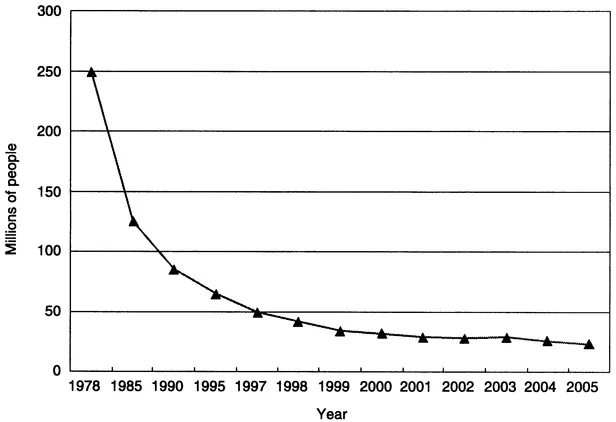
Figure 1.1 Changes in the poor population in rural areas of China from 1978 to 2005.
Source:China Statistical Summary 2006.
Source:China Statistical Summary 2006.
Figure 1.1 shows the trend in the size of the poor population in rural areas since China's reform and opening up. It is not hard to see that within seven years (from 1978 to 1985), the population was halved, falling to 125 million persons from 250 million persons. In the same period, the rate of poverty in rural areas dropped from 31 percent to 15 percent. From the research documentation available now, Chinese and foreign scholars have mostly shared a common understanding of the reasons for such significant progress. These include the income growth of peasants due to the reform of the land use rights system and the increased prices of agricultural products as the most important driving forces.9 Under the policy of equal distribution of land use rights, the growth of income from agriculture became, in quite a large part, a pro-poor growth strategy. Behind the growth was peasants' enhanced productivity, which came from the fact that peasants were provided with greater economic freedom and enabled to dispose of their means of production freely, due to the general adoption of market principles in the selling of agricultural products and the rationalization of their prices. To sum up. economic liberalization and the market-based allocation of resources have offered an effective institutional guarantee and an incentive to speed the growth of the rural economy, even as market-driven growth has been manifested, to a certain degree, in a pro-poor manner.
In the late 1980s, the rate of poverty in rural areas of China started to fall at a decreasing pace, especially from the middle of the 1980s to the middle of the 1990s. From 1978 to 1985, the annual average size of the Chinese population helped out of poverty was 17.86 million persons; from 1986 to 1990, the annual average was 8 million persons; from 1991 to 1995, the annual average was 3.92 million persons; from 1996 to 2000, the annual average rose to 6.66 million persons; from 2001 to 2005, the annual average dropped to 1.69 million persons.10 Such changes correlate, in part, to the slow growth of peasants' income, and in part to constantly widening income gaps in rural areas in this period. Compared to the early 1980s, the annual average growth rate of real per capita income of peasants from 1986 to 1995 fell sharply, reaching as low as 3.6 percent. Except for 1996, when the growth rate of the real per capita income of peasants reached 9 percent, most other years since the late 1990s have seen the growth rate at below 5 percent. Income inequality in rural areas has been rising, and the income gap among rural residents, measured by various indexes, has been widening. For instance, the Gini coefficient of the income gap in rural areas, roughly estimated according to the rural household survey conducted by the National Bureau of Statistics of China, was 0.31 in 1990. It rose to 0.35 in 2000 and 0.38 in 2005 (see Figure 1.2). Today, the composition of the poor population is totally different from 20 years ago, and the causes of poverty have become increasingly varied. Realistically speaking, those people who can be easily helped out of poverty have already benefited from poverty alleviation. The remaining poor people will find it more difficult to leave poverty, and this has already been seen as having an inevitable influence on the average number of people emerging from poverty in the ensuing years. This situation is more complex, however, than the simple conclusion that the slower pace is an indication that the Chinese Government's poverty alleviation policies have become ineffective.
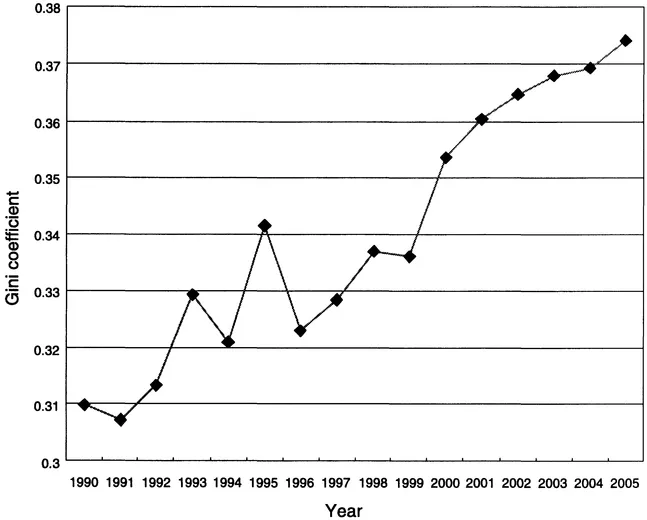
Figure 1.2 Changes in the income gap among rural areas of China from 1990 to 2005: Gini coefficient.
Source: China Yearbook of rural household survey 2006, p. 34.
Source: China Yearbook of rural household survey 2006, p. 34.
Starting in the 1990s, the Chinese Government embarked on myriad poverty alleviation strategies. Throughout that decade, developmental poverty alleviation policies played an important role. In general, this mode of poverty alleviation means governmental departments at all levels confer financial subsidies on some selected regions with a high density of poor people. The aim is to enhance development capabilities, job opportunities and market competition capabilities in these regions. This helps to boost economic growth in a manner that eliminates poverty. From the size of the population helped out of poverty at that time, compared to the 1980s, people could easily conclude that poverty alleviation results in the 1990s seemed less remarkable. But the composition of the poor population and the reasons for poverty in the 1990s varied from those in the 1980s. The environment for applying poverty alleviation policies was also different, giving rise to greater difficulties. Nonetheless, the absolute size of the rural population suffering subsistence poverty dropped from 85 million in 1990 to 32 million in 2000.11
Since the start of the new millennium, the Chinese Government has, considering the latest characteristics of the location and composition of poor populations, made timely adjustments to its poverty alleviation policies. Developmental poverty alleviation policies have undergone significant changes in two respects: (1) when it comes to offering support to poor regions, the Government no longer targets certain counties, but focuses on particular villages through the 'Entire Village Coverage' project; such a close-up emphasis on concrete targets enables poverty alleviation projects and funds to reach the poor more effectively; (2) developmental poverty alleviation projects were adjusted structurally, and an increasing number of projects to enhance capabilities in poor regions and populations were added, mostly taking the form of investments in education and the trai...
Table of contents
- Cover
- Half Title
- Series Title
- Title
- Copyright
- Contents
- List of figures
- List of tables
- List of boxes
- Foreword
- Authors' foreword
- List of contributors
- 1 Introduction
- 2 New characteristics of poverty in China today
- 3 Analysis of the causes of poverty
- 4 China's poverty alleviation policies: goals and impacts
- 5 Governance and poverty alleviation
- 6 Suggestions for poverty alleviation policies
- Bibliography
- Index
Trusted by 375,005 students
Access to over 1.5 million titles for a fair monthly price.
Study more efficiently using our study tools.
Frequently asked questions
Yes, you can cancel anytime from the Subscription tab in your account settings on the Perlego website. Your subscription will stay active until the end of your current billing period. Learn how to cancel your subscription
No, books cannot be downloaded as external files, such as PDFs, for use outside of Perlego. However, you can download books within the Perlego app for offline reading on mobile or tablet. Learn how to download books offline
Perlego offers two plans: Essential and Complete
- Essential is ideal for learners and professionals who enjoy exploring a wide range of subjects. Access the Essential Library with 800,000+ trusted titles and best-sellers across business, personal growth, and the humanities. Includes unlimited reading time and Standard Read Aloud voice.
- Complete: Perfect for advanced learners and researchers needing full, unrestricted access. Unlock 1.5M+ books across hundreds of subjects, including academic and specialized titles. The Complete Plan also includes advanced features like Premium Read Aloud and Research Assistant.
We are an online textbook subscription service, where you can get access to an entire online library for less than the price of a single book per month. With over 1.5 million books across 990+ topics, we’ve got you covered! Learn about our mission
Look out for the read-aloud symbol on your next book to see if you can listen to it. The read-aloud tool reads text aloud for you, highlighting the text as it is being read. You can pause it, speed it up and slow it down. Learn more about Read Aloud
Yes! You can use the Perlego app on both iOS and Android devices to read anytime, anywhere — even offline. Perfect for commutes or when you’re on the go.
Please note we cannot support devices running on iOS 13 and Android 7 or earlier. Learn more about using the app
Please note we cannot support devices running on iOS 13 and Android 7 or earlier. Learn more about using the app
Yes, you can access Eliminating Poverty Through Development in China by China Development Research Foundation in PDF and/or ePUB format, as well as other popular books in Business & Business General. We have over 1.5 million books available in our catalogue for you to explore.