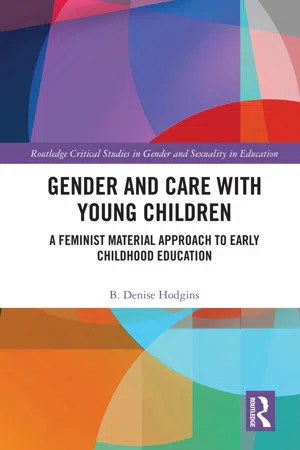
This book is an exploration of how children, educators, and things become implicated in gendered caring practices. Drawing on a collaborative research study with early childhood educators and young children, the author examines what an engagement with human-and non-human relationality does to complicate conversations about gender and care. By employing a feminist material analysis of early childhood education, this book rethinks dominant Euro-Western individualist pedagogies in order to reposition them within a relationality framework. The analysis illuminates the political and ethical embeddedness of early childhood education and the understanding that gendering and caring emerge with/in a complex web of many relations.
eBook - ePub
Gender and Care with Young Children
A Feminist Material Approach to Early Childhood Education
- 228 pages
- English
- ePUB (mobile friendly)
- Available on iOS & Android
eBook - ePub
Gender and Care with Young Children
A Feminist Material Approach to Early Childhood Education
About this book
Information
Part 1
Context Stories
1 Curiosities
* *
Curiosity underpins the work that we—a group of early childhood educators and pedagogist-researchers with young children and their families—engage in together.1 Cathie Pearce and Maggie MacLure (2009) suggest that curiosity, as “a condition for philosophy” (p. 252), raises questions as to “what philosophy might do in educational research in general and methodological texts in particular” (p. 252). In their exploration they draw on Marilyn Strathern’s (2007) view of curiosity as
the great asset of the human species … the ability to be interested in many things all at once, indeed as many as come into view. We are in peril if we do not cultivate curiosity in what is around us.
(as cited in Pearce & MacLure, 2009, p. 253)
For Donna Haraway, “curiosity—the beginning of fulfilment of the obligation to know more as a consequence of being called into response—is a critical axis of an ethics not rooted in human exceptionalism” (Gane & Haraway, 2006, p. 143). It is our intention in our inquiry projects together to think and act with curiosity from the perspectives that Pearce and MacLure and Haraway illuminate: to know more as an ethical and political obligation, to consider many things (human and nonhuman) at once, to cultivate curiosity in that which is around us. I am drawn to Haraway’s (2008) view of curiosity “as one of the first obligations and deepest pleasures of worldly companion species” (p. 7), yet I also, importantly, acknowledge, as does she, that much harm has and can come from being curious. One of the themes that run through this book is that our actions and obligations, our curiosities, are never innocent.
When first I presented the gender care inquiry project possibility to the educators who participated, I was curious to explore with them and with the children what ideas of care are being constructed and reconstructed in early years practices and the relationship these ideas have to constructions of gender. My experience in child care settings made me wonder about how young children regularly engage in acts of caring (both real and imagined) through their engagement in these spaces with materials, other children, and educators. Both research and my practice experience told me that acts of caring for young children are guided by particular beliefs, attitudes, and assumptions about gender. Feminists have shown us for many decades that both care and gender are not simply personal issues but are political as well (see Gilligan, 1982/1993; Held, 2006; Ruddick, 1980/2002, 1989/2004; Tronto, 1993, 1995). As a political issue, care takes many forms and is in constant transformation. Consequently, Virginia Held (2006) points out, our understanding of care also needs reimagination. I took this position into our project work and together we produced a rethinking, reimagining, and redefining of care that positions children, educators, and researchers as gendered caring subjects who are always becoming, always entangled with the more-than-human, and never outside the politics and ethics of our world.
This is a timely (re)consideration given the attention paid to gender in research, practice, and policy development in both education (e.g., boys’ and girls’ academic performance and social conduct, the feminization of education, the recruitment of male educators) and in parental caregiving practices (e.g., parental leave, work-family balance, initiatives to increase father involvement).2 The reconsideration of gender and care offered in this book is predicated on the argument that we need to complicate the gender and caring conversation to open up possibilities for understanding, engaging in, and facilitating multiple, diverse practices of caring for children. Klara Dolk (2009), in her review of gender equity approaches in Nordic preschools, suggests that it might be necessary for a “move toward gender diversity rather than somewhat simplified notions of ‘gender equity’ ” (p. 6). She calls for a pedagogy that complicates rather than compensates gender (p. 6). I borrow from her suggestion, as well as from William Pinar’s (2004) conceptualization of curriculum as a “complicated conversation,” in my assertion that we need a complicated gender and caring conversation.3 It is important to note that Pinar’s conceptualization of curriculum draws on Michael Oakeshott’s (1959) characterization of conversation as a “meeting-place of various modes of imagining” rather than as that which “conform[s] to a predetermined end” (Oakeshott, 1959, p. 19).
Early childhood pedagogies have been influenced by feminist critiques of dominant biological and social theories of gender, theories that tend to reduce gender to a simplified conversation of universal difference between male and female, masculine and feminine, men and women, boys and girls. Challenges to the conceptualization of gender as an essential, fixed, internally produced characteristic or trait and disruptions to the notion that gender develops in a natural and inevitable way have greatly complicated the gender care conversation.4 Feminist theorizing has been instrumental in efforts to challenge gender hierarchies and conceptualize care as an ethic of relationality and interdependence (see Gilligan, 1982/1993; Held, 2006; Ruddick, 1980/2002, 1989/2004; Tronto, 1993, 1995). This theorizing has helped to thicken gender care conversations and influence visions of education and care as a relational, ethical, and political endeavour (see Cameron et al., 1999; Noddings, 1984/2003, 2005).
While these approaches importantly challenge simplified, uncontextualized, apolitical notions of both gender and care, they do not necessarily attend to the complexity of children’s common worlds because they tend to become stuck in individualistic, human-centred accounts and strategies. Such accounts and strategies are grounded in both a humanist ontology that positions humans as separate from (and superior to) a finite nature and a humanist epistemology informed (haunted) by Descartes’s cogito, which Elizabeth Adams St. Pierre (2012) has described as “the modern subject of knowledge—the unified, conscious, coherent, stable, rational and knowing individual who exists ahead of knowledge and culture” (p. 486). This sovereign, powerful, logical human—Man—is the pre-eminent subject of our neoliberal, settler colonial times and shapes the educational inheritances we aim to confront. Karin Hultman and Hillevi Lenz Taguchi (2010) point out that these humanist understandings and our “habitual and anthropocentric ways of seeing” (p. 527) impact our pedagogical and research practices in terms of what and how we document (e.g., children), what we pay attention to in our analysis (e.g., what children do or say), and our consequent actions (e.g., individual intervention plans). Affrica Taylor (2013) suggests that recognizing childhoods as “embedded, emplaced, and above all relational” (p. 120) within naturecultures—that is conditions, worlds, that are always already materialdiscursive entanglements—creates a pedagogical shift from knowing about to learning with.
This book aims to unstick early childhood pedagogies from individualist and child-centred pedagogies and to rethink the apolitical and developmental logics that underpin them. My intention is to politically reposition pedagogies within a relationality framework in which pedagogies emerge through relations, human and more-than-human, in order to open up possibilities for understanding, engaging in, and facilitating multiple, diverse practices of caring for children. I explore what an engagement with human and nonhuman relationality does to complicate conversations about gender and care and consider how children, educators, and things become implicated in gendered caring practices. It is an exploration into how enlivening a feminist material approach in the classroom might make visible unfamiliar, multiple ways of knowing and being with/in gendered caring practices. I argue that taking seriously the things that children (seem to) take seriously might teach us something about our pedagogies, about our taken-for-granted knowledges, and ultimately about becoming caring gendered subjects. Such an orientation might lead us, as Haraway (1994, 2016) puts forward, to become worldly: to make our pedagogic actions with and of the world.
A Feminist Material Orientation
As noted in the book’s introductory pages, my gender care curiosities are linked to my previous work and personal experiences. What I notice, seek out, follow—my orientations—is shaped by what I have inherited: what is and has been available to me. Sara Ahmed (2010) puts forward that orientations take time: “Orientations are about the direction we take that puts some things and not others in our reach” (p. 245). Ahmed further notes that “these tendencies are not originary but are effects of the repetition of the ‘tending toward’ ” (p. 247). In other words, those particular preferences and beliefs we hold, the actions we take, as well as what we hope for and desire have been shaped by our experiencing, knowing, doing, and encountering over time. For me the notion of being oriented towards resonates with Haraway’s (1988) writing on situated knowledges—“partial, locatable, critical knowledges sustaining the possibilities of webs of connections” (p. 584)—and her argument against variations of “unlocatable knowledge claims” (p. 583). By working to articulate my orientations I make visible that the stories shared in this book are grounded in particular onto-ethico-epistemological positions. Making this visible further holds me to account because my tentative and targeted intervention becomes public. I stand “publicly accountable for, and psychically vulnerable to, [my] visions and representations” (Haraway, 1997, p. 267). In naming orientations, I stake an ethical and political terrain wherein readers will be able to consider how my work within this terrain does and does not disrupt that which I aim to disrupt and does or does not support them to activate the provocations offered in my work.
I am oriented towards those who write and practice with an explicit concern to situate and illuminate the materialdiscursive, historical, political, and ethical embeddedness of being in/of the world. I identify this as a commonworlding (Haraway, 2008) orientation, which my involvement in the Common Worlds Research Collective (2016) has deeply shaped, both in my understanding and in my practice. By foregrounding a more-than-human relational ontology, a common-worlds framework challenges dominant approaches to childhood and education scholarship that are rooted in Euro-Western developmental and anthropocentric perspectives (Hodgins, 2019). Landforms, forces, nonliving entities, technologies, elements, discourses, and other beings are recognized as entangled with our (human) past, present, and future lives. Taylor (2017) writes that
since the establishment of a common worlds conceptual framework that reconfigures children’s lives within the messy, imperfect and inseparable natureculture contemporary worlds that we inherit and inhabit along with a host of nonhuman others (Taylor & Giugni, 2012; Taylor, 2013), empirical research conducted by members of the Common Worlds Research Collective (2016) has refused the humanist orthodoxies of child-centred learning, and refocussed on studying forms of collective learning that are generated by children’s more-than-human everyday encounters, interactions and relations, [which] typically take place in urban natural environments.
(p. 1456)
I have argued elsewhere that commonworlding is a resolutely feminist project “indebted to inheritances from those who worked to make visible (public) that the personal and private is always political, that the mundane matters, that power is not equitably distributed and lived, that we become through webs of relations, and that we (as researchers, as educators) are not above or outside the process of generating material-discursive conditions and possibilities” (Hodgins, 2019, p. 4). To my noting of power I would add conditions and resources as being disproportionately inequitably distributed, accessed, and lived. Many researcher-educators in the Common Worlds Research Collective have endeavoured to think carefully with some of the multispecies that children live with/near, and by taking seriously multispecies complexities, have provided valuable (re)considerations about the ethico-political embeddedness of shared inheritance and cohabitation that touch and are touched by early years practices.5 It is in this same spirit that I attend to things,6 the play objects so taken for granted in early childhood spaces, in particular dolls and cars, to question how children, educators, and things are implicated in gendered care practices and to explore what this might teach us about making space for unfamiliar, multiple ways of knowing, being, and caring.
Foregrounding a more-than-human relational ontology has been particularly important for Euro-Western postqualitative research imaginaries (see Lather, 2017; Lather & St. Pierre, 2013; St. Pierre, 2011, 2013). “Given the pervasiveness of Descartes’ cogito in western thought and science for over 300 years,” St. Pierre (2013) writes, “we should not be surprised that issues of knowledge overtake issues of being in our work” (p. 648). Of significance to these reimaginaries is the recognition that matter is agentic and that matter and discourse are understood to be co-constitutive (Barad, 2007). In other words, it is not so much that matter or material conditions are significant in addition to discursive factors, or that matter comes to matter through discourse, but rather that matter and discourse are conjoined, inseparable, in their becoming (mattering). Paying attention to what Jane Bennett (2010) refers to as “the force of things” works to flatten human and nonhuman hierarchies and challenge the anthropocentricism that dominates Euro-Western theorizing and researching methodologies. As Haraway (1991) asserted, “acknowledging the agency of the world in knowledge makes room for some unsettling possibilities” (p. 199).
I first came to Euro-Western scholarship that was understood to be refiguring ontology through encountering Lenz Taguchi’s (2010) thinking-with Karen Barad’s (2007) agential realism to explore the theory/practice divide in early childhood education. Barad’s feminist (re)reading of Niels Bohr’s quantum physics has been extremely influential to this refiguring of ontology in the social sciences, including education. I was led to explore Barad’s writing at the same time I was discovering Haraway’s work, and both of these scholars have profoundly shaped my thinking in this book. Their challenges to binaries and hierarchies (e.g., man/woman, adult/child, reason/emotion, nature/culture) and their positioning of both objects and beings as not preexisting their relatings were profound for me in my desire to think/live gender and care conversations outside of boxes and beyond developmental inevitabilities. These authors offered a language for (re)presenting gender and care as always already “in the making” and “built into practice” (Haraway, 1994, p. 67). With my reading of this materialist orientation, neither educators, children, materials, gender, nor care can be conceptualized as bounded entities or as causally related, with one simply affecting/effecting the other in a linear way. I hold that this perspective helps to unstick constructions of gender and care from social (nurture) versus biological (nature) binary explanations, as well as to loosen the ties that bind gender constructions as explanations for care and vice versa. Considering “what gets to count as nature and who gets to inhabit natural categories” (Haraway & Goodeve, 2000, p. 50) is of utmost importance for pedagogies working to...
Table of contents
- Cover
- Half Title
- Series
- Title
- Copyright
- Dedication
- Contents
- List of Figures
- Acknowledgements
- Part 1 Context Stories
- Part 2 Classroom Stories
- Part 3 Invitations
- Index
Trusted by 375,005 students
Access to over 1.5 million titles for a fair monthly price.
Study more efficiently using our study tools.
Frequently asked questions
Yes, you can cancel anytime from the Subscription tab in your account settings on the Perlego website. Your subscription will stay active until the end of your current billing period. Learn how to cancel your subscription
No, books cannot be downloaded as external files, such as PDFs, for use outside of Perlego. However, you can download books within the Perlego app for offline reading on mobile or tablet. Learn how to download books offline
Perlego offers two plans: Essential and Complete
- Essential is ideal for learners and professionals who enjoy exploring a wide range of subjects. Access the Essential Library with 800,000+ trusted titles and best-sellers across business, personal growth, and the humanities. Includes unlimited reading time and Standard Read Aloud voice.
- Complete: Perfect for advanced learners and researchers needing full, unrestricted access. Unlock 1.5M+ books across hundreds of subjects, including academic and specialized titles. The Complete Plan also includes advanced features like Premium Read Aloud and Research Assistant.
We are an online textbook subscription service, where you can get access to an entire online library for less than the price of a single book per month. With over 1.5 million books across 990+ topics, we’ve got you covered! Learn about our mission
Look out for the read-aloud symbol on your next book to see if you can listen to it. The read-aloud tool reads text aloud for you, highlighting the text as it is being read. You can pause it, speed it up and slow it down. Learn more about Read Aloud
Yes! You can use the Perlego app on both iOS and Android devices to read anytime, anywhere — even offline. Perfect for commutes or when you’re on the go.
Please note we cannot support devices running on iOS 13 and Android 7 or earlier. Learn more about using the app
Please note we cannot support devices running on iOS 13 and Android 7 or earlier. Learn more about using the app
Yes, you can access Gender and Care with Young Children by B. Denise Hodgins in PDF and/or ePUB format, as well as other popular books in Education & Early Childhood Education. We have over 1.5 million books available in our catalogue for you to explore.