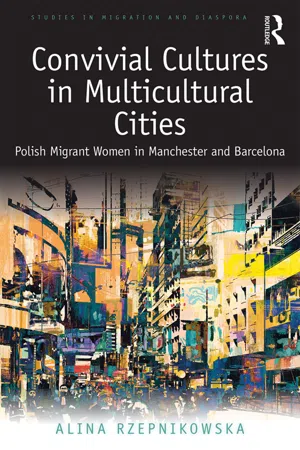
The large-scale migration brought about by the expansion of the EU over a decade ago led to migration from less ethnically diverse countries to multicultural and super-diverse societies. This book examines the complex encounters between Polish migrant women and local populations in Manchester and Barcelona, with attention to the ways in which difference is negotiated and managed through everyday practices of conviviality, which help to overcome hierarchies and create elements of sameness. Illustrating how cultural differences may become important resources for interaction that facilitates positive relationships, Convivial Cultures in Multicultural Cities draws on the narratives of Polish migrant women to shed new light on everyday social relations between migrant women and local populations, including settled ethnic minorities and other migrants. In doing so, it contributes to our understanding of the positional nature of racial identification and complicates our ideas of whiteness and privilege.
eBook - ePub
Convivial Cultures in Multicultural Cities
Polish Migrant Women in Manchester and Barcelona
- 154 pages
- English
- ePUB (mobile friendly)
- Available on iOS & Android
eBook - ePub
Convivial Cultures in Multicultural Cities
Polish Migrant Women in Manchester and Barcelona
About this book
Information
1
Introduction
Setting the context
In recent years European politicians and academics have engaged in debates on how to come to terms with the growing diversity of migrants and ethnic minorities. This has raised questions of how migrant populations and host societies can cope successfully with the challenges involved in living together. However, this re-emerging idea of having to deal with the issue of living together often falls into the discourse of immigration and diversity causing a problem often discussed in terms of segregation, competition for housing and welfare, as well as conflict between different groups. Immigration is often perceived as “a symbol of a world falling apart and a society that does not hold together” (Back and Sinha, 2016: 517). Migrants themselves are frequently framed as objects of concern and a threat. In contrast, this book offers a counter-narrative to the dominant discourses on migrants by exploring everyday interaction in the multicultural cities of Manchester and Barcelona from the perspective of Polish migrant women. It does so though the lens of conviviality understood as a dynamic process of living together at the local level. It explores the narratives about everyday encounters in both cities not only in terms of ethnicity, but also other categories which often intersect, including gender, class, religion, age and spatio-temporal dynamics. While the book explores various forms of encounter, interaction and engagement with difference, it recognises the importance of conflict, tensions, racism and xenophobia (Back and Sinha, 2016; Gilroy, 2004; Neal et al., 2018). This book aims to address the following questions: how does conviviality emerge in encounters between Polish migrant women and the local populations in both Manchester and Barcelona? What facilitates and what limits convivial encounters? Can conviviality endure despite exclusionary anti-immigration rhetoric, particularly in the context of Brexit?
There has been a growing number of scholars and researchers focusing on conviviality by exploring the ways of living together in urban spaces (Back and Sinha, 2016; Heil, 2014; Karner and Parker, 2011; Neal et al., 2013, 2018; Padilla et al., 2015; Wessendorf, 2014a, 2014b; Wise and Velayutham, 2014). Nowicka and Vertovec (2014: 1) argue that this “convivial turn” (Neal et al., 2013: 320) reflects a deeper concern about “human modes of togetherness”. This book differs from the existing literature on conviviality for several reasons. Firstly, it acknowledges the shortcomings of previous studies that mostly focus on a single country case. By adopting a comparative lens, it allows the exploration of the ways in which conviviality is experienced in two cities with attention to multiple settings, including social, political, cultural, national and local contexts. Secondly, while there is a growing body of research on gender and migration (Amrith and Sahraoui, 2018; Duda-Mikulin, 2018b; Erel, 2009; Gutiérrez Rodríguez, 2010; Kindler and Napierała, 2010; Mahler and Pessar, 2006; Phizacklea, 1983; Ryan and Webster, 2008), this book stresses the importance of under-researched migrant women’s experiences of conviviality, and it offers a critical perspective aiming to shed light on their daily encounters in multi-ethnic societies. Thirdly, whereas the existing literature tends to focus on relations between host society and postcolonial/non-European/non-white ethnic minorities, this book explores encounters between post–2004 Polish migrants not only with the native population but also with settled ethnic minorities and other migrants. What is particularly interesting about these migrants is their unstable racialised positioning as privileged white Europeans and migrant Others (Rzepnikowska, 2019). This positioning introduces the discourses of whiteness and racialisation to discussions on conviviality. Finally, this book contributes to the field of geographies of encounters by focusing on multiple locations which are often interlinked. It highlights the importance of investigating workplace relations between migrant women and their co-workers from different ethnic backgrounds. Furthermore, while research on conviviality mainly focuses on encounters with difference in public and semi-public spaces, private spaces as sites of convivial interaction have been largely overlooked. Since my interviewees often referred to encounters in private spaces of the homes, whether in the context of domestic work or socialising with neighbours, this book contributes to the understanding of conviviality in a domestic environment.
The book focuses on the experiences of migrant women coming from Poland, one of eight countries (Accession 8 [A8] countries: Lithuania, Latvia, Estonia, Poland, Czech Republic, Slovakia, Slovenia and Hungary) which joined the European Union (EU) in May 2004 – a significant event in the history of European migration. The UK, Ireland and Sweden were the only member states which granted free access of the A8 nationals to the labour market immediately after the EU enlargement. Public and political discourses on migration shifted to controversial discussions about new ‘Eastern European’ migrants, the length of their stay and their impact on the economy and public services. The profound influence of EU expansion on migration patterns within Europe has triggered an immense interest in research on migratory movements from Central and Eastern Europe, particularly from Poland to the UK. Nevertheless, there is a gap in research on everyday relations between Polish migrants and the local population, particularly in Spain which attracts fewer Poles, although there is a steadily increasing body of research on Polish post–2004 migration (Kruszelnicki, 2008; Main, 2013; Nalewajko, 2012; Władyka and Morén-Alegret, 2013). In Britain, there has been a growing interest in studying Polish migrants’ responses to other ethnic groups (D’Angelo and Ryan, 2011; Eade et al., 2006; Gawlewicz, 2016; Nowicka, 2018; Parutis, 2011; Ryan, 2010; Temple, 2011; Cook et al., 2011b). While the existing research often explores attitudes towards difference, there is still little focus on the actual experiences of conviviality which often differ from attitudes and opinions about different ethnic groups.
The term ‘multicultural’ used in this book is distinguished from the contested notion of multiculturalism. It describes societies or settings where people of different ethnic, cultural and religious backgrounds live together. This book examines the experiences of Polish migrant women in multicultural Manchester and Barcelona, which have seen rapid population shifts as a result of the arrival and settlement of various groups of migrants. It can be argued that both cities are characterised by super-diversity which highlights complexity in terms of “a dynamic interplay of variables among an increased number of new, small and scattered, multiple-origin, transnationally connected, socio-economically differentiated and legally stratified immigrants” (Vertovec, 2007a: 1024). In recent years, the concept of super-diversity has been widely used by scholars from various disciplines and in public policy, and it has been read in many different ways (Vertovec, 2014). However, the concept has been subject to some criticism. During the IRiS (Institute for Research into Superdiversity) Conference Superdiversity: Theory, Method and Practice in the Era of Change in June 2014 at the University of Birmingham, the policy roundtable (‘Rethinking policy and practice in/for an era of superdiversity’) participants expressed a concern about social inequalities and racism overlooked in discussions on super-diversity. Similarly, Back (2015) and Back and Sinha (2016) offer a critique of Vertovec’s conception of super-diversity considered as one-dimensional and neglecting attention to forms of division and racism. Further theoretical and methodological analysis is needed to understand these complexities and the dynamics of super-diversity and social inequalities. Nevertheless, the concept of super-diversity is used in this book as it allows moving beyond a simplistic view of diversity viewed solely through an ethnic lens and the presence of postcolonial ethnic minorities. It also highlights that between and within migrant groups living in close proximity there are individuals characterised by distinct gender, socio-economic statuses, experiences, patterns and motives for migration.
In the following sections I discuss the Polish, British and Spanish/Catalan contexts, including Polish migration in Britain and Spain, and finally, I offer the overview of this book.
Coming from an ethnically and religiously homogenous country?
As Valentine (2008: 333) suggests, “encounters never take place in a space free from history, material conditions, and power”. Therefore, when discussing Polish migrants’ encounters with difference, it is important to highlight the socio-historical and geographic context of Poland. Situated between the East and the West, Poland had been culturally, ethnically and religiously diverse for centuries (Podemski, 2012). From the fourteenth century, the First Polish Republic was a multi-ethnic country in which Poles, Byelorussians, Lithuanians, Ruthenians, Jews, Germans, Armenians and Tatars lived side by side (Kłosowska, 1994). According to Dziekan (2011: 37–38), the history of Polish Tatars, who have been present in Poland for more than 600 years, is a perfect example of coexistence of two different cultures, influencing one another, borrowing various elements and leaving out the others. Furthermore, by the end of the sixteenth century 80 per cent of the world’s Jewish diaspora sought refuge from persecution in Spain, Portugal and Germany. Even though the Polish state lost two-thirds of its territory after the period of partitions (1795–1918), Poland’s diverse ethnic minorities remained, consisting of about one-third of the Second Republic’s population (Kłosowska, 1994: 200). However, the tragic consequences of the Holocaust during WWII, border changes and the communist regime, which excluded Poland from the rest of the world and repressed difference, have left it as one of the most ethnically, culturally and religiously homogenous countries in the world (Podemski, 2012). While before WWII ethnic minorities constituted about 36 per cent of Poland’s population, they made up merely 2–4 per cent of the Polish population immediately after the fall of the Communist regime (Grzymała-Kazłowska and Okólski, 2003: 24–25).
With the end of socialism, Poland began to deal with arrivals of various groups of migrants, mainly from Southern and Eastern European countries, as well as from Asia and Africa who mostly regarded Poland either as a transit or a temporary place where they engaged in informal trade and short-term employment in several major cities (Grzymała-Kazłowska and Okólski, 2003: 24). During the first years of the political transformation there was an atmosphere of excitement and curiosity about diversity. Nevertheless, in the light of the economic recession and high levels of unemployment in the second half of the 1990s, the initial euphoria about difference was replaced with anxiety, stereotyping and prejudice. Despite some claims branding Poland as multicultural (Kempny et al., 1997), encounters between Polish people with non-white people are still rare in many areas of Poland. Średziński (2010) points out that Polish people hardly have a chance to challenge their stereotypical perceptions about black people, highly influenced by Western colonialist discourses, with reality since they constitute a very small number, between two and three thousand (Ząbek, 2009: 170). Only 15 per cent of all Poles come across Africans in their localities, and 7 per cent are in personal touch with them as students of higher education institutions, sportsmen, doctors and bazaar vendors in large cities (Średziński, 2010: 40). Similarly, there is a very small number of Muslims in Poland who are made up of Tatars, converts and Muslim migrants constituting 0.07–0.09 per cent of the total population of the country (Nalborczyk, 2006: 62).1 The politics of the current conservative government that came to power in 2015 with divisive nationalistic rhetoric fuelling anti-immigrant attitudes and physical attacks on Muslims or foreign-looking people, indicates that there might be even less ethnic diversity in the country (Narkowicz and Pedziwiatr, 2017). Some of my research participants noted that the presence of their non-white partners and mixed-race children often attracted a lot of attention, staring and surprise in public spaces. Racialised narratives have been more common and acceptable than in countries of mass immigration (Nowicka, 2012). While visual difference has become highly marked in Poland, whiteness has remained unnoticed, unrecognised (by the national community) and under-analysed (by the scientific community) (see also Imre, 2005).
The EU accession of the new member states in May 2004 has resulted in a large-scale migration of Poles to the UK, and a smaller one to Spain, where they have encountered people from different social classes, ethnic and religious backgrounds. To some extent, the socialisation in Poland may influence socio-spatial encounters with difference in multicultural societies. Nevertheless, it is also important to consider various trajectories of my research participants. For instance, several had traveled to and lived in different countries where they encountered difference before coming to the UK.
The context of post–2004 Polish migration in Britain
The post-war labour migration in the UK is often discussed in terms of the arrival of postcolonial migrants from Commonwealth countries, most notably from the British Caribbean and South East Asia in the 1950s. Over the past three decades, the nature of immigration and diversity has changed dramatically in Britain, char-acterised by diversification of countries of origin, migration histories, gender, age, religion, languages, education, legal status and economic background (Vertovec, 2007a). According to the 2011 Census data, 13 per cent (7.5 million) of the resident population of England and Wales were born outside the UK (ONS, 2012: 1). Geographically, the migrant population is not spread out evenly. The 2011 Census shows that over a third (37 per cent) of London residents were born abroad compared to between 5 and 12 per cent in other regions and Wales (ONS, 2012: 12).
There are diverse groups and diverse diasporic identities of Polish migrants in Britain characterised by multiple patterns of mobility as a result of at least three generations of migratory history between Poland and Britain (Eade et al., 2006). The British Isles became home to a Polish post-war diaspora. Furthermore, in the 1980s, thousands of Polish Solidarity protesters migrated to the UK as a result of the Martial Law imposed in 1981 (Garapich, 2008). Polish migration to Britain continued in the 1990s and early twenty-first century. During the 1990s and up to accession to the EU, Polish migrants were commonly associated with illegal employment and visa overstaying (Duvell, 2004). The status and the situation of Polish migrants changed significantly on 1 May 2004 when Poland joined the EU. They acquired the same rights as other EU nationals who have the right to live and work in the UK without restrictions, to remain permanently in the UK, and to be joined by dependents. Polish migrants constituted the largest single national group among the new arrivals in the UK (Burrell, 2009; White, 2011b). Between 2003 and 2010, the Polish-born population of the UK increased from 75,000 to 532,000 (ONS, 2011a). Poland became the most common country of birth for non–UK born mothers between 2010 and 2014, followed by Pakistan and India (ONS, 2015), and Polish migrants continue to be the largest non–UK national group in the UK (916,000), making up 29 per cent of all EU nationals living in the country (ONS, 2016). Furthermore, Polish is the second most spoken language after English in the UK (ONS, 2011b).
The reason behind the immediate labour market access of A8 nationals into the UK was severe labour market shortages, mainly in low-wage and low-skill occupations in construction, hospitality, transport sectors and public services (Anderson et al., 2006). Freedom of movement attracted many Polish people, especially the young, affected by high rates of unemployment, low wages and lack of opportunities in Poland (White, 2010). Low-cost transport lowered the cost of travel, encouraging ‘fluid migration’ (Grabowska-Lusińska and Okólski, 2009) with no settlement goal and for an undefined period of time.
Polish migrants are distributed very widely across the country. The socio-demographic profile of over half-a-million Polish minority is highly varied. They are mostly young (Grabowska-Lusińska and Okólski, 2008) and their qualifications often do not match their employment, although this may change over time (Ryan, 2015c). Many speak English and have finished secondary school or have obtained a degree (Grabowska-Lusińska and Okólski, 2009), although some researchers highlight that the majority are not university graduates, and many have poor English-language skills (White, 2011b). They work in a variety of sectors including administration, business and management, hospitality and catering, public services, agriculture, manufacturing and food, and fish and meat processing, as well as construction (Drinkwater et al., 2006). In addition, there has been a growing population of Polish university students (HESA, 2015). According to 2001–2006 Labour Force Survey data, there had been a minor gender imbalance amongst A8 migrants since 58 per cent of registered workers were male (Drinkwater et al., 2006: 7). Even though the numbers of both female and male migrants have increased over time, women have constituted the majority of the migrant population in the UK; in 2013, 54 per cent of the foreign-born population were women (Rienzo and Vargas-Silva, 2014: 3).
Polish migrants in Manchester
Manchester has been a city of migrants since the end of the eighteenth century (Werbner, 1999). During the first decades of the nineteenth century, Manchester attracted people from other parts of Britain to work in rapidly expanding industries. It attracted Irish migrants in the mid-nineteenth century and it was a key arrival city for Jewish and Italian migrants in the late nineteenth and early twentieth centuries. In the post-war period, the city witnessed the arrival of Polish refugees, mainly soldiers who were incorporated into the British armed forces and granted the right to stay in the UK, as well as European Volunteer Workers (EVW) recruited after the war, some of whom had been displaced persons. From the 1950s, Manchester became home to migrants from the ex-colonies of the British Empire – Afro-Caribbean, Pakistani and subsequently Bangladeshis. In the last decade, the city has seen the arrival of Polish and Chinese migrants, as well as Somali refugees. According to the 2011 Census data, the largest ethnic minority groups in Manchester are Pakistani, African and Other White (CoDE, 2013). Most ethnic minority groups are evenly spread residentially across Manchester and the Greater Manchester area. Manchester is one of the most culturally and linguistically diverse cities in Europe with up to 200 languages spoken by residents in the Greater Manchester area (Multilingual Manchester, 2013). After English, Urdu is the language most commonly spoken in Manchester followed by Polish (Manchester City Council, 2014a: 32).
In the post–2004 period, Manchester has witnessed the arrival of Polish migrants, amongst other A8 nationals, who have contributed to a greater diversity of the city. Apart from many Polish grocery shops, there is the Polish Catholic Church in Moss Side, Polish Saturday School at the Manchester Academy, Polish Catholic Social Club in Oldham and The Polish Circle in Cheetham Hill. No local authority in Greater Manchester has published up-to-date figures on post–2004 European migration. The official statistics on the numbers and distribution of Polish migrants in Manchester are very limited. According to the 2011 Census data, Polish nationals are incorporated in an imprecise category of ‘White Other’, which also includes other Europeans, Americans and Australians. According to Manchester City Council (2015: 29) data, Polish migrants constituted 1.2 per cent of Manchester population and 0.8 per cent of Greater Manchester population (based on self-descriptions). Many of my research participants arrived in deprived areas with cheaper rent and poor housing. However, as a result of improved socio-economic situation, some moved to more affluent residential neighbourhoods.
The context of post–2004 Polish migration in Spain
In contrast to Britain, Spain was predominantly an emigration state until the 1980s. Since its acceptance into the European Economic Community in 1986, Spain has become a coun...
Table of contents
- Cover
- Half Title
- Series Page
- Title
- Copyright
- Dedication
- Contents
- List of figures
- Series editor’s preface
- Acknowledgements
- 1 Introduction: setting the context
- 2 Conceptual considerations and the research
- 3 Conviviality in Manchester and Barcelona (and their environs)
- 4 Conviviality in the workplace
- 5 Brexit narratives: conviviality under threat?
- 6 Conclusions: the future of conviviality in Manchester and Barcelona
- Bibliography
- Index
Trusted by 375,005 students
Access to over 1.5 million titles for a fair monthly price.
Study more efficiently using our study tools.
Frequently asked questions
Yes, you can cancel anytime from the Subscription tab in your account settings on the Perlego website. Your subscription will stay active until the end of your current billing period. Learn how to cancel your subscription
No, books cannot be downloaded as external files, such as PDFs, for use outside of Perlego. However, you can download books within the Perlego app for offline reading on mobile or tablet. Learn how to download books offline
Perlego offers two plans: Essential and Complete
- Essential is ideal for learners and professionals who enjoy exploring a wide range of subjects. Access the Essential Library with 800,000+ trusted titles and best-sellers across business, personal growth, and the humanities. Includes unlimited reading time and Standard Read Aloud voice.
- Complete: Perfect for advanced learners and researchers needing full, unrestricted access. Unlock 1.5M+ books across hundreds of subjects, including academic and specialized titles. The Complete Plan also includes advanced features like Premium Read Aloud and Research Assistant.
We are an online textbook subscription service, where you can get access to an entire online library for less than the price of a single book per month. With over 1.5 million books across 990+ topics, we’ve got you covered! Learn about our mission
Look out for the read-aloud symbol on your next book to see if you can listen to it. The read-aloud tool reads text aloud for you, highlighting the text as it is being read. You can pause it, speed it up and slow it down. Learn more about Read Aloud
Yes! You can use the Perlego app on both iOS and Android devices to read anytime, anywhere — even offline. Perfect for commutes or when you’re on the go.
Please note we cannot support devices running on iOS 13 and Android 7 or earlier. Learn more about using the app
Please note we cannot support devices running on iOS 13 and Android 7 or earlier. Learn more about using the app
Yes, you can access Convivial Cultures in Multicultural Cities by Alina Rzepnikowska in PDF and/or ePUB format, as well as other popular books in Social Sciences & Sociology. We have over 1.5 million books available in our catalogue for you to explore.