Partition and Quantity: Numeral Classifiers, Measurement, and Partitive Constructions in Mandarin Chinese presents an in-depth investigation into the semantic and syntactic properties of Chinese classifiers and conducts a comprehensive examination on the use of different quantity constructions in Chinese.
This book echoes a rapid development in the past decades in Chinese linguistics research within the generative framework on Chinese classifier phrases, an area that has emerged as one of the most cutting-edge themes in the field of Chinese linguistics.
The book on the one hand offers a closer scrutiny on empirical data and revisits some long-lasting research problems, such as the semantic factor bearing on the formation of Chinese numeral classifier constructions, the (non-)licensing of the linker de (?) in between the numeral classifier and the noun, and the conditions regulating the use of pre-classifier adjectives. On the other hand, particular attention is paid to the issues that have been less studied or gone unnoticed in previous studies, including a (more) fine-grained subcategorization of Chinese measurement constructions, the multiple grammatical roles played by the marker de (?) in different numeral classifier constructions, the formation and derivation of Chinese partitive constructions, etc.
To explore the essential grammatical function of Chinese classifiers in numeral classifier constructions, it helps to examine the meaning of numerals first. Numerals have long been a focus of philosophers’ interest. Various philosophical approaches have been posited to account for how human beings conceptualize numbers and how people understand number assignments. Of the existing approaches, this section will introduce two representative ones, namely the intersective approach and the itemizing approach.
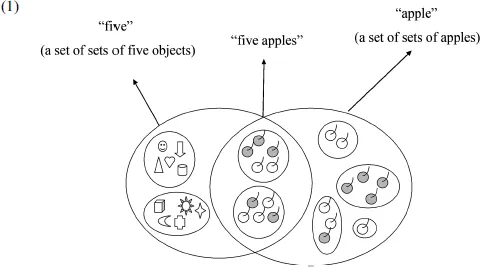
The intersective analysis was proposed by Frege (1884). In accordance with this analysis, numerals represent a property abstracted from concrete, particular sets of objects. More specifically, within the set-theoretical framework that defines a property p in terms of the set of entities owning the property p, Frege defined the numeral n as being represented by a set of sets, each of which contains n member(s). Concomitantly, an entity quantification construction composed of the numeral n and the noun x is viewed as an intersection between (i) a set of sets, each of which has n member(s), and (ii) a set of sets, all the members of which have the property of “being x.” Accordingly, five apples, for example, denotes an intersection between (i) a set of sets, each of which consists of five objects, irrespective of the particular type(s) of entities involved, and (ii) a set of sets, each member of which has the property of “being an apple,” regardless of the actual number of apple(s) contained in each set, as visualized in Figure 2.1.
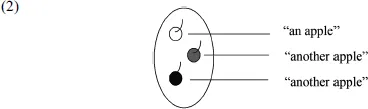
In contrast to the intersective approach, the itemizing approach considers that the numeral in itself does not denote anything but is merely a syncategorematic element that is necessarily associated with the enumeration of entities. As Russell (1919, p. 365) stated, “all numbers are what I call logical fictions … you do not have, as part of the ultimate constituents of your world, these queer entities that you are inclined to call numbers.” Taking three apples as an illustration, according to the itemizing approach, the quantified set denoted by this phrase is interpreted by enumerating apples in a one-by-one manner, as “an apple, and another apple, and another apple,” as depicted in Figure 2.2.
Figure 2.1 An intersective approach to “five apples.”
Figure 2.2 An itemizing approach to “three apples.”
Based on comprehensive empirical investigations into humans’ cognitive understanding of numerals, Wiese (2003) proposes an evolutional, synthesized account of the concept of number. She points out that the itemizing approach and the intersective approach are, in fact, associated with two different areas in humans’ cognitive number domain, with the former pertaining to the enumeration of objects, which is a preliminary empirical underpinning for developing a sense of numbers, while the latter concerns the comprehension of abstract number concepts, which constitutes a basis for arithmetical thinking. For a child to acquire the ability to indicate the total number of members included in a set correctly, in accordance with Wiese, a child has to learn how to apply “tagging” words such as “one, two, three, four, …” to respective individual objects in a one-to-one manner in a strictly ordered progression, a process reminiscent of enumeration under the itemizing approach. On the other hand, a child needs to know that the last number he/she applies when tagging objects represents the total number of objects in the set (see also Gelman, 1978, 1990; Gelman and Gallistel, 1978; Gallistel and Gelman, 1990; Starkey, Spelke, and Gelman, 1991; Gelman and Meck, 1992; Gelman and Brenneman, 1994). To illustrate, to count a set consisting of three apples x, y, and z, the child first needs to tag the apples with the counting words one, two, and three, respectively, in accordance with the ordered numeral progression. The child then has to understand that, as the last tagging word applied to the apples is three, this set should be finally identified as “three apples.” Wiese further claims that an abstract understanding of numerals (in the sense of Frege) is generalized from the enumeration of concrete entities, a capacity that does not emerge until a later stage of the development of children’s cognitive number systems. Once the abstract concept of numbers has been acquired successfully, children are able to use numerals in isolation for mathematical thinking without resorting to concrete objects.
In summary, in accordance with Wiese’s research, itemizing entities lays the cognitive ground for establishing a one-to-one correlation between discrete entities and numeral progressions such as “one, two, three, four…”; the ability to employ the last “tagging” number to quantify a set of entities indicates the eventual mastery of the link between number and quantity (Wiese, 2003, p. 167). The abstract concept of numerals is developed at a later stage when the meaning of numerals can be understood clearly without relying on the counting of concrete entities.
2.1.2 Core grammatical function of Chinese classifiers in numerical quantification
In light of Wiese’s (2003) theory, the present work maintains that numerical quantification of the entity domain must be based on the existence of individualized items, which is driven by the cognitive prerequisite for numerical counting; that is, the establishment of a one-to-one correlation between the ordered progression of numerals and the counting targets. With this in mind, this section will examine the core grammatical function performed by Chinese classifiers in numerical quantification expressions.
It has been long noted that the presence of a classifier is obligatory to form a grammatical numerical quantification construction in Chinese, as exemplified below:
(3) a. 两* (个) 人
liăng *(gè) rén
two Cl person
‘two people’
b. 五* (本) 书
wŭ *(běn) shū
five Cl book
‘five books’
c. 十* (把) 刀
shí *(bă) dāo
ten Cl knife
‘ten knives’
From a cross-linguistic perspective, a generalization that has been widely made in the literature is that languages may employ either classifiers or plural inflections to instantiate a semantic division syntactically for the purpose of expressing numerical quantification, with a well-known typological distinction being drawn between classifier languages that adopt the classifier system (for example, Chinese), and non-classifier languages ...
Table of contents
Cover
Half-title Page
Title Page
Copyright
Contents
Figures
Tables
Abbreviations
Symbols
Acknowledgments
Part I Chinese classifiers and classifier phrases
Part II Encoding of discourse-related information in Chinese numeral classifier constructions
Part III Referentiality of Chinese quantity constructions
Index
Trusted by 375,005 students
Access to over 1.5 million titles for a fair monthly price.
Study more efficiently using our study tools.
Frequently asked questions
Yes, you can cancel anytime from the Subscription tab in your account settings on the Perlego website. Your subscription will stay active until the end of your current billing period. Learn how to cancel your subscription
No, books cannot be downloaded as external files, such as PDFs, for use outside of Perlego. However, you can download books within the Perlego app for offline reading on mobile or tablet. Learn how to download books offline
Perlego offers two plans: Essential and Complete
Essential is ideal for learners and professionals who enjoy exploring a wide range of subjects. Access the Essential Library with 800,000+ trusted titles and best-sellers across business, personal growth, and the humanities. Includes unlimited reading time and Standard Read Aloud voice.
Complete: Perfect for advanced learners and researchers needing full, unrestricted access. Unlock 1.5M+ books across hundreds of subjects, including academic and specialized titles. The Complete Plan also includes advanced features like Premium Read Aloud and Research Assistant.
Both plans are available with monthly, semester, or annual billing cycles.
We are an online textbook subscription service, where you can get access to an entire online library for less than the price of a single book per month. With over 1.5 million books across 990+ topics, we’ve got you covered! Learn about our mission
Look out for the read-aloud symbol on your next book to see if you can listen to it. The read-aloud tool reads text aloud for you, highlighting the text as it is being read. You can pause it, speed it up and slow it down. Learn more about Read Aloud
Yes! You can use the Perlego app on both iOS and Android devices to read anytime, anywhere — even offline. Perfect for commutes or when you’re on the go. Please note we cannot support devices running on iOS 13 and Android 7 or earlier. Learn more about using the app
Yes, you can access Partition and Quantity by Jing Jin in PDF and/or ePUB format, as well as other popular books in Languages & Linguistics & Languages. We have over 1.5 million books available in our catalogue for you to explore.