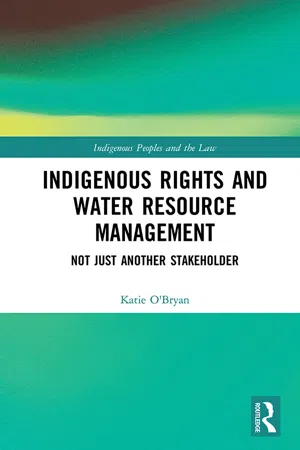
In an era of climate change, the need to manage our water resources effectively for future generations has become an increasingly significant challenge. Indigenous management practices have been successfully used to manage inland water systems around the world for thousands of years, and Indigenous people have been calling for a greater role in the management of water resources. As First Peoples and as holders of important knowledge of sustainable water management practices, they regard themselves as custodians and rights holders, deserving of a meaningful role in decision-making. This book argues that a key (albeit not the only) means of ensuring appropriate participation in decision-making about water management is for such participation to be legislatively mandated. To this end, the book draws on case studies in Australia and New Zealand in order to elaborate the legislative tools necessary to ensure Indigenous participation, consultation and representation in the water management landscape.
eBook - ePub
Indigenous Rights and Water Resource Management
Not Just Another Stakeholder
- 272 pages
- English
- ePUB (mobile friendly)
- Available on iOS & Android
eBook - ePub
Part C
Current status of Indigenous water management rights
Commonwealth legislation
4 Native title as a source of Indigenous water rights
Background to the Native Title Act 1993 (Cth)
Following the seminal 1992 High Court decision in Mabo v Queensland [No 2] (‘Mabo’),1 the legal fiction that Australia was terra nullius, or uninhabited, was finally put to rest. Prior to Mabo, in Australian law Indigenous Australians had no legal rights to land arising from their original occupation. The Mabo decision thus marked a watershed moment in Australia’s history of settler relations with its original Indigenous inhabitants. With the rejection of the terra nullius doctrine came the recognition that Australia’s Indigenous peoples were the prior owners and occupants of this country, and that any rights and interests that survived British sovereignty could be recognised by the common law. Native title thus emerged, albeit not unscathed, from the shadows of the land ownership regime imported by the colonial settlers.
Mabo was a direct challenge to conventional understandings of Australia’s land management and property rights regimes, the very existence of which had been predicated on the assumption that there were no Indigenous rights to land. It was, therefore, imperative that a mechanism be put in place to deal with native title claims, and with activities occurring on land on which native title exists or may be found to exist in the future. Thus, the Native Title Act 1993 (Cth) (‘NTA’) was born.
The NTA was the culmination of intense negotiations involving Indigenous representatives, the Prime Minister, members of the opposition, the Democrats, the Greens, state premiers, and other major stakeholders; including representatives from the mining, pastoralism and farming industries.2 After what was at the time one of the longest parliamentary sittings in Australia’s history, the Native Title Bill 1993 (Cth) was passed.3 Following a change in government and the High Court decision in Wik v Queensland (‘Wik’),4 the NTA was the subject of major amendments in 1998, with a number of those amendments affecting Indigenous water rights.5
By enacting the NTA, the Australian Parliament acted in purported recognition of international standards for the protection of human rights, in particular those of Indigenous peoples, and in purported compliance with Australia’s obligations under international law.6 This was certainly the intent of the government when it introduced the Bill.7
This chapter identifies those provisions of the NTA that recognise Indigenous rights to participate in the management of water resources and evaluates their effectiveness in light of the relevant case law.
The NTA and native title rights to water
Relationship between the NTA and the common law
The result of Mabo was that the common law could recognise those native title rights and interests that had survived the acquisition of sovereignty by the British Crown, provided that such recognition did not ‘fracture a skeletal principle of our legal system’.8 The NTA then established a statutory regime for the recognition of native title. This means that it is now the NTA rather than the common law to which Indigenous Australians turn if they wish to seek recognition in the courts of their native title rights and interests.9 The common law and Mabo remain relevant, although only to a limited extent.10
Mabo referred only to recognition by the common law of native title rights to land. This does not, however, preclude common law recognition of native title rights to waters.11
Rulings in subsequent cases have recognised native title rights to waters pursuant to the NTA definition of native title. As recognition under the NTA can only occur if the rights are ‘recognised by the common law of Australia’,12 it is clear from these cases that the common law recognises at least some form of native title right to waters.
The NTA clearly encompasses native title rights in relation to water, which is evident from the long title of the NTA. 13 The definition of native title also includes references to waters,14 which is then specifically defined as including:
(a) sea, a river, a lake, a tidal inlet, a bay, an estuary, a harbour or subterranean waters; or(b) the bed or subsoil under, or airspace over, any waters (including waters mentioned in paragraph (a)); or(c) the shore, or subsoil under or airspace over the shore, between high water and low water.15
Many determinations of native title provide their own definition of waters, usually of a less inclusive nature.16 In addition, some determinations use the term ‘water’ rather than ‘waters’ without providing a definition, and therefore the ordinary meaning of the term must be used to work out what native title rights and interests are encompassed by the determination.17 A separate definition of water also exists for the purposes of s 24HA. The reasoning behind having separate definitions and the discussion of native title determinations appear later in this chapter.
Various sections of the NTA relate to or have an impact on Indigenous water management rights. The following is an analysis of the most significant, commencing with s 24HA.
Section 24HA – management of water and airspace
Section 24HA is one of the ‘future act’ provisions of the NTA. 18 It is of particular relevance because it relates to the management of water, the role of native title holders and claimants, and notification/consultation procedures. This section was one of the 1998 amendments to the NTA, implementing Point 8 of Prime Minister John Howard’s ‘Wik 10 Point Plan’,19 the government’s response to the so-called ‘uncertainty’ it saw as having been created by the Wik decision.20
The term ‘water’, for the purposes of this section, means ‘water in all its forms’. This definition deliberately excludes the bed or subsoil under, or airspace over, any waters. The Explanatory Memorandum to the Native Title Amendment Bill 1997 (Cth) (‘Explanatory Memorandum’) explains the purpose for this exclusion as follows:
Subdivision H does not deal with the management and regulation of the bed or subsoil under onshore and offshore waters (which includes the regulation of off-shore mining such as the petroleum and gas industries). These matters are generally dealt with in proposed Subdivisions M and N, respectively, of Division 3 (see Chapters 15 and 16). It is for this reason that the term ‘water’ is used rather than the term ‘waters’ (which is defined in section 253 to include the bed or subsoil).21
The Explanatory Memorandum then explains the effect of s 24HA as being to ensure
that legislation and other future acts dealing with surface and sub-surface water, living aquatic resources and airspace will be valid. Any rights or obligations created by the acts will prevail over inconsistent native title rights and interests. The non-extinguishment principle applies to these acts and native title holders are entitled to compensation from the relevant government.22
Under s 24HA, the making, amendment or repeal of legislation or the grant of a lease, licence, permit or authority that relates to the management or regulation of water is valid. The non-extinguishment principle applies, and compensation is payable for any effect the act may have on native title rights.
Unlike future acts which relate to mining,23 future acts under this section do not attract the right to negotiate. Instead, they fall within the class of future acts to which only the rights to be notified and to have an opportunity to comment apply.24 These rights do not, however, apply to the making, amending or repeal of legislation.
In relation to the right to be notified and the opportunity to comment, those rights are very limited in scope, as the following cases demonstrate.
The scope of the opportunity to comment was discussed in Harris v Great Barrier Reef Marine Park Authority (‘Harris’).25 In Harris, the Full Federal Court stated:
The right under s 24HA(7)(b) is, we think, a right to proffer information and argument to the decision-maker that it can make such use of as it considers appropriate. The sub-section does not confer any greater right on the native title interests. It is not a right to participate in the decision whether to issue the permit or a right that entitles the recip...
Table of contents
- Cover
- Half Title
- Series page
- Title page
- Copyright page
- Acknowledgements
- List of abbreviations
- Table of contents
- Introduction
- Part A: The international context
- Part B: Case study Australia – historical context
- Part C: Current status of Indigenous water management rights Commonwealth legislation
- Part E: Case study Aotearoa New Zealand
- Part F: The way forward
- Glossary of Māori terms
- Bibliography
- Index
Trusted by 375,005 students
Access to over 1.5 million titles for a fair monthly price.
Study more efficiently using our study tools.
Frequently asked questions
Yes, you can cancel anytime from the Subscription tab in your account settings on the Perlego website. Your subscription will stay active until the end of your current billing period. Learn how to cancel your subscription
No, books cannot be downloaded as external files, such as PDFs, for use outside of Perlego. However, you can download books within the Perlego app for offline reading on mobile or tablet. Learn how to download books offline
Perlego offers two plans: Essential and Complete
- Essential is ideal for learners and professionals who enjoy exploring a wide range of subjects. Access the Essential Library with 800,000+ trusted titles and best-sellers across business, personal growth, and the humanities. Includes unlimited reading time and Standard Read Aloud voice.
- Complete: Perfect for advanced learners and researchers needing full, unrestricted access. Unlock 1.5M+ books across hundreds of subjects, including academic and specialized titles. The Complete Plan also includes advanced features like Premium Read Aloud and Research Assistant.
We are an online textbook subscription service, where you can get access to an entire online library for less than the price of a single book per month. With over 1.5 million books across 990+ topics, we’ve got you covered! Learn about our mission
Look out for the read-aloud symbol on your next book to see if you can listen to it. The read-aloud tool reads text aloud for you, highlighting the text as it is being read. You can pause it, speed it up and slow it down. Learn more about Read Aloud
Yes! You can use the Perlego app on both iOS and Android devices to read anytime, anywhere — even offline. Perfect for commutes or when you’re on the go.
Please note we cannot support devices running on iOS 13 and Android 7 or earlier. Learn more about using the app
Please note we cannot support devices running on iOS 13 and Android 7 or earlier. Learn more about using the app
Yes, you can access Indigenous Rights and Water Resource Management by Katie O'Bryan in PDF and/or ePUB format, as well as other popular books in Law & Civil Law. We have over 1.5 million books available in our catalogue for you to explore.