Of all the travels of an adventurous age, none have been more quirky and colourful than this Victorian traverse of the Middle East by canoe. Transported to the Suez Canal by steamer, the Rob Roy - an oak and cedar one-man kayak canoe – slipped into the water at Port Said and began a six months voyage. Stalked by jackals, shadowed by bandits and attacked by crocodiles, MacGregor battles on to be rewarded with the adventure of a lifetime. This is the Middle East seen from a truly unique perspective - airy minarets, colourful markets and Pasha's palaces give way to solitary marshes full of strange fishes and reed-lined rivers teeming with bird and animal life seen at close range, then give way again to eerie stretches dominated by deserted temples and ruins. Crossing deserts by horseback or steam train when no channel can be found, MacGregor follows great rivers to their sources, explores remote shores and mixes happily with the many peoples he meets along the way, captured here in all their rich diversity. This is as much a portrait of the way life can be lived as it is of a landscape. It is also a remarkable naturalist's account and a true-life epic worthy of Jules Verne. Illustrated with charming line drawings and practical notes on the design of the canoe, its provisioning and clothes and food necessary this is a book that cries out to be read.
- 256 pages
- English
- ePUB (mobile friendly)
- Available on iOS & Android
eBook - ePub
Canoe Cruise In Palestine Egypt
About this book
Information
THE EOB EOY ON THE JOEDAN,
ETC., ETC.

CHAPTER I.
Suez Canal—Port Said—Lake Menzaleh—The Start—Rogues—Sand Storm—Bears—Ismailia—Crocodile Lake—Murders—Guy Fawkes—Jackal—The Canoe—My Bed.
AT Alexandria we took off the carpet that had covered the Rob Roy during her long voyage from England in the good ship Tanjore.
Her polished cedar deck glittered in the African sun, and the waves of a new sea played on her smooth oak sides.
I stepped in lighthearted, for a six months’ cruise, and the first half-hour round the crowded harbour showed that the Moslems would be as kind in their welcome of the little craft as the Norsemen had been, and the Swiss, and the Indians of Ottawa in my other journeys.
The dockyard workmen ran to see the canoe, shouting, in their scant attire. The sailors of a hundred vessels gazed at her dark-blue sails and gilded silken flag; even the lone sentry on the walls was aroused from his vacant stare to look at the little English “Merkeb” that skimmed over the breakers.
A few days more, and the Rob Roy came to Port Said, the bustling town of wooden shanties, new sprung from the sand at the mouth of the Suez Canal. No other place so small has so large a variety of inhabitants. It is like a slioe of the great fair at Nijni Novgorod in Russia.
When the canoe touched the beach, the red men and the white ran to see her, and gabbled loud ; then she was borne on two negroes’ shoulders to the “Grand Hôtel de France.” Great interest was shown in the arrival of the smallest boat that ever journeyed in the East, and it will be entirely the fault of the narrator if her delightful voyage does not fulfil the expectations of what has to be told. It was novel indeed to paddle thus upon the Red Sea and the Nile, but far more when the Rob Roy essayed the Syrian lakes and the rivers and seas of Palestine, among sacred scenes never opened before to the traveller’s gaze, being entirely inaccessible except in a canoe. These we are to meet farther on. Meanwhile, on this 28th of October, the Rob Roy is content to start at a slower pace and in easier navigation.
The officials of the Canal Company overwhelmed me with hospitality, barely concealing a suspicion that their guest was at least half-crazy; and a fortnight’s careful observation on my side did not settle the question whether it is most difficult to cut a canal, to keep it open, or to make it pay.
“A hole in the sand is a good place for sinking capital. You can dig it if you pay the diggers ; you can keep it clear if you pay dredges rather than dividends. France having dug and dredged it, England now buys the Khedive’s shares, and lays her strong hand on Europe’s waterway to India, while holding still the other gate of the sea-path at Aden, her Prince’s road to the East.
The streets at Port Said are nothing but sand. Men fire at sea-gulls among the shops; pelicans toss upon the waves, flamingoes fly over the houses, and porpoises tumble in the harbour. Among these new friends the Rob Roy sailed over the water, and at the table d’hôte all the guests talked about her intended voyage from sea to sea; and the argument was closed by a general confession that “Les Anglais sont plus chic que nous.” A Frenchman came to thank me for a little paper, “ The British Workman ” (in French), which I had given to him at Havre last summer, before leaving that port in my yawl for a voyage alone over the broad Channel to Portsmouth. Good and harm may be done in this as in other ways: good by giving as a present; harm by giving as a rebuke. Critics need not be hard upon this ready way of addressing strangers, while their own clever thoughts are daily proffered to each of us in London streets. Out of the café to ruminate on the rise of nations, we are challenged even here by little ink-faced urchins, who rush at the new traveller with “ Black shoes, sare ?” Their 400 red-coated brother shoeblacks in London earn £12,000 a year.
From Map I., at page 77, it will be seen that the canal at first goes through Lake Menzaleh, a vast expanse of shallow water, the accumulation of what trickles through the soft dykes along the Damietta branch of the Nile. The lake, being now full (in October), had advanced its margin close to the town of Port Said. About six weeks afterwards it was at nearly the same level, when I walked to see the “ Gemileh mouth ” of the Nile, where a fitful stream only sometimes overflows seawards. At my next visit to Menzaleh (in March) the lake had receded half a mile from the swampy flats, and at that dry season the fulfilment of the prophecy seemed most complete, which tells us that “the seven streams of the Nile shall fail.” Later in our cruise we shall spend a pleasant week upon Menzaleh.
Meanwhile we launched upon the calm wide lake that reaches away to a far-off dimness.
The sun was hot, the wind was nil, and there was nothing on the unruffled water to betray the shallows round us, even to a practised eye. Very Boon, therefore, the canoe got entangled in mud-banks, and the sharp little ragamuffins of an Arab village gladly perceived there was a new victim come for them to tease. They scampered out to me, naked and black, and a score of them were splashing and tumbling round the canoe, now helpless to run away.
“ Backshish! ” was the first cry I heard in the East; and the last I heard there, after wandering long, was “Backshish!” Their lithe limbs revelled in the tepid water, and their feet in the oozy mud. Their heads were like cocoa-nuts, with only one hair-lock left at the top, for Mahomet to hold them by at last. Their frolics were very forward, to say the least: but boys, black or white, must be humoured to be ruled; so I appointed the noisiest of them a “policeman,” and paid him a month’s salary in advance—one penny—for which he made the rest drag the canoe, with me in it, a long way cheerfully, until I got out of the boat, and, wading in the soft mud, spoiled for ever a pair of chamois shoes twenty years old, but never meant for use like this. At last we launched once more upon*.the old salt sea. It was charming to be danced on the swell of real ocean waves, and to shoot at the pelicans lifted on the foam, and to scud back again with a reef in my lug, and to race with the swarthy Nubians tugging at their oars.
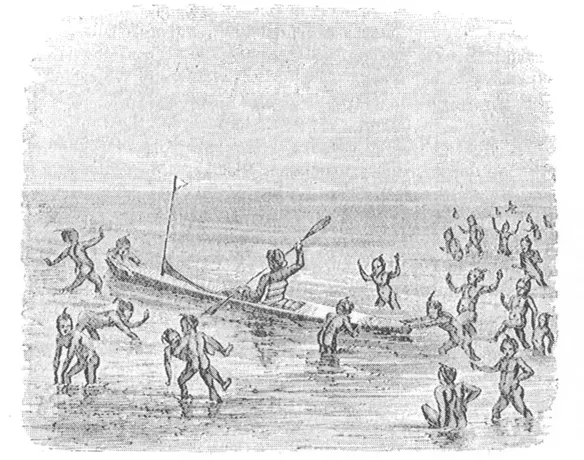
The Shallows of Lake Menzaleh.
But, after a day or two here of this amphibious life, the sights of Port Said had all been seen, the workshops inspected, and the huge machines of the canal; and after a farewell dinner with my new French friends, my “ sea-stores ” were embarked for our lonely cruise. The exulting delight of freedom possessed me once more with an access of joy which had always come soon in my voyages, and never ceased to the end.
And yet I cannot say that it would be wise to begin one’s canoeing in the East, or to begin in the East by canoeing.
Over and over I felt the great advantage of having made already three tours in these hot latitudes ; and often there was full need for the shifts and plans for safety, speed, or comfort, which had been shaped by the experience of three former cruises alone.*
The French officers crowd around as the canoe is launched, now heavy with provisions for four days. Her topsail swells with the breeze as we glide from the shore, and the Egyptian sailors shout, “ All right! ” in English, nodding their shaven polls. We were soon skimming swiftly on the smooth canal, which here runs perfectly straight for nearly thirty miles, while its banks vanish on the horizon in trembling perspective. It is but a short voyage to-day, and begun in the evening, with no work to do but to steer and to look at the high banks on both sides, like two railway viaducts, five hundred feet apart, at the steam dredges rattling their wheels and chains, and the coal-boats lazily towed in a line, and the pretty fleet of small craft all pressing on with me, crowding white-bosomed sails, and laden with merry song.
The sky glows softly as the sun sets red, and the white moon rises full. By its bright shining on the waters of cold Lake Menzaleh, we draw up the Rob Roy ashore on the bank, in the loneliest spot to be found, near Ras el Esh, and soon my “ Canoe Cuisine ” is boiling Liebig’s soup.
The fish are leaping in the moonbeams now. They often jump into the little steamers on the canal, and a fish had leaped right across my boat as she started; but there is no other noise. Wrapped in my great brown cloak for the night, I take a last look about me to see that nobody is near. For sleeping quietly, the main thing is to be quite alone, and on this Suez Canal all strangers may safely be distrusted as rogues, for the number of murders in its neighbourhood is altogether unreasonable.
Under the moon then one could see only long rows of water-fowl on the silent lake in regiments gleaming white ; so I turned in, while my cabin was lighted by a beautiful little oil lamp,* and opened a page of the Times.
With all these comforts about me I passed a miserable night. The place so carefully chosen turned out to be only a heap of refuse, and it swarmed with angry flies, so very minute, and so inquisitive, and so hungry, that the mosquito curtains of my cabin only made their attack more piquant. The moon is, indeed, very pretty to look at, and proper to sing to in rhyme or blank verse; but its pale light shows no colour in objects ; and so, for selecting night quarters, give me in future the truth-telling rays of honest Father Sol.
Next morning at four it was cheerful to breakfast on a cigar, until I could catch a boat and buy bread from a funny little Greek. But a Frenchman hailed me, and his wife brought out some excellent coffee, and both were intensely polite and conversational as they handed the sugar-tongs into the canoe.
At Kantara the canal cuts through the old Arab track over the desert, and by which I had travelled years ago on camel’s back. The name of the place reminds us that here was once some wet lagoon simmering its tepid fever in the reeking sand.*
There I stopped Sunday, and slept in a little wooden shed. A furious storm whirled up the arid plain, and dishevelled the face of nature, and dimmed the sun in heaven. The landscape, to look upon, was now one vast yellow sand-cloud, with men and camels faintly floating in a fog of dust, without any horizon. To paddle against this hurricane next day was impossible, but I towed the canoe by a long cord girt round my waist. Even the mosquito-net, double-folded over my face, quite failed to keep out the drifting sand.
Wild dogs, not exactly jackals, for their tails were erect, generally chose the night hours to call upon me, and sometimes travellers belated did the same. The white-robed Bob Roy, whiter under the moonlight, must have puzzled them greatly, and so long as they argued in whispers outside I let them alone, but there was a pistol ready all the time in my bedroom, and I always had the (unfortunate) capacity ot instantly waking at the slightest noise. A wholesome fear of the strange creature they saw was all in my favour, and often in this journey I traded on the belief that the coward and the superstitious are not seldom the same person.
For several days a curious group of beings had exactly kept pace with the Rob Roy—three brown men leading three brown bears. One bear was old, another was blind, the third was very frisky, but the men insisted upon all of them bathing in the water exactly at noon, about the very last thing a bear would like to do: it was great amusement to watch their struggles, remembering the gross indignities offered by the bathing-woman to every one of us when he was a British baby.
One pitch-dark night, when I ought to have reached El Gisr (“the bridge”), the sand-hills were high, and I could not find the place. I went at last to a barge, where loud singing told of inmates. When my paddle tapped on the window, a man came out, and offered to find me lodging; but, after some parley, he seemed so drunk, and evidently such a villain when sober, that it would never do to leave my canoe with him; so I paddled on and slept in my cabin as usual, but with no dinner or supper, and frequent visits at midnight from very strange folks. This place is noted for ruffianism, and the Greeks had the worst character by universal consent —including their own. The best men on the canal I found were Austrians.
There was ample variety in the scenery or circumstances of each day to make it extremely interesting to voyage thus here once, and it was an excellent preparation in many ways for the more difficult times and places that were to come. Among other things, I was able to make numerous experiments with my boat, and all her multifarious fittings, of which a full list and description will be found in the Appendix. Her pace I tried repeatedly in calm water, without current, and where all the kilometres were marked by posts on tho bank; and this trial was extremely useful afterwards when we (the Rob Roy and I) had to measure the lakes and rivers where no man had been before.
Thus it was found that the canoe, being in heavy-sea trim, and going at the pace one can easily keep up for eight hours a day, would paddle 542 yards, with 100 double strokes (right and left), in five minutes. This pace, it will be seen, is not four miles an hour, but then it can be kept up for months, carrying both food and lodging and comforts all the way. Current and wind are to be so used as to add to the speed and diminish the work.*
In the midday hours the heat was excessive, and I rested then in some shady nook under a mud barge, or, hauling the canoe ashore, I reclined by its side on the sand, with the sun behind the blue sail.
The Rob Roy was next housed at Ismailia, the half-way town of the Suez Canal. All the men here, and animals, and the shrubs and pretty flowers, depend for life upon the fresh water brought from the river Nile along the “Sweet Canal.” Another branch of this gives water to Port Said by an iron tube, with open troughs at intervals to drink from, as the traveller rides or walks a weary fifty miles along the bank, or sails in the salt water of this enormous cut. If ever this tube is in the power of an enemy, Port Said will be athirst, and the sternest garrison must yield.
A railway from Ismailia to the west had been opened only a few weeks. The station yard is the largest in the world— the desert. The rails themselves end on the bare sand, and the “ station master ” occupies a little bell-tent. Passengers are waiting for the next train, which is to start “about four o’clock,” that is, anything up to six. There is no platform, so they place their bundles on the sand, and friends take leave of one another as if they cannot expect to meet again alive.
Certainly it was a strange sound, the guard crying “Now, then, for Rameses !” Then he looked at each man’s ticket, a long paper crowded with Arabic writing, and, lastly, all of them lay down in a row under the bales of goods, the guard, engineer, ticket-man, and passengers, and they were soon fast asleep in the shade.
Ismailia is like a hothouse without the glass, and all the life in it is exotic. The sun’s heat and the Nile’s cool water force the arid sand into a tropical verdure. Embosomed in this are French cafes and billards, with Arab huts and camels —the signboards on booths in Greek, and Turkish, and Spanish, and American; ateliers resounding with hammer and cog wheel; and tents full of half-dressed savages chaffering uproariously; and boulevards thronged by the second-rate fashion of a French town planted, and growing fast too, in the veritable desert.
Here are the shores of the Lake Timsah, “Crocodile Lake,” which had a few pools when the canal was begun, but now it is filled with brackish water. Only freshwater shells are to be found in Lake Timsah, and the crocodile does not live in salt water. These facts seem to confirm the idea that a freshwater canal had long ago existed here, and that the town, of which there are ruins at the end of the Bitter Lakes, with relics of the canal that fed it, may have been destroyed by the same upheaving of the land which dr...
Table of contents
- Cover
- Half Title
- Title Page
- Copyright Page
- Dedication
- Table of Contents
- Illustrations
- CHAPTER I. Suez Canal—Port Said—Lake Menzaleh—The Start—Rogues—Sand Storm—Bears—Ismailia—Crocodile Lake—Murders—Guy Fawkes—Jackal—The Canoe—My Bed.
- CHAPTER II. Rameses—Sweet Canal—Bitter Lakes—Strange Leap—Red Sea—Pharaoh—Camel Wading—Wells of Moses—Mirage—Suez—How to lose Money—Shame !—Cairo Ragged Schools—On the Nile—Worship—Paddle to the Pyramids—Wild Boars.
- CHAPTER III. The Nile—Inundation—Raising Water—Watering with the Foot—Rob Roy the Robber—Catching the Canoe—Livingstone—The Delta— The Seven Streams—Delight of the Natives—Fog—Pigeons—Potters —Pumpkin Raft—Fiddle and Drum.
- CHAPTER IV. Nile and Severn—Nile and Thames—Bab El Hagar—Misery—Compass Card—Mansourah—King Cotton—Shoeblacks—The Zrier River—A Water Puzzle—A Run on the Bank—Land of Goshen— Wonderment —Admirers—Finding the Way—TheMakalolo—The Governor—Start on Lake Menzaleh—Living Clouds—Mataryeh—Legs of Ingleez— Egyptian Lock.
- CHAPTER V. River Mushra—”Field of Zoan “—Strange Creatures—A Lost Needle— “ Fire in Zoan”—Qualms—Flamingoes—Rigs—a Yarn—Lubbers—By moonlight—Port Said—Parting Shot—Squall.
- CHAPTER VI. Beyrout—Massacre—Good News—Schools—Bustle —Blind—American Mission—Moslems—Prince of Wales—Agrippa—Our Flag—French Lake—“ Gratias.”
- CHAPTER VII. Over Lebanon—Canoe on Wheels—The Rob Roy in Snow—Odd Quarters—Young Lady—Generous—Zahleh School—River Litany— Hanged—An Eagle—The Fiji—Source of Abana—Indoors—Cats.
- CHAPTER VIII. The Abana—Sources—Abana and Pharpar—Their Names—Canalettes —Start on Abana—Change to the Taura—How to do it—Pleasant Toil—Procession.
- CHAPTER IX. Damascus Dock—Pretty Sight—Eastern Desert— Reconnoitre—The Rob Roy on Horseback—Latoof—On Abana—Celebrated Canoeists—Brave Guards—Tent Life—Harran—Mirage—“Abraham’s Well”—Plunging—Ateibeh Morass—”Ko-ax Ko-ax.”
- CHAPTER X. Ateibeh Morass—Drowned in the Lake—Menagerie—Embarking— Dangerous Day—A Lonely Wold—End of Abana—Retreating— Christmas on Abana—Thoughts—Northern Lake—Mouths of Abana —Tell Dekweh—Tell Hijaneh—Hijaneh Lake—Paddling to Bashan— The Giant Cities—Nimrim—The Island—In a Boar-track—Channel.
- CHAPTER XI. Hijaneh Lake—Jungle—Plain of Pharpar—Maps—Bearings—Off to Bashan—Brak—Stone everything—Cut-throat—Stone Gate and Shutter—Mr. Bright—King Og—Paddle on Pharpar—Sources— Adalyeh—Winding Pharpar—Damascus—Spur of Hermon—Ice.
- CHAPTER XII. Rukleh—Bust of Baal—Mount Hermon—Kefr Kuk—Rasheya—Search for Jordan—Earliest Spring—Jordan’s Eye—Sad Loss—Leeches — The Hasbany—Wady Et Teim—Hasbany Source—First Bridge— Start on Jordan—Coloured Cascade—Pitch Pits—Jordan Vale—The Litany—Storm—Dripping Bedroom.
- CHAPTER XIII. Across Jordan—Bloody Fray—British Officers—Our Ignorance—Jordan’s Streams—Tell El Kady—Dan—Laish—The Golden Image— Sounding the Source—Justice and Mercy—Name of Jordan—El Ghujar—Hazor.
- CHAPTER XIV. Banias—Csesarea Philippi—Cavern—Josephus—Three Streams of Jordan—Phiale—Our Saviour’s Visit—The Great Question—Peter—Crusaders’ Keep—View from Subeibeh—Anxious—Mansoura— Parliament—Catechism—Costumes—Nose-Rings—Waterways—Bright Eyes—Enter Arabs.
- CHAPTER XV. River Banias—Strange Rock—Afloat Alone—Hiding—”Waltzing “— Meeting of the “Waters—Pursued—At Bay—Fired At—Caught— Captive’s Appeal—Carried to Captivity—Before the Court—Sentence—Taunts—Revenge—Escape.
- CHAPTER XVI. Chase Resumed—A Rascal—The River—Buffaloes—Snakes—The Barrier—How to Eat—Prison Fare—Rascal Again—Voice of the Night—Hurrah !—Riding High Horse—Free—Duty—Cheap.
- CHAPTER XVII. Mellaha—Waters of Merom—The Lake—Raft of Bulrushes—From Above—Puzzle—Kedesh—Start—Arabs Again—Pelican Hunt—Grand Discovery—New Mouth—Thunder—Inner Lake—Lilies—Royal Salute—Breadth of Barrier—Sixteen Swans—Papyrus—Its Use—How it Grows—Bent by Current.
- CHAPTER XVIII. On Hooleh—Cutting a Cape—Canoe Chase—Hooleh Lake—Jacob’s Bridge—Who Crossed It—Templar’s Keep—Grand View—Jew’s Lament—Ten Miles of Torrent—Hard Times—A Set of Ruffians —The Worst—At Last—All Right !—Note on the Rivers.
- CHAPTER XIX. “On deep Galilee”—Bank—Names of the Lake—Shores—Submerged Ruin—Naked Stranger—Lagoons—Ports—Bethsaida Julias—Oozing Streams—River Semakh—Gergesa—A Pause—Tell Hoom—Keraseh —Fête—Search for Piers—Submerged Remains—Breeze—Storm— Searching Below—Curious Stones—No Port—Tabiga—Bethsaida Bay —Flocks and Shoals—Gennesareth.
- CHAPTER XX. Bethsaida Beach—Of Old—Evidence—Bias—Sermon Afloat—Stones— Fishermen — Ships and Boats — Distinction — An Explanation — Present Boats—The “Pillow”—Sailing-Boat—Fish—Nets—Hooks— Cliff—“Scorpion Rock”—“Capharnaoum” Ain Et Tin—Other Streams —The Coracinus—Other Fish—The Hot Springs—The Aqueduct— Josephus’ Fountain—At Tabiga.
- CHAPTER XXI. Capernaum and Bethsaida—Exalted to Heaven—Josephus—Thella— Maps—Nautical Notes on the Apostles’ Voyage.
- CHAPTER XXII. Sea of Galilee—Magdala—Dalmanutha—Ain Bareideh—Tiberias—The Jews—Fast Travellers—American Confessions—How to see England—A Rainy Day—Earthquake—Shore South of Tiberias—Hot Swimmers—South-West Shore—Night—Joyous—Size of the Lake—Kerak—Ruins—Exit of Jordan—Down Stream—Molyneux and Lynch— Farewell.
- CHAPTER XXIII. In the Lake—Strange Swell—A Storm—Submerged Ruins—The “Herd of Swine ”—Samakh Village—Hippos—High Sea—Vale of Doves— Long Last Look—Cana—Nazareth—Old Sights—Sights Unseen— Plain Words.
- CHAPTER XXIV. Source of Kishon—Megiddo—Fords of Kishon—Kishon’s Banks — Sisera’s Steeds—Launch in a Storm—Up the Melchi—Meeting a Crocodile—What to Do—Feeling a Crocodile—Flight—Evidence—Start on the Belus—River Aujeh—Farewell to Jordan—Across the Bay of Acre—‘Ariadne’—Praise.
- Appendix
Trusted by 375,005 students
Access to over 1.5 million titles for a fair monthly price.
Study more efficiently using our study tools.
Frequently asked questions
Yes, you can cancel anytime from the Subscription tab in your account settings on the Perlego website. Your subscription will stay active until the end of your current billing period. Learn how to cancel your subscription
No, books cannot be downloaded as external files, such as PDFs, for use outside of Perlego. However, you can download books within the Perlego app for offline reading on mobile or tablet. Learn how to download books offline
Perlego offers two plans: Essential and Complete
- Essential is ideal for learners and professionals who enjoy exploring a wide range of subjects. Access the Essential Library with 800,000+ trusted titles and best-sellers across business, personal growth, and the humanities. Includes unlimited reading time and Standard Read Aloud voice.
- Complete: Perfect for advanced learners and researchers needing full, unrestricted access. Unlock 1.5M+ books across hundreds of subjects, including academic and specialized titles. The Complete Plan also includes advanced features like Premium Read Aloud and Research Assistant.
We are an online textbook subscription service, where you can get access to an entire online library for less than the price of a single book per month. With over 1.5 million books across 990+ topics, we’ve got you covered! Learn about our mission
Look out for the read-aloud symbol on your next book to see if you can listen to it. The read-aloud tool reads text aloud for you, highlighting the text as it is being read. You can pause it, speed it up and slow it down. Learn more about Read Aloud
Yes! You can use the Perlego app on both iOS and Android devices to read anytime, anywhere — even offline. Perfect for commutes or when you’re on the go.
Please note we cannot support devices running on iOS 13 and Android 7 or earlier. Learn more about using the app
Please note we cannot support devices running on iOS 13 and Android 7 or earlier. Learn more about using the app
Yes, you can access Canoe Cruise In Palestine Egypt by Macgregor,J. MacGregor in PDF and/or ePUB format, as well as other popular books in Social Sciences & Anthropology. We have over 1.5 million books available in our catalogue for you to explore.