This volume draws together the work of a diverse range of thinkers and researchers to address the question of happiness critically, using a wide variety of theoretical and empirical methodologies. Broadening the discussion beyond what might be considered highly individual and insular conceptualizations of happiness, often based on purely positivist approaches to the subject, authors raise questions about the nature of individual and collective anxieties that might underpin the current emphasis on happiness and the ideological or governmental ends that may be served by the framing of happiness in psychology and economics. With attention to how individuals understand and pursue happiness in their daily lives, Critical Happiness Studies highlights different theoretical paradigms that demonstrate the role of power in producing specific conceptualizations of happiness and, consequently, how they frame individual self-understanding or subjectivities and (re)shape political problems. The collection makes available critical, theoretical, and methodological resources for addressing a powerful set of cultural, political, and scientific discourses that have loomed large since the closing decade of the 20th century. A call for the establishment of a body of work in critical happiness studies, this book will appeal to scholars across the social sciences and humanities interested in the age-old problem of happiness.
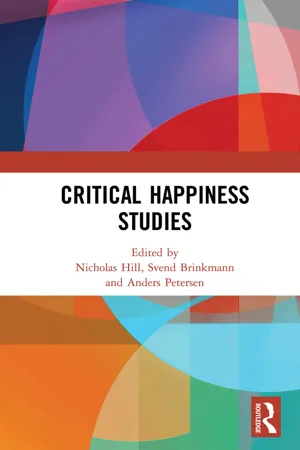
eBook - ePub
Critical Happiness Studies
- 198 pages
- English
- ePUB (mobile friendly)
- Available on iOS & Android
eBook - ePub
Critical Happiness Studies
About this book
Information
Part I
Fantastical happiness
An impossible ideal
1 Happiness, a moralistic fantasy
Carl Cederström
What we talk about when we talk about happiness
Whenever we talk about happiness, we always seem to be talking about something else.
Samuel Johnson, the British 18th-century poet, claimed that happiness could not be found in the present moment, but only when we could fully forget about ourselves. When his biographer, James Boswell, pressed him on this issue, Johnson replied, ‘Never, but when he is drunk’ (McMahon 2006). But for Johnson’s contemporary, the French philosopher Jean-Jacques Rousseau, happiness was not to be found in brief moments of alcohol-induced intoxication but in a lasting state of perfect wholeness. In 1765, at the age of 53, Rousseau spent two months on the Swiss island of Saint-Pierre, where on most days he would go out in a small boat, pull in the oars, lie down flat, and drift aimlessly. He would later describe these months as the happiest time of his life. ‘I would have been content to live all my life in this way’, he wrote in Reveries of a Solitary Walker, ‘without a moment’s desire for any other state’ (Rosseau 1979: 81–83). The Beatles offered in their 1968 hit, ‘Happiness Is a Warm Gun’, a more cryptic metaphor of happiness, comparing it with a warm gun. According to John Lennon, he had come across these words in a magazine and thought them fantastically insane.
But different as they are, these accounts make no sense to me. I should confess at the outset that I don’t have my own private ‘theory’ of happiness, which I think truer and deeper than any other. It is true that I enjoy a little drink now and then, like Samuel Johnson, but I would hesitate to call it happiness. I can also appreciate the calm and the sea, like Rousseau, although, if I had a choice, I would much rather sit erect in the boat and, that way, avoid falling asleep and, hours later, waking up shipwrecked, oars gone, facing a looming storm. The supposedly happy feeling coming from a warm gun never enticed me either, much to the dismay of the father, who has made repeated and heart-breaking attempts to pull me into hunting, paying for expensive courses I would never attend, and literally placing guns in my hands. All to no avail.
There are, of course, more reasonable theories of happiness. I recently met a journalist who had done a television documentary on the subject. She described that one of the most revelatory moments was when she met an older woman who had found her own formula of happiness. It was both simple and reasonable. All you needed was someone to love, something to do, and something to hope for. And sure enough, compared to a warm gun, aimless boat-drifting, and binge-drinking, I agree: this formula sounds perfectly reasonable. It is so reasonable, it turns out, that when I arrived home to google the phrase, it was variously attributed to Elvis Presley, Immanuel Kant, Alexander Chalmers, and Rita Mae Brown, all of whom would make for interesting dinner company, but none of whom, it turned out, had uttered these words. They were, I later found, those of the lesser known George Washington Burnap, a 19th-century American cleric.
If you feel bored one day and cannot think of anything better to do, then I can recommend spending it on Internet, browsing through the infinite catalogue of happiness catchphrases. I’m sure you will find your own favourite, which you can print out and frame. I have a bent for the more sardonic ones, such as Adorno’s ‘Happiness is obsolete; uneconomic’. I also like this one, by the satirical writer Ambrose Bierce: ‘Happiness: an agreeable sensation arising from contemplating the misery of another’. Or this one, by Aldous Huxley, ‘There is something curiously boring about someone else’s happiness’.
We don’t learn much from this exercise, of course, except the obvious fact that happiness can be defined in any way we like and that when we talk about happiness, we seem to be talking about all sorts of different things. And we may also learn, just from contemplating the sheer number of websites dedicated to collecting and organizing happiness quotes, that we are no doubt obsessed with happiness. But we don’t really need the Internet for that, since today we are reminded at all times, in all places, both online and offline, that presumably nothing is more important than happiness.
The basic argument I want to set out here is that happiness is a fantasy. To be clear, this is not to say that happiness is a delusional whim, like a belief in flying saucers or extra-terrestrial life, although, to be sure, some conceptions of happiness may be just about that bizarre, such as that of a recent advertisement suggesting that happiness is like a ‘cheese sandwich’ (McMahon 2006). No, to say that happiness is a fantasy is simply to draw attention to how happiness organizes our experience of the good life. Because, fantasy is not so much opposed to reality as it is an essential way to give meaning to reality – our reality – as we like to make sense of it. Fantasy, as the psychoanalyst Jacques Lacan once claimed, constitutes desire, which means that without its intervention, our desires would helplessly meander about with no sense of aim or direction.
All of this means that fantasies are necessary to us. They help us make sense of things and articulate what we think we like. And just like our desires, they are formed in relation to others. They are not, as it were, an altogether private matter. They are shaped socially and have evolved historically. It is through these fantasies that we can imagine the good, the harmonious, the beautiful – life as we want it to be (Zizek 1998).
It is not very strange, then, that fantasies are invariably dogmatic, self-righteous, and moralistic. While fantasies help to construct a coherent narrative about the world, in which I am conferred with a specific place and purpose, they also obfuscate all sorts of problematic things, such as the existence of others and what we may perceive as their annoying otherness. In justifying my way of life – as the good and normal way of doing things – fantasies divert our attention from otherwise unpleasant realizations, such as the potential conflict between my way of life and someone else’s. Or worse, fantasy turns the other into my enemy, a figure posing an imminent threat to my own happiness.
This, too, is a crucial insight of psychoanalysis. Fantasy does not just present narratives of the beautiful and the harmonious. It simultaneously envisions the bad, the grotesque, the unwanted – all of that which we fear may get in our way, threaten our existence, undermine our way of life. And it is in this way that fantasies help reinforce our moral convictions. We like to picture an impeccably happy world, free from all troubling elements, one that is based on a notion of the good, only to visualize, in the next instance, how this same world, if not properly protected against the bad, may be brought to ruins, leaving us in chaos and despair. Fantasy adds, we may say, a passionate and emotional edge to morality.
So when we talk about happiness, we seem to be talking about fantasies, more specifically moralistic fantasies, which set out a template for the good life. This claim may appear as strange and untenable when applied to specific conceptual statements about what happiness is or isn’t. But it makes all the more sense when we look at happiness historically. It then becomes clear that whatever we consider to be a happy life today, in the rich West, is something altogether different from what it was thought to be in the past, in times such as ancient Greece.
A brief history of happiness fantasies
In Darrin M. McMahon’s wonderfully rich and erudite Happiness: A History, we learn that when happiness was first contemplated, in Herodotus’s History, it was closely bound up with the notion of fortune. The Greek word eudaimonia – from eu (good) daimon (god, spirit, demon) – meant that to be happy was to be lucky (2006: 3). It meant that you were fortunate enough to have the gods on your side, looking out for you. In a world with imminent threats and constant dangers, that was something you no doubt needed.
To believe oneself happy was not just delusional but dangerous, Herodotus warned his readers. He used as his example the wealthy King Croesus, who arrogantly declared to the sage Solon that he, the king, was the happiest man in the world. Soon after, as punishment for his hubristic exclamations, Croesus’s son was killed and then his kingdom brought to ruins. And just as Croesus was about to get killed, it dawned on him that what Solon had tried to explain was that he, Croesus, could not have been the happiest man in the world, because no one could be fully happy when alive. Only the dead could be that happy. ‘No one who lives is happy’, Croesus now realized (McMahon 2006: 7). He screamed this realization out loud, in desperation, and then, just as he thought it was all over, the gods accepted his apology and calmed down. He was saved.
It is not hard to decipher the moral message in this story: don’t be so foolish as to think that happiness is in your own personal control, because that would upset the gods. As a human, the Greeks thought, you have to be wise enough to understand that happiness is not a choice that you can make, as positive psychologists like to say these days. It is a fortune, handed over to you by the gods, but only if you have shown yourself worthy of it. Real happiness, however, was only for the dead – and the gods, of course. Complete happiness was beyond the immediate reach of us, humans, and could be experienced only after one’s earthly life had come to an end, provided of course one had lived well. Then, as now, happiness was a fantasy. The main difference was that they knew it.
About a century after Herodotus recorded this story, Aristotle developed his own version of eudaimonia, in The Nicomachean Ethics. While he concentrated on character formation and the range of virtues that humans should aspire to acquire in their pursuit of happiness, he nevertheless emphasized the claim made by Herodotus: complete happiness was not within the reach of humans. As a human, it was your duty to live as well as you could, and that implied cultivating virtues such as ‘magnificence, moderation, gentleness, modesty, friendliness, and righteous indignation’ (McMahon 2006: 48). But the ethical life was not enough to attain happiness. To do so, you had to rise above your own self – to break out of the ordinary condition of being human – and live a life of contemplation. This was, as Jonathan Lear (2002: 48) perceptively puts it, Aristotle’s fantasy of happiness: a fantasy of happiness, beyond ordinary life, as it was experienced by the gods. For those who were so ethically virtuous as to be worthy, a short glimpse of this happy life of contemplation immediately understood how far they, as humans, were from achieving the complete and eternal happiness of the gods (Lear 2002: 50). The idea of complete happiness, as found in the contemplative life, was a fantasy from which most people were necessarily excluded. Yet as Lear points out, it ‘is a powerful organizing fantasy – one that tends to hide its fantastic status’ (2002: 48). This means that although happiness was ultimately impossible to achieve within the limits of ordinary human life, it was nevertheless inscribed into social life as something desirable and worth pursuing. Consequently, and by hiding its fantastic status, this fantasy of happiness came to give shape and meaning to people’s lives.
We should not forget that happiness, as something ultimately inaccessible to humans, continued as a basic assumption all the way up to the Enlightenment. It was not until then, in the 17th and 18th centuries, that, as McMahon describes, ‘considerable numbers of men and women were first introduced to the novel prospect that they could be happy – that they should be happy – in this life’ (2006: 12). Granted, both the Epicureans and Stoics had emphasized humankind’s ability to be happy, and it is perhaps possible to see in some of their advice a precursor to a modern notion of happiness. Yet we must not forget that the Greeks stressed that happiness was not so much a question of agency, determined by the assumed willpower of the individual, as it was a question of being on good terms with the gods.
The happiness fantasy of the Epicureans was a life governed by pleasure. Hence, it is not entirely weird that they have been mistaken for hedonists. But nothing could be further from the truth. Epicurus preached a strict regulation of desires, to the point of effacing them altogether. He argued that a good life – the morally preferred life – should be devoted only to the simplest and modest forms of pleasures. We should not, Epicurus warned in his Letter to Menoeceus, seek pleasure in ‘one drinking party after another or of sexual intercourse with women and boys or of the sea food and other delicacies afforded by a luxurious table’ (2012: 160). All you needed, Epicurus thought, was food enough to appease your hunger and the company of good friends that you could engage in conversation. Famously, he claimed to need nothing more than a barley cake and some water.
The Stoics went even further in their asceticism. They gave no elevated status to pleasure, arguing that a person had the capacity to be happy no matter how daunting and painful the circumstances of life might be. Even when facing death, one could be happy. Much later, Christianity, as preached and practised throughout the Middle Ages, shunned pleasure altogether and regarded pain as the more useful path to if not a happy life then a sort of divine union in the afterlife. That desired state could not be attained in life on earth, but only as a gift from God, in heaven. The Renaissance brought happiness from heaven back to earth, but again, it was not until the Enlightenment that it became a right – something that each and every person was assumed capable of pursuing and ultimately attaining. Interestingly, it was Marquis de Sade who now became a vocal advocate of happiness, as a right to pleasure: ‘Renounce the idea of another world; there is none. But do not renounce the pleasure of being happy and of making for happiness in this one’ (McMahon 2006: 232).
This brief history reveals three crucial aspects of happiness. First, it is contingent on the culture in which it emerges. Second, it has an unmistakable moral quality. Three, it is closely bound up with a fantasy of the perfectly harmonious life, free from all troubles, whether such existence is believed to be found on earth or in heaven.
Happiness today
In trying to capture something of the spirit of today’s dominant happiness fantasy, I focus on three ideals in particular, all of which are now, in the present moment, morally endorsed: authenticity, enjoyment, and work. Of course, they are not the only ideals that may be incorporated into our present-day fantasies of happiness. They are, however, central in many of the expressions of happiness that we find today, not least in positive psychology and other self-help books, with popular titles including Authentic Happiness, The Art of Happiness at Work, and Happiness by Design: Finding Pleasure and Purpose in Everyday Life. Concentrating on these three ideals – of authenticity, enjoyment, and work – also helps us see the dramatic contrast between our present happiness fantasies and those endorsed in the past.
Authenticity
Take Christianity as it was taught in large parts of Europe during the Middle Ages. Contrary to the message found there and then, according to which we should abandon ourselves to achieve divine union, we are now asked to pursue union with ourselves. To be happy in a time when we prize authenticity and narcissism, we need to express our true inner self, get in touch with our deeper feelings, and follow the path set by ourselves. As the philosopher Charles Taylor (1991) has argued, to be authentic has become a moral ideal, through which you can demonstrate your ability to seriously shoulder your responsibility as a unique and idiosyncratic individual. ‘There is a certain way of being human that is my way’, he ...
Table of contents
- Cover
- Half Title
- Title
- Copyright
- Contents
- Acknowledgements
- Notes on contributors
- Critical happiness studies: an invitation
- PART I Fantastical happiness: an impossible ideal
- PART II The political and social effects of happiness
- PART III Resources for critical happiness studies
- Index
Trusted by 375,005 students
Access to over 1.5 million titles for a fair monthly price.
Study more efficiently using our study tools.
Frequently asked questions
Yes, you can cancel anytime from the Subscription tab in your account settings on the Perlego website. Your subscription will stay active until the end of your current billing period. Learn how to cancel your subscription
No, books cannot be downloaded as external files, such as PDFs, for use outside of Perlego. However, you can download books within the Perlego app for offline reading on mobile or tablet. Learn how to download books offline
Perlego offers two plans: Essential and Complete
- Essential is ideal for learners and professionals who enjoy exploring a wide range of subjects. Access the Essential Library with 800,000+ trusted titles and best-sellers across business, personal growth, and the humanities. Includes unlimited reading time and Standard Read Aloud voice.
- Complete: Perfect for advanced learners and researchers needing full, unrestricted access. Unlock 1.5M+ books across hundreds of subjects, including academic and specialized titles. The Complete Plan also includes advanced features like Premium Read Aloud and Research Assistant.
We are an online textbook subscription service, where you can get access to an entire online library for less than the price of a single book per month. With over 1.5 million books across 990+ topics, we’ve got you covered! Learn about our mission
Look out for the read-aloud symbol on your next book to see if you can listen to it. The read-aloud tool reads text aloud for you, highlighting the text as it is being read. You can pause it, speed it up and slow it down. Learn more about Read Aloud
Yes! You can use the Perlego app on both iOS and Android devices to read anytime, anywhere — even offline. Perfect for commutes or when you’re on the go.
Please note we cannot support devices running on iOS 13 and Android 7 or earlier. Learn more about using the app
Please note we cannot support devices running on iOS 13 and Android 7 or earlier. Learn more about using the app
Yes, you can access Critical Happiness Studies by Nicholas Hill, Svend Brinkmann, Anders Petersen, Nicholas Hill,Svend Brinkmann,Anders Petersen in PDF and/or ePUB format, as well as other popular books in Psychology & Emotions in Psychology. We have over 1.5 million books available in our catalogue for you to explore.