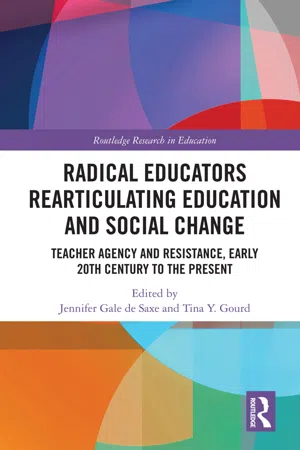
This book is a collection of six case studies of teacher agency in action, centering on voices of educators who engaged in activist work throughout the history of education in the US. Through a lens of teacher agency and resistance, chapter authors explore the stories of individual educators to determine how particular historical and cultural contexts contributed to these educators' activist efforts. By analyzing specific modes and methods of resistance found within diverse communities throughout the last century of US education, this book helps to identify and place into theoretical and historical context an underemphasized narrative of professional teacher-activists within American education.
eBook - ePub
Radical Educators Rearticulating Education and Social Change
Teacher Agency and Resistance, Early 20th Century to the Present
- 158 pages
- English
- ePUB (mobile friendly)
- Available on iOS & Android
eBook - ePub
Radical Educators Rearticulating Education and Social Change
Teacher Agency and Resistance, Early 20th Century to the Present
About this book
Information
Part I
Teacher Agency and Resistance, Theorized
1 Teachers, Power, and Agency
“Will I have agency as a teacher?” This is a question, in many variations, that I have heard from countless novice teachers across the years, particularly in the context of social foundations courses. After innumerable formal and informal discussions with hundreds of novice and practicing teachers, including my dissertation research (Gourd, 2015), I finally have what I hope is a clear response to this type of question: “Teaching is agency.”
Agency is not something you have but something you enact, and it is expressed in the choices you make and do not make, the questions you ask, the moments you keep silent, and the moments when you raise your voice in advocacy.
This chapter is my current best attempt to articulate a useful framework for understanding teacher power. I begin with sociological theory because this is where I initially sought answers, exploring what social theory had to offer our understanding of human agency in general and its relevance to teachers and the context of schooling. What follows next is an exploration of conceptual critiques, clarifications, and tensions in the study of the concept of agency, which I have accumulated over the years, and an attempt to respond to the many thoughtful and useful questions I have fielded from students, colleagues, and dissertation committee members. The chapter ends with some of the findings from my dissertation research: a discussion of the three “avenues” of agency that I identified as I worked with a group of practicing teachers engaged in self-study research projects (Gourd, 2015). Although this can be complex terrain, it is all in service of unpacking a very simple sentence and assertion: Teaching is agency.
Structure and Agency in Sociological Literature
Let us begin again with the question, “Will I have agency as a teacher?” Although this may seem like a straightforward, important question for anyone entering the profession of teaching to ask, the question is grounded in what I would term a structuralist conceptualization of the structure-agency relationship, a perspective on human power that I find incomplete.
The structure-agency relationship is a crucial sociological phenomenon in the study of human agency and has been explored by a variety of social theorists. I have divided these theorists into three “families” of theory on structure and agency: the structuralists, the structurationists, and the post-structuralists, all of whom offer useful insight into humans and our capacity for making an impact on our world.
Structure is a term used to describe the institutions in society or the social formations that [re]produce the conditions of production (Althusser, 1971). In the structuralist conceptualization of structure, institutions are conceived of and characterized as distinct and powerful entities divorced from human actors. The church, the school, the state … all of these structures are described as entities separate from the humans that exist subjected to the institutions, with these humans afforded little power in relation to the structures. Althusser is blunt when describing his understanding of the role of most teachers in the reproduction of the ideological state apparatus of the school:
How many [teachers] (the majority) do not even begin to suspect the “work” the system (which is bigger than them and crushes them) forces them to do… . So little do they suspect that their own devotion contributes to the maintenance and nourishment of this ideological representation of the School.
(1971, p. 157)
A question like “Will I have agency as a teacher?” is rooted in a perception of structure as distinct from human action. If the school is an institution distinct from the humans that inhabit it, then it would be logical to ask about the possibility for individual choice and power when subjugating oneself to the institution of the school.
Yet are structures really entities separate from humans and human action? Are not structures like the church, the school, and the state constructed by humans? Giddens (1984), the creator of the structurationist school of thought, provides an alternate vision of the structure-agency dynamic, arguing that structures are created by human action, and human action continually reconstitutes structures. In other words, humans created the school, and through our choices and actions, the institution of the school is constantly recreated and possibly changed. Giddens’s analysis also provides us with a means to talk about the limitations of agency as he describes that human action is perpetually limited by the “rules and resources” available to a given actor. This helps explain why schools do not frequently experience radical, wholesale change due to single human actors. Each human actor has available a distinct set of rules and resources that set boundaries around possible action and choices, and these rules and resources both constrain and enable action. Someone with a structurationist perspective on human agency might then respond to the question “Will I have agency as a teacher?” with the reply: “You’ll have some agency, constrained by the rules and resources available to you.”
Although this reply is frequently useful (and I have used it myself over the years), there are still some concerns in this conceptualization of the relationship between structure and agency. In the structurationist view, structure is still viewed as conceptually distinct from human action. The school as an institution is still something that has life and meaning, something that, although perpetually reconstituted by human action, is seen as a distinct, and powerful, entity. Is power located, however, in the institution itself, or in the humans that created and perpetually reconstitute the institution?
A discussion of the location of power is a subject tackled by Foucault (1977), who argues that power is not located in an institution as it is in a structuralist or structurationist view of society but is instead diffuse, to be found in the relationships among individuals. Foucault’s landmark metaphor of the panopticon vividly captures what he means by diffusion of power. He argues that it is easy to assume that in a circular prison designed with one central watchtower, power is located in the tower itself. This, however, is a false conceptualization according to Foucault. For in this scenario, individual action becomes constrained not by direct coercion by the watchtower but through monitoring and self-monitoring of individuals. Who polices action in this situation? We police each other, and we police ourselves, and as long as the panopticon is perceived to hold power or people with guns, its power would continue to be enforced through the individual actions of those living in its shadow, even if it were actually standing empty. Ahearn (2001) corroborates this analysis, arguing that language, culture, and agency are located “in the interstices between people, rather than within individuals themselves” (Ahearn, 2001, p. 129). The power to enact change and the power to oppress can be found within our interactions with each other, not in a separate entity like the school.
To return to the question, “Will I have agency as teacher?” my response that “teaching is agency” stems from a post-structural understanding of power and the relationship between structure and agency. Agency is not something you have or something that you are trying to get. Agency is the action we take or do not take, the action/nonaction that results in oppression or the perpetuation of the status quo, and the action that resists the grain, that seeks to reconstitute the meaning of school. Teaching is agency.
Agency: Conceptual Critiques and Clarifications
My statement that “the power to enact change and the power to oppress resides in each of us” could be critiqued as being deliberately blind to privilege and the institutionalization of oppression. Both theory and lived experience tell us that the effectiveness of a person’s actions is related to their position in society, and a theoretical proposition that teaching is agency must be robust enough to include an analysis of oppression and power.
Agency is mediated by our positionality in society, the structural constraints that both enable and constrain our action. Giddens’s (1989) concept of rules and resources provides a helpful conceptualization of our sphere of influence or action. However, the rules and resources available to us do not “give us” agency; we enact our agency, constrained and enabled by the rules and resources available to us. Ahearn (2001) draws a useful parallel to language when she says, “Speakers of a given language are constrained to some degree by the grammatical structures of their particular language, but they are still capable of producing an infinite number of grammatically well-formed utterances within those constraints” (p. 120). Our individual positionality in society is like our own unique language, which serves to both constrain and enable each of us while allowing for infinite creativity of action and nonaction.
Although power in society is unequally experienced, dependent on relationships and structures of privilege and oppression, those in minoritized groups and subjugated positions still enact agency. To minimize the agency of those who are perceived to be in positions of less power is to ignore the reality and complexity of human experience. MacLeod, exploring women’s agency, argues that “women, even as subordinate players, always play an active part that goes beyond the dichotomy of victimization/acceptance, a dichotomy that flattens out a complex and ambiguous agency in which women accept, accommodate, ignore, resist, or protest—sometimes all at the same time” (MacLeod, 1992, p. 534). Regardless of our positionalities in society, the power to enact change and the power to oppress is possible within each of us as well as the power to “accept, accommodate, ignore, resist, or protest” all at the same time.
A quotation that rarely fails to make an impression on the novice teachers that I work with comes from Holland, Lachicotte, Skinner, and Cain’s (1998) Identity and Agency in Cultural Worlds. These writers say, “Human agency may be frail, especially among those with little power, but it happens daily and mundanely” (p. 5). Power is not equally available to all in society, with each individual capable of choosing to act out any range of action of their free will. Yet this reality does not result in a simplistic reduction of power to “some have it, and some do not.” Agency is not something we are trying to acquire. We have it already, and the more relevant question is how we, as teachers, make daily and mundane choices that express and enact our agency.
Tensions in the Conceptualization of Teacher Agency
In teacher education literature, conceptualizations of teacher agency are frequently inconsistent with my articulation of the concept as described in this chapter and this book. Three distinct tensions in how teacher agency is conceptualized are important to explore to help frame both what this book seeks to say about teacher agency and what we, in this edited collection, are not trying to say about teacher agency.
First, teacher agency is sometimes characterized as something “special,” the province of particularly resourceful or gifted teachers (e.g., Anderson, 2010; Castro, Kelly, & Shih, 2010). Anderson (2010), in her review of the literature on teacher agency, identifies a set of literature that focuses on “offering narrative accounts of teachers’ against-the-grain practices and rooting those practices in teachers’ principled critiques of the material, pedagogical, professional, and/or ideological realities they encounter in the workplace” (p. 542). Although these are powerful examples of teacher agency, an exclusive focus on the “special” can obscure the powerful yet mundane choices that every teacher makes every day. Case study research that focuses on “unique” cases is particularly prone to characterizing teacher agency as something above the ordinary. For example, Anderson (2010) shares the experiences of Liz, whose story has been chosen for “its uniqueness, particularly in the way she drew from a mix of school-based and beyond-school ties to secure additional resources for students, hold colleagues accountable, accumulate political capital, and transform conditions for teaching and learning at her school” (p. 548). Although this is an extraordinary story, characterizing teacher agency as only something extraordinary, and only accessed by extraordinary teachers, limits the usefulness of the concept of teacher agency. However, it is hard, in any collection of stories about teacher resistance and agency, to avoid the conclusion that these are “special” teachers, yet that is precisely a conclusion we hope readers of this text will resist.
An “exceptional action” narrative of teacher agency can be particularly harmful for novice or preservice teachers, whose insecurities and lack of experience can keep them from seeing themselves in tales of extraordinary educators making identifiable change. The implication that teacher agency is something “special” that special teachers “do” can make agency appear to be an intimidating and perhaps unreachable goal, something that is reserved for the distant future when they have their own classrooms (and are no longer student teachers) or when they have a few years of teaching experience, if ever. The “exceptional” narrative does not encourage novice teachers to recognize the power inherent in every interaction between teacher and students, student and curriculum, and teacher and community, for example, or provide them with the tools to examine their own choices as educators.
Similarly, agency often appears to be conceptualized in teacher education literature as only a “positive” phenomenon, as if all teacher agency is beneficial and has a positive impact (Priestley, Edwards, Priestley, & Miller, 2012). Priestley et al. (2012) particularly critique policy that discusses teacher agency in light of “successful” educational reform, arguing that “such policy can tend to construe agency as solely a positive capacity—as a factor in the ‘successful’ implementation of policy—whereas one might legitimately take the view that agency could equally well be exercised for ‘non-beneficial’ purposes” (p. 192). Teachers can choose to exert their power in an infinite number of ways, including to deliberately maintain the status quo or to act in ways that might disrupt a stated agenda of educational reform. Yet the literature on teacher agency sometimes leaves out the “negative,” or the choices of teachers that might impede intended “progress” with “progress” defined by the values of the researcher, policymaker, funder, administration, and so on.
For example, in Castro et al.’s (2010) examination of resiliency strategies among new teachers, their findings include the resiliency strategies of “help-seeking,” “problem-solving,” “managing difficult relationships,” and “seeking rejuvenation and renewal.” All of these strategies are characterized as positive moves to survive as new teachers in high-needs areas, with these teachers “demonstrate[ing] agency in the process of overcoming adversity” (p. 622). Not highlighted in the study were what might be characterized as “negative” strategies for coping, which could just as validly be described as examples of these teachers’ agency. Having worked with many novice teachers, I can easily come up with many hypothetical findings for a study on new teacher coping strategies that are not quite so “positive” yet would be expressions of their agency, such as “impersonalizing work, students, and colleagues,” “transferring blame,” “becoming callused to the challenges of teaching,” or “becoming desensitized to students’ circumstances.” Th...
Table of contents
- Cover
- Title
- Copyright
- Dedication
- Contents
- Foreword
- Acknowledgments
- Introduction
- Part I Teacher Agency and Resistance, Theorized
- Part II Historical and Contemporary Case Studies of Teacher Agency and Resistance in Action
- Contributors
- Index
Trusted by 375,005 students
Access to over 1.5 million titles for a fair monthly price.
Study more efficiently using our study tools.
Frequently asked questions
Yes, you can cancel anytime from the Subscription tab in your account settings on the Perlego website. Your subscription will stay active until the end of your current billing period. Learn how to cancel your subscription
No, books cannot be downloaded as external files, such as PDFs, for use outside of Perlego. However, you can download books within the Perlego app for offline reading on mobile or tablet. Learn how to download books offline
Perlego offers two plans: Essential and Complete
- Essential is ideal for learners and professionals who enjoy exploring a wide range of subjects. Access the Essential Library with 800,000+ trusted titles and best-sellers across business, personal growth, and the humanities. Includes unlimited reading time and Standard Read Aloud voice.
- Complete: Perfect for advanced learners and researchers needing full, unrestricted access. Unlock 1.5M+ books across hundreds of subjects, including academic and specialized titles. The Complete Plan also includes advanced features like Premium Read Aloud and Research Assistant.
We are an online textbook subscription service, where you can get access to an entire online library for less than the price of a single book per month. With over 1.5 million books across 990+ topics, we’ve got you covered! Learn about our mission
Look out for the read-aloud symbol on your next book to see if you can listen to it. The read-aloud tool reads text aloud for you, highlighting the text as it is being read. You can pause it, speed it up and slow it down. Learn more about Read Aloud
Yes! You can use the Perlego app on both iOS and Android devices to read anytime, anywhere — even offline. Perfect for commutes or when you’re on the go.
Please note we cannot support devices running on iOS 13 and Android 7 or earlier. Learn more about using the app
Please note we cannot support devices running on iOS 13 and Android 7 or earlier. Learn more about using the app
Yes, you can access Radical Educators Rearticulating Education and Social Change by Jennifer Gale de Saxe,Tina Y. Gourd in PDF and/or ePUB format, as well as other popular books in Education & Education General. We have over 1.5 million books available in our catalogue for you to explore.