Negative emotions are familiar enough, but they have rarely been a topic of study in their own right. This volume brings together fourteen chapters on negative emotions, written in a highly accessible style for non-specialists and specialists alike. It starts with chapters on general issues raised by negative emotions, such as the nature of valence, the theoretical implications of nasty emotions, the role of negative emotions in fiction, as well as the puzzles raised by ambivalent and mixed emotions. The second part of the volume consists of studies of specific emotional phenomena, ranging from the emotion of being moved and the sense of uncanniness to jealousy, hatred, shame, contempt, anxiety, and grief.
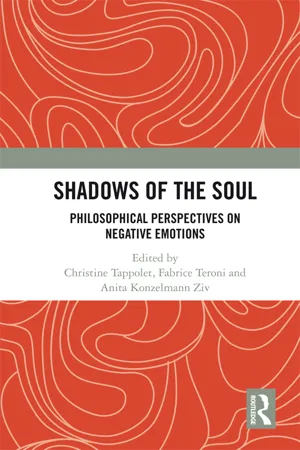
eBook - ePub
Shadows of the Soul
Philosophical Perspectives on Negative Emotions
- 146 pages
- English
- ePUB (mobile friendly)
- Available on iOS & Android
eBook - ePub
Shadows of the Soul
Philosophical Perspectives on Negative Emotions
About this book
Information
1 Emotionally Charged—The Puzzle of Affective Valence1
We intuitively distinguish between positive emotions (pride, joy, admiration) and negative emotions (shame, sadness, fear). It is true that we also speak of positive or negative perceptual experiences and memories, but these properties accrue to these states only because of the emotions that we feel when we perceive or remember. This suggests that the positivity or negativity of emotions has priority over that of other mental states. Contemporary researchers interested in this feature of emotions speak in terms of “polarity” or “valence”. Elucidating these notions, and understanding what it is that makes emotions positive or negative, is a major theoretical task in the field.
As a point of departure, and along with contemporary accounts of valence, I will presuppose that the kind of features we are trying to get at when talking about the valence of an emotion is distinct from moral or prudential evaluations concerning the emotion. So, we are concerned with the sense in which we all classify shame as a negative emotion, quite independently of any argument about its moral or prudential value. Although it is difficult to be informative at this stage of our discussion, we may say that this presupposition is justified because the sorts of positive things that may be said about shame (viz. that it manifests a virtue in specific circumstances or that it motivates self-reform) are actually explained by its negative valence. Reacting with shame to a wrong one has done can manifest one’s decency because shame is a negative emotional reaction to this wrong, and the fact that shame may motivate one to avoid committing such wrongs in the future is also rooted in its negative valence. To put it differently, positive or negative valence is supposed to be a feature intrinsic to types of emotions, and so it is independent of the specific objects that elicit emotions or the potential effects emotions may have. Pride has positive valence despite the fact that it sometimes manifests the vice of pridefulness and the fact that it may lead to vile courses of action.
On the basis of this assumption, my aim is to understand what makes certain emotions positive and others negative. I will focus on the following explanatory constraint: an account of valence must appeal to a fundamental contrastive property of emotions that does not itself in turn require explanation by another of their properties. It is fair to say that most participants in contemporary debates would accept this constraint, since valence is supposed to be a basic aspect of emotions. In what follows, I will use this constraint to criticize representative accounts of valence that appeal to desires and hedonic states. I will argue that their explanatory power is largely illusory because the relevant desires need to be explained by hedonic states, and hedonic states are themselves in part composed of emotions. On this basis, I will explore an alternative explanation of valence by means of evaluation and give some reasons to favor one specific evaluative account.
Desire-based Accounts
The first account seeks to explain valence in terms of desire representation. It amounts to claiming that an emotion is positive insofar as it represents a desire as potentially or actually satisfied and negative insofar as it represents the desire as potentially or actually frustrated (Lazarus 1991). Fear is negative because it represents, say, the desire to preserve one’s physical integrity as potentially frustrated, whereas joy felt following a victory is positive because it represents the desire to succeed as satisfied. What makes emotions positive or negative is this layer of representations concerning desire. Now, it is certainly plausible to say that positive emotions are those that signal that one “gets what one wants”, while negative emotions are those that signal that one does not.
This first account turns out not to be convincing, however. Even if we were to admit that all emotions represent a desire as frustrated or satisfied, itself a dubious claim, we would still be forced to concede that it is not possible to use that representation to analyze valence. This is because the account relies on an ambiguity in the meaning of “frustrated” and “satisfied”. Suppose that, while lying on a beach, you come to represent the situation as frustrating your desire to go to a meeting. Claiming that you represent this desire as frustrated can simply amount to attributing to you a representation of this desire as something that cannot be fulfilled—the desire is to go to a meeting, and you appreciate that your lying on the beach means that you will not go. Within the project of explaining valence, an appeal to this kind of representation is legitimate because it does not itself presuppose that the subject has any negative emotion. This is the case since, while lying on the beach, your realization that your desire to go to the meeting cannot be satisfied may leave you unmoved, or even amuse you. Yet, such a representation cannot for the same reason account for negative valence. The theory creates the illusion of an explanation because we also use the notion of being “frustrated” (or “satisfied”) to refer to a common affective reaction, one that occurs when we notice irreconcilable differences between the world as it is and how we would like it to be. Realizing that your desire to preserve your physical integrity is likely to be frustrated will typically elicit fear, and realizing that your desire for success has been satisfied will typically elicit pride. However, since we are seeking to understand what makes emotions positive or negative, we cannot allow ourselves to appeal to emotions in the analysis. We must conclude that the first account is either unsatisfying or circular.
This problem may nonetheless not be fatal to all accounts that appeal to desires. Indeed, the second account to which we shall now turn our attention claims that emotional valence results from the presence of particular desires about the emotions (Prinz 2010). Some emotions are positive because we want them to persist (pride, admiration), and others are negative because we want them to cease (fear, shame). The crucial difference between the first and second accounts is that the relevant desires in the second account are not directed at the object of the emotions (the lion of which you are afraid or the victory of which you are proud), but rather at these emotions themselves. For that reason, valence is not claimed to consist in the representation of a desire as satisfied or as frustrated—it rather consists in the content of the desire, which is that the emotion either persists or ceases. There is again something attractive in this appeal to desires about the emotions. After all, states of affairs are often assessed positively because we want them to persist, negatively because we want them to cease. Yet, there are reasons to doubt that explaining valence in terms of these emotion-directed desires pitches the explanation at a satisfactory level.
Suppose that I ask you why you want your shame to cease or your joy to persist. We have two options here. We could first consider the presence of these desires as a primitive fact from the first-person point of view. This is tantamount to conceiving of these desires as urges, that is to say, as desires for which we have no reasons. This answer is unconvincing: desires to see shame dissipate or joy persist are desires for which we have reasons. And, if such desires are intrinsically tied to different types of emotions, these reasons must be found among other aspects of these emotions that can explain their presence (Mulligan 2010). What are these reasons for which we intrinsically desire certain emotions and are intrinsically averse to others? They must have to do with a contrastive property of the emotions that gives us a deeper and more complete explanation of their valence. Thus, this desire-based account stops halfway; it is not fully explanatory of valence. It does not meet the constraint by which we have agreed to abide.
From Hedonic States to Values
In order to reach the required level of explanation, why not try to account for valence by means of hedonic states (Goldstein 2002)? Our desires for some emotions and aversion to others can then easily be explained: fear and shame are unpleasant, which is why we want them to cease, whereas admiration and pride are pleasant, which is why we desire that they persist. In short, emotions are positive or negative in virtue of exemplifying positive or negative hedonic properties. This theory posits that the explanation stops here; because these hedonic properties are fundamental psychological properties, there is no further account of them. At best, we may say that positive and negative emotions have one of two phenomenal “glows” in common (Duncker 1941).
As I hope to make clear, the explanatory force of this third account is largely illusory. To do so, I will present two observations that are central to recent research concerning bodily pain, suggesting that they apply mutatis mutandis to other kinds of pain. These observations concern respectively the unity of the category of pain and the theoretical consequences of certain cases of dissociation.
The first observation highlights the rich variety of bodily pains, such as the different types of migraines and joint pain, stomach aches, pain associated with cuts or pain resulting from other modifications of skin tissue. We have at our disposal a broad vocabulary to describe these pains: there are shooting, throbbing, stabbing, darting pains, and so on (Clark 2005). The question then arises, why are we tempted to consider these disparate phenomena as pains? Is it, as the third account of valence claims, because they all exemplify the same unanalyzable hedonic property? One initial reaction to the variety of bodily pains is to grant that they do not have one specific “glow” in common, but to insist that each of them has one phenomenal property that belongs to a kind of properties united by a common experiential core (Crisp 2006). In light of the variety of these phenomena, this claim is far from evident: what exactly does it mean to say that pains have different “glows” that share an experiential core? Is this a genuine alternative to the idea that negative valence is an unanalyzable property? In any case, a momentous tradition, starting with Plato2 and quite dominant in recent research, tends to draw a deeper lesson from the variety of pains: pains do not even share an experiential core (Labukt 2012). If so, we should find an alternative explanation as to why we consider all of them to be pains.
This explanation is motivated by a second observation prompted by certain cases of dissociation revealed by clinical studies of pain (Grahek 2007). The patients with the dissociative condition in these studies have the capacity to refer to and to recognize their bodily pains, but the latter curiously do not move them at all. When an experimenter pierces their skin with a needle, they tend to smile and say something along the lines of “it is painful, but I don’t care”. These cases of dissociation suggest that we need to make a distinction. Pain is not a single phenomenon, but is comprised of two distinct aspects. First, it involves a sensory aspect that we can regard as a form of proprioception, whose content can vary considerably. This sensory aspect, however, does not explain what makes a pain negative. To explain that, and in light of the dissociation cases, we must introduce a second feature of pain that we can regard as the subject’s reaction to what he discriminates by proprioception. A bodily pain is then a complex phenomenon consisting in the subject’s reaction to a sensory representation of a part of his body.
At this point, we find ourselves facing a problem for the hedonic account of valence. The reactive feature of pain can be understood in two ways. We could first claim that it consists in the fact that the subject desires her current mental state to cease (Sidgwick 1874). However, this is tantamount to reverting to the second account of valence, which we have deemed unsatisfactory for emotions and which is also most assuredly unsatisfactory for pains. Much as in the case of emotions, it seems that we want to avoid pains because of their negative aspect. If so, then this aspect cannot simply consist in the presence of a desire. Second, and more plausibly, we can understand the reactive feature of pain in a different way, in terms of affective states (Tye 2005). Victims of dissociation tend to share two types of deficiency. They lack desires about the pain, but seem also to remain emotionally unmoved by what is happening in the affected parts of their body. They somehow do not appreciate that something is “going wrong” there, which seems to be constitutive of our experience of pain. This suggests that, due to their neurological deficit, the victims of dissociation cannot have a certain kind of evaluative experience.
In light of most contemporary approaches, this constitutes the central and distinctive aspect of emotions: emotions are experiences that relate to values and evaluations. This should not come as a surprise, as this relation is linguistically manifest. We speak, for instance, of such values as the shameful, the disgusting, the admirable, the funny, and so on. Contemporary approaches to the emotions take heed of this relation between emotions and values by conceiving of the emotions as experiences that track values and make them manifest (Deonna and Teroni 2012, Prinz 2004, Tappolet, this volume). Now, the claim that pain involves an emotion that allows us to appreciate that something is going wrong in a bodily part carries with it a clear advantage. It allows us to say that this emotional aspect of pain explains the desires typically linked to it: they are desires motivated by the realization that something is going wrong in one’s body.
If hedonic states are partially affective, advocates of the hedonic account of valence cannot simply appeal to these hedonic states to explain valence. On the contrary, they must choose one of the two following options. The first option is to generalize our observations about pains and apply them to emotional valence, where the latter is understood in terms of bodily pains and pleasures. So, a subject undergoing fear would appreciate that something is wrong in the way his bodily condition is altered, while a subject undergoing pride would appreciate that something is right in this. More generally, an emotion would be positive or negative insofar as it contains a bodily pleasure or pain. This option is hardly convincing, as it is difficult to resist the idea that what is pleasant or unpleasant in most emotions is not what is happening in our body, but rather some given external situation. What is unpleasant in fear is above all, say, the encounter with a predator. Further, the idea that all emotions contain the appreciation that something right or wrong is going on in parts of our body is itself implausible.
The second option, in light of these difficulties, is to draw a deeper lesson from the parallels between positive and negative emotions, on the one hand, and bodily pleasures and pains, on the other (Solomon 2001). The starting point here is the observation that we should not make a mistake similar to the one consisting in claiming that all bodily pains have a phenomenal property in common. Repeating this mistake would involve, much like in the first option, considering bodily pains and pleasures as features shared by negative and positive emotions. The lesson that we must draw instead is that “pleasant” and “unpleasant” should rather be understood as determinables, of which the determinates are evaluative experiences. What is this supposed to mean? Take the property of being colored. It is often claimed that being colored is a determinable with different determinates in order to underscore two things (Johnson 1921). First, it underscores that an object is always colored in virtue of exemplifying a determinate color, say a certain nuance of scarlet red. Second, it underscores that the determinate property cannot itself be defined in terms of the determinable together with a determinate property: the nuance of scarlet red cannot be defined in terms of the determinable "being colored" together with a determinate property (the only suitable determinate property is the nuance itself, and this does not constitute a definition).3 I suggest that we apply this distinction to the case at hand. “Pleasant” and “unpleasant” are determinables of the determinate values to which types of emotions relate. The unpleasant nature of fear consists in the fact that the subject experiences a danger; the unpleasant nature of sadness consists in the fact that he experiences a loss; the pleasant nature of pride consists in the fact that he experiences a success; and bodily pains and pleasures relate to hedonic values. The valence of an emotion is ultimately nothing but the polarity of the value of which it is an experience: fear and pride have negative and positive valence because they are, respectively, experiences of danger and of success.4
If viable, this account of valence is explanatorily deeper than those discussed in the preceding sections and is thus more convincing. It allows us to understand what is positive or negative about certain representations of satisfied or frustrated desires. It explains why we desire for certain experiences to persist and for others to cease. It also accounts for what unifies pains, pleasures and emotions. This is all fine and well, but the viability of the account requires that we make sense of the idea that emotions are experi...
Table of contents
- Cover
- Title
- Copyright
- Dedication
- Contents
- Notes on Contributors
- Introduction
- 1 Emotionally Charged—The Puzzle of Affective Valence
- 2 Nasty Emotions and the Perception of Values
- 3 Imaginative Resistance: Negative Emotions, Values and Fiction
- 4 Who is Afraid of Contrary Emotions?
- 5 Bitter Joys and Sweet Sorrows
- 6 The Emotion of Being Moved
- 7 The Uncanny and Other Negative Existential Feelings
- 8 Disgustingly Handsome: Nausea in the Face of Physical Beauty
- 9 Stench and Olfactory Disgust
- 10 Anxiety: A Case Study on the Value of Negative Emotion
- 11 Grief
- 12 The Moral Shadows of Shame and Contempt
- 13 Negative Emotions and Racism
- 14 How to Think Yourself Out of Jealousy
- Index
Trusted by 375,005 students
Access to over 1.5 million titles for a fair monthly price.
Study more efficiently using our study tools.
Frequently asked questions
Yes, you can cancel anytime from the Subscription tab in your account settings on the Perlego website. Your subscription will stay active until the end of your current billing period. Learn how to cancel your subscription
No, books cannot be downloaded as external files, such as PDFs, for use outside of Perlego. However, you can download books within the Perlego app for offline reading on mobile or tablet. Learn how to download books offline
Perlego offers two plans: Essential and Complete
- Essential is ideal for learners and professionals who enjoy exploring a wide range of subjects. Access the Essential Library with 800,000+ trusted titles and best-sellers across business, personal growth, and the humanities. Includes unlimited reading time and Standard Read Aloud voice.
- Complete: Perfect for advanced learners and researchers needing full, unrestricted access. Unlock 1.5M+ books across hundreds of subjects, including academic and specialized titles. The Complete Plan also includes advanced features like Premium Read Aloud and Research Assistant.
We are an online textbook subscription service, where you can get access to an entire online library for less than the price of a single book per month. With over 1.5 million books across 990+ topics, we’ve got you covered! Learn about our mission
Look out for the read-aloud symbol on your next book to see if you can listen to it. The read-aloud tool reads text aloud for you, highlighting the text as it is being read. You can pause it, speed it up and slow it down. Learn more about Read Aloud
Yes! You can use the Perlego app on both iOS and Android devices to read anytime, anywhere — even offline. Perfect for commutes or when you’re on the go.
Please note we cannot support devices running on iOS 13 and Android 7 or earlier. Learn more about using the app
Please note we cannot support devices running on iOS 13 and Android 7 or earlier. Learn more about using the app
Yes, you can access Shadows of the Soul by Christine Tappolet,Fabrice Teroni,Anita Konzelmann Ziv in PDF and/or ePUB format, as well as other popular books in Philosophy & Philosophy History & Theory. We have over 1.5 million books available in our catalogue for you to explore.