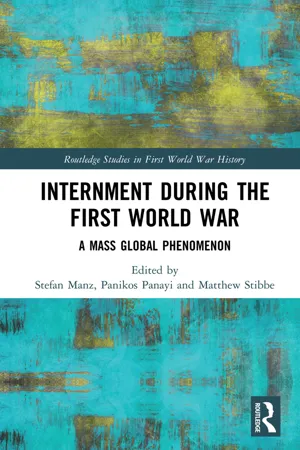
Although civilian internment has become associated with the Second World War in popular memory, it has a longer history. The turning point in this history occurred during the First World War when, in the interests of 'security' in a situation of total war, the internment of 'enemy aliens' became part of state policy for the belligerent states, resulting in the incarceration, displacement and, in more extreme cases, the death by neglect or deliberate killing of hundreds of thousands of people throughout the world. This pioneering book on internment during the First World War brings together international experts to investigate the importance of the conflict for the history of civilian incarceration.
eBook - ePub
Internment during the First World War
A Mass Global Phenomenon
- 298 pages
- English
- ePUB (mobile friendly)
- Available on iOS & Android
eBook - ePub
Internment during the First World War
A Mass Global Phenomenon
1
Internment during the First World War
A mass global phenomenon
The First World War led to a step change in the use of internment as a constituent element of twentieth-century warfare. The Red Cross International Prisoners of War Agency estimates that around eight million military prisoners of war (POWs) and two million civilians worldwide experienced some form of forced detention during the course of the war. Other estimates arrive at a comparable grand total but a different distribution with nine million POWs and close to one million civilians, highlighting the difficulties in clearly separating the two categories.1 For most of the twentieth century, these millions of men, women and children did not experience the same degree of scholarly and public memorialisation as the combatants who fought or died on the battlefields. In her groundbreaking study of 1998, Annette Becker rightly called those who had found themselves behind barbed wire ‘the forgotten of the Great War’.2 A number of studies have since added to our understanding of captivity for military POWs.3 Comparatively fewer studies are concerned with the plight of civilians.4 The current volume aims to redress this imbalance by bringing together studies from a range of empires and countries to present a multifaceted and global picture of civilian internment during the First World War.
The fact that the war was not just one of nations, but one of multi-ethnic and global empires had a wide-ranging impact on civilian populations. After a century of mass emigration, many found themselves in countries which were at war with their country of origin. Commonly labelled ‘enemy aliens’, they experienced hostility as potential collaborators and spies. Many men of military age were interned to prevent them from travelling back and filling the ranks of their respective armies. In some cases, women and children were also interned, although they were more commonly repatriated. Those who experienced neither still suffered as the main breadwinner of the family was locked away for the duration of the war. One did not have to have a foreign background, though, to be viewed with suspicion. In multi-ethnic empires, some nationality groups were targeted as being ‘unreliable’ and prone to support the enemy. They often resided in border areas which were sensitive in terms of military defence and home front security. Particularly suspicious were those groups that were bi- or even tri-lingual. In an age where nationalist fervour demanded clear-cut declarations of national loyalty, multi-lingualism and complex identities did not fit into mobilisation efforts.
Even more precarious was the situation for those civilians residing in areas occupied by foreign armies. John Horne and Alan Kramer, among others, have shown this most drastically with regard to atrocities committed by the German army in occupied Belgium;5 Christoph Jahr and Jens Thiel will refine this picture in the current volume with regard to deportation and internment of Belgians. This also included forced labour in German camps. In the end, however, all contributions to the present volume show that internment was an important, but by no means the only measure to ‘deal with’ allegedly hostile minorities. It must be seen in the context of a wide range of measures which could include deportation, repatriation, property confiscation, and economic and social marginalisation. A recent volume by Hannah Ewence and Tim Grady has made important inroads into understanding the globality and inter-connectedness of these measures.6
Suffering within Europe comes to mind first when approaching our theme, reflecting a long-held fixation upon the European frontlines by scholars and collective memory cultures. This, however, only tells half the story. Repercussions were felt around the globe, as exemplified most poignantly by Sandra Barkhof in an antipodean context. New Zealand forces occupied German Samoa and subsequently deported the majority of its German residents to a small prison island in Auckland Harbour, Motuihi Island. These and other case studies in the current volume gain a new significance through integration into global contexts. Internment emerges more strongly as a global policy pursued by all belligerent (and some neutral) powers, disseminated through a transnational ‘learning process’ and the idea of reciprocity whereby civilians became bargaining pawns in the hands of political and military elites. Regional examples in the volume such as Corsica (Simon Giuseppi) and Ottoman Syria (Khatchig Mouradian) serve to highlight the wide spectrum of camp conditions: whilst confinement on Corsica was relatively benign, with ‘enemy aliens’ being allowed to pursue cultural activities and being housed in civilian accommodation, camps in Ottoman Turkey were essentially set up as extermination centres through deliberate neglect and mistreatment of Armenians. Even within empires, conditions could differ. Austro-Hungarians and Germans in Canada, for example, were used as forced labour in the emerging national parks, whilst other dominions did not pursue this policy. The range of conditions highlights that it is next to impossible to filter out a single representative experience of internment.
This complexity makes it all the more important to unearth case studies in order to underpin our theoretical understanding of the mass phenomenon, and in particular the question why and how internment spread across the globe during this particular point in time. The technological modernisation of warfare has been amply described as a pre-condition of mass killing on the battlefields,7 but how did it affect mass internment? The logistics and large scale deportations around the globe would have been impossible without efficient means of communication (telegraph) and mass transportation on land and sea (steamship, train). The barbed wire had been invented during the North American conquest of the West, and the very idea of isolation on ethnic, political, economic and social grounds owed a great deal to novel ideas about scientific racism, hygiene, welfare and social control.8 The topography of modern camps is deeply engrained in the collective memory of twentieth-century minority persecution, with watch-towers, barbed wire enclosure and accommodation in military-style barracks. This generic structure did, in fact, develop and spread during the First World War. It thus constitutes a symbolic end-point of nineteenth-century globalisation and modernisation on the one hand, and the starting point of twentieth-century warfare mechanisation on the other hand. Internment is one of many facets which make the First World War a hinge between the two centuries.
Internment as a global phenomenon
During the First World War internment became a truly global phenomenon but this globality had already begun to emerge in the later nineteenth century, especially during colonial wars. Iain R. Smith and Andreas Stucki argue that the term ‘concentration’ first appeared during the Ten Years’ War involving the Spanish on Cuban soil between 1868 and 1878, although they also point out that the actual term ‘concentration camp’ emerged during the Boer War.9 Sibylle Scheipers identified ‘the four most prominent examples of the use of camps’ in her analysis of this phenomenon at the beginning of the twentieth century as ‘the Cuban War of Independence (1895), the Philippine War (1899–1902), the Boer War (1899–1902) and the Herero and Nama Revolt in German South West Africa (1904–07)’.10 These episodes have a common characteristic of the concentration of civilians by the imperial or invading power, supported by an ideology driven by racial hierarchy, in specific locations, whether in the form of a camp or in a particular part of the controlled territory to prevent civilians from assisting the forces at war with the invading power. The case of German South West Africa (GSWA) and the Boer War have attracted most attention. In the former case, much research has focused upon the actions of General Lothar von Trotha, who used concentration camps as part of his genocidal campaign against the Herero, thereby starting a process that – for some historians – led from Windhoek (the then capital of GSWA) to Auschwitz.11
The Boer War demonstrates the importance of the British Empire in the evolution of the concentration camp, as well as its global nature. As many as one hundred places of incarceration emerged during this conflict.12 B. E. Mongalo and Kobus du Pisani have asserted that 116,000 white Boers and 115,700 blacks experienced internment.13 Concentration during the conflict did not simply take place in South Africa, as some people found themselves deported to British-ruled India, St Helena, Ceylon and Bermuda. As many as 9,000 people were incarcerated in seventeen camps in India, initially in the Punjab, Bengal, Madras and Bombay commands.14 Aidan Forth has recently placed the concentration camps which emerged during the Boer War into a wider context of control of suspect populations throughout the Empire including the poor in Britain and the development of plague and famine camps in India and South Arica.15
While incarceration of civilian populations had emerged as a global phenomenon before the outbreak of the First World War, this conflict became a turning point in the history of civilian internment, as all the participants controlled enemy aliens, ‘internal enemies’, ‘suspect’ nationalities and ethnic outsiders. Such control included the use of emergency legislation, as several of the contributions below indicate.16 We can partly understand the spread of the concentration camp throughout the world after 1914 as a consequence of the victory of extreme nationalism during the First World War which left little space for minority ethnic groups to maintain their pre-war identities. The mistreatment of such groups, which had characterised imperial adventures in Africa and elsewhere before 1914, now also became heavily focused upon Europe. While racial ideas drove the actions of the British, German and American Empires before 1914, nationalism became the determining ideology in this process during the First World War,17 although, as Matthew Stibbe has shown in the case of the multinational Habsburg Empire, anti-nationalist imperial ideologies and concerns for military security in border regions could also play a role.18 The growth of concentration camps during the conflict finds additional explanation in the fact that the boundaries between civilians and soldiers as participants in, and therefore victims of, war became even more blurred than had become apparent in the extra-European colonial sphere.19 This targeting of civilians in wartime receives further understanding from the fact the First World War became – to use a concept pioneered by Arthur Marwick – a ‘total war’.20 As Tammy Proctor has demonstrated more recently in her study of civilians between 1914 and 1918, total war brought the population of the belligerent states into the conflict not simply as victims, but also as active participants, whether as munitions workers, nurses or experts.21
The First World War transformed incarceration into a global mass phenomenon which impacted upon millions of people. While the overwhelming majority of internees may have consisted of male captured soldiers,22 beyond the scope of this volume, their diverse nature meant that they also included women and children, whether in the case of Armenians,23 those deported from war zones by invading armies, or refugees and internally displaced persons interned by their own governments.24 Enemy alien internees, especially Germans held within the British Empire and British internees held by Germany, tended to be men of military age, although women also faced incarceration on a more limited scale, often because they wished to stay with their husbands.25
The British Empire, which globalised internment before the First World War, also did so during the conflict through the implementation of a system of mass transportation. While Aidan Forth has focused upon the development of camps throughout the Empire during the late nineteenth century, we need to take an even longer-term perspective because British imperial internment during the conflict did not simply mean incarcerating local enemy alien (especially German) populations, but also transporting them throughout the world, emerging from long-term traditions of global population displacement whether it involved convicts, rebels or slaves.26
The globalisation of internment within the British Empire therefore took place in two ways. Firstly, by means of the establishment of camps throughout its territories. London, Sydney, Delhi, Wellington and Ottawa each controlled their own camps and devised their own specific internment policies and procedures, as Bohdan Kordan indicates in his contribution to this volume However, as Stefan Manz and Panikos Panayi also demonstrate in their chapter, First World War internment within the British Empire used global transportation as a series of internment hubs emerged, which meant that Germans did not simply face incarceration in the places where they lived but could also experience transportat...
Table of contents
- Cover
- Title
- Copyright
- Contents
- Notes on contributors
- Preface
- 1 Internment during the First World War: a mass global phenomenon
- 2 The internment of civilian ‘enemy aliens’ in the British Empire
- 3 Adding colour to the silhouettes: the internment and treatment of foreign civilians in Germany during the First World War
- 4 The internment of enemy aliens in the Habsburg Empire, 1914–18
- 5 The internment of enemy aliens in France during the First World War: the ‘depot’ at Corbara in Corsica
- 6 Enemy aliens and colonial subjects: confinement and internment in Italy, 1911–19
- 7 Internment and destruction: concentration camps during the Armenian genocide, 1915–16
- 8 Internment in Canada during the Great War: rights, responsibilities and diplomacy
- 9 Control and internment of enemy aliens in the United States during the First World War
- 10 The New Zealand occupation of German Samoa during the First World War, 1914–18: enemy aliens and internment
- 11 Internment in neutral and belligerent Romania, 1914–19
- 12 The internment of prisoners of war and civilians in neutral Switzerland, 1916–19
- Bibliography
- Index
Trusted by 375,005 students
Access to over 1.5 million titles for a fair monthly price.
Study more efficiently using our study tools.
Frequently asked questions
Yes, you can cancel anytime from the Subscription tab in your account settings on the Perlego website. Your subscription will stay active until the end of your current billing period. Learn how to cancel your subscription
No, books cannot be downloaded as external files, such as PDFs, for use outside of Perlego. However, you can download books within the Perlego app for offline reading on mobile or tablet. Learn how to download books offline
Perlego offers two plans: Essential and Complete
- Essential is ideal for learners and professionals who enjoy exploring a wide range of subjects. Access the Essential Library with 800,000+ trusted titles and best-sellers across business, personal growth, and the humanities. Includes unlimited reading time and Standard Read Aloud voice.
- Complete: Perfect for advanced learners and researchers needing full, unrestricted access. Unlock 1.5M+ books across hundreds of subjects, including academic and specialized titles. The Complete Plan also includes advanced features like Premium Read Aloud and Research Assistant.
We are an online textbook subscription service, where you can get access to an entire online library for less than the price of a single book per month. With over 1.5 million books across 990+ topics, we’ve got you covered! Learn about our mission
Look out for the read-aloud symbol on your next book to see if you can listen to it. The read-aloud tool reads text aloud for you, highlighting the text as it is being read. You can pause it, speed it up and slow it down. Learn more about Read Aloud
Yes! You can use the Perlego app on both iOS and Android devices to read anytime, anywhere — even offline. Perfect for commutes or when you’re on the go.
Please note we cannot support devices running on iOS 13 and Android 7 or earlier. Learn more about using the app
Please note we cannot support devices running on iOS 13 and Android 7 or earlier. Learn more about using the app
Yes, you can access Internment during the First World War by Stefan Manz,Panikos Panayi,Matthew Stibbe in PDF and/or ePUB format, as well as other popular books in History & 20th Century History. We have over 1.5 million books available in our catalogue for you to explore.