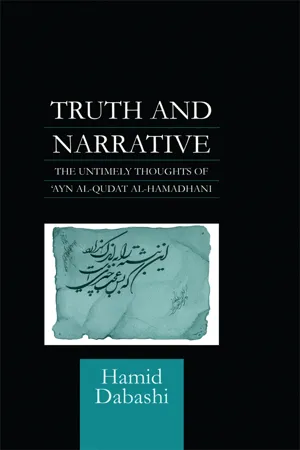
'Ayn al-Qudat is one of the great multi-dimensional geniuses of Islamic intellectual history and has even been described as the true father of deconstructionism, yet he remains little known and even less understood in the English speaking world. Hamid Dabashi has filled this gap with a compelling and sophisticated analysis of this seminal 12th century writer and thinker. Prof. Dabashi frees 'Ayn al-Qudat from the static categorizations of mystic, philosopher, theologian, poet or social critic and allows the dynamism and subversive thrust of his life and intellect to emerge. Untimely thoughts provides a clearly written critical introduction to the intellectual, literary, religious and philosophical struggles of the time as expressed by one of Islam's greatest and most radical writers.
- 694 pages
- English
- ePUB (mobile friendly)
- Available on iOS & Android
eBook - ePub
About this book
Information
Eight
… To Write On
1
It is perfectly clear that ʿAyn al-Quḍāt writes these “letters” voluntarily and at his own discretion. A particularly powerful writing urge gets hold of him and does not let go and then he begins to write, relentlessly, impatiently, letting loose his narrative impulses: words, phrases, suggestions, ironies, and paradoxes leading his narrative urge from one theme to another. The assumption that these letters are all written in response to ʿAyn al-Quḍāt’s students’ and followers’ requests is not tenable. He was too much of an impulsive writer to let go of a momentum for the sake of some prosaic question put to him by a friend or a follower. At the conclusion of a letter in which he responds to a request to provide a commentary on the opening chapter of the Qur’an, he severely admonishes his addressee for having asked him why he does not write: “You have asked why I do not write? Am I your chained and enslaved [servant]? If you want to amount to anything, be absolutely obedient! What do you have to do with interrogation? If you are told, ‘It is night,’ and you see the sun with your own eyes, then simply say you are making a mistake… What do you have to do with asking questions? Asking [me] why things are? Or why it should be such and thus? Or that had it been so, it would have been thus. Be polite! And listen to what you are told! Not everything can be explained to you. If you are told something, be grateful for it, if not, do not be impertinent. … I swear by His Majesty and Power that I wanted much to admonish you, and yet that is an unforgivable sin. Besides, you would not have been able to tolerate that admonition. You cannot imagine. What I have done is a [simple] reminder, not an admonition, so that you would know. And peace be upon you, and praise be to God, the Lord of both worlds, and His Peace and Benedictions be upon Muḥammad and all his family.”1
2
The spontaneity which is thus constitutional to ʿAyn al-Quḍāt’s narrative is the preparatory mood for what his “letters” in particular achieve. What ʿAyn al-Quḍāt achieves in his “letters” is the subversion of the very metaphysical assumptions of the narrativity of “Truth,” of the possibility of “telling” it. This is achieved much more effectively in form and rhetoric than in any pronounceable argument. The anti-narrativity of writing a “letter” to a personal friend and to pray for his health and prosperity and send regards of mutual friends as you also propose to reflect on God’s Essence and Attributes comes with its own undoing of itself. ʿAyn al-Quḍāt’s effective, not argumentative (which would have been counterproductive), suspension of the narrativity of “Truth-Telling” obviously rests on his ground-breaking recognition of that very narrativity of any claim to “Truth-Telling.” That is why we should read his “letters” as the counter-cause of all his factual writings to which we have access. His formal form of writings came to a closure in the Tamhīdāt which in their counter-narrative constructions are very similar to ʿAyn al-Quḍāt’s “letters.” But the “letters” themselves run along other writings as an internal dialogue against all possibilities of “Truth-Telling.” “The letters,” the Tamhīdat, and the Shakwā challenge collectively, each in a particular way, the received, unquestioned, and institutionalized presumptions of “Truth-Telling” in any “Islamic” universe that ʿAyn al-Quḍāt had inherited. When one reads these “letters,” there is scarcely a moment when he argues against a specific position of theologians or philosophers, or even “mystics.” There are, of course, occasions that he announces his preference for, say, the Avicennian position on the question of bodily resurrection. But these moments fade out in comparison with the general texture of ʿAyn al-Quḍāt’s writings in which he is primarily concerned not with whether philosophers are right or theologians, or whether jurists are or “the mystics,” but with the much more basic question of “Truth-Telling” – as to how one tells “the Truth,” who tells “the Truth,” whence is the assumption of “Truth-Telling,” what is the role of language in this act and, perhaps most significantly, what is at stake in the entire narrative underpinning of telling, of putting into words and sentences, “the Truth.”
To make his readers conscious of this act of “Truth-Telling,” ʿAyn al-Quḍāt constantly challenges all their basic epistemic assumptions. To know, for example, is one thing, to have simply memorized things is an entirely different thing. And thus those who know are one thing and those who have simply memorized things are entirely different. This is not something new. People have always known this, and yet recently (i.e., ʿAyn al-Quḍāt’s time of the sixth/twelfth century) this insight has been distorted. In the older time, people used to say that “so and so is one of the knowers,” and that “such and such claims to know.” From this premise, ʿAyn al-Quḍāt proceeds to argue that there is a fundamental difference between “words” (lafd) and “meanings” (maʿnī). Look at this letter, for example, ʿAyn al-Quḍāt writes.2 It is merely a carrier of words. It cannot, by virtue of being a mere carrier of words, be a carrier of meanings, because a paper is a corporeal being, a thing, and meanings are of a higher existential status. It is only through an act of “reasoning” (istidlāl) that the letter carries meaning. From a written letter, one (a reader) can conclude that its writer had power, intention, and knowledge to produce it. But that “conclusion” is a mere rational process. The letter as a letter, by virtue of being a “thing,” cannot carry the meanings that the words of a letter refer to. Other than the soul (jān) of the writer, itself an existence of equally high status as meanings, no other “thing” can carry meanings. But other than through the rational act of istidlāl, words carry meanings also through the act of convention or istilāh. How does istlāh work? It has now become a convention that the combination of the letters H-O-N-E-Y (ʿAyn al-Quḍāt uses ʿ-S-L for the Arabic/Persian equivalent) stands for a sweet substance that is produced by bees. The word H-O-N-E-Y is the carrier of a meaning only through convention.
Thus the carrier of meaning cannot be but a heavenly substance (gawharī malakūtī). And as someone has described the nature of this substance in a poem:
O Thou the good and enlightened Substance!
Thou art not from our World, Where does Thou come from?
Thou hast come to our world, Thou art a lonely stranger,
And I know for a fact that Thou art not God.3
Thou art not from our World, Where does Thou come from?
Thou hast come to our world, Thou art a lonely stranger,
And I know for a fact that Thou art not God.3
There is this substance which is not God and yet upon which acts of meanings and significations are borne. Otherwise, a letter can only carry the letters, as the tongue can only carry the sounds. Neither the letter (the letters) nor the tongue (the sounds) can carry meanings. The ear can only hear the sounds. It cannot understand the meanings associated with them through istidlāl or istilāh. Now the brain (dimāgh) of a person who has humanized things is the carrier of letters and sounds. “It is not and it can never be the carrier of meanings.”4 It is the heart (dil) of the knower which is the carrier of meanings. The letters and sounds have no place in the knower’s heart. The heart is a far superior place in comparison to the brain.
Concluding example: People like Abū Jahl and Abū Lahab, the archenemies of the prophet Muḥammad, had ears, tongues, and eyes with which they could hear, write, and read the Qur’an. And yet, as the Qur’an itself testifies, they, and many others like them, could not understand a word of the Qur’an. Because they lacked heart. Consider also this: A sick person can say the word H-O-N-E-Y. And if you write it on a piece of paper, the sick person can read it. And yet, being sick, the sweetness of honey completely escapes him/her. “Heart” is where all meaning is received and registered. Otherwise: “The word H-O-N-E-Y is not the carrier of the meaning of honey. The person’s heart carries it….”5 This, ʿAyn al-Quḍāt contends, is the beginning of an understanding for such humanly meaningless expressions as “HMʿSQ” or “KHYʿS” that appear in the Qur’an. They are expressions of certain meanings, closest to the Qur’anic truth, for which there is no conventional or rational referent in human tongue. The truth of the Qur’an is something, its conventional use of words and expressions something entirely different. “Thus,” ʿAyn al-Quḍāt concludes, “it is perfectly possible that a person may read the Qur’an in a multiple narrative and yet understand nothing from the Qur’an.”6 And here is a piece of ʿAyn al-Quḍāt’s own prejudices that clarifies the point even further. “Because Jews and Christians can learn (yād giriftan) the Qur’an but they cannot understand (dānistan) it.”7
How, and here comes ʿAyn al-Quḍāt’s radical subversion of the writtenability and/or narrativity of “Truth,” is it perfectly possible for a person to know everything about God’s Essence and Attributes without being able to read a word from the Qur’an properly? Let’s read his own words:
And it is [perfectly] possible for a person to know all the truths of His Pre-Eternal Essence (Dhāt-i Qadīm) and Attributes (Awsāf) upon reaching the end of the knowledge of the path and yet cannot utter a word of the Qur’an properly, as if he were a Turk or a Persian, not being able to read a page of the Qur’an, unable to distinguish between Alif (“A”) and Jim (“J”).8
Then he argues: The majority of the prophet’s companions did not know how to read and write and were complete illiterates, and yet they were the real ʿulamā’, None of the books that ʿAyn al-Quḍāt’s contemporaries were able to read in the sixth/twelfth century were not even written during the time of Prophet Muḥammad and his contemporaries. Then what, asks ʿAyn al-Quḍāt rhetorically, “They did not have faith? Indeed! They had faith. We know the name (nām) ‘faith,’ they know the truth of faith. Because we are people of tongue, and they were the people of heart.”9
3
This, of course, is a complete and radical rupture between language and truth, or between tongue and heart, as ʿAyn al-Quḍāt puts it. Language is one thing, truth is an entirely different thing. Language at best is conventional approximation to truth. But in the provisioned possibility of non-linguistic access to truth (for people of the heart), then language is completely suspended from any direct, unmitigated, and authoritative claim to telling “the Truth.” This effective subversion of language as having an integral claim to “Truth-Telling” challenges the very root of the narrativity of “Truth.” The possibility of telling it. Now, as to the claim that there is a “Truth” outside and beyond the linguistic realm, somewhere in “the heart of the believer,” that shall ever, by virtue of ʿAyn al-Quḍāt’s own argument, remain a mute, humanly inaccessible, and entirely dubious proposition, if for nothing else, then at least for the fact that there is no human access to it.
There is a powerful and dangerous political implication to what ʿAyn al-Quḍāt is proposing here which he does not leave unpronounced:
What about Uways Qaranī ʿAyn al-Quḍāt rhetorically asks, referring to a legendary early Muslim who believed in Prophet Muḥammad’s message without having ever laid eyes on him], may God be Pleased with him? Did he ever read or write anything? Where did he get that much blessed fortune? But no, indeed, God forbid, of all these so-called “ʿulamā’”’, They are thoroughly distorting Muḥammad’s religion. God’s peace and benediction be upon him. … A bunch of jack-asses have completely concealed in this world as to how things have been, and then they claim that “The ʿulamā’ are the inheritors of the prophets,” thinking that ...
Table of contents
- Cover
- Half Title
- Title
- Copyright
- Dedication
- Contents
- Acknowledgments
- Chronology
- Preface
- Introduction A Matter of Method
- One The Birth of an Individual
- Two Signs of a Time
- Three The Mad Game of Writing Begins
- Four The Brothers al-Ghazālī and Beyond
- Five “I, ʿAyn al-Quḍāt”
- Six A Book Full of Preparations
- Seven Letters with No Paper …
- Eight … To Write On
- Nine Apologia
- Ten The Death of an Individual
- Eleven The Man Dies, the Legacy Unfolds
- Conclusion Truth and Narrative
- Bibliography
- Index
Trusted by 375,005 students
Access to over 1.5 million titles for a fair monthly price.
Study more efficiently using our study tools.
Frequently asked questions
Yes, you can cancel anytime from the Subscription tab in your account settings on the Perlego website. Your subscription will stay active until the end of your current billing period. Learn how to cancel your subscription
No, books cannot be downloaded as external files, such as PDFs, for use outside of Perlego. However, you can download books within the Perlego app for offline reading on mobile or tablet. Learn how to download books offline
Perlego offers two plans: Essential and Complete
- Essential is ideal for learners and professionals who enjoy exploring a wide range of subjects. Access the Essential Library with 800,000+ trusted titles and best-sellers across business, personal growth, and the humanities. Includes unlimited reading time and Standard Read Aloud voice.
- Complete: Perfect for advanced learners and researchers needing full, unrestricted access. Unlock 1.5M+ books across hundreds of subjects, including academic and specialized titles. The Complete Plan also includes advanced features like Premium Read Aloud and Research Assistant.
We are an online textbook subscription service, where you can get access to an entire online library for less than the price of a single book per month. With over 1.5 million books across 990+ topics, we’ve got you covered! Learn about our mission
Look out for the read-aloud symbol on your next book to see if you can listen to it. The read-aloud tool reads text aloud for you, highlighting the text as it is being read. You can pause it, speed it up and slow it down. Learn more about Read Aloud
Yes! You can use the Perlego app on both iOS and Android devices to read anytime, anywhere — even offline. Perfect for commutes or when you’re on the go.
Please note we cannot support devices running on iOS 13 and Android 7 or earlier. Learn more about using the app
Please note we cannot support devices running on iOS 13 and Android 7 or earlier. Learn more about using the app
Yes, you can access Truth and Narrative by Hamid Dabashi in PDF and/or ePUB format, as well as other popular books in Scienze sociali & Studi sull'etnia. We have over 1.5 million books available in our catalogue for you to explore.