Most of the Cypriot population, especially the lower classes, remained loyal to the British cause during the Great War and the island contributed significantly to the First World War, with men and materials. The British acknowledged this yet failed to institute political and economic reforms once the war ended. The obsession of Greek Cypriot elites with enosis (union with Greece), which only increased after the war, and the British dismissal of increasing the role of Cypriots in government, bringing the Christian and Muslim communities closer, and expanding franchise to all classes and sexes, led to serious problems down the line, not least the development of a democratic deficit. Andrekos Varnava studies the events and the impact of this crucial period.
eBook - ePub
British Cyprus and the Long Great War, 1914-1925
Empire, Loyalties and Democratic Deficit
- 242 pages
- English
- ePUB (mobile friendly)
- Available on iOS & Android
eBook - ePub
British Cyprus and the Long Great War, 1914-1925
Empire, Loyalties and Democratic Deficit
About this book
Information
1 British Cyprus, 1878–1915
The inconsequential possession
What role did Cyprus (see Figures 1.1 and 1.2) have in the British imperial structure before the Great War and what was life like for Cypriots transitioning from Ottoman to British rule? This chapter provides an overview from the British occupation in 1878 to October 1915 when the island was offered to Greece, building on findings in British Imperialism in Cyprus and foregrounding the main chapters that follow.
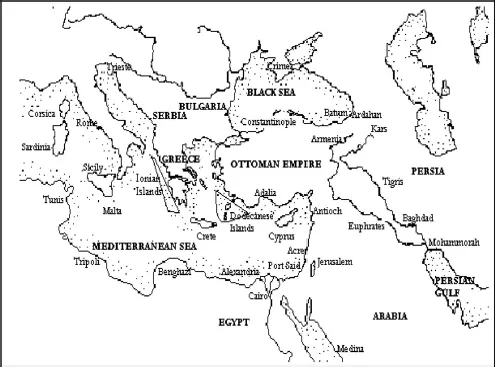
Figure 1.1 The Location of Cyprus. Source: © Dr Andrekos Varnava, 2007.
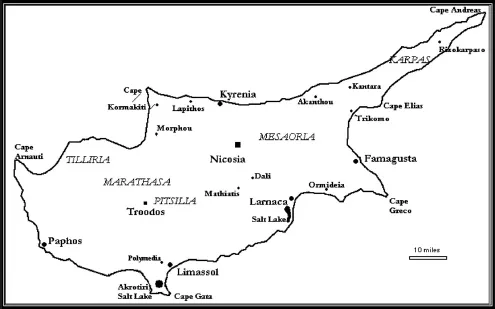
Figure 1.2 Map of Cyprus. Source: © Andrekos Varnava, 2005.
A few days before the outbreak of the Great War in July 1914, officers of the German battlecruiser Goeben had lunched at the English club at Famagusta. However, by the time the war had started, the Goeben had left Cypriot waters and there were ‘no German submarines in the [eastern] Mediterranean in those early days’ of the war.1 As a backwater of the British Empire, Cyprus had few military personnel and installations, and the Ottoman Empire did not enter the war until later that year. The war impacted Cyprus in other ways, but it was not until mid-1916 that the country started to play a strategic role, the first time it had done so since the British occupation in 1878, despite strategic reasons for that occupation.2
The establishment of the British occupation and administration of the island in 1878 brought many changes to Cyprus, yet the impact of many of these changes was not felt until the turn of the century, and many reforms were not introduced until after that. Cyprus was an Ottoman backwater, neglected for its small size and its isolation on the way to nowhere and, therefore, also for its lack of strategic advantage. One could substitute British for Ottoman in the previous sentence. By the end of Ottoman rule, there were deep class/social cleavages in Cypriot society across the urban and rural divide and the religious communities, which continued during British rule.3 These cleavages impacted on the political and socio-economic conditions, on local relations with the British colonialists and between the two main religious groups. British rule ‘modernised’ Cyprus, facilitating significant population growth because of improvements to health, yet the island’s inconsequence to British imperialism meant there was little economic development, with the corresponding lack of employment for the growing population. Politically, British rule created a power vacuum, as the Muslim and Christian religious elites who had previously held power were scrambling to recover their political authority in the aftermath of the British secularisation of the state. The political authority of the Muslim clerical hierarchy declined as their politics increasingly became secularised under the leadership of their representatives in the legislative and executive councils, and they were subordinated to defending their status as a community against the demographic majority. Conversely, the political authority of the Orthodox Christian clerics went into free-fall because it was no longer aligned/co-opted by the colonial state and they were unwilling to enter the ‘democratic’ system that was introduced. After Archbishop Sophronios died in 1900, the church hierarchy became the willing tool of the emergent political class, whether that was tied to landowning or to the white-collar classes, who progressively adopted Greek nationalism to recover their power and eventually take control of the island from the colonial authority and the Turkish-Muslim community. The conflicts and crises that this engendered at this level of society did not, however, penetrate to the lower or lower-middle classes, and although the growing middle classes were aware and – in some cases (i.e. in urban areas) – involved, the enosis movement was not a mass movement during the interwar period.
The last decades as an Ottoman backwater
For most of Ottoman rule, Cyprus was a backwater. It may have been occupied by the Ottomans for strategic reasons in 1570–71 against Western control and broader influence in the eastern Mediterranean, but Cyprus was soon garrisoned by only a few troops and was a small fry in trade terms.4 It was a similar story with the British arrival, with similar consequences on the development of the island. The historiography of late Ottoman Cyprus is healthy in terms of quantity but mixed in quality. Generally, when Ottomanists have situated Cyprus into the broader imperial system the results of their work have been good.5
During Ottoman rule, Cypriot society had greater socio-economic cleavages than religious or ethnic ones, and these influenced society and politics. The educated elites had rather fluid collective identities that were based on various identifications, kinship, the village, religion, and class, which is not the same as ethnic.6 In the nineteenth century, some secular elites developed an ethnic identity, but they did not unite behind this identity with the clergy until the eve of the Great War. Religious differences between Muslims and Eastern Orthodox Christians did not preclude integration within classes that cut across religion. Under the Ottomans there was little ethnic division and disturbances were mostly driven by power struggles amongst elites or economic inequalities amongst the lower-classes. Thus, class, geography (urban-rural divide), and religion determined identities.7
The elites in Ottoman Cyprus were both Muslims and Christians. Ottoman rule saw the introduction of the Ottoman civil and military bureaucracy. The leading clergy of the Eastern Orthodox Church gained much power because they replaced the Catholic Church as the only recognised Christian authority, while Catholics embraced both Orthodoxy and Islam.8 The Cypriot Orthodox Church was independent of the Ecumenical Patriarchate in Constantinople and the three Apostolic Patriarchates in Jerusalem, Antioch and Alexandria, giving it religious and political independence. The Ottoman millet system, which allowed for religious autonomy as long as millet leaders (ethnarchs) ensured the loyalty of their people (dhimmi) to the government, saw, by the eighteenth century, the Cypriot archbishop and the higher clergy become secular leaders, with the archbishop becoming the ethnarch. Thus, the Eastern Orthodox Church elite were willingly co-opted into the ruling class, and their power was derived from the Ottoman imperial system and dependent on ensuring the loyalty of their flock. They guaranteed this loyalty by either suppressing revolts led by the lower-class or representing them to the imperial government during droughts, locust plagues, and famine.9 Thus, Christian and Muslim elites relied on each other for power and control over the Cypriot masses.10 Rarely was the contract between Christian elites and the government broken, and when the Ottoman authorities erroneously linked the Cypriot Church leadership to the Greek revolt in 1821, Ottoman punishment was swift and bloody, with the execution of leading Orthodox figures, including the archbishop.11
The Christian and Muslim lower-classes also relied on each other and became integrated culturally. They shared the economic and social hardships, brought on by droughts, bad harvests, locust plagues, and a lack of technological advancement and government and private investment in industries and infrastructure. Together they opposed high taxes through memorials and revolts. They also shared a folklore, a commonly spoken language (i.e. Cypriot Greek, which also contained Cypriot Turkish), cultural events (even religious), and even intermarried.12 The increase in mixed villages exemplified integration: the 1832 Ottoman census recorded 172 mixed villages13; in 1858 the British consul estimated 23914; and in 1891, in the second British census, there were 346 mixed villages out of 702.15 Some Christians (originally mostly Roman Catholics) were ‘lino-bambaki’ (linen-cottons): publicly Muslim and privately Christian, developing their own hybrid religion that confused the practices, traditions and rituals of both.16 Cypriot Eastern Orthodox Christians referred to themselves, and were referred to by Muslims, as Ρωμιοί (pronounced Romyee; i.e. Romans; Rûm in Turkish), a term used after the spread of Christianity to the Roman Empire (because to call one...
Table of contents
- Cover
- Half Title
- Series Page
- Title Page
- Copyright Page
- Dedication
- Table of Contents
- List of figures
- List of tables
- Acknowledgements
- List of abbreviations
- Introduction
- 1. British Cyprus, 1878–1915: The inconsequential possession
- 2. Elite loyalties: Enosis, the Greek schism and the war effort
- 3. Middle class loyalties: Military intelligence and the war effort
- 4. Lower class loyalties: Cypriots at war
- 5. Refugees and settlers: Inclusivity and exclusivity
- 6. ‘Remember Heligoland’: Retaining Cyprus against the enosis policy
- 7. Colonialism, enosis and democratic deficit, 1921–25
- Conclusion
- Selected Bibliography
- Index
Trusted by 375,005 students
Access to over 1.5 million titles for a fair monthly price.
Study more efficiently using our study tools.
Frequently asked questions
Yes, you can cancel anytime from the Subscription tab in your account settings on the Perlego website. Your subscription will stay active until the end of your current billing period. Learn how to cancel your subscription
No, books cannot be downloaded as external files, such as PDFs, for use outside of Perlego. However, you can download books within the Perlego app for offline reading on mobile or tablet. Learn how to download books offline
Perlego offers two plans: Essential and Complete
- Essential is ideal for learners and professionals who enjoy exploring a wide range of subjects. Access the Essential Library with 800,000+ trusted titles and best-sellers across business, personal growth, and the humanities. Includes unlimited reading time and Standard Read Aloud voice.
- Complete: Perfect for advanced learners and researchers needing full, unrestricted access. Unlock 1.5M+ books across hundreds of subjects, including academic and specialized titles. The Complete Plan also includes advanced features like Premium Read Aloud and Research Assistant.
We are an online textbook subscription service, where you can get access to an entire online library for less than the price of a single book per month. With over 1.5 million books across 990+ topics, we’ve got you covered! Learn about our mission
Look out for the read-aloud symbol on your next book to see if you can listen to it. The read-aloud tool reads text aloud for you, highlighting the text as it is being read. You can pause it, speed it up and slow it down. Learn more about Read Aloud
Yes! You can use the Perlego app on both iOS and Android devices to read anytime, anywhere — even offline. Perfect for commutes or when you’re on the go.
Please note we cannot support devices running on iOS 13 and Android 7 or earlier. Learn more about using the app
Please note we cannot support devices running on iOS 13 and Android 7 or earlier. Learn more about using the app
Yes, you can access British Cyprus and the Long Great War, 1914-1925 by Andrekos Varnava in PDF and/or ePUB format, as well as other popular books in Storia & Storia mediorientale. We have over 1.5 million books available in our catalogue for you to explore.