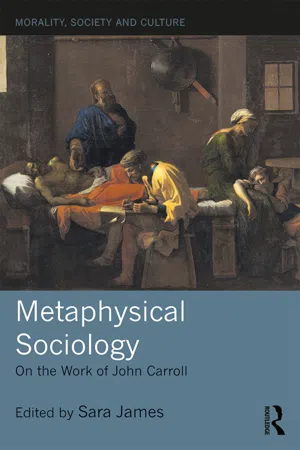
This volume critically engages with the work of the acclaimed Australian sociologist John Carroll. It makes the argument for a metaphysical sociology, which Carroll has proposed should focus on the questions of fundamental existence that confront all humans: 'Where do I come from?', 'What should I do with my life?' and 'What happens to me when I die?'. These questions of meaning, in the secular modern West, have become difficult to answer. As contemporary individuals increasingly draw on their inner resources, or 'ontological qualities', to pursue quests for meaning, the key challenge for a metaphysical sociology concerns the cultural resources available to people and the manner in which they are cultivated. Through wide-ranging discussions which include, film, romantic love, terrorism and video games, Metaphysical Sociology takes up this challenge. The contributors include emerging and established sociologists, a philosopher, a renowned actor and a musician. As such, this collection will appeal to scholars of social theory and sociology, and to the general reader with interests in morality, art, culture and the fundamental questions of human existence.
- 170 pages
- English
- ePUB (mobile friendly)
- Available on iOS & Android
eBook - ePub
About this book
Information
p.1
1 John Carroll’s metaphysical sociology
Sara James
From anomie and alienation to liquidity and the reflexive project of the self, sociologists have been adept at articulating the difficulties – and occasionally the rewards – of the modern human experience. For John Carroll, the major problem of modernity is that it is ‘metaphysically precarious’ (2014: 565). Modernisation may have dealt with most of the material hardships that plagued previous eras, but it has not been able ‘to neutralise the Old Testament wisdom that we do not live by bread alone’ (Carroll, 2008: 4). The problem, for Carroll, is one of meaning; and the solution lies in the realm of culture.
This focus on meaning, on the metaphysical as opposed to the physical requirements of life, sets Carroll apart from much contemporary sociology. Carroll has proposed that a metaphysical sociology should focus on how societies grapple with the fundamental existential questions that confront all humans – ‘Where do I come from, What should I do with my life, and What happens to me when I die’ (2014: 1). In the modern West, with the declining influence of religion and other traditional signposts, these questions of meaning have become difficult to answer. Contemporary individuals increasingly pursue individual and experimental quests for meaning, drawing on their own inner resources, their ‘ontological qualities’ (Carroll, 2012: 221). The key question for a metaphysical sociology then is: ‘What metaphysical resources are available to people and how do we cultivate them?’
John Carroll is the author of one of the most important and ambitious projects in contemporary cultural sociology. While Jeffrey Alexander describes him as a ‘maverick’ and ‘one of the most interesting theoretical minds in sociology’, others question whether he belongs within the discipline. This is partly because Carroll is an effective populariser of insights from classical sociology; his work transcends the narrow jargon-laden categories of contemporary academic sociology. This is reflected in the breadth of contributors in this collection, which includes a philosopher, a renowned actor and a musician.
Carroll’s body of work spans four decades. He completed his PhD at Cambridge University, supervised by George Steiner and Anthony Giddens. Stimulated by Steiner, he moved away from political and economic concerns, towards culture, also citing Riesmans’s The Lonely Crowd as a major influence (Campain, 2005: 7). His PhD thesis was published as Break-Out from the Crystal Palace: The Anarcho-Psychological Critique: Stirner, Nietzsche, Dostoevsky, in 1974. Carroll returned to Australia and was appointed as a lecturer at La Trobe University in Melbourne, where he taught for over forty years and is now Professor Emeritus. He has also held visiting appointments at Harvard, Yale and the London School of Economics.
p.2
Carroll is also a prominent public intellectual, bringing a sociological perspective to current affairs and introducing sociological thought to the general reader. He has been a frequent writer of essays for popular literary journals such as Meanjin, Quadrant and The Salisbury Review. Carroll also regularly publishes opinion-piece articles in broadsheet publications such as The Age, The Australian and The Australian Financial Review and appears frequently as a commentator on radio programmes. Many of his books have found an audience beyond academia. Australian Book Review said of Ego and Soul: ‘A genuine attempt by an academic sociologist to deal with the crisis of meaning that is felt everywhere in the wider community, especially in youth culture.’ Carroll’s work strikes a chord with the public audience because it speaks to issues that are felt by many but seldom articulated in public discourse.
This collection of essays provides a critical survey of Carroll’s metaphysical sociology,1 while also expanding the project into new areas. My aim in this introductory chapter is to familiarise the reader with Carroll’s approach, while outlining his major themes, in order to contextualise the chapters that follow. I do not provide a comprehensive survey of Carroll’s body of work; I intend only to set the scene and explain the rationale for this collection. Later chapters, particularly those by Dickson and Murphy, provide more detailed accounts of Carroll’s intellectual project.
Carroll’s vision and approach
Taken as a whole, Carroll’s published works and lectures present a distinctive vision of the history of the West and its cultural implications. Following Nietzsche and Weber, he argues that the major challenge faced by the modern West is a ‘crisis of meaning’ (1998: 1), brought about by the birth of humanism:
We live amidst the ruins of the great, five-hundred-year epoch of humanism. Around us is that ‘colossal wreck’. Our culture is a flat expanse of rubble. It hardly offers shelter from a mild cosmic breeze, never mind one of those icy gales that regularly return to rip us out of the cosy intimacy of our daily lives and confront us with oblivion.
(Carroll, 1993: 1)
Emerging in the European Renaissance and articulated fully in the Enlightenment, humanism attempted to ‘put humans at the centre of the universe’ (Carroll, 2004: 2) and establish an order where human flourishing was a consequence of their own achievements, rather than by the grace of God. Reason was enshrined as the path to human maturity. This vision of progress as a consequence of human reason led to the questioning of religious and traditional authority, paving the way for the political, scientific and industrial revolutions that marked the beginning of the modern era. Carroll (2004: 7) makes it clear that modernity has brought extraordinary physical and material benefits, liberating people from the ‘miserable struggle to survive’. His argument is that the concurrent cultural decline left the modern West psychologically and spiritually starved (Carroll, 1974).
p.3
For Carroll, a healthy culture provides a firm foundation, a secure ‘place to stand’ (2004: 2). Without this, the world is ‘relativity and chaos, without direction, bearings or sense – a world in which humans cannot live and stay sane’ (Carroll, 2004: 2). Only from a secure platform can people live confidently and be creative (Carroll, 1977).2 Modern Western culture struggles to provide this rock. The forms that give order and security have been broken down, in an attempt to remove the ‘limits to pleasure’ (Carroll, 1977: 87). Carroll argues that this liberation has had serious consequences: ‘individuals detached from community are prone to egoism, restlessness, rootlessness, and a sense that life is aimless and futile’ (1986: 4). This line of argument is influenced by Durkheim – who argued that the individualism humanism encouraged in a society lacking a strong collective conscience would leave individuals vulnerable to anomie – and Dostoevsky, who saw that when everything is permitted, the consequences are chaos and lethargy. Human flourishing requires authority3 (Carroll, 1977).
Carroll describes contemporary Western culture as remissive – a term derived from Phillip Rieff – meaning that it lacks energy and authority. In a remissive culture, guilt, which is ordinarily a necessary regulator of human action, is not successfully sublimated and can lead to paralysis. Christianity used to help reduce guilt by providing an explanation for it and telling the individual how to reduce it, but Western culture has not been able to find a replacement for this (Carroll, 1986). Guilt, for Carroll, is not only psychological but spiritual. It is triggered when we violate the sacred order, thus performing the important function of making us aware of this order. Healthy cultures allow individuals to sublimate guilt through activity that connects them to the sacred order. Myths play a vital role here in guiding human action. These stories express the universal, ‘“capital T”’ truths (Carroll, 2007: 2) that can guide human lives, offering a perspective that reminds individuals they are subject to the forces of fate: ‘There are eternal laws – moral and metaphysical – and at its deepest level, the human consciousness is born understanding them . . . however much a particular period may distort and repress true conscience, it will not eliminate it’ (Carroll, 2004: 267). In sum, humanism, in attempting to replace myth with reason, has not been able to provide answers to the big questions of how to live. As Carroll memorably puts it: the Western world is ‘dying for want of Story’ (2001: 7).
So far, this is a bleak assessment. In the prologue to the revised edition of Humanism: The Wreck of Western Culture (first edition 1993, second edition 2004), Carroll notes that the question he was asked most often in response to the first edition of the book was ‘What is the remedy? Where do we go now?’ (2004: vii). In his later works – beginning with the first edition of Ego and Soul: The Modern West in Search of Meaning (1998) – Carroll takes on this task. His critique of Western culture, set forth in Humanism, was levelled at the realm of high culture, which he argues failed in its key task of retelling the archetypal stories in a way that speaks to the times. He is more optimistic, however, about popular culture.
p.4
In The Western Dreaming (2001) Carroll shows how popular music, film and television have retold archetypal stories (including ‘The Hero’ and ‘Soul Mate Love’) so that they continue to provide guidance for the conduct of a meaningful life. In Ego and Soul (first edition 1998, second edition 2008) he demonstrates this through an analysis of everyday activity in areas as diverse as tourism, DIY cultures, sport and work. Carroll takes this project of reviving foundational stories even further in The Existential Jesus (2007) and Greek Pilgrimage (2010). In these two books, Carroll attempts to reconnect Western culture with its roots, which, he suggests, are to be found in ancient Greece (particularly the works of Homer and the tragedies) and in the Jesus story: ‘We cut ourselves off from our sacred origins at our own peril: it is they that anchor us, that give us a sense of home and belonging, of past and future that are meaningfully continuous’ (1986: 10). Written as a journey through the great sites and cultural works of ancient Greece, Greek Pilgrimage is both travel guide and meditation on its pivotal role in Western culture.
The Existential Jesus is much more daring. In this book Carroll attempts to retell Mark’s gospel, recovering it from the churches’ version, to revitalise the story of Jesus. The resulting narrative portrays a Jesus who is angry, solitary and enigmatic. As a work of sociology, it is strikingly unorthodox; as John Dickson suggests in a later chapter – drawing on a review by Peter Jensen – it is ‘something like an old-fashioned sermon’. Unsurprisingly, it is a divisive book. While social theorist Zygmunt Bauman called it an ‘awe-inspiring . . . work of genius’, academic theologian Roland Boer described it as ‘pretentious and arrogant’, the first part of the book merely ‘a paraphrase of Mark with a thin veneer of existential thought’ (2008: 243–244). Carroll does not set out to shock or to generate controversy; his aim in this book is simply to retell the story. As the sociologist of religion Gary Bouma (2007) has commented:
He appears to have no agenda other than retelling Mark’s story as he has encountered and understood it. The book has no audience, no desire to convert, just to recount an authentic encounter with Mark’s story of the Jesus who said ‘I am’ and demanded of others, ‘Who am I?’
As early as 1980, Carroll argued that ‘The art of story-telling is essential to sociology’ (1980: 39). In Sceptical Sociology (1980) – his intellectual manifesto – he puts forward his vision for how sociologists should proceed. He argues that the discipline must return to its roots. The great classical works of sociology, ‘like great works of literature or art’, were able to ‘reveal important things about the human condition that had not been seen before’ (Carroll, 1980: 18). The discipline has become too idealistic and is preoccupied with a need to appear sufficiently scientific and socially relevant. In its use of ‘barbaric jargon’, ‘legalistic syntax’ and ‘statistical tables’ and in its ‘obsession with the humdrum’ (Carroll, 1980: 5) sociology has veered off course from its primary task. In the Preface, he writes:
p.5
I have been stirred by the belief that sociology since 1918 has tended to make the world as dull as it is at its worst, and that this tendency needs reversing. My second animating belief is that sociology lost contact with the great metaphysical questions that elevate men’s lives, that precipitate crisis and that underlie feelings of success or failure – Tolstoy’s questions of how to live and what to do.
This identification of Tolstoy’s questions comes from Weber’s vocation lectures. Carroll chooses 1918 as his cutoff point as this was the year Weber delivered the lectures, two years before he died. Durkheim had died in 1917 and Marx and Tocqueville were long departed. In later works Carroll refers to more contemporary sociologists who have kept this tradition alive, but his point here is to emphasise that the vast majority of sociological work no longer engages with the ‘great metaphysical questions’. The best social theory, Carroll argues, teases out meaning from everyday life; it is a ‘process of making intelligible’ that which was previously inchoate. It is not a literal description of the routines of everyday life but rather ‘the getting behind that everyday life to reflect in terms of the metaphysical questions of how to live and what to do, or alternatively the questions of where we are and where we might be going’ (Carroll, 1980: 18). If sociology is to succeed, Carroll argues, then it must return to ‘first principles’ (1980: 3) and wrestle with the key metaphysical questions faced by us all.
I have sketched an outline of Carroll’s approach and the major themes of his metaphysical sociology; this will be filled out in greater depth in the chapters that follow. Carroll has written two pieces for this book: an introductory essay and a response to the other contributors. There is also the transcript of a radio interview with Carroll and Stephen Crittenden. The other contributors to this volume were asked to write an essay that engages with Carroll’s metaphysical sociology. While some provide critical discussions of his work, others use his ideas as a jumping-off point for new investigations. As such, this is a diverse collection in terms of subject matter, but thematically, all chapters return to the key concerns of culture, story and the question of how to live in modernity.
Metaphysical sociology
In the book’s lead essay, ‘What is metaphysical sociology?’, Carroll puts forward his argument for a sociology that tackles the key questions of meaning faced by every individual: Where do I come from? What should I do with my life? And what happens to me when I die? The sociological ‘parentage’ of this approach, Carroll argues, can be found in Weber, Nietzsche and Durkheim. He also points to some later examples including David Riesman, Philip Rieff and Zygmunt Bauman. These accounts of culture and the contemporary Western condition, he argues, are too pessimistic. In the era following World War Two ‘cultural despair’ is not appropr...
Table of contents
- Cover Page
- Metaphysical Sociology
- Morality, Society and Culture
- Title
- Copyright
- Contents
- 1 John Carroll’s Metaphysical Sociology
- 2 What is Metaphysical Sociology?
- 3 The Existential Jesus: Transcript of an Interview With Stephen Crittenden and John Carroll
- 4 John Carroll’s Jesus
- 5 John Carroll: Towards a Definition of Culture
- 6 The Passion in Port Talbot
- 7 A Neo-Calvinist Sociology: John Carroll’s Metaphysical Modernity
- 8 The Eclipse of Metaphysics
- 9 Digital Western Dreaming
- 10 Ego-Terrorism: The Benefit of an Anarcho-Psychological Perspective of Terrorism
- 11 Mortality, Time and Embodied Finitude
- 12 Modern Metaphysical Romance
- 13 Response
- Index
Trusted by 375,005 students
Access to over 1.5 million titles for a fair monthly price.
Study more efficiently using our study tools.
Frequently asked questions
Yes, you can cancel anytime from the Subscription tab in your account settings on the Perlego website. Your subscription will stay active until the end of your current billing period. Learn how to cancel your subscription
No, books cannot be downloaded as external files, such as PDFs, for use outside of Perlego. However, you can download books within the Perlego app for offline reading on mobile or tablet. Learn how to download books offline
Perlego offers two plans: Essential and Complete
- Essential is ideal for learners and professionals who enjoy exploring a wide range of subjects. Access the Essential Library with 800,000+ trusted titles and best-sellers across business, personal growth, and the humanities. Includes unlimited reading time and Standard Read Aloud voice.
- Complete: Perfect for advanced learners and researchers needing full, unrestricted access. Unlock 1.5M+ books across hundreds of subjects, including academic and specialized titles. The Complete Plan also includes advanced features like Premium Read Aloud and Research Assistant.
We are an online textbook subscription service, where you can get access to an entire online library for less than the price of a single book per month. With over 1.5 million books across 990+ topics, we’ve got you covered! Learn about our mission
Look out for the read-aloud symbol on your next book to see if you can listen to it. The read-aloud tool reads text aloud for you, highlighting the text as it is being read. You can pause it, speed it up and slow it down. Learn more about Read Aloud
Yes! You can use the Perlego app on both iOS and Android devices to read anytime, anywhere — even offline. Perfect for commutes or when you’re on the go.
Please note we cannot support devices running on iOS 13 and Android 7 or earlier. Learn more about using the app
Please note we cannot support devices running on iOS 13 and Android 7 or earlier. Learn more about using the app
Yes, you can access Metaphysical Sociology by Sara James in PDF and/or ePUB format, as well as other popular books in Social Sciences & Sociology. We have over 1.5 million books available in our catalogue for you to explore.