One of the primary objectives of comparative literature is the study of the relationship of texts, also known as intertextuality, which is a means of contextualizing and analyzing the way literature grows and flourishes through inspiration and imitation, direct or indirect. When the inspiration and imitation is direct and obvious, the study of this rapport falls into the more restricted category of hypertextuality. What the author has labeled a cryptic subtext, however, is an extreme case of hypertextuality. It involves a series of allusions to another text that have been deliberately inserted by the author into the primary text as potential points of reference. This book takes a deep dive into a broad array of literature and film to explore these allusions and the hidden messages therein.
eBook - ePub
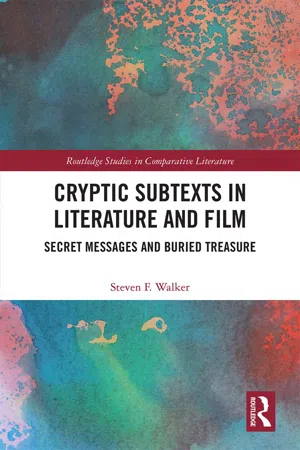
Cryptic Subtexts in Literature and Film
Secret Messages and Buried Treasure
- 208 pages
- English
- ePUB (mobile friendly)
- Available on iOS & Android
eBook - ePub
Cryptic Subtexts in Literature and Film
Secret Messages and Buried Treasure
About this book
Information
1 Provocative Reinterpretations
The effect of the discovery of a cryptic subtext can be said to be intellectually jolting as well as enriching in that, in suggesting a new interpretation of the text, it may partially demolish prior interpretations by providing the text with an enlarged and richer context for hermeneutic investigation. Although Gérard Genette is generally not interested in the hermeneutical value of the study of hypertextuality, I will take a different position over the course of this book and attempt to demonstrate that, at least as regards the detection of the presence of a cryptic subtext, the study of hypertextuality can be closely linked to the process of reinterpretation.
The following rereading of Henry James’s novella The Turn of the Screw provides a nice example of how a new and provocative interpretation can be based on the detection of a cryptic subtext. The cryptic subtext I have detected in this case is the biblical story of Herod’s massacre of innocent children (the Holy Innocents), as found in the Gospel of Matthew.1 Having been told by the three wise men from the East that a child born in Bethlehem would become the King of the Jews, King Herod feared for his throne and ordered the wise men to report back to him when they had discovered the baby boy. But the wise men did no such thing as they had been warned in a dream of Herod’s murderous intentions, and so they left for home without informing Herod of the divine child they had found lying in a manger. Meanwhile, Mary and Joseph, warned by an angel, fled to Egypt with the child Jesus. What happened next? I quote from the King James Version, with which James would have been familiar:
Herod, when he saw that he was mocked of the wise men, was exceeding wroth, and sent forth, and slew all the children that were in Bethlehem, and in all the coasts thereof, from two years and under, according to the time which he had diligently inquired of the wise men.
(Matthew 2.16)
The long prologue (or “frame”) of Henry James’s The Turn of the Screw serves as an introduction to the reading of a manuscript that was providing evening entertainment for some guests staying for the Christmas holiday at the country estate of Bly. It consists of a confession written down years later by someone who, at the time of the events she describes, was a governess only recently employed there. In spite of her youth and inexperience, she had been given chief responsibility for the welfare of her absent employer’s young niece Flora and nephew Miles. This frame can be considered a bit of a teaser for the particular rapport it suggests between a certain Douglas and the narrator of the frame (presumably Henry James himself). But it was something else that first aroused my suspicions: the exasperatingly vague chronology of the dates between which the manuscript is sent for, delivered, and then read out loud. The author’s strange reluctance to provide the exact dates thus constitutes a possible clue. As regards the dates of the starting point of the actual reading out loud of the story to the small audience at Bly, T.J. Lustig2 has suggested three options: December 26, 27, or 28. I will argue for the greater plausibility of assuming that the reading begins on December 27 and that it continues (and probably ends) on December 28. December 28 is the traditional date of the Feast of the Holy Innocents, and it can be argued that it is quite an appropriate date on which to narrate the death (or murder) of the boy Miles. This feast day and the biblical narrative associated with it will turn out to be a cryptic subtext that is real buried treasure when it comes to a reinterpretation of James’s novella.
The Turn of the Screw opens with an account of a ghost story told “round the fire” “on Christmas Eve” (James Stories 435), that is, on December 24, and with the announcement that Douglas, one of the guests, “had something himself to produce” that would be more entertaining than the “not particularly effective” (435) story that had been told before. (The fact that the manuscript of the governess’s autobiographical account of her time spent at Bly in her early youth is announced on December 24, and later proves to have twenty-four sections, ought to be a clue that James is playing around with dates and numbers, although for what reason is not yet clear.) But the actual manuscript will only arrive (“We waited in fact till two nights later” [436]) on December 26 for Douglas does not have it with him at Bly and so must send for it to his home in London. Douglas’s letter to London goes off “the next day” (439), i.e., on December 25. The manuscript reaches him at Bly “on the third of these days” (439), i.e., on December 26, always counting from December 24 as the “first” of “these days” since Christmas Eve was when the existence of the manuscript had first been announced. Douglas only begins to read from the manuscript “on the night of the fourth” (439), i.e., on December 27. The narrator reveals archly, however, that “the whole thing took indeed more nights than one” (442). Now, how many nights might that be? At least two, obviously. Although from this point onward in the text, no more references to specific days are given, and there are no indications as to when Douglass broke off the first evening’s reading, we can assume with certainty that the reading extended at least through the evening of December 28. I have estimated that the reading out loud of the twenty-four sections of the governess’s account would have taken four or five hours, and so, assuming a long winter’s evening reading of two or two and a half hours per evening, the whole reading would have taken two evenings and would likely have ended on December 28, i.e., on the evening of the Feast of the Holy Innocents. Henry James certainly knew of the Feast of the Holy Innocents since in nineteenth century-England, familiarity with the church calendar can be taken for granted among educated people of his generation. In addition, the Feast of the Holy Innocents was one of the “days of Christmas,” i.e., it was an especially well-known feast day.
December 28 is thus a crucial but curiously elided date in the frame’s suspiciously strange fussing over dates. It is the probable date on which is read out loud the governess’s account of little Miles’s death at the end of the manuscript. It is also, for anyone familiar with the feast days of the Christian calendar, and with that of the Church of England more specifically, the day on which the Feast of the Holy Innocents is traditionally celebrated. It is thus a significant date, and it provides a significant cryptic subtext for the reinterpretation of The Turn of the Screw. The Feast of the Holy Innocents (also called Childermas in England) commemorated Herod’s slaughter of the male infants of Bethlehem, and it had been part of the Christian calendar since the fifth century.
After Edmund Wilson, it is common to consider the Governess to be psychologically troubled—if not delusional—and to believe that she accidentally killed the innocent, young Miles while trying to save him from the ghost of Peter Quint for reasons invented by her own feverish imagination. The public reading at Bly of her account of the exact circumstances of Miles’s death occurred long after her death, presumably on the evening of December 28, and, as we have seen, this date suggests a significant cryptic subtext—that of the biblical narrative of the massacre of innocent children as found in Matthew and of the feast day and ritual which derived from it. This cryptic subtext (which James buried deeply—perhaps, as we shall see, for good reason) vindicates the total innocence of Miles, by making him a modern equivalent of one of the slaughtered innocents of the biblical narrative, and assigns to the Governess a genuinely horrific biblical predecessor in the figure of the murderous King Herod. With this subtext in mind, The Turn of the Screw can be taken as evoking a secular commemoration of the traditional religious feast day that is celebrated at Bly via the reading of a confession concerning the slaughter of a modern-day innocent, whose final episode is finished on the very evening of the Feast of the Holy Innocents.3
But why did James bury in the text of his tale clues pointing toward this provocative biblical mythic and ritual subtext? (James himself would later write nothing that would give a glimpse into his original intentions.)4 In order to suggest an answer, it is necessary to examine the accusations that the governess levels at young Miles, especially the charge that he had an ill-defined but possibly improper relationship with the master’s former servant Peter Quint, who had died recently. She believes that the boy is now in danger of being carried off by Peter Quint’s possessive and evil ghost, and that it is consequently her duty to save him from Quint’s clutches and ultimately from eternal damnation. But her more-than-vague sense of the actual relationship that existed between Miles and Peter Quint is colored by her suspicion of largely undefined perversity and furthermore is contaminated by her messianic eagerness to see herself as the boy’s savior. A young, inexperienced daughter of a clergyman, the Governess brings to her job a mind-set which is all too prone to see evil where it is not and to take extreme measures to eradicate it. As the Herod subtext suggests, it is she herself who winds up doing evil (the involuntary murder of the young Miles) out of a tragic ignorance of the real facts of the matter. In the biblical account, King Herod had misinterpreted the title “King of the Jews” to indicate a threat to his throne rather than as a title designating the infant Jesus’s potential for great spiritual leadership; in similar fashion, the governess misinterprets the nature of the relationship between Miles and Peter Quint. In so doing, she has gone over to the dark side, so to speak, for she has projected the shadows of her own troubled mind onto a situation she does not really understand. This tragic ignorance perverts her judgment and leads her to suspect, then to condemn, and finally to become the proximate cause of the death of an innocent young boy. Just before his death, Miles will finally understand the evil dimension of her inquisitorial process, and his last words to her, “you devil!” (James Stories 550), turn the tables on her. In his childlike innocence, Miles clearly sees that the evil is located in her, not in Peter Quint (the same reversal had happened earlier, when the eight-year-old Flora refused to see what the governess wanted her desperately to see and cried out “I think you’re cruel. I don’t like you!” and called on the housekeeper Mrs Grose to take her away forever from the increasingly unhinged Governess) (James Stories 529).
Ever since Edmund Wilson’s essay “The Ambiguity of Henry James,”5 it has been easy to stress how the story can be better read, not as a haunting of two children by two diabolical ghosts (presumably the reading James encouraged his high-minded Victorian readers to make) but rather as the tragic descent into delusional madness of a sexually frustrated governess who is a victim of her own confused mind, and who makes the young Miles a victim of it as well. But initially, this would not seem to be a plausible explanation of the events at Bly many years ago. The story is after all presented as an entertaining ghost story—something James says he was asked for “by the promoters of a periodical dealing in the time-honoured Christmas-tide toy” (James 1992 xlviii) told to a circle of guests gathered around a fire during the “days of Christmas.” It is presented as the counterpart of a story just told concerning the haunting of a child by a ghost, except in this case, the narrator’s friend Douglas suggests that his story—the manuscript he will have brought to Bly in a few days—will be better since it concerns the haunting of two children and will thus have the effect of a double “turn of the screw.” (The title of James’s novella thus alludes to the use of the screw as an instrument of torture—the anticipated effect of the ghost story on the gathering at Bly being a form of titillating torture through its “dreadful—dreadfulness!”) But by the end of the story, it is just possible for the reader—or rereader—to see beyond the entertaining ghost story and to suspect that a terrible tragedy may have taken place, i.e., the governess, without realizing what she was doing, had been acting as a kind of latter-day inquisitor conducting an auto da fe, trying through a process of psychological pressure, terrorization, and torture to wring a confession out of Miles—a confession the boy cannot give because he does not know what she means and cannot see what she tries to make him see—and then to save his soul through an execution that will guarantee his salvation.
Even so, the text provides the governess’s misguided inquisitorial zeal with some attenuating circumstances. Douglas calls her “young, untried, nervous” and suggests that she is quite possibly not up to the challenge of “the serious duties,” the “little company,” and the “really great loneliness” (442) that her position as governess and “supreme authority” (441) at Bly would entail. It may also be granted that her suspicions regarding Miles are not based solely on fantasy. Young Miles had indeed been expelled from school, and the Governess could reasonably suspect that it was because of some accusation of moral turpitude. Corrupted by Peter Quint in some undefined manner, Miles might have gone on to corrupt the young boys who were his classmates, and this might have justified his expulsion. It is only in the last chapter that the governess gets Miles to explain what it was that had actually led to his expulsion, although his answer is evasively imprecise. The dialogue between the two goes as follows:
“Well, I said things.”
“Only that?”
“They thought it was enough!”
“To turn you out for?”
(547)
According to Miles, the “things” he “said” were said only to a few classmates he “liked.” What is clear, in all events, is that it was words and not deeds that got him expelled. At this juncture, the governess begins to doubt—if only for a moment—the plausibility of her dire suspicions and to question her own motives:
Those he liked? I seemed to float not into clearness, but into a darker obscure, and within a minute there had come to me out of my very pity the appalling alarm of his being perhaps innocent. It was for the instant confounding and bottomless, for if he were innocent what then on earth was I?
(548)
In answer to her self-questioning as to who she really is, in which the key word “innocent” appears twice [re: the Holy Innocents], one is tempted to reply, “you are a modern Herod!” But the governess cannot hear us, and so we are powerless to forestall the tragic dénouement, and little Miles dies in her arms—presumably because she smothers him, although James, as usual, is not totally clear about this. What is clear is that, one way or another, the governess had been the proximate cause of Miles’s death.
But, if little Miles were innocent, what did he do that resulted in his expulsion? As we have seen, taking his confession at face value, he did not do forbidden and scandalous things; rather, he said forbidden and scandalous things. The most plausible explanation, it would seem to me, is that he had taught his friends at school some of the working-class slang he would have picked up from Peter Quint. In the class-ridden society of late nineteenth-century England, these “dirty words” would have created a scandal if reported, as they seem to have been, to the masters of a school for upper-class boys. Miles was expelled for violating a linguistic, and not a sexual, taboo. But by the time the Governess begins to realize anything of this, she is too far gone in her zeal to save Miles’s soul from what she believes is Evil in the form of the return of Peter Quint in ghostly form.
But there may be more involved to the governess’s conduct than that which stems from mental confusion and tragic error, and the cryptic subtext suggests the possibility of a more provocative reinterpretation. She is not only an inexperienced young woman of twenty who has been given a job beyond her capacities—to wield absolute control over the little community at Bly. That she has also stepped into the mythic role of a Victorian Herod is something that the cryptic subtext suggests. In such a role she becomes the agent of a cruel Victorian morality that sees the worst in everything and everybody. So, the realization of the presence of the cryptic subtext of Herod’s massacre of the Holy Innocents allows for an even more devastating moral critique of the Governess’s state of mind. She is not merely misguided; she has done something evil—for a while, at least, she has become evil; the manuscript she entrusted only to her friend Douglas is the confession of something that had bothered her conscience for years, although it is not clear that she ever fully realized the moral implications of her actions. It is the cryptic subtext, once its presence is detected, that provides a way of contextualizing with greater clarity and power the evil Herod-like nature of her acts and of her mind.
But why would James have so carefully hidden this buried treasure from his readers? Several reasons are possible. One is the greater esthetic power and effectiveness to be achieved by indirection and ambiguity. Another is the need to keep his first readers at least from suspecting that the author was accusing of dreadful evil-mindedness a character who embodied the Victorian iconic image of a pure-minded young woman and good-hearted governess. A third might be perhaps the need to suggest—but only to suggest—how a tragedy can develop out of the best of good intentions: a delicate moral point that undermines the confident assurance of the Victorian faith in Good overcoming Evil.
But for me the most compelling reason for James to bury the treasure would be related to the fact that The Turn of the Screw was written and published in late 1898, the year after Oscar Wilde was released from prison (May 19, 1897). The memory of Oscar Wilde’s trial was thus still fresh in his and his readers’ minds: on May 25, 1895 Wilde was condemned to two years hard labor—almost a death sentence for someone unused to discomfort and manual labor—for “sodomy” and “gross indecency.” This charge resulted from his homosexual affair with the younger Lord Alfred Douglas (Wilde was around forty and Douglas fifteen years younger) but also from accusations of dalliance with younger lower-class men.6 At his trial Wilde famously defended what the prosecution called “the love tha...
Table of contents
- Cover
- Title Page
- Copyright Page
- Dedication Page
- Table of Contents
- Acknowledgments
- Introduction
- 1 Provocative Reinterpretations
- 2 Myth and Message in Four Linked Texts
- 3 Proust’s Cryptic Mass as Buried Treasure
- 4 Cryptic Platonic Subtexts
- 5 Three Modernist Cryptic Subtexts
- 6 Behind the Camera
- Bibliography
- Index
Trusted by 375,005 students
Access to over 1.5 million titles for a fair monthly price.
Study more efficiently using our study tools.
Frequently asked questions
Yes, you can cancel anytime from the Subscription tab in your account settings on the Perlego website. Your subscription will stay active until the end of your current billing period. Learn how to cancel your subscription
No, books cannot be downloaded as external files, such as PDFs, for use outside of Perlego. However, you can download books within the Perlego app for offline reading on mobile or tablet. Learn how to download books offline
Perlego offers two plans: Essential and Complete
- Essential is ideal for learners and professionals who enjoy exploring a wide range of subjects. Access the Essential Library with 800,000+ trusted titles and best-sellers across business, personal growth, and the humanities. Includes unlimited reading time and Standard Read Aloud voice.
- Complete: Perfect for advanced learners and researchers needing full, unrestricted access. Unlock 1.5M+ books across hundreds of subjects, including academic and specialized titles. The Complete Plan also includes advanced features like Premium Read Aloud and Research Assistant.
We are an online textbook subscription service, where you can get access to an entire online library for less than the price of a single book per month. With over 1.5 million books across 990+ topics, we’ve got you covered! Learn about our mission
Look out for the read-aloud symbol on your next book to see if you can listen to it. The read-aloud tool reads text aloud for you, highlighting the text as it is being read. You can pause it, speed it up and slow it down. Learn more about Read Aloud
Yes! You can use the Perlego app on both iOS and Android devices to read anytime, anywhere — even offline. Perfect for commutes or when you’re on the go.
Please note we cannot support devices running on iOS 13 and Android 7 or earlier. Learn more about using the app
Please note we cannot support devices running on iOS 13 and Android 7 or earlier. Learn more about using the app
Yes, you can access Cryptic Subtexts in Literature and Film by Steven F Walker,Steven F. Walker in PDF and/or ePUB format, as well as other popular books in Literature & Film & Video. We have over 1.5 million books available in our catalogue for you to explore.