eBook - ePub
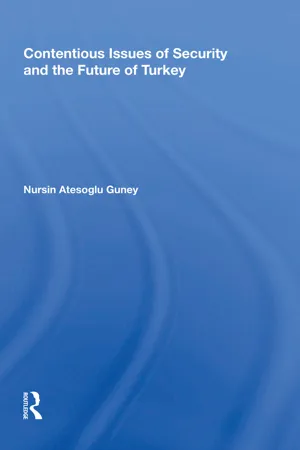
Contentious Issues of Security and the Future of Turkey
- 216 pages
- English
- ePUB (mobile friendly)
- Available on iOS & Android
eBook - ePub
Contentious Issues of Security and the Future of Turkey
About this book
Security is a major contemporary concern, with foreign and security policies topping the agenda of many governments. At the centre of Western security concerns is Turkey, due to its geographical proximity to converging major fault lines such as the Caucasus, the Mediterranean and the Middle East. As trans-Atlantic debates evolve around these major fault lines, future relations will have a direct impact on the re-orientation of Turkish foreign and security policies. This comprehensive study focuses on the future of Turkish foreign and security policies within the emerging strategies of the two Wests. Discussing the challenges Turkey has been facing since the turn of the century, it examines Turkish foreign policy in the context of trans-Atlantic relations - as a global actor, and with respect to conflict, new power relations, energy security, Greece, Cyprus and the environment.
Information
Chapter 1
A Tale of Two Centuries: Continuities in Turkish Foreign and Security Policy
Gokhan Cetinsaya
For about two hundred years, from the late eighteenth until the late twentieth century, the Ottoman Empire and its successor, the Republic of Turkey, faced three prominent challenges. The first was a military and strategic threat posed by the Russian Empire and later by the Soviet Union; from the end of the eighteenth century until the end of the Cold War, the most important concern for Ottoman/Turkish statesmen (except for certain brief periods) was the regional challenge posed by Russia/Soviet Union. The second challenge was the emergence of nationalist ideas and movements in the Ottoman Empire after the French Revolution, first among non-Muslim elements, and then among non-Turkish Muslim elements. This development continued in new forms after the disintegration of the Empire. The third challenge that determined the course of the Ottoman/Turkish foreign policy was Turkey's economic conditions and financial dependence on the West. These three interrelated challenges have determined the foreign and domestic (particularly her pro-Western orientation) policies of the Ottoman Empire and the Republic of Turkey since the beginning of the nineteenth century. They have affected not only Turkey's relations with her neighbours and the West but also her domestic politics through the process of westernisation. This essay seeks to examine the evolution of this pro-Western orientation, and to highlight certain continuities in Turkish foreign and security policy over the last two hundred years.
From the fourteenth to the nineteenth century, the Ottoman Empire governed parts of Europe, and became involved in the continent's affairs. Until the third quarter of the eighteenth century, Austria had been the main enemy and France the main ally. However, in the eighteenth century, the emergence of Russia as a great power brought about a shift in the balance of power, at the expense of the Ottoman Empire (see Naff 1984, 143–169). From the second half of the eighteenth century until 1917, Russia was the most immediate threat. The Ottoman Empire was in decline militarily, and Russia was eager to fill the vacuum that Ottoman weakness had created in the region. There were a series of Russo-Ottoman wars, resulting in the Russian invasion of Ottoman territory in the Balkans, Southeast Europe, and the Caucasus. The Ottomans were persistently defeated by the Russians (with the exception of the Crimean War of 1853–56), and the very heart of the Ottoman Empire, the capital Istanbul, was often threatened by the Russian army (see Kurat 1990; Muratoff 1953).
Starting from the late eighteenth century, Russian advances continued into the Black Sea, eventually reaching it's the western and eastern shores. After Russian victory in the war of 1768–74, the Porte was forced to sign the Treaty of Kucuk Kaynarca in 1774. This gave Russia a foothold on the northern shores of the Black Sea, recognised the independence of the Crimea, which was virtually delivered into the Russian orbit of control, and allowed Russian navigation rights in the Black Sea, as well as handing over to the Russians what they dubiously interpreted as a protectorate over the Orthodox subjects of the Ottoman Empire (see Davison 1976, 463–483). Russia annexed the Crimea in 1783, and, after another war in 1787–92, captured further territory between the rivers Dniestr and Bug.
During the turbulent diplomatic events and wars in the period following 1789, especially those between 1799 and 1812, the Ottomans, instead of pursuing the old policy of non-involvement in Europe, entered the European power alliances and became part of the continental state system. Although Ottoman Empire was weak in comparison with the European Great Powers, it remained a significant international actor whose independent decisions could materially influence the interests and behaviour of more powerful states (see Anderson 1966, 28–52). In the 1828–29 war with Russia, Ottoman forces were defeated and Edirne, located some 250 kilometres west of Istanbul, was captured by the Russians. Due to an epidemic in the army and a fear of a major European war, the Russians did not advance to Istanbul. Instead, Russia preferred to preserve a weak Ottoman Empire along its southern border as a buffer state for the coming decades.
In the 1830s, especially during the Egyptian crisis (1831–41), considerations of defence and security became crucial in Ottoman thinking. Although the Ottoman state initiated a series of military reforms in order to cope with the Russian and other military threats which had arisen at the end of the eighteenth and beginning of the nineteenth century, it was soon acknowledged that the Ottoman army was in no state to cope with the Russian army or any other modern army, for several internal reasons. It was thus the military defeats at the hands of Russia and Egypt that forced the Ottomans to change their foreign and security policy.
The stated aim of the Ottoman statesmen was the survival and territorial integrity of the Empire. Throughout the nineteenth century, the principal threats were in three main zones of conflict: the Balkans (from national movements aided by Russia); along the straits of the Bosporus and Dardanelles (from Britain and Russia), and; Egypt and the rest of the Arab provinces (again, threatened by Britain and France). Ottoman statesmen were well aware of the fact that the Empire was militarily too weak to tackle these threats and effective diplomacy was thus regarded as an essential guarantee of the Empire's survival. It was duly accepted that a war for territory against major European powers could not be won, unless supported by one or more of the others. The Empire thus had to resort to diplomatic manoeuvring, rather than risk unaided military resistance to any major European power. They attempted to exploit the balance of power between the Great Powers and exploit the rivalries, especially that between Britain and Russia. In terms of diplomacy, which was seen as the key to survival, two different approaches to the threats posed by the Great Powers were considered throughout the nineteenth century: one was to avoid both conflict and close alliances by taking advantage of the balance of power system itself; the second was to establish a reasonably stable alliance with one or more of the European powers; in other words, an alliance with a power or combination of powers against the enemy (see Hale 2000, 13–43).
In the Tanzimat period (1839–76), Ottoman statesmen opted to pursue the second approach. The fact that the Ottoman Empire was no match for Russia unless it was supported by one of the other European powers was widely accepted. Military and bureaucratic reforms needed time and power and until such time, the existing international situation had to be taken advantage of. This dilemma forced Ottoman statesmen to revise the traditional diplomacy in favour of a new type based upon cultivating relations with Britain and France and, to some extent, Austria.
At the same time, to compliment the pro-Western orientation in foreign policy, the Ottomans launched the Tanzimat, in order to reform and survive in the age of nationalism and imperialism. The state underwent a period of westernisation in political, social, legal, and economic fields. As proclaimed in 1839, the Tanzimat reforms promised an overall reorganisation in every institution of state and society, from a more orderly tax collection to a fair and regular system of military conscription, and from a reform in education to a radical reorganisation of the justice system. The proposed reforms were partially based upon European models, and initiated an unprecedented, though slow, process of institutional and cultural 'westernisation.' In another respect, too, the Islamic and Ottoman tradition was partially severed, with the promise of civil equality for the Empire's non-Muslim subjects. The westernizers of the Tanzimat believed that the Ottoman Empire could be saved only by being integrated into the Western political and economic system. It would be wiser for the Empire to join, rather than resist, Europe and would also benefit from joining the world economic system. In order to recruit their assistance in the struggle against Russia, the Porte offered the British certain financial incentives, so as to create a stronger bond (see Davison 1973).
During the Tanzimat period, Britain (and France and Austria at times) emerged as the main supporter of the Ottoman Empire against Russia. From 1838 onwards, the protection and strengthening of the Ottoman Empire as a shield against Russia became the first priority of British strategy in the Near East and Eurasia. This policy reached its climax during the Crimean War of 1853–56, where Russia was defeated by coalition forces composed of Britain, France, and the Ottoman Empire. Under the Treaty of Paris, signed in March 1856, the territorial integrity and independence of the Empire was guaranteed, and the Porte was invited to 'participate in the advantages of the public law and system (concert) of Europe' (see Anderson 1970, 81). The Ottoman Empire was thus formally admitted by treaty into the European state system, and her European Great Power status recognised. The continuation of this recognition has ever since remained one of the Ottoman/Turkish state's core foreign policy goals.
The Treaty of Paris led to a period of calm in the Empire’s relations with the European powers, lasting until 1875. There were internal crises in the Balkans and Syria and Lebanon but no international crises. The Great Eastern Crisis of 1875-77, however, was followed by a war with Russia (1877–78), during which Russian troops penetrated deep into the Balkans and Eastern Anatolia; by the end of January 1878, Russian troops had reached the outskirts of Istanbul (see Anderson 1966, 178-219). The British declared their opposition to a Russian occupation of Istanbul and subsequently sent their fleet to defend the Ottoman capital. However, the Russians forced the Ottoman government to accept their own peace conditions and the Treaty of San Stefano, creating an enlarged state of Bulgaria, was signed in March 1878. As a result of British pressure and threats, the Russians agreed to submit the Treaty of San Stefano to an international congress in Berlin. In the meantime, the British guaranteed protection of eastern Anatolia, receiving the lease for Cyprus in exchange. The Congress of Berlin met in June 1878, and reduced the frontiers of the new Bulgarian state, placed Bosnia-Herzegovina under Austro-Hungarian occupation, and confirmed the cession of Batum, Kars, and Ardahan along the Caucasian border to Russia (see Anderson 1970, 108–112). With the Berlin settlement, the Ottoman Empire lost, in one stroke, one fifth of its population and two fifths of its territory.
Taking into consideration the lessons of the Tanzimat foreign policy and the new international system which had been in force since 1871, Sultan Abdulhamid II (1876–1909) sensed that, as a result of the Treaty of Berlin, his empire needed to immediately seek a new foreign policy. Preoccupied with the Empire's vulnerability to the influence of the European Great Powers, Abdulhamid's primary foreign policy objective was to defend the Empire's independence and territorial integrity. He feared not only a military attack from the outside, but also from within, via the Powers' 'peaceful penetration' strategy, manifested, for example through the establishment of 'zones of influence' which could ultimately lead to partition, as had occurred in Egypt and India. Abdulhamid's success in preserving the Empire's integrity and independence for thirty years must be attributed primarily to his diplomacy. He reached the conclusion that the Ottoman Empire was exposed to too many potential foes in too many quarters; and that conflict could easily develop into a major war against numerous enemies and destroy the Empire. His foreign policy was one of moderation and neutrality towards the rival Great Powers. As he believed no Great Power alliance could protect the Ottoman Empire and that it was unwise to take sides in Great Power conflicts, he avoided peacetime alliances with them and maintained an overall diplomatic stance of 'neutrality' or 'non-commitment' and distanced the Empire from its former protector, Great Britain and harmonized relations with the Empire's traditional enemy, Russia, initiating the longest period of peace in Russo-Ottoman relations since the Treaty of Kucuk Kaynarca (1774). He also initiated a series of close ties with Germany in order to restrain Britain and Russia (see Yasamee 1993, 20–36; Yasamee 1999, 223–232; Yasamee 1996). The strategy of neutrality and moderation did prove successful, at least until the late 1890s, but its success depended upon the existence of Great Power divisions and balances which the Ottoman Empire was able to manipulate: Russia and Britain competing for supremacy on the Straits, Russia and Austria-Hungary vying for primacy in the Balkans, Britain and France clashing in Egypt, and France and Italy competing in North Africa. After 1897, these securities disappeared, and reduced the Sultan's freedom of manoeuvre: Austro-Hungary and Russia agreed on the Balkans, Italy drew closer to France, and Britain and Russia signed an alliance in 1907.
The Young Turks, or the Committee of Union and Progress (CUP), which came to power in 1908, partly as a reaction to Abdulhamid's policies and partly as a response to the new international system after 1907, adopted a new foreign and security policy. The main aim was a defensive foreign policy and rapprochement with the Entente Powers (Britain, France and Russia). In order to save the territorial integrity of the Empire, the CUP (1908–1918), which, after the traumatic effect of the Balkan Wars (1912–13) on the Turkish political and military elites, was convinced that only an alliance with Britain and the Entente could guarantee the survival of what remained of the Empire, tried to seek support from London and Paris, but this proved impossible for the Great Power politics of the time, and by the start of the First World War, Turkey had failed to fulfil its objectives. The CUP leaders were convinced that neutrality would be disastrous for Turkey since it would leave her isolated and at the mercy of the belligerent states. In the end, the CUP formed an alliance with Germany and entered the war (see Kent 1984; Yasamee 1995, 229–268).
During the First World War, the Ottoman Empire faced hostilities in eastern Anatolia against the Russians and in Mesopotamia, Arabia, and Palestine against the British and their allies. Although they successfully resisted an armada of British-French naval and land forces in the Dardanelles in 1915, they were less successful in other areas: the Russians penetrated deep into eastern Anatolia and the British captured Baghdad, Palestine and Syria. Throughout the war, the Allies signed a number of agreements for the partition of the Ottoman Empire. As a result of the Anglo-Franco-Russian agreements of March–April 1915 (known as the Constantinople Agreement), Britain and France agreed that 'the question of Constantinople and the Straits' would finally be solved by annexing the area into the Russian Empire. Under the Sykes-Picot agreement of April-October 1916, Russia was also given most of eastern Anatolia (including Erzurum, Trabzon, Van and Bitlis), with France to receive Syria and Clicia and Britain to gain control of Palestine and Mesopotamia in exchange (see Fromkin 1991). By 1917, Russian forces occupied territories east of the Trabzon-Van line. The Ottomans/Turks should have been grateful to the Bolshevik revolution of 1917 as the Ottoman army was only able to regain eastern Anatolia after Russian forces had evacuated as a result of the outbreak of revolution at home. As a consequence of Russia's withdrawal from the war, arrangements with Russia, including the Constantinople Agreement, were annulled.
After the Armistice of Mudros on October 30, 1918, Britain, France and Italy submitted their respective demands, based on previous agreements, to the Paris Peace Conference and began to occupy several parts of Anatolia. The peace treaty with Turkey, known as the Treaty of Sevres, dated 10 August 1920, was extremely severe; not only did it strip the Ottoman Empire of all its Arab provinces, it also deprived the Turkish government control of the Straits, as well as create an independent Armenian state and envisage future Greek control of western Anatolia. The Turkish nationalists, led by Mustafa Kemal (Ataturk), organized an armed resistance movement against the Allies' occupation and successfully fought the Greeks, French and Italians in western and southern Anatolia (see Mango 1999; Oran 2001a, 95–238; Hale 2000, 44–78).
With the Bolshevik revolution a new chapter was opened in the history of Russian-Turkish relations. Although Mustafa Kemal's ideas had little in common with the socialism of the Bolsheviks, Ankara and Moscow were brought together by a common fear of the Western Powers, especially Britain, and a common resentment towards the Treaty of Sevres. The Soviet-Turkish Treaty of Friendship (16 March 1921) marks the culmination of the rapprochement between the two governments (see Gokay 1997). The new government in Ankara became a natural ally of the Bolsheviks and a special relationship based on mutual interests was developed, culminating in the Treaty of Friendship and Neutrality (17 December 1925). This friendly atmosphere lasted (though with a cooling trend) until the outbreak of World War Two.
The Lausanne Peace Treaty of July 1923, despite partially fulfilling the deman...
Table of contents
- Cover
- Half Title
- Title
- Copyright
- Contents
- List of Tables and Appendices
- Notes on Contributors
- Preface
- List of Abbreviations
- Introduction
- 1 A Tale of Two Centuries: Continuities in Turkish Foreign and Security Policy
- 2 Transatlantic Relations and Turkey
- 3 Turkey's Potential (and Controversial) Contribution to the Global 'Actorness' of the EU
- 4 A Retrospective Analysis of Turkey-United States Relations in the Wake of the US War in Iraq in March 2003
- 5 The 'Iraq Factor' in Turkey, EU and US Triangle since 9/11
- 6 The Limits of Change: Turkey, Iran, Syria
- 7 The New Power Calculations and 'Structured' Relations in the Fluctuating Security Environment of Eurasia
- 8 Turkey and the Greater Black Sea Region
- 9 Twenty First Century Energy Security Debates: Opportunities and Constraints for Turkey
- 10 Mediterranean Fault Line — The Future of Greece and Turkey
- 11 Cycles of Transformation of the Cyprus Question
- 12 The New Security Environment and Turkey's ISAF Experience
- Conclusion
- Index
Trusted by 375,005 students
Access to over 1.5 million titles for a fair monthly price.
Study more efficiently using our study tools.
Frequently asked questions
Yes, you can cancel anytime from the Subscription tab in your account settings on the Perlego website. Your subscription will stay active until the end of your current billing period. Learn how to cancel your subscription
No, books cannot be downloaded as external files, such as PDFs, for use outside of Perlego. However, you can download books within the Perlego app for offline reading on mobile or tablet. Learn how to download books offline
Perlego offers two plans: Essential and Complete
- Essential is ideal for learners and professionals who enjoy exploring a wide range of subjects. Access the Essential Library with 800,000+ trusted titles and best-sellers across business, personal growth, and the humanities. Includes unlimited reading time and Standard Read Aloud voice.
- Complete: Perfect for advanced learners and researchers needing full, unrestricted access. Unlock 1.5M+ books across hundreds of subjects, including academic and specialized titles. The Complete Plan also includes advanced features like Premium Read Aloud and Research Assistant.
We are an online textbook subscription service, where you can get access to an entire online library for less than the price of a single book per month. With over 1.5 million books across 990+ topics, we’ve got you covered! Learn about our mission
Look out for the read-aloud symbol on your next book to see if you can listen to it. The read-aloud tool reads text aloud for you, highlighting the text as it is being read. You can pause it, speed it up and slow it down. Learn more about Read Aloud
Yes! You can use the Perlego app on both iOS and Android devices to read anytime, anywhere — even offline. Perfect for commutes or when you’re on the go.
Please note we cannot support devices running on iOS 13 and Android 7 or earlier. Learn more about using the app
Please note we cannot support devices running on iOS 13 and Android 7 or earlier. Learn more about using the app
Yes, you can access Contentious Issues of Security and the Future of Turkey by Nursin Atesoglu Güney,Nursin Atesoglu Guney in PDF and/or ePUB format, as well as other popular books in Politics & International Relations & International Relations. We have over 1.5 million books available in our catalogue for you to explore.