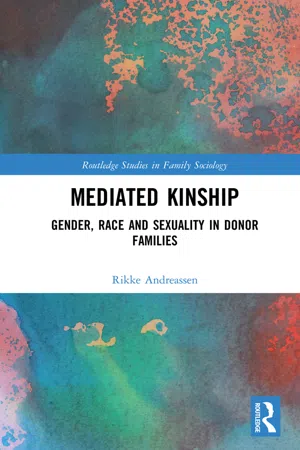
Illustrating the fascinating intersections of online media and new kinship, this book presents a study of the increasing numbers of single women and lesbian couples reproducing by using donor sperm. It explores how they connect with each other online, develop intimate digital communities and, most importantly, locate their children's hitherto unknown biological half-siblings, throughout the world. The author discusses how these new families - consisting of only mothers - engage in extended families involving large numbers of 'donor siblings'. The new families challenge previous understandings of kinship, and provide illustrations of how norms of gender, sexuality and family are challenged, negotiated and maintained in contemporary times. A crucial study of contemporary formations of family, gender and race, Mediated Kinship discusses the racial aspects of the world's largest sperm bank exporting Danish sperm (termed 'Viking sperm'), and explores the narratives of whiteness and imagined racial superiority that circulate among mothers, as well as the racialisations accompanying commercial online sperm sales. By analysing contemporary families of donor-conceived children in the context of legislation, reproduction technologies and online media, the book will appeal to scholars across the social sciences with interests in race and ethnicity, whiteness, gender, sexuality, kinship and the sociology of the family.
- 190 pages
- English
- ePUB (mobile friendly)
- Available on iOS & Android
eBook - ePub
About this book
Information
1Introduction
Motherhood and the Web 2.0
Queer reproduction and the Internet
In the mid-2000s, I began to think about having children. I identified as a queer woman living in a lesbian relationship and, at the time, access to medically assisted reproduction (MAR) was prohibited for lesbians in my home country (Denmark). Only women in a heterosexual marriage (or long-term heterosexual relationship) were allowed treatment in fertility clinics, and, thus, allowed to reproduce at the state’s expense. Of course, both lesbian and single women have had children for decades – many from a (previous) heterosexual marriage or more casual encounters, and others from an arrangement with a gay man (or men) to form a family. As I was reviewing my options, including meeting with various gay men to discuss the possibility of forming a family together, the law was changed (in 2006/2007) to provide lesbians and single women free access to fertility treatments on par with the treatments available to coupled heterosexual women. This exposed me (and other women in my situation) to a new world of options. Suddenly, we (women not in a relationship with a man) were invited into a reproductive world involving large selections of donor sperm and medical assistance to conceive.
Previously, lesbian reproduction was a demanding affair, requiring either significant financial means (to pay for sperm and services at a private fertility clinic that could manage to get around the prohibition) or the resources to find a man who could contribute sperm and arrange for home insemination. With the new law, reproduction was transformed into a professional service that enabled lesbians (and single women) to pick and choose sperm and gave them various options for conceiving. This led to a baby boom for lesbians at the end of the 2000s and well into the 2010s, which was followed by a baby boom for single women from the 2010s onwards (Statistics Denmark, 2017). Importantly, free access to MAR meant that the baby boom was very inclusive across social classes, enabling a wide and diverse spectrum of women to become mothers. To me, the legislative change and the baby boom it accompanied – which I became a part of – meant that I went from planning to have children in a context heavily dominated by heterosexual families to suddenly giving birth in a context in which a number of alternative families were popping up. It seemed as if the family landscape was changing from an endless sea of heterosexual families to much more diverse scenery, consisting of lakes of lesbian families, streams of solo mothers and puddles of rainbow families involving gay men and lesbian women (or gay men and single heterosexual women). Personally, I embraced this change with enjoyment.
Around the same time (2007), I created my first Facebook account. Simultaneously with – but independent of – the queer baby boom, Facebook exploded as a social media site.1 I began to use the site to connect online with friends, family and colleagues, exchanging news, photos and ‘pokes’. Within the next few years, my network of friends expanded to include more distant friends and colleagues, and I joined an increasing number of Facebook groups.
The boom in alternative families was mirrored in the emergence of Facebook groups targeting ‘rainbow families’, ‘lesbian mothers’, ‘solo mothers’, ‘gay fathers’ and similar communities. With 3.7 million Danish subscribers, Facebook is one of the most popular social media sites in Denmark: within the Danish population of 5,711,837 (2017), Facebook penetration is 65% (Internet World Stats, 2017). It is therefore not surprising that Facebook is the platform on which many alternative families connect and create groups to cater to specific family constellations.
One of the effects of Denmark’s new reproductive legislation was that many lesbians chose to conceive via donor sperm from sperm banks. Sperm banks offered easy access to a variety of sperm, whereas previously, lesbian women could only conceive via (gay) friends and acquaintances or had limited access to sperm banks. As would logically follow, a number of Facebook groups gathering the mothers of donor-conceived children were created.
Donor sperm figure into three categories: anonymous donor sperm, extended donor profile sperm and open donor sperm. With an anonymous donor, the parent(s) and future child have access to only limited information about the donor, such as race, height, weight, hair colour and eye colour. With an extended profile donor, the family has access to a more detailed donor profile, which includes information about the donor’s education, medical health, artistic abilities and so forth. With an anonymous donor, the future child never obtains any information about the donor’s identity; in contrast, with an open donor, the future child can retrieve information about the donor’s identity when she or he turns 18 years old. Extended profile donors fall into two categories: one in which the donor remains anonymous and another in which the identity of the donor can be released when the child turns 18. When a woman conceives via donor sperm, she cannot know the identity of the donor. Instead, she receives a ‘donor number’, which tells her that she conceived via (for example) donor no. 517. Equipped with both a donor number and access to online media platforms such as Facebook, on which several groups exist to facilitate contact between parents of donor-conceived children, many parents have begun to connect with parents of children conceived from the same donor (i.e. their child’s ‘donor siblings’). For some parents, these connections have developed into close relations, enabling new types of families and kinship.
When I first encountered lesbians and solo mothers engaging with each other online and forming new extended families via donor siblings, I was amazed. Firstly, I realised that a number of women were reproducing without men; secondly, I discovered that they were connecting with one another and creating new extended families. The women, their children and their connections allowed for new contours of kinship and invited new structures of family and parenthood. Furthermore, the new extended families were very international. Denmark is a great exporter of donor sperm. For example, the world’s largest sperm bank, Cryos International, is Danish and exports sperm to all parts of the world. Connections between donor-conceived children are therefore very international, and social media sites that connect families with donor-conceived children have members from various parts of the world.
My personal encounter with queer motherhood and Web 2.0 communication formed the focal point of this book. Through these experiences, I became interested in researching the ways in which media technologies – in particular social media sites such as Facebook – facilitate new kinds of kinship. I wanted to explore how this new baby boom – caused by women reproducing without men – and the online connections between donor families that accompanied the boom have challenged and expanded our understandings of family and gender. This book explores the meeting of queer motherhood (involving women who reproduce without men) and social media sites (in particular, Facebook). It asks the questions: What happens when lesbian mothers and heterosexual solo mothers meet on the Internet? How do they negotiate family, sexuality and gender? Do they dismantle traditional family norms or cultivate fantasies of forming nuclear families? And what are the effects on biology and racial formation when donor sperm is acquired commercially? These and many more questions are investigated in this book, which situates itself in a Scandinavian context but branches out to many other countries and contexts.
I was very optimistic at the beginning of my research; I even envisioned how the women’s reproduction and connections with each other might dismantle the nuclear family as an ideal – or at least seriously challenge and destabilise it. However, while this book does illustrate how the nuclear family is being challenged, it also documents that it is not in danger of becoming extinct. Rather, it is still being upheld as an ideal – in both lesbian families and solo mother families.
Alternative families today
Currently, almost one out of every ten babies born in Denmark is the result of a fertility treatment (Okkels, 2014). There are multiple reasons for this high number. One reason is the low sperm quality of many Danish men (Jørgensen, 2012, p. 8; Jørgensen et al., 2001, p. 1015 f.). Another reason is the liberal Danish law, which provides Danish lesbian couples and single women with state-funded fertility treatment. It is estimated that about 1% of mothers in the Danish national birth cohort are solo mothers (Ravn, 2017, p. 20; Salomon, Sylvest, Hansson, Andersen and Schmidt, 2015, p. 273). The proportion of lesbian families is harder to estimate, as the statistics only include women registered as married (to another woman) or in a civil union (with another woman); the large number of lesbian couples who live together without being formally married or in a registered civil union are not recorded, nor are the (fewer) lesbian couples who do not co-habit. Almost 0.3% of the national birth cohort are registered as having mothers who are a (married or civil unionised) same-sex couple (Statistics Denmark, 2017; Vesterholm Lind, 2017). Most likely, the actual number is much higher – probably at least twice as high – as Danes have a strong tradition of having children before getting married: almost half (48%) of all heterosexual couples who had children in 2017 were not legally married, but ‘only’ co-habiting (ibid.)
The local and the global intersected in my research. While my geographical context was Denmark, it quickly became clear that connections between families with donor-conceived children were international – both because social media has a global reach and, more importantly, because donor sperm is circulated globally. In addition to Cryos International, another Danish sperm bank, Nordic Cryobank, with its sub-branch European Sperm Bank, also exports donor sperm internationally. Danish intended mothers use donor sperm from these banks, just as a number of intended mothers in various other countries do. Lesbians are denied access to assisted reproduction technologies (ART) and MAR in more than half of all European nations, and single women are denied access to ART and MAR in half of all European nations (Präg & Mills, 2017, p. 298). As a result, many lesbians and single women travel to Denmark to undergo fertility treatment or buy Danish sperm from a Danish sperm bank. In contrast to most European countries, which prohibit anonymous donor sperm, Denmark allows both open and anonymous donor sperm. This leads many women with access to MAR in their home country to travel to Denmark for fertility treatment with anonymous sperm. For this reason, as families with donor-conceived children begin to search for one another, many of them discover ‘donor relatives’ in other countries.
Many women who conceive via donor sperm undergo fertility treatment in a private or public fertility clinic; a lesser number of women perform home insemination.2 Within kinship studies, the term ‘assisted reproduction technology’ (ART) is often used to describe treatments used to achieve pregnancy. Medically speaking, ART is defined as any reproductive treatment involving in vitro handling of oocytes, sperm and embryos (such as in vitro fertilisation (IVF), embryo transfer, gamete and embryo cryopreservation, gestational surrogacy, etc.). Thus, ART involves ‘out of the body’ treatments and does not include insemination with sperm, as that is an ‘into the body’ treatment. Most of the women in this study became pregnant via insemination with donor sperm at a fertility clinic. In this book, I therefore use the term ‘medically assisted reproduction’ (MAR) to describe their specific reproduction. MAR includes all kinds of fertility treatments, including ‘in body’ treatments such as intrauterine insemination (IUI) (i.e. insemination in which sperm is inserted directly into a woman’s uterus), which is the most common form of insemination at clinics. ARTs are often considered high technological fertility treatments, whereas insemination is considered a low technological treatment (Ravn, 2017, pp. 22, 309). I use both terms (ART and MAR) when describing general reproductive laws and regulations or debates about such laws, as they often intersect in legislation and debates about legislation.
Lisa C. Ikemoto notes that the term ‘donation’ frames commercial egg and sperm procurement as an altruistic gift, rather than a financial purchase (Ikemoto, 2010, p. 245 f.). As a result, ‘[the term donation] positions commercial egg [and semen] procurement outside the ethical prohibition on treating humans and human body parts as property’ (ibid., p. 146). Similarly, Daisy Deomampo argues in favour of using the term ‘provider’ instead of ‘donor’, in order to underscore the financial and commercial aspects of gamete donation (Deomampo, 2016, p. 306). While I agree with Deomampo’s and Ikemoto’s concern about masking the commercial sale that accompanies gamete donations/transactions by not naming it – and the importance of underscoring this commercial aspect – I use the term ‘donor’ throughout this book. All of my interviewees used the terms ‘donor’ and ‘donation’, and in order to represent their voices and render their family descriptions verbally visible, I chose to reproduce their terms. I therefore also apply terms such as ‘donor families’, ‘donor siblings’ and ‘donor children’, as these terms were used by most informants; I also use the term ‘donor-conceived children’ to describe the children conceived via donor sperm. I do, however, underscore the commercial aspects of sperm donation in Chapter 4 (‘Race and reproduction’).
The Facebook Donor Group
Empirically, I studied one particular Facebook group (referred to as the ‘Facebook Donor Group’ in this book), which aims at connecting donor-conceived children and their families. The group is Danish-based but Scandinavian in scope, hosting members from Denmark, Sweden and Norway, as well as Finland, Germany, the Netherlands and the US. I joined the group a few years after my first daughter was born, as I was interested in the group’s discussions and knowledge sharing about living in an alternative family. Besides connecting donor-conceived children and families, the group acts as a forum for discussions about living in a lesbian family or being a solo parent, and I was interested in this knowledge sharing between alternative families. Personally, I had ended up conceiving via sperm from a gay male friend. I had seriously considered using commercial donor sperm, and still feel that I might as well have boarded my journey to family making in this way, but my partner was more invested in forming a family with a gay friend. Had she been more invested in conceiving via donor sperm, I think we would have done so. In other words, I was not particularly invested in either model, I just wanted children. Today, we have two children, each conceived with sperm from (two different) gay male friends.
As a member of an alternative family, I was happy to engage in discussions in the Facebook group; these discussions were characterised by knowledge sharing and support, so it was a friendly group to be a part of. After a year or so, I began to think about researching the merging and meeting of alternative families and social media, and considered using the Facebook Donor Group for research, in addition to personal engagement. My analysis of the group therefore builds on years-long participatory observation (Emerson, Fretz & Shaw, 2001; Kozinets, 2015). When I became interested in conducting research within the group, I posted a message on the group’s Facebook ‘wall’ that explained my position and invited members for interviews. By doing so, I made my research interest public to the group. I received solely positive comments from members about this ‘coming out’ as a researcher.
In order to protect the anonymity of group members in this book, I refer to the Facebook group as the ‘Facebook Donor Group’ instead of using its real name, and I replace all members’ names with a fictional name associated with the same nationality, social class and ethnicity. In addition, I replace birth dates, geographical locations and other potential identity markers with similar substitutes, and I ensure the anonymity of all donors by using substitute donor numbers. Finally, while all Facebook discussions analysed in this book took place between 2014 and 2016, I do not include the exact dates of the discussions, as they are not important for the analysis and omitting these details contributes to securing the members’ anonymity.
The Facebook Donor Group is large, with more than 3,000 members. The absolute majority are women, but the group also includes a few men. Most of the women are solo mothers. I use the term ‘solo mothers’ (rather than ‘single mothers’ or ‘single mothers by choice’), as I want to distance solo motherhood from the negative association of singlehood. In our society, being single is often framed negatively as representing a void or a lack, and thus a non-desirable state of being. I wish to remove this potential negative stigma from the mothers who create families on their own. By labelling them solo mothers, I hope to provide them with more agency and power, and thus to frame their motherhood as a positive choice (as opposed to a ‘second best’ option) for reproduction. In the group, most of the solo mothers are heterosexual; but a number of solo mothers identify as lesbian or queer. The Facebook Donor Group also includes large numbers of women in lesbian relationships and lesbians who have divorced from their wives and are now raising children with their ex-wives. I refer to these women as ‘lesbians’, as this is the term they most often use to refer to themselves in the group’s discussions, and the term my interviewees most frequently used. I acknowledge that some women in the group may be involved sexually and/or romantically with other women but do not self-define as a lesbian, just as I acknowledge that there might be individuals in the group who do not self-define as a ‘woman’. However, in this book, I use the term ‘lesbian’ as a common denominator for women in a relationship with a woman and the term ‘woman’ as an overall term, because these terms are consistent with those that were employed by my informants. Finally, the group includes a number of individuals who themselves are donor-conceived; many of these are young adults.
Empirically, this book is based on qualitative analysis of the Facebook Donor Group and in-depth interviews with 11 individuals who were active within the group. This stands in contrast to a large proportion of research on donor families, which is carried out via questionnaires (Blyth, Crawshaw, Frith & Jones, 2012). While some questionnaires include open-ended questions and thus involve qualitative research (e.g. Freeman, Jadva, Kramer & Golombok, 2009), the majority of research on donor families is quantitative. For the present study, all interviews were conducted during 2015. The interviewees were found via advertisements placed on the Facebook Donor Group wall, and the interviewed women represented different family forms: three women were heterosexual solo mothers, one was a lesbian solo mother, three were divorced lesbians and shared child(ren) with their ex-partners, two were in a lesbian relationship and two were donor-conceived. Demographically, they inhabited the capital, small cities and rural areas; their ages ranged between early 20s and early 50s. Educationally, most had a professional bachelor’s degree, one had a university degree, one was a university student and some had no formal education. The majority identified as white, while a few identified as women of colour. While the interviews cannot claim to be representative of the whole Facebook Donor Group, they do provide insight into the practices and experiences of the larger group. Similarly, the women’s families, social classes, racial identifications, ages and demographic settings seemed to mirror the distribution within the Facebook Donor Group as a whole. To date, most research on donor families has been carried out in a US context (Blyth et al., 2012), where the legal system and fertility industry is different. The l...
Table of contents
- Cover
- Half Title
- Series Information
- Title Page
- Copyright Page
- Contents
- Acknowledgements
- 1 Introduction: Motherhood and the Web 2.0
- 2 Creating family
- 3 The missing father
- 4 Race and reproduction
- 5 Community and new scripts of family
- 6 Conclusion: Expansion within limits
- References
- Index
Trusted by 375,005 students
Access to over 1.5 million titles for a fair monthly price.
Study more efficiently using our study tools.
Frequently asked questions
Yes, you can cancel anytime from the Subscription tab in your account settings on the Perlego website. Your subscription will stay active until the end of your current billing period. Learn how to cancel your subscription
No, books cannot be downloaded as external files, such as PDFs, for use outside of Perlego. However, you can download books within the Perlego app for offline reading on mobile or tablet. Learn how to download books offline
Perlego offers two plans: Essential and Complete
- Essential is ideal for learners and professionals who enjoy exploring a wide range of subjects. Access the Essential Library with 800,000+ trusted titles and best-sellers across business, personal growth, and the humanities. Includes unlimited reading time and Standard Read Aloud voice.
- Complete: Perfect for advanced learners and researchers needing full, unrestricted access. Unlock 1.5M+ books across hundreds of subjects, including academic and specialized titles. The Complete Plan also includes advanced features like Premium Read Aloud and Research Assistant.
We are an online textbook subscription service, where you can get access to an entire online library for less than the price of a single book per month. With over 1.5 million books across 990+ topics, we’ve got you covered! Learn about our mission
Look out for the read-aloud symbol on your next book to see if you can listen to it. The read-aloud tool reads text aloud for you, highlighting the text as it is being read. You can pause it, speed it up and slow it down. Learn more about Read Aloud
Yes! You can use the Perlego app on both iOS and Android devices to read anytime, anywhere — even offline. Perfect for commutes or when you’re on the go.
Please note we cannot support devices running on iOS 13 and Android 7 or earlier. Learn more about using the app
Please note we cannot support devices running on iOS 13 and Android 7 or earlier. Learn more about using the app
Yes, you can access Mediated Kinship by Rikke Andreassen in PDF and/or ePUB format, as well as other popular books in Social Sciences & Sociology. We have over 1.5 million books available in our catalogue for you to explore.