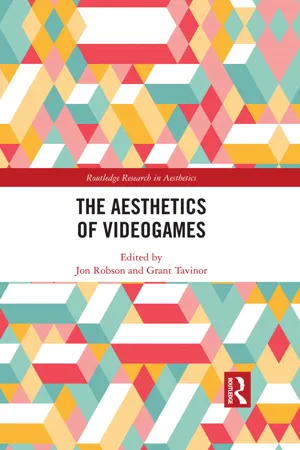
This collection of essays is devoted to the philosophical examination of the aesthetics of videogames. Videogames represent one of the most significant developments in the modern popular arts, and it is a topic that is attracting much attention among philosophers of art and aestheticians. As a burgeoning medium of artistic expression, videogames raise entirely new aesthetic concerns, particularly concerning their ontology, interactivity, and aesthetic value. The essays in this volume address a number of pressing theoretical issues related to these areas, including but not limited to: the nature of performance and identity in videogames; their status as an interactive form of art; the ethical problems raised by violence in videogames; and the representation of women in videogames and the gaming community. The Aesthetics of Videogames is an important contribution to analytic aesthetics that deals with an important and growing art form.
- 236 pages
- English
- ePUB (mobile friendly)
- Available on iOS & Android
eBook - ePub
The Aesthetics of Videogames
About this book
Information
1
Introduction
Videogames are perhaps the most significant development in the modern popular arts, and they provide a fertile field of study for philosophers of the arts (and philosophers more generally). This volume presents the reader with the first anthology exclusively devoted to the philosophical examination of the aesthetics of videogames. Not only do videogames have bearing on a range of standard aesthetic issues, they also raise entirely new topics of concern for philosophically inclined aestheticians. These topics range from the ontology of videogames, the nature of videogame interactivity, the ethics of videogame violence, and the aesthetics of game design and gameplay. While the papers in this volume offer a wide and even conflicting range of perspectives on these issues, their authors are united in the belief that there are important philosophical lessons to be learned from the in-depth study of videogames, and that philosophical aesthetics can make important contributions to the understanding of videogames.
It will hardly surprise the reader to learn that serious philosophical interest in videogames is a recent phenomenon. Videogames themselves are, after all, a very new art form. There is no uncontroversial date for the earliest videogame, but estimates typically vary from the mid-1940s to the early 1960s. By contrast, philosophers of art working in areas such as theatre, music, dance, and poetry have several millennia’s worth of material to focus on. And even other relative newcomers on the art scene—such as films and comics—have existed for well over a century. Further, there has been a longstanding tendency amongst philosophical aestheticians to be somewhat conservative in their choice of subject matter—a conservatism that manifested itself both in the choice of art forms studied and the particular instances of those art forms discussed (until recently, for example, philosophers of music had focused almost exclusively on works within the Western classical canon). Fortunately, though, this tendency has become considerably less pronounced in recent years, and an increasing number of philosophers of videogames have shown that they are keen to make up for lost time. In recent years such philosophers have investigated, as the chapters in this volume will illustrate, a truly remarkable range of topics.
There are many ways in which the consideration of videogames might prove to be useful to philosophers. For example, we may—as Jon Cogburn and Mark Silcox (2008) ably demonstrate—use videogames as an accessible means to illustrate extant philosophical views or arguments. Alternatively, we might use videogames merely as an arbitrary example to illustrate some general points with aesthetics. The contributors to this volume are, for the most part, engaged in a very different project. Their interest lies not in using videogames as a pedagogical or illustrative tool for broader philosophical issues but, rather, in studying the philosophical issues which videogames themselves generate. While we cannot hope to do justice to the full scope of these issues in this introduction, we hope that the brief overviews we offer below will give the reader some indication as to the ways in which videogames are proving to be a fertile topic for philosophical investigation.
The first three chapters in our collection deal with issues in the ontology of videogames, asking questions about the nature of videogames themselves. What kinds of things are videogames? What are the identity conditions for videogames? What distinguishes instances of videogames from instances of other art forms? As with many other art forms, these questions aren’t as easy to answer as they may initially seem. We are used to talking as if, say, the particular disc we hold in our hand is identical to a game such as Lego Worlds. A little reflection, though, shows us that things aren’t so straightforward. Lego Worlds, the game itself, would continue to exist even if our particular copy of the game was destroyed. Similarly, it seems as if the same game could be realized in a very different form: as a Nintendo Switch cartridge, or a digital download, for example. The chapters in this volume adopt diverse approaches, but they all aim to shed light on some of the difficult ontological issues that arise from considering the nature of videogames.
In “Ontology and Transmedial Games,” Christopher Bartel considers the claim that certain games are “transmedial.” That is, that there are certain cases where literally the same game can be played across disparate media. It seems, for example, that two competitors could play a game of chess using physical pieces, using a computer program, or merely by representing the game in their own minds. By contrast, it seems much less clear that someone who plays a computerized version of ice hockey is really playing ice hockey in a different medium. What is required, then, is some method by which we can determine whether we are dealing with two distinct games or a single game across different media. Bartel considers, and rejects, a view according to which sameness of game is determined solely by sameness of rules, before proposing his own preferred view. According to Bartel sameness of game is determined by a combination of sameness of rules and sameness of skill required to play the relevant games.
In “Videogames as Neither Video nor Games: A Negative Ontology,” Brock Rough focuses not on what videogames are but on what they aren’t. Rough argues for the surprising conclusion that, etymology notwithstanding, videogames need not be games and they need not involve any kind of video display. Rough begins by considering Bernard Suits’ influential definition of “game” according to which “playing a game is the voluntary attempt to overcome unnecessary obstacles” (2014: 43).1 He then argues that there can be videogames that fail to qualify as games on Suits’ account. Rough then goes on to focus on the “video” part of “videogame.” He begins with the observation that videogames, particularly many modern videogames, are not merely visual affairs. Rather, they may also make use of other sensory modalities such as touch and hearing. From this, Rough argues that there could be (and, indeed, may actually be) videogames that lack any visual element. What this all means—perhaps echoing the definition of art debate—is that definitions of videogames may need to look beyond intrinsic or perceptible features towards intentional or historical analyses.
Shelby Moser’s chapter, “Videogame Ontology, Constitutive Rules, and Algorithms,” argues for a positive ontology of videogames that identifies a particular videogame with its algorithm. Before she arrives at this position, however, Moser seeks to reconcile this algorithmic ontology with the earlier and familiar claim that specific games can be identified and individuated by their rules. According to Suits (2014) it is “constitutive rules” that individuate games: to use Moser’s example, adapting a running race so that the “runners jump and clear hurdles as they run toward a finish line, we [would] now have an example of hurdling.” The problem with applying this rule-based account of game identity to videogames is that there are reasons to think that different playings of the same videogame may involve varied and even incompatible rule sets. By drawing on illustrative precedents from interactive and non-interactive art forms, but also on a careful account of the nature of algorithms, Moser argues that the philosophy of the arts has the resources to account for this ontological peculiarity of videogames. This leads Moser to formulate the concept of a complete game algorithm, an abstract structure that is physically instantiated within a videogame program that is interacted with in the individual playing of that game. Different playings may manifest different Suitsian games; however, it is the complete game algorithm that explains why these different games are playings of the same videogame work.
The next three chapters investigate important connections between videogames and some perennial debates within aesthetics. Traditional theorizing within the philosophy of art has focused on issues relating to art in general—definitions of “art,” the nature of aesthetic value, and so forth—but this emphasis has begun to change in recent decades. Following influential work, such as Kivy (1997), it has now become more common for philosophers of art to look not only at these general issues but also at specific issues that arise concerning particular art forms. This tendency toward the specific can also been seen in much work within philosophy of videogames. While some philosophers of videogames have focused on general issues (asking, for example, how, if at all, the new phenomenon of videogames fits within traditional definitions of art), others have focused on what is specific to videogames. These latter philosophers have asked what it is that distinguishes videogames from other art forms, how our aesthetic assessment of videogames differs from that of other related art forms (such as film), and much more besides. The chapters in this section largely fall within this camp. That is, while they address issues (such as creativity and aesthetic value) that have been of interest to philosophers of art in general, they focus specifically on the ways in which these issues arise with respect to videogames.
In “Appreciating Videogames,” Zach Jurgensen sets out to develop a new account of the aesthetics of videogames. While Jurgensen is sympathetic toward those who have argued that videogames are (or are capable of being) genuine artworks, he believes that the methodology they have employed has had some unfortunate consequences for our understanding of the aesthetics of videogames. Efforts to establish the art status of videogames have, understandably, focused on the points of commonality between videogames and traditional artworks but, Jurgensen argues, this has sometimes led philosophers to underplay those aspects of videogames that distinguish them from these other art forms. In particular, he argues that there has been a tendency to underestimate the importance of videogames being games. Jurgensen then goes on to consider some ways in which game mechanics might have an important influence on our aesthetic evaluation of videogames and to argue that any fully developed aesthetics of videogames would need to give a central position to their ludic status.
In “The Beautiful Gamer? On the Aesthetics of Videogame Performances,” Jon Robson moves focus from the aesthetics of games themselves to the aesthetics of individual performances, or playings, of such games. After defending the aesthetic interest of videogame playings, Robson asks whether we can assimilate the aesthetics of performance in this area to performance in some already well-theorized domain. In particular, Robson considers comparisons between the playing of videogames and performance in three other areas: sports, film, and theatre. He highlights some important areas of commonality between videogames and each of these areas but, ultimately, concludes that none of them provides a successful model for understanding the aesthetics of videogame performances. Given this, Robson suggests, we are left with the important task of developing a new model for understanding the aesthetics of individual videogame playings.
Aaron Meskin’s chapter, “Videogames and Creativity,” considers various claims that might be, and sometimes have been, made concerning the relationship between videogames and creativity. There has, as Meskin notes, been a tendency in the popular press to criticize videogames as a distraction from more creative (or otherwise valuable) activities, alongside an opposing tendency amongst some defenders of videogames to argue that they enhance, rather than impede, creativity. However, both sides have sometimes been less than admirably clear in the claims they make and rather lacking in empirical evidence to support their conjectures. In order to cast some light on these issues, Meskin largely focuses on two related questions. First, to what extent does videogame play promote or retard creativity? Second, to what extent does videogame play involve creativity? In response to the first question, Meskin surveys extant empirical work in the area and argues that it provides no clear evidence that videogames either promote or retard creativity. In response to the second, Meskin argues that playing videogames often (though by no means always) involves a significant degree of creativity.
Many, perhaps most, videogames are fictions. While this claim will, doubtless, strike many readers as too obvious to require any defense, it has proven surprisingly controversial, with various videogame theorists (such as Espen Aarseth [1997]) arguing that we should reject the claim that videogames (and their contents) are fictional. This has led to a vibrant controversy within game studies between various camps such as narratologists (who stress the fictional aspects of videogames) and ludologists (who stress their gamehood). Such debates have, however, proven rather less influential amongst philosophers who have tended to retain the view that (most) videogames are clearly fictions. This is likely because, as the discussions in this section will illustrate, philosophers typically regard fiction as a rather broader category than their colleagues within games studies (such that there is no tension in, to use Aarseth’s [2007: 36] example, regarding a videogame dragon as both fictional and virtual). The authors of the next three chapters in the volume are all united in taking (many) videogames to be fictions. However, they do not focus on arguing for this claim (though for such arguments see Tavinor [2009: 34–60]) but, rather, on exploring some fundamental questions concerning the nature of videogame fictions.
In “Interactivity, Fictionality, and Incompleteness,” Nathan Wildman and Richard Woodward argue for a new account of interactivity in video-games. It seems obvious that videogames are typically interactive in some way (or ways) in which many other fictions—including standard films, novels, and plays—are not. What’s less clear, though, is precisely what marks the relevant difference. After raising worries for some standard accounts, Wildman and Woodward propose their own view according to which videogame interactivity is a form of incompleteness. In particular, they argue that videogame interactivity arises from what they term “forced choice incompleteness.” A fiction is forced choice incomplete when it leaves it open to users of the fiction to choose for themselves which of various options become true within the fiction but forces them to make some choice. For example, a complete playing of Persona 5 requires a player to either “rat” on some of her fellow Phantom Thieves or to keep their identities secret. However, the game itself leaves it open which of these options the player takes. While all (or almost all) fictions are incomplete in some respects (to use a famous example, Macbeth is incomplete with respect to the number of Lady Macbeth’s children), most of these are not forced choice incomplete. It is this difference that, Wildman and Woodward argue, will allow us to explain what differentiates videogame fictions (and other interactive fictions) from ordinary fictions.
Given the ways in which gamers contribute to the unfolding of narratives found in videogame fictions, it may seem natural to regard them as taking on the role of narrators. For example, as discussed above, it is up to the gamer to determine whether her playing of Persona 5 is one in which she is loyal to her compatriots or one in which she sells them down the river. However, in his chapter “Why Gamers Are Not Narrators,” Andrew Kania argues that this tempting view is mistaken. Kania argues that, while (many) videogames are interactive narratives, gamers do not qualify as co-narrators of the videogames they play. To support this conclusion Kania appeals to Berys Gaut’s (2010: 232–233) account of narration according to which a narrator must intend to transmit story information. He then goes on to argue that there is good reason to think that typical game players do not meet this requirement.
Grant Tavinor’s chapter “Videogames and Virtual Media” investigates the effect that a new wave of virtual reality technology is having on the representational and interactive media of videogames. Finding that the concept of virtual worlds and media is itself quite vague in the literature, Tavinor initially argues against a metaphysically robust conception of the term recently advanced by David Chalmers. He suggests, contrary to Chalmers’ contention that virtual worlds cannot be fictions, that the theory of fiction is capable of accounting for virtual worlds if we take the designation “virtual” to refer to features of a representational medium rather than metaphysical aspects of a world represented by those media. In the context of videogames, virtual media embody a “structural and functional isomorphism” between their representations and the gameworlds thus represented. This isomorphism manifests most clearly in the sense of visual “situation” afforded by stereoscopic headsets and motion tracking technology, and the “gestural control” via which players can now interact with the virtual fictional worlds of videogames.
The final four chapters in our collection all consider the relationship between videogames and broader social issues, particularly regarding how people and their actions are represented within videogames. Anyone with even a passing familiarity with recent pop culture cannot help but have noticed some vociferous debates concerning the place of videogames in society—the seemingly unending controversy surrounding the ethics of violent videogames and the recent “Gamergate” furor being two prominent examples. However, the manner in which such debates are conducted often fails (to put things mildly) to live up to philosophical standards of clarity and rigor. The contributors in these chapters begin to address these shortcomings by employing philosophical techniques to clarify our understanding of such debates while also advocating for their own preferred views. In doing so, they consider issues such as violence in videogames, the treatment of women in videogames, and the potential for videogames to enrich our emotional lives.
In her chapter “Videogames and Gendered Invisibility,” Stephanie Patridge investigates the representation of women in videogames. Patridge focuses on whether women are underrepresented in videogames (or in certain genres of videogames) and on whether they are disproportionately sexualized when they are present. Patridge argues that extant arguments for underrepresentation of women in videogames have sometimes been overly hasty and insufficiently attentive to the relevant empirical data. Further, the picture this data presents is, she argues, rather more nuanced than we might initially think. In particular, Patridge considers some data which seems to suggest that (despite a regrettable history in these matters) there is no longer a clear gender gap when it comes to overall...
Table of contents
- Cover
- Title
- Copyright
- Contents
- Acknowledgments
- 1 Introduction
- 2 Ontology and Transmedial Games
- 3 Videogames as Neither Video nor Games: A Negative Ontology
- 4 Videogame Ontology, Constitutive Rules, and Algorithms
- 5 Appreciating Videogames
- 6 The Beautiful Gamer? On the Aesthetics of Videogame Performances
- 7 Videogames and Creativity
- 8 Interactivity, Fictionality, and Incompleteness
- 9 Why Gamers Are Not Narrators
- 10 Videogames and Virtual Media
- 11 Videogames and Gendered Invisibility
- 12 Games and the Moral Transformation of Violence
- 13 Videogames and the “Theater of Love”
- 14 Pornographic Videogames: A Feminist Examination
- List of Contributors
- Index
Trusted by 375,005 students
Access to over 1.5 million titles for a fair monthly price.
Study more efficiently using our study tools.
Frequently asked questions
Yes, you can cancel anytime from the Subscription tab in your account settings on the Perlego website. Your subscription will stay active until the end of your current billing period. Learn how to cancel your subscription
No, books cannot be downloaded as external files, such as PDFs, for use outside of Perlego. However, you can download books within the Perlego app for offline reading on mobile or tablet. Learn how to download books offline
Perlego offers two plans: Essential and Complete
- Essential is ideal for learners and professionals who enjoy exploring a wide range of subjects. Access the Essential Library with 800,000+ trusted titles and best-sellers across business, personal growth, and the humanities. Includes unlimited reading time and Standard Read Aloud voice.
- Complete: Perfect for advanced learners and researchers needing full, unrestricted access. Unlock 1.5M+ books across hundreds of subjects, including academic and specialized titles. The Complete Plan also includes advanced features like Premium Read Aloud and Research Assistant.
We are an online textbook subscription service, where you can get access to an entire online library for less than the price of a single book per month. With over 1.5 million books across 990+ topics, we’ve got you covered! Learn about our mission
Look out for the read-aloud symbol on your next book to see if you can listen to it. The read-aloud tool reads text aloud for you, highlighting the text as it is being read. You can pause it, speed it up and slow it down. Learn more about Read Aloud
Yes! You can use the Perlego app on both iOS and Android devices to read anytime, anywhere — even offline. Perfect for commutes or when you’re on the go.
Please note we cannot support devices running on iOS 13 and Android 7 or earlier. Learn more about using the app
Please note we cannot support devices running on iOS 13 and Android 7 or earlier. Learn more about using the app
Yes, you can access The Aesthetics of Videogames by Jon Robson, Grant Tavinor, Jon Robson,Grant Tavinor in PDF and/or ePUB format, as well as other popular books in Philosophy & Aesthetics in Philosophy. We have over 1.5 million books available in our catalogue for you to explore.