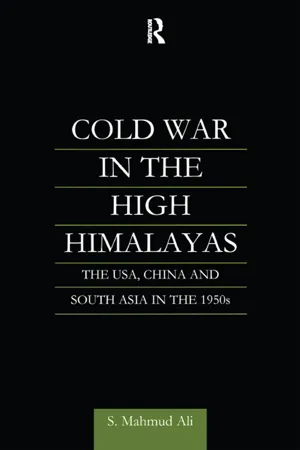
This text examines elite-insecurity perceptions in India, Pakistan and the USA in the 1950s. The book highlights the consequent linkages in alliance-building efforts and the subsequent triangular covert collaboration against Communist China, especially along Tibet's Himalayan frontiers. This secret alliance had an unexpected fall-out on the Kashmir dispute between India and Pakistan. Lastly the book examines the divergence of Indo-Pakistani security policies along fundamental cleavages since the 1960s.
eBook - ePub
Cold War in the High Himalayas
The USA, China and South Asia in the 1950s
- 286 pages
- English
- ePUB (mobile friendly)
- Available on iOS & Android
eBook - ePub
About this book
Information
List of Appendices
1 US-India agreement on the use of Indian airspace and ground facilities by United States military aircraft and crew; July 1947
2 US-India agreement on the use of Indian airspace and ground facilities by United States military aircraft and crew; July 1949
3 US-Pakistan Mutual Defense Assistance Agreement; December 1950
4 US-India Mutual Defense Assistance Agreement; March 1951
5 India-China Agreement on Tibet; April 1954
6 US-Pakistan Mutual Defence Assistance Agreement; May 1954
7 US-Pakistan Mutual Security: Defense Support Assistance Agreement; January 1955
8 US-Pakistan Mutual Defence Assistance Agreement; May 1956
9 US-India Mutual Defense Assistance Agreement; April-December 1958
10 US-Pakistan Agreement of Cooperation; March 1959
11 US-Pakistan Agreement on the Establishment of a Communications Unit; July 1959
12 US-India Mutual Defense Assistance Agreement; November 1962
List of Annexures
1 The Agreement of the Central People’s Government and the Local Government of Tibet on Measures for the Peaceful Liberation of Tibet, 23 May 1951 (The 17-Point Agreement)
2 Unsigned letter from the US embassy in New Delhi to the Dalai Lama, July 1951
3 Letter from Indian Ambassador to the US, B R Sen, to Indian Finance Minister, Chintaman Desmukh, 11 January 1952
4 Letter from President Dwight D. Eisenhower to Prime Minister Jawaharlal Nehru, delivered by the US Ambassador on 24 February 1954
5 Text of a statement by President Dwight D. Eisenhower released by the White House in Washington, on 25 February 1954
6 Letter from Prime Minister Jawaharlal Nehru to President Dwight D. Eisenhower, delivered by Ambassador G.L. Mehta, on 27 May 1955
7 Memorandum from US Counsellor Frederick P. Bartlett in Delhi to the Department of State, dated 7 December 1956, recommending the line President Eisenhower should take in his negotiations with Prime Minister Nehru during the latter’s forthcoming visit
8 Note from the Chinese Foreign Office to the Embassy of India in Beijing protesting ‘subversive and disruptive activities against China’s Tibet region’, Beijing, 10 July 1958
9 Note from the Indian Ministry of External Affairs to the Embassy of China in New Delhi in response to Beijing’s note of 10 July, New Delhi, 2 August 1958
10 CIA memorandum, ‘Review of Tibetan Operations’, 25 April 1959
11 Letter from President John F. Kennedy to President Mohammad Ayub Khan, Washington, 28 October 1962
12 Letter from President Mohammad Ayub Khan to President John F. Kennedy, Rawalpindi, 5 November 1962
13 Letter from President John F. Kennedy to President Mohammad Ayub Khan, Washington, 22 December 1962
14 Letter from President John F. Kennedy to Prime Minister Jawaharlal Nehru, Washington, 22 December 1962
Dramatis Personae
Dean Acheson US Secretary of State in the early 1950s, Dean Acheson was the first US policymaker to deal with Tibetan plea for support. In June 1951, three months after the first US-India Mutual Defence Assistance Agreement was signed, he told the Tibetans that his government was sympathetic and willing to provide arms and ammunition to the resistance, but only if the Tibetans maintained a cohesive struggle against Beijing. This was the beginning of Washington’s formal entry into Tibetan affairs and the evolution of Indo-US relationship into a strategic alliance against Communist China.
Gompo Tashi Andrugtsang Tibetan merchant-prince and resistance leader. He enjoyed the Dalai Lama’s tacit support and rose to command the formal structure of the Tibetan resistance, the Chushi Gangdruk. His fighters harried the PLA and took the war from the eastern provinces of Kham and Amdo to the central U Tsang and southern Lhoka regions in the late 1950s, and to Lhasa itself in 1959. However, he claims to have been uninvolved in the Lhasa revolt and the flight of the Dalai Lama in March 1959 when he was fighting the PLA away from the capital. This account strengthens the view that the Dalai Lama’s flight was masterminded by US-armed guerrillas and the Dalai Lama’s Chamberlain, Phala, co-ordinating closely with the CIA based in Dhaka, East Pakistan.
Mohammad Ali Pakistani Prime Minister in the early 1950s who took his country into deepening military alliance with the US although Pakistan’s primary motivation was fear of India rather than of Communism. His correspondence with his Indian counterpart, Nehru, brought them close to an agreement in late 1953 on holding a plebiscite in Jammu & Kashmir. However, Delhi’s discovery of an imminent US-Pakistan security agreement led Nehru to renege on that accord. In the late 1950s, as Pakistan’s Foreign Minister, Mohammad Ali initiated border talks with the Chinese which provided Pakistan with strategic leverage vis-a-vis India but angered both Washington and Delhi.
Chester Bowles US civil servant and diplomat who served as President Eisenhower’s ambassador to India and Nepal in 1951–1953. This was a crucial period for the development of the US-Indian security relationship. The Chinese had just taken control of Tibet and India was seeking to establish ‘a third way’ away from Cold War entanglements. Bowles conducted the Delhi element of the delicate, protracted and secret negotiations which led to the consolidation of covert collaboration on the basis of the first Mutual Defence Assistance Agreement between Washington and Delhi. Bowles and Nehru, and other senior Indian officials, discussed close co-operation in the security and intelligence fields while agreeing to disagree on other issues. He returned to Delhi as US ambassador after the Sino-Indian war, serving from 1963 to 1969 and fashioning an alliance that had strong and parallel strategic and economic elements to it. McGeorge Bundy A Harvard Professor and a political scientist of repute, Bundy was appointed Special Assistant to the President for National Security Affairs in 1961 and left that post to take up the presidency of the Ford Foundation in 1966. In the intervening period, he stamped his authority on the National Security Council and the process of security policy formulation. Bundy was formally responsible for preparing the agenda for NSC meetings and this shaped the priorities in terms of time allocation for presidential briefings and discussions during most of the Kennedy-Johnson administrations. Policies relating to China, South Asia and Tibet were no exception.
Ellsworth Bunker Trained as a lawyer, Ellsworth Bunker moved from industry and commerce to more academic pursuits and then, to diplomacy. He was ambassador to India from 1956 to 1961, spanning the transition between the Eisenhower and Kennedy presidencies. During this period, he played a critical role in maintaining the covert alliance between Washington and Delhi while overtly, India moved close to China and the Soviet Union. Bunker was instrumental in getting the 2nd US-India Murual Defence Assistance Agreement signed in 1958 following which the level and intensity of covert collaboration against the Chinese in Tibet rose considerably.
Chiang Kai-shek Leader of the Kuo Min-tang (nationalist) Chinese administration, Generalissimo Chiang was forced to flee to Taiwan after Mao Ze-dong’s Red Army took control of Beijing, and then, of the whole of mainland China. Chiang continued to receive considerable military and economic assistance from the US and turned Taiwan into a base for anti-Communist operations. When the Tibetan resistance to China became a considerable force, Chiang’s intelligence services extended covert assistance to it. In the late 1950s, when the CIA and Indian Intelligence Bureau became very active in aiding the Tibetan guerrillas, Taiwan’s covert assistance declined in importance.
Morarji Desai Senior Congress politician and cabinet minister in the 1960s and 1970s. As Finance Minister during the 1962 war with China, Desai pushed for expanding ties with the US from the covert to the overt. In the late 1970s, as the Prime Minister in an anti-Congress coalition, he revealed the extent of US-Indian collaboration against China in the late 1960s, especially the activities of the CIA in India. His revelations stunned many knowledgeable Indians at the time. But even Desai chose not to speak about Indo-US co-operation in the period before the Sino-Indian war.
‘Wild Bill’ Donovan Commander of the wartime ‘Office of Strategic Services’, General Donovan established an activist culture for US intelligence organs and operatives. This was most visible when OSS officers carrying messages and gifts for the infant Dalai Lama from President Roosevelt visited Lhasa and established contact with the Tibetan Regency. Donovan appreciated Tibet’s strategic importance in a period of fluidity. He pleaded for treating Tibet as an autonomous entity, supporting the Lamaist authorities with long-range radio transmitters without consulting the KMT government in Nanjing. Despite opposition from the Department of State, this course was adopted. In 1947, the OSS was merged with several other agencies into the CIA which then became a principal instrument of US policy in the region.
John Foster Dulles President Eisenhower’s Secretary of State credited with fashioning the anti-Communist ‘Containment’ policy. Dulles was said to be fired with a missionary zeal to roll back Communist expansion in Europe and Asia and to this end he provided the intellectual stimulus to the erection of a cordon sanitaire of anti-communist alliances along the fringes of the Soviet Union and China. US relations with India and Pakistan were shaped by this drive. Dulles preferred overt alliances which he managed to secure with Turkey, Iran, Pakistan but not with India. But the degree of secret collaboration with Delhi against Beijing compensated for this lack of transparency. Dulles saw China as an appendage of the Soviet Union, and his refusal to endorse Vice President Nixon’s suggestion to normalise relations with China effectively blocked any changes to US policy in the 1950s. His notorious refusal to shake Zhou En-lai’s hand at a Geneva conference was reflective of the disdain in which he held Beijing, and the Nehru-Menon initiative to mediate between the US and China.
Allen Dulles US lawyer and diplomat, and brother of John Foster Dulles, Allen Dulles was appointed Deputy Director of the CIA in 1951. Promoted to Director of Central Intelligence 1953, he served in that capacity until 1961. Guiding the CIA through the formative years of the Cold War, Dulles turned the organisation into a large and much-feared instrument of covert diplomacy around the world. Under Dulles the CIA undertook many operations around and often within Communist states in what was called the ‘humint’ (human intelligence) area. One of its best-concealed clandestine operations was in Tibet where the CIA sponsored and aided Tibetan resistance in its bitter struggle against Communist Chinese forces from bases in India and to a lesser extent, Pakistan. The CIA was sometimes an activist alter ego to the somewhat more restrained Department of State. Taken together, the Dulles brothers could be described as key shapers and executors of the anti-Communist ‘Containment’ policy pursued by the Eisenhower administration and its successors into the 1980s.
Subimal Dutt Indian Foreign Secretary and close confidante of Prime Minister Nehru, he signed one of the key US-India mutual defence assistance agreements. Dutt was identified by the Americans as one of the more pro-Western diplomat...
Table of contents
- Cover
- Half Title
- Title Page
- Copyright Page
- Table of Contents
- Foreword
- Acknowledgements
- List of Appendices 1–12
- List of Annexures 1–14
- Dramatis Personae
- Chronology of Key Events
- Preface
- Map
- Introduction
- CHAPTER 1 The Early Treaties
- CHAPTER 2 Histrionics in the High Himalayas
- CHAPTER 3 The Kashmir Fallout
- CHAPTER 4 Covert Collaboration in Diplomacy and War
- CHAPTER 5 War Clouds Gather
- CHAPTER 6 The Denouement
- CHAPTER 7 Epilogue
- Appendices 1–12
- Annexures 1–14
- Notes
- Bibliography
- Index
Trusted by 375,005 students
Access to over 1.5 million titles for a fair monthly price.
Study more efficiently using our study tools.
Frequently asked questions
Yes, you can cancel anytime from the Subscription tab in your account settings on the Perlego website. Your subscription will stay active until the end of your current billing period. Learn how to cancel your subscription
No, books cannot be downloaded as external files, such as PDFs, for use outside of Perlego. However, you can download books within the Perlego app for offline reading on mobile or tablet. Learn how to download books offline
Perlego offers two plans: Essential and Complete
- Essential is ideal for learners and professionals who enjoy exploring a wide range of subjects. Access the Essential Library with 800,000+ trusted titles and best-sellers across business, personal growth, and the humanities. Includes unlimited reading time and Standard Read Aloud voice.
- Complete: Perfect for advanced learners and researchers needing full, unrestricted access. Unlock 1.5M+ books across hundreds of subjects, including academic and specialized titles. The Complete Plan also includes advanced features like Premium Read Aloud and Research Assistant.
We are an online textbook subscription service, where you can get access to an entire online library for less than the price of a single book per month. With over 1.5 million books across 990+ topics, we’ve got you covered! Learn about our mission
Look out for the read-aloud symbol on your next book to see if you can listen to it. The read-aloud tool reads text aloud for you, highlighting the text as it is being read. You can pause it, speed it up and slow it down. Learn more about Read Aloud
Yes! You can use the Perlego app on both iOS and Android devices to read anytime, anywhere — even offline. Perfect for commutes or when you’re on the go.
Please note we cannot support devices running on iOS 13 and Android 7 or earlier. Learn more about using the app
Please note we cannot support devices running on iOS 13 and Android 7 or earlier. Learn more about using the app
Yes, you can access Cold War in the High Himalayas by S Mahmud Ali,S. Mahmud Ali in PDF and/or ePUB format, as well as other popular books in Social Sciences & Indian & South Asian History. We have over 1.5 million books available in our catalogue for you to explore.