The special needs of women with disabilities have been disregarded in a wide variety of vital areas. Issues pertain to women as wives and mothers. Studies of the effects on female sexuality of such conditions as renal disease and diabetes are lacking, though the sexual functioning of men with these diseases has been researched. On the economic front, the Federal-State Vocational Rehabilitation system and the regulations concerning disability benefits under Social Security provide less adequately for women than for men. Hopefully, this volume will raise the consciousness of its readers to the special status of women with disabilities as a minority group experiences multiple sources of discriminations.
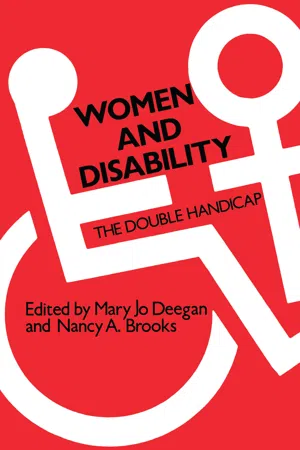
- 160 pages
- English
- ePUB (mobile friendly)
- Available on iOS & Android
eBook - ePub
About this book
Information
1
Introduction
Women and Disability: The Double Handicap
Mary Jo Deegan and Nancy A. Brooks
During the 1970s a social movement arose to address the concerns of people with disabilities. Action groups pressed for reforms in architectural barriers, educational and employment opportunities, deinstitutionalization, and legal protection of civil rights. Although accurate demographic information is lacking, estimates indicate that approximately one in ten Americans has a disability or chronic disease and would be directly affected by the disability movement. These people experience serious limitations in major activities such as housework, employment, or education. Although physical restrictions pose significant problems, social restrictions generated by negative attitudes impose greater handicaps, because socially created barriers effectively prevent full community participation. The primary purpose of the disability movement therefore has been to combat both environmental and social handicaps through public education and legal advances.
Despite the attention given to disability in general and certain impairments in particular, one category within the disabled population has received little recognition or study: women. Like many social change movements, the disability movement has often directed its energies toward primarily male experiences. Male sexual concerns and employment issues, for example, have received more attention than child-bearing problems. Our purpose here is to identify the issues and experiences that are particular to disabled women.
A Brief Note on the Collection of Essays
The papers assembled here are ample documentation of the special barriers to and strengths of physically disabled women. Each essay starts with a short abstract, allowing the reader to grasp the central points quickly. Each of these summaries introduces the individual paper far better than we can do in a traditional editorial review. We have chosen, instead, to present our response to the papers as a collection and to reflect on their implications as a set of writings.
These papers do have coherence, despite the variety and range of viewpoints included. The major factors unifying the collection are a central focus on the “double” jeopardy of disabled women, the lack of information available about their lives and experiences, and the need to alleviate the conditions that perpetuate structured inequality.
Fine and Asch have conceptualized the disabled woman as “roleless.” In so doing, they point to the need for idealized social models, systematic recognition of social worth, and the enactment of abstract ideas of social placement within actual lives. Negative and delimiting stereotypes make disabled women a social category that is demeaned across situations and time. Nontraditional choices, such as never being married or being childless, can be interpreted as a function of narrow expectations, as an “inability” to achieve traditional roles instead of an independent choice of great meaning and commitment.
Deaf women, often living in institutional settings in their youth and separated from parents who cannot use sign language, are frequently more conservative than other women. Becker and Jauregui explain eloquently and insightfully that the social world is based on communication. Deafness can raise communication barriers which delay socialization and isolate the individual. By defining deafness as more than a hearing loss, they explain the underlying problem of deafness as a socially created barrier to understanding and participation. Social meaning and its nuances are conveyed through interaction, causing systematic limits on social intercourse for the hearing impaired. American Sign Language (ASL) is seen by many as the most viable communication system for the deaf, while many others dispute its value. One of the ways to help resolve this controversy would be a close analysis of the social meaning and interaction patterns that result from its use.
These types of social restrictions in daily living and in structured opportunities are not always clearly understood, by others or the women involved. The degree of consciousness of structured discrimination, as a woman and as a disabled person, is a necessary component of being a member of a minority group. “Multiple minority groups” must have both objective limitations on their participation in everyday life and a consciousness of their groups’ restrictions. Deegan discusses the ramifications which follow the combination of more than one minority status. The articles in this volume reaffirm and document many of her points. Instances of discrimination by “liberated women” and by peer disabled men are dispersed throughout the collection of articles. Similarly, the courage and stamina of disabled women reveal their strengths and transcendence of the limited expectations that frequently surround them. Thus, this book is a beginning step in unraveling the interaction between more than one minority status being held concomitantly by an individual and a group. A greater understanding of this distinctiveness and similarity with other disadvantaged groups will aid in building “communication” and “community building” skills so badly needed by minorities in general.
In Kutza’s article, a dramatic documentation of the economic effects of multiple minority status is given. In a truly insightful argument, she reveals that government benefits for disabled persons are systematically based on a patriarchal conception of work. This male-dominant world view is operationalized through programs that are primarily tied to work histories in the marketplace. Labor in the home is ineligible for remuneration through government programs, so much of “women’s work” is not technically considered “work” nor rewarded economically. Most women who receive benefits, therefore, receive them in the more stigmatizing and lower-paid category of “welfare” rather than “workers’ compensation” for labor expended as a legitimated contribution to the community.
Similarly, Bonwich examines the problems of traumatic spinal cord injuries and sheds light on the potential for nontraditional sex roles to build new strengths out of a situation of severe role loss. Pointing to the dearth of information about disabled women’s lives, she uses interviews to document the changing lives of women who have disabilities. The extreme disruption in interpersonal relationships, sexuality, and in child bearing and rearing strikes at the core of traditional female roles. Rural women, moreover, may face limited options in job opportunities and counseling. Despite these difficulties, however, the spinal cord injured women whom she interviewed show us some of the ways out of dark dilemmas often handled in isolation and with despair.
Although each of these first five articles is concerned with pragmatic issues, they also address abstract ideas and develop generalized concepts. The remaining four articles continue to analyze the experiences and opportunities of disabled women but do so in more specific contexts.
Two articles, Kolb’s on assertiveness training and Saxton’s on peer counseling, are excellent examples of the coordination of interests among all of the authors. The early articles emphasized the need for disabled women to be active in the process of social change, then Kolb and Saxton provide us with information and reflection on two models of successful self-help programs.
Although all women are unjustifiably expected to be patient, passive and tranquil, the techniques for learning to be more assertive may be particularly difficult for a disabled woman to utilize. Advice on how to obtain one’s rights may be based on the assumption that the woman is able-bodied. For example, Kolb discusses the problem of being unable to use eye contact as a mechanism to assert authority. This specific example reveals tellingly the more general problem of assertiveness for disabled women. The problems here may involve learning to be assertive, disregarding advice drawn from able-bodied women, and creating new ways to be assertive with limited physical capacities. In other words, disabled women must be assertive before they can follow traditional advice on how to be assertive! Kolb and her informants do provide us with some specific mechanisms for dealing with this issue, but their raising the general question is a particularly astute and valuable contribution. We have only begun to examine this crucial problem here. For example, to pose a more complicated problem for the reader, how can a deaf person who is limited in communication skills and nuances of interaction, as documented by Becker and Jauregui, confront a rude salesperson?
One answer to these dilemmas is peer counseling. Legitimated experience, shared trust, and knowledge-building are all possible benefits of meeting regularly and discussing systematically the lived reality of being both disabled and female. A twelve-week program of topics for such a group is presented by Saxton, and one group’s response to this agenda illustrates its timeliness and significance. An emphasis on social action and change is important for making peer groups do more than engage in narcissistic analysis. The parallels with “consciousness-raising” groups are striking. Heightened awareness can uncover, discover, and recover a unity that generates power and identity. Peer counseling and assertiveness training, then, are two concrete methods to generate roles for disabled women, ending the present problems of rolelessness documented by Fine and Asch.
Eliminating the barriers to self-help is another way to resolve problems facing physically disabled women, and some of the most appalling barriers are those generated by the “helping” professions. Kutner and Gray document the lack of knowledge, understanding, and even denial of services associated with chronic renal failure in women. Dealing with a specific population, they provide systematic documentation of callousness in research and services and reveal the heretofore unknown linkage between being a woman and having this disability. Although they pinpoint a specific group, their work highlights the general, pervasive problems of (1) sexuality and the disabled woman, (2) the link between financial resources and receipt of services, and (3) the general lack of appreciation for or understanding of women’s work in the home.
These same issues are discussed in very different settings in the remaining articles. McCharen and Earp have developed a complex model of employment practices for women with breast cancer. They show that formal knowledge about the disease is not sufficient to change the present situation of inequality. Emotional reactions to the stigma of disability and past experiences with the illness are prime motivating factors for employers that limit the effectiveness of “rational” information.
One interpretation of their findings leads to the vocational advice to encourage women with breast cancer to look at larger-sized organizations that have maximum sick leave policies and medical coverage. Although this is a short-term response to a serious problem in the marketplace, temporary aid is often vital. More research carefully explaining the variety of factors occurring in any one situation is badly needed. McCharen and Earp provide an excellent model for conducting further studies in this vein.
Finally, the last article by Shaul, Dowling, and Laden is on motherhood. There is a reason for ending the book with this chapter. The women who became mothers are so full of vitality, so positive about their choices, and so eloquent in their analysis that they provide a living example of both the stresses on and strengths of disabled women. Liberation involves taking risks and affirming life. Although motherhood has often been an oppressive status, glorifying self-negation and “saintliness,” it has also been a positive opportunity for intimacy, regeneration, and human commitment. These disabled mothers have revealed the latter process and potential. In doing so, they provide us with lessons on what it is to create and challenge not only themselves, but also their children.
This last article is an excellent ending for what must be, by necessity, a rather grim set of readings. The lives of disabled women are severely limited in American society. Since this is the reality, it must be reflected here. In many ways, these papers are an indictment of a socially created world. Calls for more research, knowledge, and understanding must be heard in a world that is now economically distressed as well as “deaf,” “immobile,” “blind,” and “paralyzed”. It is society that is disabled, not our sisters who suffer from the social restrictions created by a handicapped symbolic and mythic world.
2
Disabled Women: Sexism without the Pedestal
Michelle Fine and Adrienne Asch
There is presently a dearth of information on the status of disabled women in U. S. society. In this paper we present an introductory statement on the lives of disabled women by delineating the economic, social and psychological constraints which place them at a distinct disadvantage relative to disabled men and nondisabled women. We begin by evaluating the ways in which a disability is viewed as an impediment to traditional and nontraditional sex role development. We then examine the profile of the disabled woman, propose a theoretical explanation of her imposed rolelessness, and recommend specific steps to ameliorate some of her role problems.
Introduction
It is estimated that 36 million persons in the U.S. have disabling conditions (Bowe, 1980). From another perspective, it is noted that 13,110,000 persons ages 16 to 64 have work disabilities: 8.5 percent of all working age females and 9.3 percent of all working age males (U.S. Bureau of Census, 1983). These figures alone, however, tell only a partial story. We argue here that disability is a more severely handicapping condition for women than for men.
We trace this differential experience to the more limited role choices and limited role models available to disabled women. Whereas disabled men are obliged to fight the social stigma of disability, they can aspire to fill socially powerful male roles. Disabled women do not have this option. Disabled women are perceived as inadequate for economically productive roles (traditionally considered appropriate for males) and for the nurturant, reproductive roles considered appropriate for females (Broverman, Clarkson and Rosenkrantz, 1972).
Examining the Context
The lack of approved adult social roles for disabled women derives from a constellation of confounding forces. Disabled women (like racial or ethnic minority women) experience a major disadvantage in relation to their relevant “single” minority reference groups: disabled men and non-disabled women (Harrison, 1977). The disadvantage is “double” because disabled women fare worse than both relevant comparison groups economically, socially, and psy-chologically.1 These multiple dimensions of disadvantage are discussed in more depth below.
Economic Realities
Disabled women confront grim economic realities. The situation is even worse for racial/ethnic minorities within this population (Glover et al., 1979; Greenblum, 1977; Medvene and Akabas, 1979). It is estimated that between 65 percent and 76 percent of all disabled women are unemployed. During times of economic crisis, the economic status of this class cannot be expected to improve (O’Toole and Weeks, 1978; Rehab Group, 1979).
Unemployment problems are compounded by inequities in training programs. Disabled men are more likely than disabled women to be referred to vocational school or on-the-job training. While 94 percent of disabled men who are rehabilitated receive training in wage-earning occupations, only 68 percent of the disabled women are so trained (cf. O’Toole and Weeks, 1978).
Census and survey data consistently document the many problems facing disabled women: disabled women (1) are less likely to be employed than disabled men, (2) somewhat less likely to be college educated, and (3) earn substantially less (for vocationally rehabilitated men vs. women, the mean annual incomes are $4188 vs. $2744, respectively, Greenblum, 1977). Women are less likely to find a job post disability and those who do find a job are more likely to absorb a cut in pay. They are even more likely to live in families with incomes at or below the poverty level (Medvene and Akabas, 1979, Rehab Group, 1979; Schechter, 1977). Concomitantly, disabled women have disproportionately lower levels of disability coverage and insurance benefits (Greenblum, 1977), conditions which deepen their economic dis-advantage.2
Social Realities
In social interactions, which are related to economic factors, disabled women are again at a disadvantage. While marriage may not be a preferred status for an increasing number of women, it is a customary measure of social options and position. Compared to nondisabled women, disabled women are more likely to never marry, marry at a later age and, once married, to be divorced (Franklin, 1977). Of those individuals who are married with partner absent, separated, divorced or widowed, more are disabled women than disabled men. Similarly, a greater percentage of female heads of household than male heads of household are disabled (Rehab Group, 1979). Evidence collected on problem drinkers documents this even more dramatically—90 percent of wo...
Table of contents
- Cover
- Half Title
- Title Page
- Copyright Page
- Dedication Page
- Contents
- List of Tables
- Foreword
- Preface
- 1. Introduction Women and Disability: The Double Handicap
- 2. Disabled Women: Sexism without the Pedestal
- 3. The Invisible Isolation of Deaf Women: Its Effect on Social Awareness
- 4. Multiple Minority Groups: A Case Study of Physically Disabled Women
- 5. Sex Role Attitudes and Role Reorganization in Spinal Cord Injured Women
- 6. Benefits for the Disabled: How Beneficial for Women?
- 7. Assertiveness Training for Women with Visual Impairments
- 8. A Peer Counseling Training Program for Disabled Women: A Tool for Social and Individual Change
- 9. Women and Chronic Renal Failure: Some Neglected Issues
- 10. Toward a Model of Factors Influencing the Hiring of Women with a History of Breast Cancer
- 11 Like Other Women: Perspectives of Mothers with Physical Disabilities
- Contributors
Trusted by 375,005 students
Access to over 1.5 million titles for a fair monthly price.
Study more efficiently using our study tools.
Frequently asked questions
Yes, you can cancel anytime from the Subscription tab in your account settings on the Perlego website. Your subscription will stay active until the end of your current billing period. Learn how to cancel your subscription
No, books cannot be downloaded as external files, such as PDFs, for use outside of Perlego. However, you can download books within the Perlego app for offline reading on mobile or tablet. Learn how to download books offline
Perlego offers two plans: Essential and Complete
- Essential is ideal for learners and professionals who enjoy exploring a wide range of subjects. Access the Essential Library with 800,000+ trusted titles and best-sellers across business, personal growth, and the humanities. Includes unlimited reading time and Standard Read Aloud voice.
- Complete: Perfect for advanced learners and researchers needing full, unrestricted access. Unlock 1.5M+ books across hundreds of subjects, including academic and specialized titles. The Complete Plan also includes advanced features like Premium Read Aloud and Research Assistant.
We are an online textbook subscription service, where you can get access to an entire online library for less than the price of a single book per month. With over 1.5 million books across 990+ topics, we’ve got you covered! Learn about our mission
Look out for the read-aloud symbol on your next book to see if you can listen to it. The read-aloud tool reads text aloud for you, highlighting the text as it is being read. You can pause it, speed it up and slow it down. Learn more about Read Aloud
Yes! You can use the Perlego app on both iOS and Android devices to read anytime, anywhere — even offline. Perfect for commutes or when you’re on the go.
Please note we cannot support devices running on iOS 13 and Android 7 or earlier. Learn more about using the app
Please note we cannot support devices running on iOS 13 and Android 7 or earlier. Learn more about using the app
Yes, you can access Women and Disability by Mary Jo Deegan in PDF and/or ePUB format, as well as other popular books in Social Sciences & Gender Studies. We have over 1.5 million books available in our catalogue for you to explore.