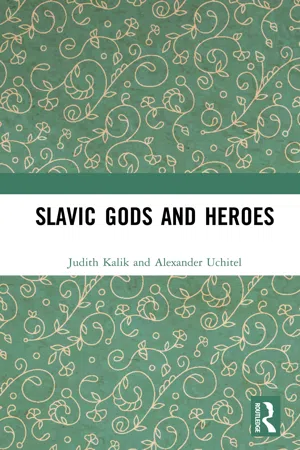
This book offers a radical reinterpretation of the Slavic pagan religion made on the basis of a thorough re-examination of all reliable sources. What did Slavic pagan religion have in common with the Afro-American cult of voodoo? Why were no Slavic gods mentioned before the mid-tenth century, and why were there no Slavic gods at all between the Dnieper and the Oder? Why were Slavic foundation legends similar to the totemic myths of the nomadic peoples of the Eurasian Steppe, and who were Slavic Remus and Romulus? What were the Indo-European roots of Slavic hippomantic rituals, and where was the Eastern Slavic dragon Zmey Gorynych born? Answers to these and many other provocative questions can be found in this book.
- 186 pages
- English
- ePUB (mobile friendly)
- Available on iOS & Android
eBook - ePub
Slavic Gods and Heroes
Part I
Ancient Slavs
1 Ancient Slavs and their neighbors
Slavic languages
Slavic languages belong to the Indo-European linguistic family. In this family, Slavic, Baltic, Indo-Iranian, Armenian, and Albanian form the so-called satem linguistic branch, in contrast to the Celtic, Germanic, Italic, Greek, and Tocharian languages, which belong to the so-called centum linguistic branch. Satem and centum mean “one hundred” in Avestan and Latin, respectively. This subdivision of the Indo-European languages is based on the phonetic development of proto-Indo-European palatalized velars (k', g', kh') into sibilants (s, z, zh) in the satem languages, and their survival as velars (k, g, kh) in centum languages. The earlier view that the subdivision of Indo-European languages into these two branches reflects the ancient split of the proto-Indo-European language into two protolanguages is no longer considered valid. Most scholars now presume that the phonetic changes took place independently in different language groups. However, Slavic and Baltic languages are closely related to each other through a common vocabulary and grammar. They form the Balto-Slavic linguistic entity. Several other important isoglosses connect the Balto-Slavic languages with the Indo-Iranian, Germanic, and Albanian languages. The latter is the only surviving representative of the paleo-Balkan languages, but it is not clear whether it represents the Illyrian or the Thracian language group. The proto-Slavic language was characterized by the existence of the reduced super-short vowels ǐ and ǔ, which are expressed in the Cyrillic script by the signs ь and ъ and the nasal vowels ę and ǫ, which are expressed by the letters ѧ and ѫ. Super-short vowels are dropped in all modern Slavic languages except for Bulgarian, and nasal vowels survived only in modern Polish.
Slavs’ homeland
The location of the original homeland of the ancient Slavs is unknown. Various proposals to identify various prehistoric archaeological cultures with the Slavs are usually associated with the national preferences of the scholars who present them. Poles like to identify the early Bronze Age Lusatian culture, which flourished on the territory of modern-day Poland as Slavic. Ukrainians prefer to identify the so-called Antes, which are associated with the Pen’kovka archaeological culture in the mid-Dnieper region, as Slavs. Finally, the identification of the Adriatic Veneti with the Slavs is popular in modern-day Slovenia.
Most archaeologists now associate ancient Slavs with the Prague-Korchak culture,1 which stretched as a long strip from the upper Dnieper to the Elbe through modern-day northern Ukraine, southern Belarus, Slovakia, southern Poland, and the Czech Republic. This association is the current favorite among most modern Slavic nations. However, an archaeological culture is, by its definition, merely a material cultural complex that does not necessarily correspond with any specific ethnic or linguistic entity. Thus, the material culture of the Prague-Korchak cultural horizon could simply reflect the trade-route connecting the Dnieper with the Elbe, which existed in the ninth century.2 Medieval Polish chroniclers believed that the Slavs came to Poland either from Pannonia (modern-day Hungary)3 or from Carinthia (in modern-day Austria),4 but archaeologists unanimously reject these suggestions.
In 2001, Paul Barford5 and Florin Curta6 simultaneously proposed that the Slavs simply did not exist before the mid-sixth century, when they suddenly appeared in Byzantine sources during the reign of Justinian. According to these scholars’ view, Byzantine authors labeled the heterogeneous tribes that began to make incursions into the Byzantine Danubian provinces during this time as “Slavs” (Sklavenoi), probably because they used the Slavic language as a lingua franca. This hypothesis explains the conspicuous silence in written sources about the Slavs before the mid-sixth century, the difficulty of ascribing a Slavic identity to any East European archaeological culture, and the remarkable uniformity of the Slavic language, which, as late as the tenth century, was understandable in Bulgaria, Moravia, and Kievan Rus’. However, this explanation does not solve the question of the origin of this Slavic language itself, which originally had to be spoken by some tribal group in some location.
Hydronymics
The largest concentration of Slavic hydronyms is to be found in modern-day Romania: Bistriţa—“rapid,” Cerna—“black,” Crasna—“red,” Belareca—“white river,” Târnava—“thorny,” Ialomiţa—“infertile,” Dâmboviţa—“of oaks,” and many others. Their presence there is usually explained by the brief Slavic occupation of this country in the seventh to ninth centuries.7 This explanation is problematic because hydronymics are usually the most stable element of a toponymy.
Hydronymics found in all countries where Slavs currently form the majority show unequivocally that before the Great Migration Age of the fifth to eighth centuries, non-Slavic peoples inhabited them. The names of all the major rivers in the northern Pontic area (modern-day Ukraine) are of Iranian origin: Don—from the Iranian dānu—“stream,” Dnieper—from dānu-apara—“far away river,” Dniester—from dānu-nadzyo—“nearby river,” etc. According to historical sources, several successive waves of Iranian nomads occupied this territory: Cimmerians, Scythians (from the seventh century bce), and Sarmatians (from the second century bce). Turkic Bulgars replaced them in the seventh century ce. The Khazars (also of Turkic origin) defeated the Bulgars in 668, and the Bulgars then migrated in two directions: northwards to the Volga-Kama confluence, where they established the Volga-Bulgarian State, and westwards to the Balkans, where they founded Danubian Bulgaria.
The hydronymics of Belarus and Central Russia are predominantly Baltic. Many of them are derived from the Baltic root nara—“stream”; for example, the River Narev in Belarus, Lake Nero, Revers Nerl’, and Nara in Central Russia. However, on the eve of the Slavic colonization, Central Russia was populated by Finnish peoples, who drove away the Baltic tribes some time before the Great Migration Age. These were the now extinct peoples of Meria, Muroma, and Meshchora. The only Baltic people who survived until the Slavic expansion were the Galindians (Slavic Голѧдь) in the River Protva (a tributary of the Oka) valley. North-Western Russia was the homeland of Finnish peoples from great antiquity. These were the Votes (Boudinoi of Herodotus, Slavic Водь) and the Vepsians (Vas of Jordanes, Slavic Весь, Arabic Wisu, Wizzi of Adam of Bremen). The Votes are now nearly extinct (64 persons remain as of 2010), and the Vepsians are a diminutive ethnic group (numbering about 6,000) in Southern Karelia. Finnish hydronyms in Northern and Central Russia include Lake Ilmen’ (from Finnish ilma—“air”), the River Volga (Karelian valga—“white), and the River Oka (Finnish joki—“river”). Numerous Iranian loanwords to be found in Finnish languages attest that Finnish and Iranian peoples were neighbors before the “Slavic wedge” separated them. Thus, most of the ethnic names of Eastern Finnish peoples are derived from Iranian words; for example, martiya—“man” (Mordva, Udmurts) or marya—“warrior” (Meria, Mari). In contrast, the Finnish word for slave—orja—is derived from the Indo-Iranian ethnic Arya.8
The Germanic tribe of the Vandals inhabited the territory of modern-day Poland before the Slavs. The Vandals left in their wake the names of Poland’s major rivers: the Vistula (Polish Wisła)—from Old Norse veisa—“slime” with the diminutive suffix –ula and the Bug—from the Germanic baug—“winding.” The Boii Celtic tribe lived in what is today the Czech Republic, and they gave to this country its ancient name, Bohemia. In the second-century bce, the Germanic tribes of the Quadi and the Marcomani replaced them. The ancient inhabitants of modern-day Slovenia were the Veneti, whose linguistic affiliation is disputed. Their language either belonged to the Italic or the Celtic groups or was a separate language within the Indo-European family.9 Modern Croatia, Serbia, Bosnia-Herzegovina, and Montenegro are located in what once was Illyria, modern Bulgaria—in the lands that were ancient Thrace—and modern-day Slavic Macedonia is an area that was once part of the ancient Greek-speaking Macedonia.
Names of the Slavs and Slavic names for their neighbors
The name “Slavs” is derived from the Slavic slovo—“word,” meaning that ancient Slavs called themselves “those who speak with words.” Subsequently, they called their western neighbors—Nemcy—“mute,” and this word survives to this day in various Slavic languages as the name for Germany (Polish Niemcy) and Germans (Russian Nemtsy). The Slavs called Finnish peoples Chud’—“strange.” They named the Celts and later also the Romans Vlachs—from the Celtic tribe of Volcae. In Polish, Italy is known to this day as Włochy. Germanic peoples called Slavs Wends—from the name of the Veneti Baltic tribe. The Veneti, known as Vends, survived up to the sixteenth century in what is today Latvia. Modern Finnish peoples still use this word as the name for Russia – Finnish Venäjä and Estonian Venemaa. The relationship between this word and the North Adriatic Veneti is unknown, although these two identical ethnic names conspicuously occupy two opposite ends of the Great Amber Road—the trade route that supplied amber from the Baltic to the Mediterranean as early as the mid-second millennium bce.
Slavic migrations
In the sixth to eighth centuries, Slavs actively participated in the Great Migration, but only their southward expansion into the Balkans was documented in written sources. Byzantine historian Theophylact Simocatta descr...
Table of contents
- Cover Page
- Slavic Gods and Heroes
- Title
- Copyright
- Contents
- List of Charts
- List of Tables
- Preface
- Introduction
- Part I Ancient Slavs
- Part II Gods
- Part III Heroes
- Appendix 1: Indo-European Hippomancy
- Appendix 2 Zmey Gorynych
- Afterword
- Bibliography
- Index
Trusted by 375,005 students
Access to over 1.5 million titles for a fair monthly price.
Study more efficiently using our study tools.
Frequently asked questions
Yes, you can cancel anytime from the Subscription tab in your account settings on the Perlego website. Your subscription will stay active until the end of your current billing period. Learn how to cancel your subscription
No, books cannot be downloaded as external files, such as PDFs, for use outside of Perlego. However, you can download books within the Perlego app for offline reading on mobile or tablet. Learn how to download books offline
Perlego offers two plans: Essential and Complete
- Essential is ideal for learners and professionals who enjoy exploring a wide range of subjects. Access the Essential Library with 800,000+ trusted titles and best-sellers across business, personal growth, and the humanities. Includes unlimited reading time and Standard Read Aloud voice.
- Complete: Perfect for advanced learners and researchers needing full, unrestricted access. Unlock 1.5M+ books across hundreds of subjects, including academic and specialized titles. The Complete Plan also includes advanced features like Premium Read Aloud and Research Assistant.
We are an online textbook subscription service, where you can get access to an entire online library for less than the price of a single book per month. With over 1.5 million books across 990+ topics, we’ve got you covered! Learn about our mission
Look out for the read-aloud symbol on your next book to see if you can listen to it. The read-aloud tool reads text aloud for you, highlighting the text as it is being read. You can pause it, speed it up and slow it down. Learn more about Read Aloud
Yes! You can use the Perlego app on both iOS and Android devices to read anytime, anywhere — even offline. Perfect for commutes or when you’re on the go.
Please note we cannot support devices running on iOS 13 and Android 7 or earlier. Learn more about using the app
Please note we cannot support devices running on iOS 13 and Android 7 or earlier. Learn more about using the app
Yes, you can access Slavic Gods and Heroes by Judith Kalik,Alexander Uchitel in PDF and/or ePUB format, as well as other popular books in History & World History. We have over 1.5 million books available in our catalogue for you to explore.