eBook - ePub
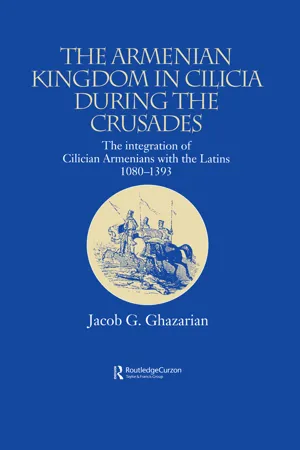
The Armenian Kingdom in Cilicia During the Crusades
The Integration of Cilician Armenians with the Latins, 1080-1393
- 256 pages
- English
- ePUB (mobile friendly)
- Available on iOS & Android
eBook - ePub
The Armenian Kingdom in Cilicia During the Crusades
The Integration of Cilician Armenians with the Latins, 1080-1393
About this book
This unique study bridges the history of the Crusades with the history of Armenian nationalism and Christianity. To the Crusaders, Armenian Christians presented the only reliable allies in Anatolia and Asia Minor, and were pivotal in the founding of the Crusader principalities of Edessa, Antioch, Jerusalem and Tripoli. The Anatolian kingdom of Cilicia was founded by the Roupenian dynasty (mid 10th to late 11th century), and grew under the collective rule of the Hetumian dynasty (late 12th to mid 14th century). After confrontations with Byzantium, the Seljuks and the Mongols, the Second Crusade led to the crowning of the first Cilician king despite opposition from Byzantium. Following the Third Crusade, power shifted in Cilicia to the Lusignans of Cyprus (mid to late 14th century), culminating in the final collapse of the kingdom at the hands of the Egyptian Mamluks.
Information
Chapter 1
Ancient & medieval roots

Medieval Armenian symbol of eternity
And the ark rested in the seventh month, on the seventeenth day of the month, upon the mountains of Ararat.
(Gen 8:4)
Early Mesopotamia
Many of the most important sociological and agricultural achievements of early civilizations took form in the great fertile basin of the rivers Tigris and Euphrates.1 Much of this progress occurred during the late fourth to mid second millennium BC as a result of the rapid commercial expansionism that spread principally between the Sumerian, Semite (Akkadian and Amorite), Hittite and the Hurrian inhabitants of this basin. In southern Mesopotamia it was the Sumerians who in the late fourth millennium BC introduced writing and founded the beginnings of the practice of city dwelling. The cuneiform script that can be read as Sumerian developed from the first records in the form known as pictograms, which usually contained descriptions of business transaction accounts.2 By 2500 BC it appears that the majority of the Near Eastern populations resided in substantial cities of more than 100 acres in surface area enclosed by a city wall with estimated populations of 15,000 to 30,000.
Though the Sumerians are considered indigenous to southern Mesopotamia, recent studies have suggested that they may have migrated from the Indus valley of central Asia as early as the mid fifth millennium BC.3 Akkadian migrations into Mesopotamia from the Syrian desert seem to have taken place in early third millennium BC. Under Hammurabi ‘The Lawgiver’, sometime around 2100 BC the realms of Sumer and Akkad were united into a single state known as Babylonia with its centre in Babylon. After a succession of kings who followed Hammurabi, the Kassite dynasty reigned in Babylon until the end of its rule in 1169 BC. In turn, it was replaced by a dynasty from Isin whose first king was Marduk, and a later one was King Nebuchadnezzar II (604-562 BC), who in 587 BC defeated the Judean forces at Jerusalem, destroyed the first Jerusalem Temple and took the king of Judah and his entourage along with thousands of Jews as captives to Babylon.
The Amorite migrations into Mesopotamia also seem to have taken place from the Syrian desert around the late third millennium, but the direction from which the Hittites came to Mesopotamia is unknown although their appearance on the Anatolian plateau of Asia Minor took place before the second millennium BC. The Hurrians, on the other hand, began their southward movement from the Caucasus in the third millennium and were well established inhabitants of eastern Anatolia and northern Mesopotamia by 1800 BC. Areas in northwestern Iran, northern Iraq, far northern Syria and southeastern Turkey constituted the central regions of their settlements which developed into the Hurrian state of Mitanni. However, the dominant political pattern of the region by this time was that of a multitude of independent city-states forging alliances and competing with each other for power, and struggling for survival by establishing an overall political hegemony.
By the 17th century BC, the Hittites had begun to extend their influence from Asia Minor southeasterly and had come to control much of northern Syria and the lands west of the Euphrates. In the late 16th century BC the Hittites overran and took Babylon. But Babylon was eventually lost to the Hurrians and thus the Hittite taste for expansionism was brought to a halt. Soon thereafter, the Hurrians extended their power and eventually dominated Assyria. In the context of the biblical prophecy on the fall of Babylon we find a reference made to Ararat:
Set ye up a standard in the land, blow the trumpet among the nations, prepare the nations against her, call together against her the kingdoms of Ararat, Minni, and Ashchenaz.
(Jer 51:27)
With the rise of the Hurrians, the foci of political and commercial powers in the Near East during the 15th century BC rested in northern Mesopotamia and Syria where Hittite and Hurrian cultures met face to face. But, as a consequence of the burgeoning regional competitions for power and the territorial losses suffered by the Hittites — predominantly in Anatolia, Cilicia and northern Syria — the Hittite Empire finally collapsed in the 12th centruy BC. It was about this time that Assyria was beginning to emerge as a major regional independent power in its own right, extending its authority along the Tigris River from its capital Nineveh in the north to Ashur in the south. Eventually the limits of the Assyrian Empire extended from the upper reaches of the Nile Delta in the west to the Persian frontiers and southern Caucasus in the east and north, respectively. Assyrian rule prevailed in Babylon in 747 BC and in 711 Sargon became its king. Sargon died in 705 BC and was succeeded by his son Sennacherib, who was murdered by two of his sons in 680 BC. We have a biblical account of this event in which the land of Armenia is specifically identified, hence dating the existence of this

land, as Armenia, at least as far back as the eighth century BC:
So Sennacherib king of Assyria departed, and went and returned, and dwelt at Nineveh. And it came to pass, as he was worshipping in the house of Nisroch his god, that Adrammelech and Sharezer his sons smote him with the sword: and they escaped into the land of Armenia. And Esarhaddon his son reigned in his stead.
(II Kings 19:36-37) also (Isa 37:38)
The Kingdom of Urartu
During the early first millennium BC, in the northern reaches of Assyria around Lake Van, peoples predominantly Hurrian in origin were beginning to form a federation of states which soon developed extensively and came to be known as the Kingdom of Urartu. The area covered by the Urartian kingdom was centred in eastern Turkey with present-day Armenia in the north, parts of Azerbaijan in the east and a small strip of northeast Iraq in its southern reaches. It included the fertile Yerevan plain around Lake Sevan whose integration into the kingdom was marked by the construction of enormous fortresses for the control and administration of the region. One such fortress is known as Armavir Plur on the river Araxes, and another as Erebuni on the edge of modern Yerevan. Though the Urartian kingdom did not pose a serious threat to the Assyrian Empire for the control of northern Syria, the eventual collapse of the empire in the late seventh century BC did not come at the hands of the ambitious kingdom, but at those of the Chaldeans who first seized Babylon in 625 and then followed their victory with the capture of the Assyrian capital Nineveh in 612 BC.
The kingdom of Urartu, soon after the collapse of Assyria, expanded its territorial holdings westward and southward from the immediate vicinity of Lake Van. The boundaries of the kingdom were soon defined by the uplands of upper Euphrates in the west and by the Caspian Sea in the east while the Caucasus Mountains and the Taurus Range formed its northern and southwestern boundaries, respectively. The areas contained within these boundaries constitute the landmass of ancient Armenia, referred to as ‘Greater Armenia’, as opposed to ‘Cilician Armenia’ in which significant Armenian feudal settlements were only begun to be established in the early 11th century AD. The land of Greater Armenia was known to the Persians as Armina, and in ancient times it was known to its Semitic neighbours (Assyrians, Babylonians and Hebrews) as Urashtu, derived from Urartian. It is important to note that there is no intention here to dwell further on the subject of the kingdom of Urartu as its details are far beyond the scope of the present work, and thus my treatment of it has been kept sufficiently comprehensive. However, for the reader who wishes to delve further and deeper into the origins and formation of the Armenian nation, I highly recommend the

excellent brief review published recently by James Russell.4 In this review, a systematic and a balanced discussion is presented on the prehistory of Armenia and its language from a variety of perspectives, which make the reading pleasurable and highly informative. However, for a more thorough treatment of the subject of the Urartian kingdom and the development of its prehistoric civilization, I refer the reader to the most recent treatise on this subject authored by Amelie Kuhrt.5
Essentially all of the Armenian folklore and heroic mythology which most Armenians identify with find their origins, and understandably so, in the ancient land of Greater Armenia, the land of its native historian Movses Khorenatsi and where the Bible tells us Noah’s Ark came to rest on Mount Ararat (Genesis 8:4). Armenian epics are not unlike those of the heroic Greek mythologies or of the folklore of the British Isles in the tales of King Arthur and his Knights of the Round Table. Epics are the embodiments of national aspirations, ideals and dreams which impart meaning and identity to the cultures they represent. Most of the Armenian epic tales have sprung from the national will to persevere in the midst of physical and political subjugation and from the Armenian desire to find a safe spiritual haven from their repeated religious and social persecutions. Hence, the Armenian epics for the most part are necessarily tales of heroic revolts attempting to free a nation from the yoke of foreign oppressive domination. To illustrate this, one need not go beyond the epic story of David Sasuntsi (David of Sasoun) which tells the story of a rebellion of heroic proportions that occurred during the Arab domination of Armenia from the mid seventh to the late ninth century AD. Other, much earlier, epic tales of mythical proportions also exist:
The Artsruni dynasty of Vaspurakan, whose descent is traced in legend to two brothers who fled from Assyria, may derive its name from Urartean artsibini (eagle). The eagle, artsiv in Armenian, was the totemic animal of the Artsrunis. In a legend, the progenitor of the Artsrunis is said to have been abandoned as a child but rescued by an eagle, which nurtured the infant in its eyrie.6
Armenian tradition calls the Milky Way the ‘Trail of the Straw-Thief’ from the story of the Armenian god Vahakn (Hercules) who on a cold night once stole kindling for his people from the heavenly woodshed of the mighty Bel (derived from the Assyrian word baal for a god).7
It is vital that we remain cognizant of the complexity of Armenian history through the centuries and not be lulled into thinking that it is introversive and devoid of historical substance concerning places away from the limits of Armenia’s borders. On the contrary, we often speak of a historic Armenia whose rulers and conquerors alike created opportunities for the Armenians to exploit and exercise their talents beyond the confines of their native land. These encompassed territories in Byzantium, Georgia, Albania, Iberia, Cappadocia and in the vicinity of the Taurus Mountains in Asia Minor. The latter, tucked in the southern and southeastern parts of present-day Turkey, is known as Cilicia.
Arab rule of Armenia
During the last decade of the fourth century, the territory of Armenia was divided between Rome and Persia with the larger portion falling under the suzerainty of the Persian Sassanids. This situation ultimately brought an end to the Arsacid dynasty in Armenia at the death of Arshak III (Arsaces) in 428. However, the shared balance of power between the two great empires gradually shifted in favour of Byzantium. By the last decade of the sixth century, a larger portion of the Armenian plateau was dominated by Byzantium but ruled by Armenian civil administrators, curopalates, appointed by the emperor. For four and a half centuries, beginning with the fall of the Arsacid dynasty, Armenian sovereignty was in a political wilderness. In its place, the hereditary nakharars (the great nobility) as Byzantine vassals, or the Armenian marzpans (governors) as Persian appointees, assumed a more dominant role in governing their respective territories, and quite successfully developed the Armenian feudal system to its fullest potential. One of the most distinguished families that administered Armenia during this period was the Bagratuni family (the House of Bagrat), which later was also to govern Armenia under Arab domination; and, in cahoots with them, they achieved their ambition for power over other Armenian princes. But before this, the relatively peaceful state of affairs brought about by the fragile truce between the Byzantines and the Persians was to be suddenly shattered by the explosive surge of Arab expansionism that began in the middle of the seventh century.8 The Arabs, launching their offensive from the Mesopotamian border districts in the south and also through Azerbaijan, succeeded in vanquishing completely the Persian Sassanid power. They then swiftly conquered Artaz in Vaspurakan, where they decisively defeated the combined forces of Byzantium and their Armenian vassal, Prince Theodore Rashtuni, who had under his control the territories south of Lake Van.
The Arab occupation of Armenia in 661, though not complete, was considerable. The Umayyad caliph, Mu’awiya, installed Grigor Mamikonian as vassal of the caliphate under the authorized title of ‘Prince of Armenia.’ Grigor governed his charge successfully for more than 20 years until his death when he was succeeded by Prince Ashot Bagratuni. Relations between the Armenians and the caliphate were at first cordial and accommodating. However, the devastation of the land continued nonetheless throughout the seventh century either as a result of Byzantine attacks under Emperor Justinian II, who was determined to oust the Arabs from what he saw as a Byzantine possession, or as result of Khazar incursions who had begun attacking the caliphate through the Caucasian passes in the north. Ultimately,

the amicable relationship that existed between the caliphate and the Armenians came to a sudden halt in 693 when Muhammad ibn Marwan was appointed governor of Armenia.
The Armenian prince at this time was Sempat Bagratuni, who was compelled to recognize the authority of the new governor and to whom he had to commit his allegiance and loyalty. In the early eighth century, ibn Marwan initiated his plan to extend Arab possessions in Armenia. His garrisons soon began to appear as far north as Tbilisi and as far west as Melitene (Malatya). The brutality of ibn Marwan ran parallel to his military victories. He removed Sempat from authority, demanded strict observance and application of Islamic laws, and undertook the execution of the Armenian clergy and destruction of their monasteries and houses of Christian worship.
The majority of the Armenian nobles fell victim to ibn Marwan’s massacres, but Sempat managed to flee and take refuge in Byzantine territories along the eastern shores of the Black Sea. The folly of this policy however became quickly evident to the caliphate when they began to realize the importance of Armenian collaboration in defending their realm against the violent Khazar invasions from the north. Thus, ibn Marwan was summarily replaced and a new policy of benevolent toleration was initiated. Ashot Bagratuni, the grandson of the earlier Ashot, later to be known as ‘Ashot the Blind’, was honoured in 732 with the office of ishkhan (prince) and given fall authority to govern Armenia. This signaled the coming to power of the House of Bagrat (the Bagratids) and the rapid rise of their political prestige.
The Bagratids: last kings of the ancient land
The collapse of the Umayyad caliphate however in 750 brought their mo...
Table of contents
- Cover
- Half Title
- Title
- Copyright
- Contents
- Dedication
- List of illustrations & tables
- Abbreviations
- Prologue
- Introduction
- 1. Ancient and medieval roots
- 2. The heritage of the new kingdom
- 3. The first Latin encounters
- 4. The new inheritance
- 5. Cyprus — A stepping stone
- 6. The last Latin connections
- 7. End of a kingdom
- Plates
- Chronologies
- Notes
- Bibliography
- Index
Trusted by 375,005 students
Access to over 1.5 million titles for a fair monthly price.
Study more efficiently using our study tools.
Frequently asked questions
Yes, you can cancel anytime from the Subscription tab in your account settings on the Perlego website. Your subscription will stay active until the end of your current billing period. Learn how to cancel your subscription
No, books cannot be downloaded as external files, such as PDFs, for use outside of Perlego. However, you can download books within the Perlego app for offline reading on mobile or tablet. Learn how to download books offline
Perlego offers two plans: Essential and Complete
- Essential is ideal for learners and professionals who enjoy exploring a wide range of subjects. Access the Essential Library with 800,000+ trusted titles and best-sellers across business, personal growth, and the humanities. Includes unlimited reading time and Standard Read Aloud voice.
- Complete: Perfect for advanced learners and researchers needing full, unrestricted access. Unlock 1.5M+ books across hundreds of subjects, including academic and specialized titles. The Complete Plan also includes advanced features like Premium Read Aloud and Research Assistant.
We are an online textbook subscription service, where you can get access to an entire online library for less than the price of a single book per month. With over 1.5 million books across 990+ topics, we’ve got you covered! Learn about our mission
Look out for the read-aloud symbol on your next book to see if you can listen to it. The read-aloud tool reads text aloud for you, highlighting the text as it is being read. You can pause it, speed it up and slow it down. Learn more about Read Aloud
Yes! You can use the Perlego app on both iOS and Android devices to read anytime, anywhere — even offline. Perfect for commutes or when you’re on the go.
Please note we cannot support devices running on iOS 13 and Android 7 or earlier. Learn more about using the app
Please note we cannot support devices running on iOS 13 and Android 7 or earlier. Learn more about using the app
Yes, you can access The Armenian Kingdom in Cilicia During the Crusades by Jacob Ghazarian in PDF and/or ePUB format, as well as other popular books in Social Sciences & Ethnic Studies. We have over 1.5 million books available in our catalogue for you to explore.