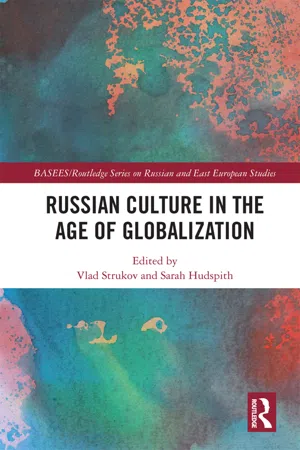
This book brings together scholars from across a variety of disciplines who use different methodologies to interrogate the changing nature of Russian culture in the twenty-first century. The book considers a wide range of cultural forms that have been instrumental in globalizing Russia. These include literature, art, music, film, media, the internet, sport, urban spaces, and the Russian language. The book pays special attention to the processes by which cultural producers negotiate between Russian government and global cultural capital. It focuses on the issues of canon, identity, soft power and cultural exchange. The book provides a conceptual framework for analyzing Russia as a transnational entity and its contemporary culture in the globalized world.
- 318 pages
- English
- ePUB (mobile friendly)
- Available on iOS & Android
eBook - ePub
Russian Culture in the Age of Globalization
About this book
Information
1 Introduction
The present volume has arisen out of the collaborations of the Leeds Russian Centre with numerous international partners and articulates the Centre’s purpose to reposition Russia and Russian Studies in the global era. We wish to propose the concept of ‘Russia(n) in the global context’, where ‘global’ is understood more broadly than just as a synonym for ‘contemporary’. In this respect our volume is a successor to Catriona Kelly and David Shepherd’s Russian Cultural Studies: An Introduction (1998) and is similar to their study in its inclusivity and broad understanding of culture. Kelly and Shepherd laid the groundwork for the present collection by departing from the hitherto existing top-down approach to Russian culture which arose out of the conditions particular to Western study of Russia in the Soviet era and also derived from the conceptual difficulties identified by Condee (2006). They acknowledged that future studies would need to ‘have recourse to some of the theoretical agenda of contemporary cultural studies in the West, such as the study of globalization and localization’ (Kelly and Shepherd 1998: 6).
Our volume addresses this need but also goes beyond it: thus, our purpose is not to trace how globalization is bestowed on Russia but to investigate alternative notions of globality and how these globalities compete for leadership on the world stage. We would argue that tensions are formed not where the global meets the local but rather where one global system encounters another competing version. For example, does the Russian vision of globalization encompass actions such as the annexation of Crimea? How does this vision correlate with non-Western global entities, such as India and Brazil? Whilst being cognizant of these ‘global’ theoretical questions we present a number of inter-linked studies that consider the intersections of global forces from different perspectives. Therefore, in our volume Russia will function as a case study and it will provide scholars with knowledge that can be transferred to and used in the study of other forms of globalized culture.
The diverse perspectives and broad coverage of the chapters in this volume are collected here so as to build up a composite picture of Russia as a transnational space. We advance the position that even as Russia’s geopolitical actions suggest a renewed focus on national identity, its cultural production exceeds these narrow parameters; the Russian case will demonstrate that since 2014 we are entering a post-national era of globality which requires a new theoretical apparatus for analysis. Thus we argue that there is a need for an interdisciplinary volume that explores the common flow of narratives across diverse fields of cultural production in relation to discourses on the global, national and individual whereby individuals are involved in production of the self at all levels, including the global level.
In addition to theorizing new forms of cultural exchange, we wish to problematize the position and objective of Russian studies as a field. In 2006, Nancy Condee wrote a commentary on the state of Russian studies, in which she outlined the contrasting influences of area studies and cultural studies in developing an understanding of interdisciplinarity in Russian studies over the course of the latter half of the twentieth century. Referring to the contradictions inherent in applying to the former Soviet Union analytical models that originated in a Western discourse locked within its own dimensions of capitalist modernity and liberal democracy, she wrote, ‘We must concede in advance that our research does not exist uncontaminated by its point of origin’ (Condee 2006: 202). Now that more than ten years have passed and events including the annexation of Crimea and the crisis in Ukraine mark a sea change in the image of itself that Russia presents to the world, it is timely to make a new intervention in the field with the aim to de-westernize the field of Russian studies.
1. Querying the validity of the top-down approach
In this volume we aim to forge a new conception of what is meant by ‘Russian culture’. On the one hand, we enhance the understanding of ‘Russian’ by including in our analysis the production and consumption of cultural products that exceed the national realm and speak to a global audience, either explicitly or implicitly. On the other hand, we expand the notion of ‘culture’ so as to accord as much weight to popular culture as to traditional ‘high’ cultural forms, such as literature, theatre and ballet. In this respect the volume highlights the contemporary contrast with the previous repugnance for anything that could be deemed ‘middle-brow’: the current decade has seen the democratization of culture through an emergence of DIY practices and criticism. Therefore our understanding of culture is deliberately broad so as to encompass a number of angles, including different media and realms (literature, film, TV, digital media, music, etc.) and also agency (governments, legacy institutions, NGOs, pop-up communities, etc.). Building on the tradition of British cultural studies (e.g., Hall 1973) and French poststructuralism (Deleuze 2004 [1968]; Derrida 2016 [1976]), we understand these as ‘fields of production of meaning’ rather than generic categories. The Russian semiotic tradition (Bakhtin 1984 [1965]; Lotman 1990) is employed as a mode to theorize cultural exchange both diachronically (the critical engagement with Soviet legacy) and synchronically (the transnational domain of Russian culture). Our understanding of culture is also informed by the developments in the field of international studies and popular geopolitics (e.g., Dittmer 2010; Power 2013) so that culture encompasses cultural practice, policy and means of dissemination.
Following the dissolution of the Soviet Union, the Russian Federation as a geopolitical entity has been repositioning itself in the globalized world in political, economic and cultural terms. Recent scholarship has noted that for Russia the Soviet legacy left an unclear position that complicated self-determination (Oushakin 2009; Teper 2016). We take a standpoint that the Russian Federation is a multi-ethnic, multi-faith and multilingual state, whilst significant communities of people who identify as Russian now reside in neighbouring states that became independent after 1991. Moreover, the ‘imagined community’ (Anderson 2006 [1983]) of global Russia extends beyond the populations identifying as Russian in the ‘near abroad’ of newly independent states, thanks to migration flows to ‘far abroad’ countries, such as UK, Germany, Cyprus and beyond, which increased sharply in the 1990s. The Russian state has been presented with the question of how to relate to these ‘compatriots’ [sootechestvenniki]. Although scholars have identified ambivalent aspects to the relationship in terms of compatriots’ legal status and state responsibilities towards them (Byford 2012; Kosmarskaya 2011; Laruelle 2015), more coherent initiatives can be seen in the cultural sector, which has become an area of increasing government interest and activity. The Russian World [russkii mir] concept became prominent in official discourse from 2007, when Putin established the Russkii Mir Foundation with the original idea of promoting the Russian language and cultural heritage as a means of reconnecting the Russian community abroad with the Russian homeland. The Russkii Mir Foundation has developed into a soft power tool through its professed mission to ‘promote understanding and peace in the world by supporting, enhancing and encouraging the appreciation of Russian language, heritage and culture’ to speakers and learners of Russian alike (Russkii Mir 2016).1
The Russkii Mir Foundation emphasizes the importance of propagating the Russian language and culture worldwide in achieving its goals and thus it implies a one-way flow of engagement. In this respect it plays an overt part in the ongoing process of canon formation and revision, through a competitive grant scheme inviting individuals and non-profit organizations to bid for support for cultural and educational projects – for example, a language Olympiad in China and an exhibition to commemorate the anniversary of Ivan Turgenev in Madrid. Grant applications must adhere to the Foundation’s principles so that approval is given to those projects which promote the ‘ideas and values of the Russian world’ (Russkii Mir 2016). The Russkii Mir Foundation is supported by the Federal Agency for the Commonwealth of Independent States Affairs, Compatriots Living Abroad and International Humanitarian Cooperation, or Rossotrudnichestvo, founded in 2008 under the auspices of the Ministry of Foreign Affairs. This agency has a similar soft power agenda geared towards public relations (Laruelle 2015: 94) in its goal to promote an ‘objective image of contemporary Russia’ abroad (Rossotrudnichestvo 2016) and is primarily unidirectional in orientation.
The Russian World concept is just one of a number of initiatives designed to shape Russia’s image for the outside world, developed in the mid-2000s. In 2005 the Russian news agency RIA Novosti established an English-language cable and satellite news channel, Russia Today.2 In the ensuing years with addition of channels in more languages, the network grew into an international state-sponsored cross-platform media outlet, providing content in Arabic, English, French, German, Russian and Spanish, and was rebranded as RT in 2009. RT’s operations provide a contrast with the ideals of the Russian World concept and contribute to modelling alternative globalization. With a tag line of ‘Question more’ and a mission to provide both ‘alternative perspectives on current affairs’ and ‘a Russian viewpoint on major global events’ (RT 2005–2018), RT has been accused by some Western commentators of being a mouthpiece for Kremlin propaganda (Ioffe 2010; Bidder 2013). For our purposes the chief significance of this interpretation is that it illustrates a return in the West to perceptions according to Cold War binary paradigms (e.g., Lucas 2008), demonstrating that the conceptualization of globalization is fraught with contradictions which the Russian case helps to expose.
Russian government-led initiatives are in fact an effort to catch up with those in the private sector. Already in June 2003 Roman Abramovich became the owner of the companies that control Chelsea Football Club in West London. With Alisher Usmanov’s ownership of London-based Arsenal and Mikhail Prokhorov of the American basketball team the Brooklyn Net, Russian oligarchs did not need the Sochi Olympics to demonstrate the power of their capital on the global sporting arena.3 In the arts sector, we find The Calvert Journal and Calvert 22 Foundation, which showcase art from Russia and ‘the former Eastern Europe’. Branded as ‘a guide to the New East’, Calvert has been instrumental in advancing post-communist visual culture and reinventing Eastern Europe as one of the coolest regions on the planet. Calvert is the most successful project on the saturated London art scene: Grad, Erarta4 and other foundations and galleries had to change locations or shift their focus in order to reach an audience. For example, Grad has evolved into a research lab that studies the possibility of using augmented reality in urban environments (Strukov 2018a). In fact, in 2016–2017 all major exhibitions of art, not necessarily Russian, in London were funded by Russian donors, including the Blavatnik Family Foundation, which funded the construction of the new sections of the Tate Modern (Ellis-Petersen 2017).
London is also home to Russian clothing brand ZDDZ, which is ‘a contemporary womenswear brand, that views fashion as media and proves that ready-to-wear can be a contemporary form of street art, raising social and political issues or reflecting aspects of big-city life’ (Strukov 2018b). It belongs to Dasha Selyanova, who has been active promoting Russian clothing brands in Europe and Asia. Alissa Timoshkina runs a hugely successful supper club called ‘KinoVino’; as the title suggests it includes screenings of films and a dinner consisting of a film-themed menu. KinoVino has been described by TimeOut magazine as the most exciting pop-up restaurant in London (TimeOut 2016). These are just some cultural initiatives in London which are also replicated in major European, Asian and North and South American cities, thus building a markedly different context for the evolution of Russian culture.
State and non-state initiatives meet and compete with each other in the Russian- language Internet known as Runet, which offers a more pluralistic alternative from the top-down unidirectional approach of Russkii Mir and Rossotrudnichestvo. Runet distinguishes itself from the Anglophone-dominated Internet as an online space with its own culture and its own versions of popular web applications (Young 2016). At the same time its users can be located anywhere in the world. At a time when culture is increasingly posited by the state as a resource for exploitation rather than a site of dialogue and critical reflection, Runet’s role in developing the concept of a global Russia has many facets. As well as providing a platform for the coordination of criticism of the Russian state, as seen during the protests preceding Putin’s third presidential term, it allows for the flourishing of grass-roots creativity that exceeds the bounds of official state discourse and brings an alternative Russia into dialogue with the world. There is a wealth of existing scholarship on Runet in relation to politics and geopolitics (e.g., Oates 2013; Suslov and Bassin 2016), security (e.g., Gaufman 2017), economics (e.g., Gnezdova et al. 2016) and new media (e.g., Morris et al. 2012). Such studies are informed by a comparison of online versus offline platforms. By contrast, our volume takes a holistic approach to digital technologies by demonstrating their permeation and enrichment of the cultural sphere so that they feature among many varied creative tools and contribute to a more inclusive, democratic understanding of culture.
2. Globalization and the question of identity
Our volume aims to investigate Russia’s investment in the globalization process through the prism of cultural and information exchange. At the same time the shift in ownership of culture has identified the need to address the evolving relationship between cultural producers and cultural gatekeepers and their strategies for negotiating the formation of a cultural canon in the post-Soviet era. We pose the following research questions: (a) How can we conceptualize Russia’s response to its own cultural developments in a global context? (b) What is the future of Russian classical literature and high culture in the age of globalization? And what is the role of Russian popular culture socially, politically and culturally? (c) What is the mutual relationship between global cultural flows and the sites and spaces of cultural production? These questions necessitate a development of three theoretical frameworks in the volume: the cultural feedback loop, canon (re‑)formation and glocal (re‑)imaginings.
The existing scholarship on Russia and globalization, in the main, prioritizes Russia’s domestic, economic and fo...
Table of contents
- Cover
- Half Title
- Series
- Title
- Copyright
- Dedication
- Contents
- List of figures
- List of tables
- List of contributors
- Acknowledgements
- Note on transliteration
- 1 Introduction
- 2 Poetry, canon and identity in contemporary Russia
- 3 Lev Tolstoy and contemporary Russian cultural policy: negotiating the canon
- 4 ‘That’s ours. Don’t touch’: Nashe Radio and the consolations of the domestic mainstream
- 5 The Perm Cultural Project [Permskii kul’turnyi proekt]: looking back, looking forward
- 6 Projecting Russia on the global stage: international broadcasting and ‘recursive nationhood’
- 7 Joking about doping: contested visions of sporting nationalism and patriotism in Russian political cartoons
- 8 Visualizing the conservative revolution: alternative globalization and aesthetic utopia of ‘Novorossiia’
- 9 Theorizing the hyperlocal: the cinema of Sakha (Yakutia) and global contexts
- 10 Independent and popular? Russian youth videos in the age of globalization
- 11 Russian linguistic culture in the age of globalization: a turn to linguistic violence
- 12 Geopolitical enemy #1? VVP, anglophone ‘popaganda’ and the politics of representation
- Index
Trusted by 375,005 students
Access to over 1.5 million titles for a fair monthly price.
Study more efficiently using our study tools.
Frequently asked questions
Yes, you can cancel anytime from the Subscription tab in your account settings on the Perlego website. Your subscription will stay active until the end of your current billing period. Learn how to cancel your subscription
No, books cannot be downloaded as external files, such as PDFs, for use outside of Perlego. However, you can download books within the Perlego app for offline reading on mobile or tablet. Learn how to download books offline
Perlego offers two plans: Essential and Complete
- Essential is ideal for learners and professionals who enjoy exploring a wide range of subjects. Access the Essential Library with 800,000+ trusted titles and best-sellers across business, personal growth, and the humanities. Includes unlimited reading time and Standard Read Aloud voice.
- Complete: Perfect for advanced learners and researchers needing full, unrestricted access. Unlock 1.5M+ books across hundreds of subjects, including academic and specialized titles. The Complete Plan also includes advanced features like Premium Read Aloud and Research Assistant.
We are an online textbook subscription service, where you can get access to an entire online library for less than the price of a single book per month. With over 1.5 million books across 990+ topics, we’ve got you covered! Learn about our mission
Look out for the read-aloud symbol on your next book to see if you can listen to it. The read-aloud tool reads text aloud for you, highlighting the text as it is being read. You can pause it, speed it up and slow it down. Learn more about Read Aloud
Yes! You can use the Perlego app on both iOS and Android devices to read anytime, anywhere — even offline. Perfect for commutes or when you’re on the go.
Please note we cannot support devices running on iOS 13 and Android 7 or earlier. Learn more about using the app
Please note we cannot support devices running on iOS 13 and Android 7 or earlier. Learn more about using the app
Yes, you can access Russian Culture in the Age of Globalization by Vlad Strukov,Sarah Hudspith in PDF and/or ePUB format, as well as other popular books in Social Sciences & Ethnic Studies. We have over 1.5 million books available in our catalogue for you to explore.