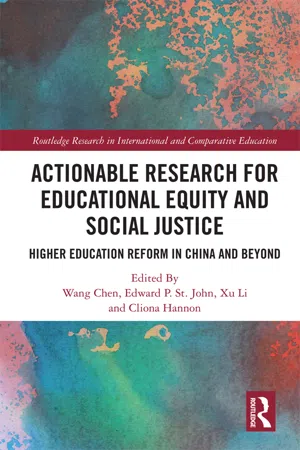
Actionable Research for Educational Equity and Social Justice advances a unique, engaged approach to promoting educational equity and social justice in higher education across China and beyond. Developed as a joint venture of senior and junior scholars in China and the United States, this book documents Chinese, Latin American, U.S., and European examples of engaged scholarship supporting the development of strategies for expanding educational opportunities for low-income families. Drawing from collaborative research, workshops, and field investigations, chapter authors propose and test new methods and practices for reducing educational inequality and provide examples of successful practices that have improved access for low-income students across the globe.
eBook - ePub
Actionable Research for Educational Equity and Social Justice
Higher Education Reform in China and Beyond
- 290 pages
- English
- ePUB (mobile friendly)
- Available on iOS & Android
eBook - ePub
Actionable Research for Educational Equity and Social Justice
Higher Education Reform in China and Beyond
About this book
Information
Part I
Education Equity Promoting Social Justice in Global Perspective
1
The Global Access Challenge
Human Rights, Capital, and Capabilities Reconsidered
While global economic competition has been used as a primary rationale for expanding higher education access through privatized educational systems (Stiglitz, 2002), there is reason to question this notion (Piketty, 2014). The moral aspects of this logic have been questioned by economists (e.g., Friedman, 2005; Stiglitz, 2012; Piketty, 2014), but arguments for expanding college access have too seldom been interwoven in the discourses on human rights and capabilities (e.g., Moyn, 2010; Sen, 2009). Changes in public investment in education, including but not limited to privatization, have raised serious questions about fairness in access as a human right within developed and developing economies.
This chapter introduces the volume by reconsidering the linkages between human rights and educational opportunity and exploring ways researchers can engage as partners with government agencies and universities as they evolve new strategies for meeting the access challenge. While I’ve used a historical perspective on US education as a basis for making the arguments here, as I did in the original lectures used as a basis for this chapter, my subsequent engagement in projects with international scholars has helped me understand the global nature of these challenges (e.g., Meyer, St. John, Chankseliani, & Uribe, 2013; St. John, Hannon, & Chen, 2017). Thus, my approach in this text is to supplement the historical analysis of inequality in the United States with insights gained from international collaborations.
Education and Social Justice
The underlying question about human rights within nations is: What is a just nation from the perspective of its citizens? Since this question originally emerged from the revolutionary period when peoples in the West rebelled against monarchies (i.e., the American and French Revolutions), I start my argument for rethinking the links between education and social justice by reconsidering why education is a human right and how preparation for higher education in US high schools has necessitated bringing fairness in college access into the discourse on social justice and human rights. The literature written about each of these frames (rights, economic capital, and human capabilities) argues that expansion of college access is integral to social justice within developed and developing nations.
Finding Historical Perspective
During the Enlightenment, there was a shift from philosophy centered in religion to both science and philosophy being based on reason, which created new opportunities for inquiry using scientific methods. Public discourses on human rights developed in England, France, and the American Colonies prior to the American and French Revolutions (Habermas, 1990; Taylor, 2007) at a time when the idea that humans derived their individual rights from God was central; this idea has had a profound influence on notions of justice in the West. In Western societies, capitalism evolved consistent with early economic theory (Smith, 1776/2010), along with democratic forms of government. These historical foundations need to be recast relative to the unfreezing of ideologies after the demise of the Cold War.
Unfreezing After the Cold War: Global modernization began on a large scale after World War II, when a “just nations” concept emerged in the West (e.g., Walzer, 1983). During the Cold War following World War II, a strong ideological clash separated nations, as anti-communist arguments and a focus on economic development clashed with the communist view (e.g., Rostow, 1960). This dialectic had a huge influence on the paths chosen by developing nations through the end of the colonial period. However, neither communist nations nor social democracies guaranteed human rights consistent with the underlying theories and claims made by groups on either side of this divide (Hall, 1996; Moyn, 2010; Sen, 2009); the colonies of Western nations and the new communist nations of the mid-20th century did not live up to the ideals of their founders. We need to step back from these debates—this old form of dialectic—to consider what is fair and just from the perspective of peoples within and across nations.
After WWII, the United Nations included an emphasis on human rights in its charter that was generally interpreted narrowly, usually in relation to rights as defined within nations (Moyn, 2010). The United Nations did not extend the emphasis on human rights to the colonies of industrialized nations, causing protests and critiques by anti-colonialists. In the current period, there has been a move toward an emphasis on rights in international law and political philosophy, which represents a major shift in the political discourse on individual rights within and across nations (Chomsky, 2010; Moyn, 2010).
Lingering Inequalities: Equal rights to education can be difficult to actualize. In the United States, for example, there was legal slavery for nearly a century, with a Civil War fought to emancipate the slaves. This was followed by a history of legally segregated and unequal schools in the early 20th century and, in spite of the Supreme Court’s decisions that declared racial segregation of schools illegal, equalizing opportunity for education remains a serious challenge in the United States. Legal barriers to college access persist in the United States, especially for migrant families without citizenship.
In the United States, the debate about education reform in the early 21st century has been framed in terms of global competitiveness, including competition with India and China for the intellectual work in design and invention that was the hallmark of the American economic boom after World War II. The policy literature focuses on workforce education, especially in the fields of science, technology, engineering and math (STEM fields) making the argument that educational standards must be raised (Commission on the Skills of the American Workforce, 2007; Conklin & Curran, 2005; Hoffman, Vargas, Venezia, & Miller, 2007). This started with the publication of A Nation At Risk by the U.S. Department of Education in 1983. Since then, most states have raised educational standards in math for high school graduation (Daun-Barnett & St. John, 2012). There are still serious problems:
- Raising standards and aligning high school graduation exams with college preparation was accompanied by increased high school dropout rates, expanding the disparity in educational gains (National Research Council, 2011).
- The introduction of competitive markets in urban areas through the development of charter schools has not improved educational achievement, as traditional public and charter school have similar academic performance (Ravitch, 2010).
- The rising costs of attending four-year colleges and the increased use of loans as a means of providing financial access for low-income students have increased racial disparities in opportunities (St. John, Daun- Barnett, & Moronski-Chapman, 2013).
- Although the rate of enrollment has increased over the past three decades, the degree completion rates among college students have not improved in the United States (Bowen, Chingos, & McPherson, 2009).
- Not only does the United States have a history of racial discrimination that has created educational barriers for African Americans, but currently many states deny college access to the children of immigrant workers from Mexico.
While the U.S. is engaged in the global economy and has pursued a policy agenda that promotes fair and equal access to advanced education, serious barriers remain. In fact, inequalities in educational opportunity have worsened since the start of the global transition in the latter part of the 20th century. I have argued that the correction of these inequalities involves both a rethinking of public policy and new forms of action within high schools and higher education (St. John, 2003, 2006, 2013; St. John, Daun-Barnett, Moronski-Chapman, 2013; St. John, Masse, Lijana, & Bigelow, 2015).
Education Access and Human Rights: The idea that an individual right for education should be extended to higher education is related to arguments about expanding education for global competition, a notion that is central in logics in the United States, Western Europe, and the Pacific region that are actively engaged in the global economy (Meyer et al., 2013; St. John, Kim, & Yang, 2013). This argument is aligned with the principles of justice: basic liberties (rights for all) and differences (first opportunity for the least advantaged) from John Rawls’s theory of justice (1971, 1999a, 1999b).
Specifically, in the United States the right to a high school education available to all citizens is now is aligned with the basic curricular requirements for college admission in virtually all states (St. John, Daun-Barnett, & Moronski- Chapman, 2013); however, fairness in access has not been achieved. Financial barriers in the form of high college costs undermine democratic values in the U.S., a pattern evident in many states. But differences in college affordability are not the only problem: low-income families typically live in communities with inferior schools, denying equal opportunities to prepare.
These underlying inequalities are inexorably linked to underlying issues of social class and race, patterns evident in developed, developing, and underdeveloped nations alike (Meyer et al., 2013; Tierney, 2015; St. John & Bowman, 2015). The US quick fix of raising graduation requirements only deepened the socio-economic divide in access to elite universities, in spite of the availability of well-documented, research-based strategies for actualizing fairness in college admissions (e.g., Bowman & St. John, 2011; Sedlacek, 2004). Addressing the problem of unequal opportunity requires more than changing requirements and setting new standards. The human capital and capabilities perspectives also add to a general understanding of the access challenge.
Education and Human Capital Reconsidered
Human capital theory took shape post-WWII in the United States and Western Europe as nations rebuilt their social and economic infrastructures. In the United States, economists used a general rubric that claimed investment in education had both economic benefits to states (e.g., Paulsen, 1996a, 1996b) and contributed to social uplift, including expansion of the middle class (CITES). From the 1950s through the 1970s, US state governments invested in specialized colleges of education and engineering, as well as provided higher than average funding levels for professional programs in medicine and law (Halstead, 1974). Similar rationales for public investment in higher education were used to rebuild and expand higher education in Western Europe (Piketty, 2014). However, human capital frameworks changed to emphasize privatization of public systems and individual monetary benefits of education after 1980 (Henry, Lingard, Rizvi, & Taylor, 2001).
Not only has the past quarter-century witnessed remarkable change in the role of education reform in relation to the globalization process, we can expect the next quarter-century will be accompanied by even more change. First, I state my position on international exchange between the United States and China on social justice in education. Second, I turn to the future, not to predict but to share my reflections on the challenges we are likely to face as we ponder education reform. Finally, I discuss the issues of education and human rights within nations in relation to the globalization process.
Economic Theory and Globalization: Benjamin M. Friedman, chair of economics at Harvard when The Moral Consequence of Economic Growth was published in 2005, provides a partial explanation for the turn away from egalitarianism in the United States. Friedman presents case histories of the U.S. and Western European nations along with quantitative analyses of international patterns of economic development in relation to human rights. In tracing the histories of nations, Friedman notes a paradox: as nations engage in the global economy, the rights of citizens expand but inequality increases. Friedman also examines the statistical correlation between economic growth and increased human rights which corresponds well for most nations except China, which has had a high rate of economic growth but constrained human rights. Friedman recognized that expanding the rights and freedoms of citizens differs from equity in wealth and opportunity for education.
The economic shifts resulting from the opening of global trade and labor markets have had profound impacts on the working class in the United States, the nations of Western Europe, and even developing countries. Of course, there have been many radical critiques of these policies, calling attention to the human consequences of the new market ideologies (Chomsky, 2010; Klein, 2007). Globalization has resulted in a decline of jobs in all forms of manufacturing in the U.S., but new jobs in the more cost- competitive nations have not always led to improved living standards for their workers (Chang, 2008; Smart & Smart, 2005). For example, the globalization of the garment industry drove down earnins and added to the economic hardship of piece workers in Mexico and workers in the clothing industry in Eastern Europe.
The decline in earnings of the average worker is not just an American problem. Global competition has driven down the costs of production, increased the wealth of people at the top of the economic ladder, and decreased the standard of living for skilled workers. Contemporary global competition is far different from the economic security of most laborers in the U.S. after World War II, a period when wealth was more equitably distributed.
Benjamin Friedman (2005) analyzed the correlation between the engagement of nations in the global economy and the rights and liberties of citizens, using both quantitative comparative and historical methods. Not only does economic globalization have a documented link to the international discourse on human rights, the engagement of nations in the global economy generally corresponds with increased human rights. Of course, as Friedman notes, China does not fall into the general pattern of correlation between rights and engagement in the global economy: China is highly engaged in the global economy, but human rights are constrained by government action, especially the control of the party. Focusing on expanding educational opportunity may provide a means for promoting fairness across social classes within the Chinese system, especially given the centrality of education to national planning.
The problems of human rights differ when Westerners enter...
Table of contents
- Cover
- Title
- Copyright
- Contents
- List of Figures
- Acknowledgments
- Introduction
- Part I Education Equity Promoting Social Justice in Global Perspective
- Part II Chinese Perspectives
- Contributing Authors
- Index
Trusted by 375,005 students
Access to over 1.5 million titles for a fair monthly price.
Study more efficiently using our study tools.
Frequently asked questions
Yes, you can cancel anytime from the Subscription tab in your account settings on the Perlego website. Your subscription will stay active until the end of your current billing period. Learn how to cancel your subscription
No, books cannot be downloaded as external files, such as PDFs, for use outside of Perlego. However, you can download books within the Perlego app for offline reading on mobile or tablet. Learn how to download books offline
Perlego offers two plans: Essential and Complete
- Essential is ideal for learners and professionals who enjoy exploring a wide range of subjects. Access the Essential Library with 800,000+ trusted titles and best-sellers across business, personal growth, and the humanities. Includes unlimited reading time and Standard Read Aloud voice.
- Complete: Perfect for advanced learners and researchers needing full, unrestricted access. Unlock 1.5M+ books across hundreds of subjects, including academic and specialized titles. The Complete Plan also includes advanced features like Premium Read Aloud and Research Assistant.
We are an online textbook subscription service, where you can get access to an entire online library for less than the price of a single book per month. With over 1.5 million books across 990+ topics, we’ve got you covered! Learn about our mission
Look out for the read-aloud symbol on your next book to see if you can listen to it. The read-aloud tool reads text aloud for you, highlighting the text as it is being read. You can pause it, speed it up and slow it down. Learn more about Read Aloud
Yes! You can use the Perlego app on both iOS and Android devices to read anytime, anywhere — even offline. Perfect for commutes or when you’re on the go.
Please note we cannot support devices running on iOS 13 and Android 7 or earlier. Learn more about using the app
Please note we cannot support devices running on iOS 13 and Android 7 or earlier. Learn more about using the app
Yes, you can access Actionable Research for Educational Equity and Social Justice by Wang Chen, Xu Li, Edward P. St. John, Cliona Hannon, Wang Chen,Xu Li,Edward P. St. John,Cliona Hannon in PDF and/or ePUB format, as well as other popular books in Education & Comparative Education. We have over 1.5 million books available in our catalogue for you to explore.