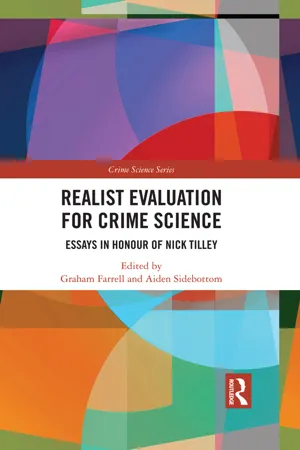
This collection of essays, published to mark the 20th anniversary of Realistic Evaluation, celebrates the work of Professor Nick Tilley and his significant influence on the fields of policing, crime reduction and evaluation. With contributions from colleagues, co-authors and former students, many of whom are leading scholars in their own right, the thirteen essays which make up this volume contain both personal reflections and analysis of the prominent topics in Professor Tilley's forty years of scholarship.
eBook - ePub
Realist Evaluation for Crime Science
Essays in Honour of Nick Tilley
- 232 pages
- English
- ePUB (mobile friendly)
- Available on iOS & Android
eBook - ePub
About this book
Information
Chapter 1
Nick Tilley: the Wizard of Whitby
The bestowal of the title Wizard of Whitby upon our colleague and friend Professor Nick Tilley has dual origins. The first is that Nick lives, with wife Jenny, in the much-admired seaside resort of Whitby, England. The second is an academic symposium at which he and Ray Pawson were designated ‘wizards’ and encouraged to circulate among attendees to discuss how their realistic approach to evaluation provides an alternative to the experimental method.1 We think the (pointy) hat fits, and not just for Expelliarmus Experimenta but for Nick’s wide and influential range of scholarly wizardry. We hope to capture some of the Tilley magic here.
This volume is offered as a tribute to Nick’s work and influence. We made initial plans for the book in 2015, knowing that 2017 was Nick’s 70th birthday as well as the 20th anniversary of Realistic Evaluation (Pawson and Tilley 1997). We thank the chapter authors for their enthusiastic participation, and their contributions are the primary tribute. The book’s focus on crime science was a practical decision on our part. While the impact of Nick’s research can be observed across disciplines, crime science remains his principal disciplinary reference point.
This chapter offers an overview of Nick’s career and the book. The first section is a portrait miniature divided into three broad time periods. The first is the Early Years, spent largely at Lanchester Polytechnic studying the work of Karl Popper. The second is the 1990s when Nick, formally working at Nottingham Trent University, was seconded to the Home Office to work on situational crime prevention and problem-oriented policing. The third section covers the 2000s, when Nick has been located at University College London and influential in the development of crime science. We identify key intellectual influences and direction of travel within each period. In the second section we consider some of the substantive areas in which Nick’s work has been particularly influential. This covers realistic evaluation, problem-oriented policing and the international crime drop. We then outline the motivation for and contents of this book. The selected photographs at the end of this chapter illustrate how Nick’s personal and professional life are wholly integrated.
Early years: Lanchester and Karl Popper
Nick was born on 10 May 1947 in Hornchurch, Essex, England, the third of four children with an older brother (Roger) and sister (Lorna) and a younger sister (Helen). Nick speaks fondly of how his adventurous 19-year-old brother took him on a tandem cycling tour of France, and how in the 1990s Nick’s interest in repeat victimisation led Roger, an operational researcher, to develop a mathematical model of crime concentration. Lorna was a medical doctor specialising in child psychiatry who retrained to pursue an interest in ceramics. Helen left England aged 16 to live in Spain. This caused tension with their parents at the time but Nick and Helen remained close and, in 2017, Helen and partner Casto hosted Nick’s 70th birthday party (at which a small group of crime scientists were present) at their house on the Spanish island of Majorca.
Nick has always been bookish. His curriculum vitae boasts that in 1966– 1967, following a year as a school teacher at Trinity Road County Primary School, he was Library Assistant at the County Library Headquarters. It was then that he met Jenny, both of whom were volunteers on a community project examining housing conditions – over-crowding and excessive rents among first and second-generation immigrants – in North Kensington, London. They married on the 26 July 1969 at Chelsea Registry Office, Jenny then supporting Nick through the completion of his Masters in Sociology at the London School of Economics in 1971.
Nick took up his first full university post as Lecturer at Lanchester Polytechnic (now Coventry University) in 1971, becoming Senior Lecturer and remaining there until 1979. Their daughters Alice and Johanna (Jo) were born in 1972 and 1975 respectively. Nick and Jenny describe their years at Lanchester fondly: there was a young teaching staff many of whom, like themselves, had small children, and so they socialised and bonded as a group. It was also here where Nick became firm friends with a similarly young colleague and long-time-collaborator-to-be, Ray Pawson (see Pawson, chapter 2). Their first co-authored publication was a critique of the sociology of science (Pawson and Tilley 1982).
In 1979 Nick took a promotion and moved to Nottingham Trent University. He and Jenny lived in the United States for the academic year 1982–1983 where son Peter was born, Nick being a visiting professor at the University of Minnesota in the town of Duluth. But for the most part their three children grew up in a large house in the city of Nottingham.
The focus of Nick’s research at Lanchester and the first decade at Nottingham Trent was centred on the ideas of Karl Popper (Tilley 1978, 1980a, 1980b, 1981, 1982) This goes to the heart of how Nick has always identified as a sociologist while being highly critical of much of that discipline. Nick’s work is characterised by an interest in understanding and addressing real world problems, while sociology in particular and the social sciences more generally have long been criticised for a preoccupation with theory over solving problems (Watts 2017). That is, the Tilley blend of sociology is analytic and applied, rooted in Popperian principles. This is clearly observed early on in the 1976 article, ‘An apt sociology for polytechnics’, in which Nick, alongside John Selby, calls for a reorientation of sociology as was then practiced in the UK. Quoting from the abstract: ‘we argue that an applied approach is a fruitful one for sociology … sociology would be enhanced by an increased emphasis on social problem solving’ (p. 38). Looking back, this article sets out the kind of applied, problem-oriented approach that has come to define much of Nick’s career.
The Home Office years: evaluation, evaluation, evaluation
Nick turned to crime in 1990. He was the evaluator for a burglary prevention project in Nottingham that was part of the Home Office’s Safer Cities Programme (Tilley, Webb and Gregson 1991; Tilley 1992). This was how he met Gloria Laycock who was then Head of Research and Development for the Crime Prevention Unit at the Home Office. It was a meeting of minds, a collaboration emerging that has been as important to Nick’s trajectory as his work with Pawson. For the decade from 1990, while still formally based at Nottingham Trent, Nick was seconded as a consultant to the Home Office, largely at the behest of Laycock. It was a golden opportunity. At the time, the Crime Prevention Unit was actively pursuing a research agenda concerned with situational crime prevention (Clarke 1980) and problem-oriented policing (Goldstein 1979, 1990). This fell precisely into the intellectual space that Nick enjoyed: theoretically informed applied social science. The move was a major catalyst for Nick, providing a substantive area (crime and policing) in which his existing skill set (rooted in Popperian ideas) and applied orientation could be put to good work. And the practical advantages were immense: as a consultant to the Home Office, Nick had his independence – free from university teaching and administration but also, since not a civil servant, independent of the Home Office and the demands of ministers. Nick thrived in the freedom and intellectually exciting atmosphere that marks Laycock’s leadership.
In a decade at the Home Office, Nick sailed gaily through a sea of crime prevention and policing evaluation projects (Tilley 1992, 1993a, 1993b, 1993c, 1993d; Edwards and Tilley 1994; Laycock and Tilley 1995a, 1995b; Tilley 1995a, 1995b). This work chiefly involved developing ways of specifying how implemented programmes produced the observed outcomes (intended or unintended), and the circumstances under which such programmes are likely to be more or less effective. The rationale behind this approach was that useful lessons might be learnt that would better enable the replication and/or scaling up of successful demonstration projects, as well as identify those people or places most likely to benefit from selected interventions. Nick recalls that, at the time, evaluation studies were overwhelmingly focussed on determining whether crime prevention policies and programmes were or were not effective. Less attention was being paid to questions about how and under what conditions. A turning point that identified the need to reorient the focus of evaluation was Nick’s evaluation of three would-be replications of the successful Kirkholt anti-burglary project (Forrester et al. 1988).
The Kirkholt story will be familiar to many readers of this book. Kirkholt is an area of public housing in north Manchester, England. In the 1980s it experienced exceedingly high levels of household burglary. Analysis of various sources of information included identifying that around half of burglaries were repeat offences against the same households. A series of measures were put in place, tailored to the local context and primarily designed to reduce repeat victimisation. The measures substantially reduced burglary over a three-year period (from 25 burglaries per 100 households to 6). Not surprisingly, there were soon efforts to replicate the Kirkholt success elsewhere but the three intended replications were less effective than the original. However, Nick’s evaluation made lemonade from what at first blush appeared to be lemons. He determined that the null effects were largely attributed to an attempt to replicate the tactics of Kirkholt rather than the problem-solving approach that gave rise to the selected (and ultimately effective) tactics (Tilley 1993d). He emphasised that replication of any crime prevention scheme would necessarily involve some variation, such is the inevitable difference in the initial conditions underpinning crime patterns, the resources available, the intended recipients and so on, as well as the to-be-expected incomplete accounts of what was done, when, by whom and what was delivered. This examination amounted to a discussion on how the measures and mechanisms that reduced crime in one setting will not necessarily produce the same outcomes in another: an illustration of what became the ‘context, mechanism, outcome’ mantra of realist evaluation.
The evidence suggests to us that the string of evaluations Nick conducted for the Home Office was the proving ground for the landmark publications on realist evaluation (Pawson and Tilley 1994, 1997; Tilley 1996). We evidence this statement with the fact that his publication trajectory from around 1990 splits into two streams. The first pursues problem-solving and crime prevention evaluation. The second reflects on lessons for and the experience of realist evaluation. We discuss these streams later.
Nick developed many fruitful and lasting collaborations whilst at the Home Office. His evaluation work overlapped significantly with that of Paul Ekblom (Ekblom and Tilley 2000). He developed collaborations with colleagues including Rick Brown (Tilley, Pease, Hough and Brown 1999), Karen Bullock (see Bullock, Farrell and Tilley 2002; Bullock and Tilley 2003; Bullock, Erol and Tilley 2006), Kate Painter (Painter and Tilley 1999), Adrian Leigh and Tim Read (Leigh, Read and Tilley 1996) and Barry Webb (Tilley and Webb 1994). Along the way Nick was appointed professor at Nottingham Trent University in 1995, senior advisor (along with Ken Pease and Mike Hough) to the government’s Crime Reduction Programme (Hough and Tilley 1998; Tilley 2000, 2004b), and the eponymous Tilley Awards for excellance in UK POP were established in 2000. Involvement in the Crime Reduction Programme added further evidence and experience that progressed the realist approach to evaluation (Nutley, Davies and Tilley 2000; Pawson and Tilley 2001; Tilley 2001, 2002a, 2002b, 2002c; Tilley and Laycock 2002). The second author (GF) first met Nick at a Safer Cities conference in 1993 and they corresponded intermittently over the next decade (GF was working outside the UK), particularly in relation to repeat victimisation. They began working together more closely from the mid-2000s when GF moved to Nottingham not far from the Tilley’s home.
In 2001 the Tilley family bought a summer house in Whitby. It was less than a three-hour drive from their home in Nottingham which was ideal for weekend and longer trips. It was 2010 when Nick and Jenny moved to enjoy Whitby’s charms full time, undertaking extensions and renovations that made the weekender their main residence.
The UCL years: the pursuit of crime science
At the time of writing, Nick’s collaboration with Gloria Laycock has continued for close to three decades. Gloria is a frequent guest at N...
Table of contents
- Cover
- Half Title
- Series Page
- Title
- Copyright
- Contents
- List of contributors
- 1 Nick Tilley: the Wizard of Whitby
- PART I On realist evaluation
- PART II On research and evidence
- PART III On policing and crime prevention
- Index
Trusted by 375,005 students
Access to over 1.5 million titles for a fair monthly price.
Study more efficiently using our study tools.
Frequently asked questions
Yes, you can cancel anytime from the Subscription tab in your account settings on the Perlego website. Your subscription will stay active until the end of your current billing period. Learn how to cancel your subscription
No, books cannot be downloaded as external files, such as PDFs, for use outside of Perlego. However, you can download books within the Perlego app for offline reading on mobile or tablet. Learn how to download books offline
We are an online textbook subscription service, where you can get access to an entire online library for less than the price of a single book per month. With over 1.5 million books across 990+ topics, we’ve got you covered! Learn about our mission
Look out for the read-aloud symbol on your next book to see if you can listen to it. The read-aloud tool reads text aloud for you, highlighting the text as it is being read. You can pause it, speed it up and slow it down. Learn more about Read Aloud
Yes! You can use the Perlego app on both iOS and Android devices to read anytime, anywhere — even offline. Perfect for commutes or when you’re on the go.
Please note we cannot support devices running on iOS 13 and Android 7 or earlier. Learn more about using the app
Please note we cannot support devices running on iOS 13 and Android 7 or earlier. Learn more about using the app
Yes, you can access Realist Evaluation for Crime Science by Graham Farrell,Aiden Sidebottom in PDF and/or ePUB format, as well as other popular books in Social Sciences & Criminology. We have over 1.5 million books available in our catalogue for you to explore.