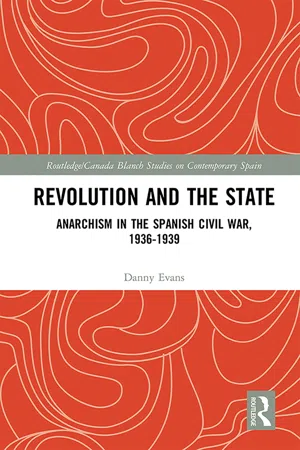
This book analyses the processes of revolution and state reconstruction that took place in the Republican zone during the Spanish civil war. It focuses on the radical anarchists who sought to advance the revolutionary agenda. Their activity came into conflict with the leaders of the libertarian organisations committed to the reconstruction of the Republican state following its near collapse in July 1936. This process implied participation not only in the organs of governance but also in the ideological reconstitution of the Republic as a patriarchal and national entity. Using original sources, the book shows that the opposition to this process was both broader and more ideologically consistent than has hitherto been assumed, and that, in spite of its heterogeneity, it united around a common revolutionary programme. This resistance to state reconstruction was informed by the essential insight of anarchism: that the function and purpose of the modern state cannot be transformed from within. By situating the struggles of the radical anarchists within the contested process of state reconstruction, the book affirms the continued relevance of this insight to the study of the Spanish revolution.
- 230 pages
- English
- ePUB (mobile friendly)
- Available on iOS & Android
eBook - ePub
1 Spanish anarchists and the Republican state, 1931–1936
The Spanish Second Republic was declared, to mass jubilation, on 14 April 1931. It brought to an end a period of dictatorship during which anarchists had been driven underground or into exile, the CNT declared illegal and hundreds of its activists jailed. However, while the rebirth of democracy brought new opportunities for the CNT to propagate its ideas and build its organisational capacity, the Republic could not satisfy either the immediate economic demands of the organisation’s working-class members or the long-term goals of its anarchist activists. Tensions were inevitable and not long in spilling over into violence and state repression. Activists found that constitutional guarantees could quickly be suspended, and within a short period anarchists considered that their insistence on the totalitarian essence of even democratic states had been vindicated. One episode that both encapsulated and accelerated this dynamic was the uprising of Alt Llobregat in 1932.
At the outset of the Republic, the population of the mining valley of Alt Llobregat in northern Cataluña lived in extreme poverty in labour colonies. The mining company, the greater part of which was owned by the Liverpool-born José Enrique de Olano, First Count of Figols, prohibited union organisation and paid its workforce in tokens redeemable only in the company stores.1 Children of fourteen cried on the way to their first day of work, while men over twenty-five were considered surplus to requirements.2 The first eight months of the Republic saw no changes to these conditions, and when the beginning of the new year brought word that workers in the town of Berga had gone on strike, miners in the village of Figols decided that the moment had come to revolt. On 18 January 1932 a revolutionary committee was formed and, a few hours before work was to begin, its members called the villagers on to the streets to disarm the security forces. The success of the insurrection was confirmed by the hoisting of the red and black flag of the CNT over the town hall. The revolutionary general strike, characterised by the peaceful takeover of towns and villages and the declaration of ‘libertarian communism’, spread like wildfire through the mining district before it was crushed, within a week, by the army.
The response of the CNT’s committees was widely perceived to be too little, too late.3 By the time the organisation declared a general strike in solidarity with the movement, Alt Llobregat was under military occupation. The fate of the insurrection provided a foretaste of how the episodic revolts that broke out in the following years would unfold: a workers’ uprising established temporary dominance of an isolated region within Spain, the residents immediately attempted to put into practice a new social system based on the abolition of money and the sharing of resources, the workers’ organisations throughout the rest of the country were unprepared, unwilling or unable to unite with the insurrection, the authorities crushed the rising and initiated a period of repression against the labour movement. After the rising in Alt Llobregat, more than a hundred anarchists, most of whom had only had a tangential relationship to it, were summarily deported to Spanish Guinea. Although the insurrections that followed, in January and December 1933 and October 1934, grew progressively in scale and levels of violence, the importance of the rising in Alt Llobregat for the anarchist movement is difficult to overstate. This is because it marked a definitive, worker-led break with the Republican state and pushed libertarian communism to the forefront of the movement’s political imaginary, not as a vaguely agreed upon aim but as an immediately realisable practice.
Libertarian communism, a concept that drew heavily on the ideas of Peter Kropotkin and Errico Malatesta, and which conceived of the future society as a moneyless, free association of producers organised in federal communes, had been the stated goal of the CNT since 1919. For many influential figures in the organisation, however, this vision was a distant dream with little relevance to the more urgent organisational priorities of the day. At the outset of the Republic, the organisation’s National Committee was dominated by gradualists, who tended to emphasise the importance of building and strengthening an organisation capable of remoulding society rather than embarking on an immediate attempt to overturn capitalism. Alt Llobregat showed, however, that many workers could not afford to wait. What had the declaration of libertarian communism meant to the miners of Alt Llobregat? The oral history investigation of Crisina Borderias concluded that
Communism was a familiar word, although difficult to define, but to all it implied arms, justice and freedom. And because of this, most people agreed with the insurrection: ‘Yes, there everybody agreed, everybody wanted it… Communism – this had to be done… and everybody did it!’4
Inspired by anarchist propaganda, the workers in the district threw caution to the wind. In contrast to the gradualists, the revolt energised both the purist and voluntarist currents of the libertarian movement, who were convinced that it confirmed their prognoses as to the practicability of the anarchist ideal and the appetite of the masses for revolutionary action.5 In its aftermath, the Peninsular Committee of the Iberian Anarchist Federation, the FAI, declared that ‘libertarian communism, labelled utopian by retrograde mentalities that have sold out to capitalism, has become a living and incontrovertible reality’.6 The purist review La Revista Blanca, which had welcomed the coming of the Republic as a progressive step and which tended to glorify industrial and technological advances in its pages, published an editorial on the front page of its edition of 15 February 1932 which declared: ‘It has been our custom to use the word future. Perhaps it would have been better to say near future and that is the term we will use from now on… The downfall of bourgeois society is at hand.’7 The reproductions of oil paintings and photos of bridges in its pages were replaced by scenes of striking workers and defeated insurrectionaries under armed guard. From this point on, few anarchists in Spain were prepared to dispute that the country was on the verge of revolution, and that libertarian communism would be its outcome. The question of how it could be brought about, and what its precise characteristics would be, was more vexed, however.
The upswing in insurrectionary activity in Spain ultimately served to reinforce the three-way division of the anarchist movement into gradualist, voluntarist and purist currents. In opposition to gradualists, voluntarists emphasised the revolutionary possibilities that could be brought about by insurrectionary activity, and purists prioritised propagandistic and cultural work in favour of the anarchist ideal. With the exception of ‘voluntarist’, the labels of gradualist, voluntarist and purist were not ordinarily self-applied by libertarian activists, but they provide a descriptively accurate complement to the analogous contemporary terms which were deployed in the polemical context of faction fights, such as ‘reformist’, ‘anarcho-Bolshevik’ and ‘red-skin’, respectively.
As we will see in this chapter, representative figures of each of these currents were capable of justifying a conciliatory attitude to the Republican state at various times. The gradualists, who tended to be more united in this regard, welcomed an end to the disruption to organisation that had been occasioned by state repression, while some voluntarists had participated alongside future state actors in insurrectionary essays against the dictatorship, and certain purists were mindful that the propagandistic and educational work they prioritised was easier to undertake under a democracy than a dictatorship. The birth of the Second Republic in 1931 had provided one example of when elements of the three strategic tendencies of Spanish anarchism contributed to a broadly conciliatory attitude towards the state and the democrats at its helm. Subsequently, an upsurge of working-class self-activity brought about a tactical convergence among purists and voluntarists from the middle ranks of the Spanish libertarian movement, who determined to reanimate their organisations with an anti-state purpose. This chapter provides an analysis of the background and outcomes of these divisions and alliances. The question of how to attain arms, justice and freedom was not a new one for anarchists during the Second Republic, but the radicalism and restlessness of the working class, and the severity of the measures adopted or considered by the authorities in response, gave it an ever-increasing urgency.
The libertarian movement in Spain
Although anarchism as both an ideology and a branch of the workers’ movement is impossible to define narrowly, hostility to the state has been taken to be a common principle.8 Anarchists have historically conceived of the state as the manifestation of authority and the negation of individual liberty.9 When the Spanish section of the First International, the Federación Regional Española (Spanish Regional Federation – FRE) was founded in 1869, this anarchist interpretation of the state gained formal recognition within the country’s labour movement, albeit not without debate.10 The FRE thus assumed the thesis of Mikhail Bakunin, that the state could not be a tool of socialist transformation, either via parliamentary politics or the Marxist concept of a dictatorship of the proletariat. The latter would represent nothing more than the ‘disguised resurrection of the state’, which ‘could never produce any effect but the paralysis and death of the popular revolution’s vitality and power’.11
In the period covered in this book, the tendencies of Spanish anarchism were able to coexist, with varying degrees of harmony, within the framework provided by what came to be known as anarcho-syndicalism, but which was initially referred to as revolutionary syndicalism. The development of revolutionary syndicalism in France was embodied by the Confédération générale du travail (General Confederation of Labour – CGT) and had been formalised in the famous Charter of Amiens, which that union had adopted in 1906.12 Inspired by the successes of the CGT, the belief had grown among Spanish anarchists that, as the Charter stated, an apolitical trade union would be able to combine struggles of an economic nature with a wider project of revolutionary transformation.13 In 1907, Solidaridad Obrera (Workers’ Solidarity – SO), a union federation which produced a newspaper of the same name and which did not, at first, extend beyond Barcelona, was founded. SO was an amalgamation of ideologically varied unions that expanded rapidly and whose early success in bringing together Cataluña’s unionised workforce led to a Congress in 1910 to decide whether it should be constituted on a national basis.14 This was agreed to and the CNT was formed, with Solidaridad Obrera becoming the official newspaper of its Catalan region.15
The founding Congress of the CNT reflected the plurality of priorities and tactics favoured by its affiliates. It affirmed the need to overturn existing society and that, echoing the First International, the emancipation of the working class was to be the task of the working class itself.16 It proclaimed its commitment to tactics of direct action, by which was meant the absence of third-party mediation in industrial disputes, but it also allowed for members of political parties to join the organisation, urged caution with regard to the general strike and committed itself to the short-term goal of establishing the eight-hour day.17 The commitment to direct action was related to a further question under debate at the Congress: the advisability of constituting a new syndicalist organisation on a national level that would be separate from the pre-existing national trade union, the Unión General de Trabajadores (General Union of Workers – UGT), which had been founded in 1888. The UGT was the trade-union wing of electoral socialism, represented in Spain by the Partido Socialista Obrero Español (Spanish Socialist Workers’ Party – PSOE). Contrary to revolutionary syndicalism’s commitment to direct action, the UGT considered the mediation of its political allies to be potentially advantageous to its members. Despite assurances to the contrary from prominent figures within the CNT, the probability that the new organisation would provide a revolutionary alternative to the UGT was admitted by disappointed Socialists and hailed by enthusiastic anarchists in the weeks that followed the former’s foundation.18
The CNT was organised federally into regional organisations. From 1918 these re...
Table of contents
- Cover
- Half Title
- Title Page
- Copyright Page
- Dedication
- Table of Contents
- Acknowledgements
- Abbreviations
- Notes
- Introduction
- 1. Spanish anarchists and the Republican state, 1931–;1936
- 2. Revolution and the state, July–;December 1936
- 3. Radical anarchism: programme and alliance, January–;April 1937
- 4. May 1937: from a second July to the ‘Spanish Kronstadt’
- 5. The Spanish revolution in retreat, May–;December 1937
- 6. The experience of defeat, 1937–;1939
- Conclusion
- Recurring personages
- Bibliography
- Index
Trusted by 375,005 students
Access to over 1.5 million titles for a fair monthly price.
Study more efficiently using our study tools.
Frequently asked questions
Yes, you can cancel anytime from the Subscription tab in your account settings on the Perlego website. Your subscription will stay active until the end of your current billing period. Learn how to cancel your subscription
No, books cannot be downloaded as external files, such as PDFs, for use outside of Perlego. However, you can download books within the Perlego app for offline reading on mobile or tablet. Learn how to download books offline
Perlego offers two plans: Essential and Complete
- Essential is ideal for learners and professionals who enjoy exploring a wide range of subjects. Access the Essential Library with 800,000+ trusted titles and best-sellers across business, personal growth, and the humanities. Includes unlimited reading time and Standard Read Aloud voice.
- Complete: Perfect for advanced learners and researchers needing full, unrestricted access. Unlock 1.5M+ books across hundreds of subjects, including academic and specialized titles. The Complete Plan also includes advanced features like Premium Read Aloud and Research Assistant.
We are an online textbook subscription service, where you can get access to an entire online library for less than the price of a single book per month. With over 1.5 million books across 990+ topics, we’ve got you covered! Learn about our mission
Look out for the read-aloud symbol on your next book to see if you can listen to it. The read-aloud tool reads text aloud for you, highlighting the text as it is being read. You can pause it, speed it up and slow it down. Learn more about Read Aloud
Yes! You can use the Perlego app on both iOS and Android devices to read anytime, anywhere — even offline. Perfect for commutes or when you’re on the go.
Please note we cannot support devices running on iOS 13 and Android 7 or earlier. Learn more about using the app
Please note we cannot support devices running on iOS 13 and Android 7 or earlier. Learn more about using the app
Yes, you can access Revolution and the State by Danny Evans in PDF and/or ePUB format, as well as other popular books in History & 20th Century History. We have over 1.5 million books available in our catalogue for you to explore.