Criminology has developed strong methodological tools over the past decades, establishing itself as a competitive, sophisticated, and independent social science. Perhaps because of its emphasis on matters of design, methodology, and quantitative analysis, criminology has had few significant advances in theory. Advances in Criminological Theory is the first series exclusively dedicated to the dissemination of original work on criminological theory.The Process and Structure of Crime, the ninth volume in this landmark series, is a thorough overview of the conceptual and empirical issues raised by the adoption of a criminal event perspective, which takes into account the multifaceted character of human behavior. This book is divided into three sections: conceptual bases of criminal events, the criminal event perspective itself, and responses to criminal events. Contributors analyze and explore a wide range of topics, including: how interpersonal routines are structured through past experience; the influence of social context on interpersonal routines; criminal opportunity and its impact on criminal events; the significance of neighborhood context; the effect of victimization and fear; how problem-oriented policing efforts need to be informed by and reflect the problems of repeat offenders, repeat victims, and hot spots of crime; and finally, how changes in the physical environment constrain or limit criminal opportunities. This fascinating work will be beneficial to criminologists, sociologists, and scholars of legal studies.Contributors to this volume include: Leslie W. Kennedy, Erin Gibbs Van Brunschot, Robert F. Meier, Mark Warr, Christopher Birkbeck, Luis Gerardo Gabaldon, Kriss A. Drass, Terance D. Miethe, Julie Horney, Jeffrey Fagan, Deanna L. Wilkinson, Robert J. Buskirk, Jr., Vincent F. Sacco, Ross Macmillan, John E. Eck, Paul J. Brantingham, and Pat Brantingham.
eBook - ePub
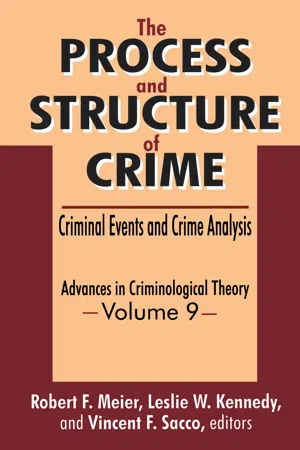
The Process and Structure of Crime
Criminal Events and Crime Analysis
- 317 pages
- English
- ePUB (mobile friendly)
- Available on iOS & Android
eBook - ePub
The Process and Structure of Crime
Criminal Events and Crime Analysis
About this book
Information
Table of contents
- Cover
- Half Title
- Title Page
- Copyright Page
- Table of Contents
- Preface
- 1. Crime and the Criminal Event Perspective
- 2. Routines and the Criminal Event
- 3. Macro Models of Criminal Events
- 4. Crime and Opportunity: A Theoretical Essay
- 5. Offender Morality and the Criminal Event
- 6. Qualitative Comparative Analysis and the Study of Crime Events
- 7. Criminal Events and Criminal Careers: An Integrative Approach to the Study of Violence
- 8. A Theory of Violent Events
- 9. The Unfolding of Criminal Events within Neighborhood Contexts
- 10. Victimization and Fear of Crime: Re-Thinking a Classic Controversy from a Criminal Event Perspective
- 11. Policing and Crime Event Concentration
- 12. The Implications of the Criminal Event Model for Crime Prevention
- Index
Trusted by 375,005 students
Access to over 1.5 million titles for a fair monthly price.
Study more efficiently using our study tools.
Frequently asked questions
Yes, you can cancel anytime from the Subscription tab in your account settings on the Perlego website. Your subscription will stay active until the end of your current billing period. Learn how to cancel your subscription
No, books cannot be downloaded as external files, such as PDFs, for use outside of Perlego. However, you can download books within the Perlego app for offline reading on mobile or tablet. Learn how to download books offline
Perlego offers two plans: Essential and Complete
- Essential is ideal for learners and professionals who enjoy exploring a wide range of subjects. Access the Essential Library with 800,000+ trusted titles and best-sellers across business, personal growth, and the humanities. Includes unlimited reading time and Standard Read Aloud voice.
- Complete: Perfect for advanced learners and researchers needing full, unrestricted access. Unlock 1.5M+ books across hundreds of subjects, including academic and specialized titles. The Complete Plan also includes advanced features like Premium Read Aloud and Research Assistant.
We are an online textbook subscription service, where you can get access to an entire online library for less than the price of a single book per month. With over 1.5 million books across 990+ topics, we’ve got you covered! Learn about our mission
Look out for the read-aloud symbol on your next book to see if you can listen to it. The read-aloud tool reads text aloud for you, highlighting the text as it is being read. You can pause it, speed it up and slow it down. Learn more about Read Aloud
Yes! You can use the Perlego app on both iOS and Android devices to read anytime, anywhere — even offline. Perfect for commutes or when you’re on the go.
Please note we cannot support devices running on iOS 13 and Android 7 or earlier. Learn more about using the app
Please note we cannot support devices running on iOS 13 and Android 7 or earlier. Learn more about using the app
Yes, you can access The Process and Structure of Crime by Robert F. Meier,Leslie W. Kennedy,Vincent F. Sacco,Robert Meier,Leslie Kennedy,Vincent Sacco in PDF and/or ePUB format, as well as other popular books in Social Sciences & Criminology. We have over 1.5 million books available in our catalogue for you to explore.