- 143 pages
- English
- ePUB (mobile friendly)
- Available on iOS & Android
eBook - ePub
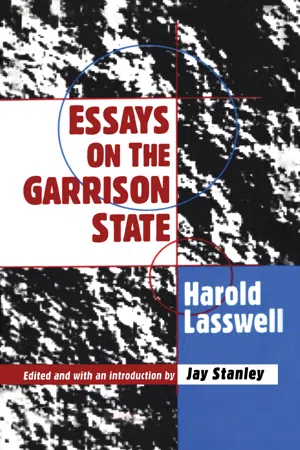
Essays on the Garrison State
About this book
Lasswell introduced the developmental construct of the garrison state as an antithesis of the civilian state more than fifty years ago, suggesting it would evolve from the industrial state in response to technical achievement. His original thoughts on the garrison state construct remain applicable today. This important volume brings together four major essays written by Lasswell.
1
Sino-Japanese Crisis: The Garrison State versus the Civilian State
No serious and protracted crisis in Sino-Japanese affairs can fail to affect the future of political institutions in both contending states, and it is idle to presume that what happens to the political institutions of Japan and China can fail to touch off a train of repercussions throughout Asia, and thence throughout the world. The present crisis has become acute at a time when civilian institutions are in desperate need of curative years of peace and recovery. If the existing emergency is permitted to careen from bad to worse, it may be doubted whether civilian institutions are equal to the strain. The upshot may be the rise of the garrison state to displace the civilian state.
In the garrison state the specialist on violence is at the helm, and organized economic and social life is systematically subordinated to the fighting forces. This means that the predominating influence is in the hands of men who specialize in violence. Skill in business, in organization, in propaganda counts for less in entitling the individual to his share of material income and community deference.
A grim though often veiled struggle for survival is being waged between civilian skills and military skills, and this struggle is confined to no one nation of the world. In the present disturbed condition of world affairs the result of the struggle in one nation reacts immediately upon the relative strength of the contending parties in other countries.
Private business already exists on sufferance in the Japanese Empire, where the younger officers have cast the stigma of disloyalty upon the captains of industry and finance. If this crisis is long drawn out and tension rises to the breaking point, the first victim, it appears, may be the business elements in Japanese society.
Should bad deepen into worse, the outlook in China for the preservation and for the strengthening of civilian elements is no more promising. Should the authority of the Chinese state be relegated to the interior provinces, the hammer of adversity would no doubt beat political institutions into the rigid shell of the garrison state.
If the crisis spreads, the Soviet Union may become involved. Already the Soviet Union is vexed with bitter internal strife between the civilian leadership of the party and the military leadership of the Red Army. In war, the generals may win.
Garrison states in Asia and Europe would compromise the security and undermine the prestige of civilian institutions in every nation.
The Business State
The predominating form of civilian state in Western Europe and North America is the business state. Bargaining in the competitive market is the distinctive skill in such a community. The modern business state has been associated with the institutions of representative and responsible government, and the free forum. Where private enterprise prevails, prices are set by bargaining and policies are set by electioneering.
The pattern of free institutions may differ in many particulars in different states. The degree to which free markets have been preserved may vary widely in practice. Governmental and party organs may retain distinguishing local features. The ceremonial executive is recruited according to descent in Great Britain and chosen by a national assembly in France. The ceremonial and the executive are combined in one office, the presidency, in the United States, though they are carefully separated in Great Britain and France. The effective executive of the United States is responsible to a numerous constituency of enfranchised citizens; in Great Britain and in France the cabinet is responsible to the legislature. Party life in the United States is carried on through the channels of the two-party system, while in France the factional party system is the rule.
In deciding whether a particular state conforms to the pattern of the business state it is necessary to consider the practices in effect rather than the prescriptions in force. Most of the central and South American states provide for representative and responsible government in written constitutions, yet these are defied in practice. Business elements in these states are mixed with racial and feudal oligarchies.
The Official Bureaucratic State
The form of civilian state which puts skill in organization at the top is the official bureaucratic state. In such a state all organized activities are directed by the government, hence by the duly constituted officials. Competitive markets are drastically curtailed, and free discussion is treated as the privilege of the few rather than the right of the many.
Though they possessed strong bureaucratic marking, most of the large states of the world before 1914 were not perfect examples of the pattern. Pre-1911 China was a bureaucratic state insofar as the functions of the central government were concerned, but the scope of the central government was limited by the vigor of families, guilds, and villages. Pre-war Japan, Russia, and Prussia were mixed forms, since the potent bureaucracies were side by side with influential army and business men.
Long before the outbreak of the war of 1914–18, some of the most important bureaucratic and business states were categorically challenged by specialists whose skill lay in propaganda and in the organization of mass parties. The symbols which were invoked by the challengers were “anti-capitalistic” and “anti-bourgeois,” and “pro-socialist” and “pro-proletarian.” In the chaos of the war, these challenging skill groups seized power in Russia and set up a new and more complete form of bureaucratic state.
The Party Bureaucratic State
Unlike the bureaucratic state of pre-war days, the Soviet state speedily relinquished all compromises with private business, and abolished the free market. Thus, the governmentalization of social life was far more complete than in the pre-war states.
The system of party supremacy introduced an important new element into the pattern of the bureaucratic state. A single party of large membership now monopolized legality, and was protected from lawful competition. Although numerically large, the party was small in proportion to the total population, and thus preserved the irresponsible features of the bureaucratic state.
Internal politics in the party bureaucratic state pivots upon the struggle for supremacy among the specialists on propaganda and organization who run the party, the specialists on organization who run the administration, and the specialists on violence who run the armed forces. During the bitter days of 1918–21 the Communist party concentrated all control in party hands. The elite of the party subordinated the elites of rival parties, co-operative societies, trade unions, government departments, and the army. Behind the formal structure of the all-powerful party the skill struggle continued to flourish, unannihilated by the knife of party discipline.
The cause of the vitality of the skill struggle is to be found in the special conditions which accompany the exercise of any particular skill, and which foster and preserve differences in attitude. The government official is placed in a relationship to reality which contrasts at many points with the position of the leader of the party. The two groups have different foci of attention, and hence they develop contrasting pictures of reality, formulate contrasting demands, and experience contrasting loyalties.
The government official feels better qualified to run his department than anyone else, and he readily convinces himself that he has a better grasp of the constructive needs of the party than the party bosses themselves. Some of the specialists who are useful to the practical conduct of administration are not party members to begin with; the significant point is that even those who are recruited from the party undergo subtle transformations in outlook which spring from their new conditions of work.
The official elite may assert itself against the elite of the party by instigating factions within the party. The officially inspired factions may press for the expansion of the membership in the party, hoping to dislodge the existing leadership from their monopolistic position.
If the party elite is alert, this program has little chance of success. The elite is in control of propaganda, and is the supervisor of applicants for party membership and of the membership as well. It is quite possible to make concessions in the name of “democracy” and to subtract disagreeable elements by means of the “purge.”
So strong are the advantages of the party leadership that those who struggle against party control are driven to resort to conspiracy, and to enter into secret plots and understandings with heads of the political police and army authorities. By joining with the specialists on violence the officials hope to tip the balance of power against the party propagandists and organizers.
War itself becomes a threat to the ascendancy of party leaders: it may create new public heroes, and hence new rivals. The party seeks to temporize, to defer, to delay the test of war.
The current Sino-Japanese crisis broke out when the skill struggle within the Soviet Union had reached a phase which induced a temporary paralysis.
The Garrison State and the Expectation of Violence
The present juncture in world affairs is peculiarly favorable to the specialists on violence in their struggle with civilian businessmen, party leaders, and government officials.
Although we are too deeply entangled in the titanic movements of world affairs to have much confidence in our ability to separate superficial eddies from the deeper currents of our historical epoch, there is much to support the view that we have recently experienced a change in the line of historical evolution.
Nineteenth-century Europe was the scene of a revolution in technology which created the objective opportunities so readily grasped by the private merchant, manufacturer, and financier. The army and the navy of the major powers became more and more obviously “degraded” to the task of opening and protecting the markets for the business men to exploit. The increasing size of naval and military establishments did not keep pace with the phenomenal expansion of private business. The peoples of the world were coerced or induced to join the network of economic activity which seemed to create a world market which would furnish the material basis for united world order.
The more sanguine prophets of world unity did not attach enough importance to the counter-tendencies which were bound to be stimulated by the very tendencies on which they pinned their hope. In this sense, their thinking was “undialectical.” The expansion of the market was taking place in a world where the expectation of violence cast a shadow on the future of human relations. Whether they liked it or not, men continued to expect violence as a last resort in internal and external difficulties. This expectation might be deplored; it might be ignored; it could not be destroyed.
In a world caught in the shackles of this ominous expectation, more contact bred more insecurity. Cumulative crises of insecurity found expression in the feverish play of the balance of power, internal and external: in the colonial rivalries of the 1890s, in the crystallization of the great alliances in the opening years of the present century, in the mounting fear of social revolution, and in the eventual eruption of the World War itself.
During the World War the tendency toward the creation of a world market was reversed: the two contending groups of allies tried to break up the world into two self-sufficient economic systems; and this tendency toward ever-smaller self-sufficient systems continued after the expiration of the war.
World business is still struggling to survive and to reverse these unpropitious developments, and such crises as the Sino-Japanese conflict gain fresh significance when we see them against the larger background of world affairs. Successive rebuffs of the business state and of the bureaucratic state increase the chances of the garrison state.
The Garrison State and Revolution
There is no large-scale example of the garrison state in the modern world and we are left in some doubt about the way in which the ascendancy of the military will be accommodated to other institutions of this historical epoch.
However, we may hope to obtain some insight into the auxiliary patterns of a possible garrison state by subjecting the dominant revolutionary pattern of the time to careful examination.
A leading trait of the form of civilization now dominant in world affairs is the succession of world revolutionary waves which rise and spread among the states which share this civilization. The important revolutions may be distinguished by the novelty of the patterns of symbol and practice which they introduce. Each individual detail may have been anticipated elsewhere, yet the new dynamic whole may become a turning point in the history of institutional change.
It was no novelty when the French revolutionaries rejected the “divine right of kings” and proclaimed the “rights of man” and the rule of “liberty, fraternity, equality.” But it was novel to associate these demands with positive revolutionary practices, and to crystallize revolutionary zeal into such channels as the liquidation of the landlord state, and the completion of the business state.
The Russian revolutionary pattern exhibited the same novelty of association between revolutionary language and practice. In the name of the “dictatorship of the proletariat” revolutionary measures wound up the business state and set up the party bureaucratic state. Money incomes were relatively equalized, organized activities were government-alized, party life was monopolized.
These political innovations in France and Russia were proclaimed as programs for the world as a whole: those who seized the power in France spoke of the “rights of man,” not merely of Frenchmen, and those who took the power in Russia invoked the “world proletariat,” not simply the Russian proletariat.
We observe, however, a striking duality in the history of each important revolutionary pattern. On one hand, the scope of those who seize authority at the revolutionary center is gradually blocked by the play of the balance of power: neither France nor Russia led the way to the unified world order which they envisaged. On the other hand, the opponents of the early revolutionized states gradually adopt and adapt certain of the essential practices of the new revolutionary pattern itself. Thus the restriction of the scope of the original revolutionary leadership is compatible with the tendency to universalize some of the principal revolutionary institutions.1
Although the rulers of France were limited to France, other states took on more and more of the characteristics of the revolutionary pattern of France. We may anticipate that the restriction of the Russian leadership to Russia may continue to be followed by the partial incorporation of certain of the cardinal features of the pattern of the Russian revolution. In particular, a garrison state would doubtless governmentalize business and establish rough equality of money income. A garrison state would probably reduce the party bureaucracy in importance: in the garrison state, authority flows downward from the commanders at the top; initiative from the bottom can hardly be endured.
There is nothing set and foreordained about the coming of the garrison state to displace the civilian state of the types now known to us. The creative potentialities of our epoch are capable of finding expression in many forms and in many places. Only the iron heel of protracted military crisis can subdue civilian influences and pass “all power to the general.” Hence, it is to the interest of civilian state of every kind to use all the means at their disposal to cut short the Sino-Japanese crisis, and to reduce the chances of the garrison states.
Note
This chapter was originally published in The China Quarterly 11 (Fall 1937): 643–49.
1. The processes of restriction and expansion have been examined ...
Table of contents
- Cover
- Title Page
- Copyright
- Table of Contents
- Preface
- Acknowledgments
- Introduction: An Invitation to Revisit Lasswell’s Garrison State
- 1. Sino-Japanese Crisis
- 2. The Garrison State
- 3. The Garrison State Hypothesis Today
- 4. The Universal Peril
- Conclusion: Landmarks in Defense Literature
- Index
Trusted by 375,005 students
Access to over 1.5 million titles for a fair monthly price.
Study more efficiently using our study tools.
Frequently asked questions
Yes, you can cancel anytime from the Subscription tab in your account settings on the Perlego website. Your subscription will stay active until the end of your current billing period. Learn how to cancel your subscription
No, books cannot be downloaded as external files, such as PDFs, for use outside of Perlego. However, you can download books within the Perlego app for offline reading on mobile or tablet. Learn how to download books offline
Perlego offers two plans: Essential and Complete
- Essential is ideal for learners and professionals who enjoy exploring a wide range of subjects. Access the Essential Library with 800,000+ trusted titles and best-sellers across business, personal growth, and the humanities. Includes unlimited reading time and Standard Read Aloud voice.
- Complete: Perfect for advanced learners and researchers needing full, unrestricted access. Unlock 1.5M+ books across hundreds of subjects, including academic and specialized titles. The Complete Plan also includes advanced features like Premium Read Aloud and Research Assistant.
We are an online textbook subscription service, where you can get access to an entire online library for less than the price of a single book per month. With over 1.5 million books across 990+ topics, we’ve got you covered! Learn about our mission
Look out for the read-aloud symbol on your next book to see if you can listen to it. The read-aloud tool reads text aloud for you, highlighting the text as it is being read. You can pause it, speed it up and slow it down. Learn more about Read Aloud
Yes! You can use the Perlego app on both iOS and Android devices to read anytime, anywhere — even offline. Perfect for commutes or when you’re on the go.
Please note we cannot support devices running on iOS 13 and Android 7 or earlier. Learn more about using the app
Please note we cannot support devices running on iOS 13 and Android 7 or earlier. Learn more about using the app
Yes, you can access Essays on the Garrison State by Harold D. Lasswell in PDF and/or ePUB format, as well as other popular books in History & World History. We have over 1.5 million books available in our catalogue for you to explore.